
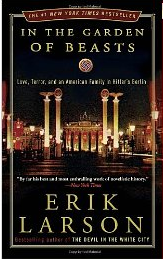
 This week’s Best Book is In the Garden of Beasts by Erik Larson!
Author: whatmeread
Day 155: In the Garden of Beasts: Love, Terror, and an American Family in Hitler’s Berlin
 Best Book of the Week!
In the Garden of Beasts is the latest of Erik Larson’s extremely interesting histories. In a couple of his books, he takes the approach of juxtaposing two seemingly different subjects and showing how they are related, for example, in Thunderstruck, where he tells the story of Marconi and the invention of radio and how that affected the capture of the famous British murderer, Crippen. In other books, though, he has managed to make historical events more personal by relating them from the point of view or one or two people. Such is the case with In the Garden of Beasts, which follows William E. Dodd’s years as the American ambassador to Germany during the build-up of Nazi power before World War II (1933-1937).
The book is about the experiences of Dodd and his family as they witnessed the events of those times. It focuses mostly on Dodd and his daughter Martha, based upon their letters and memoirs.
Dodd was in many ways an uncomfortable fit for the position of ambassador. He was an academic–a historian whose previous position was chairman of the history department at the University of Chicago. He had worked his way up from extreme poverty and believed that he had not risen as far as he would have if he had come from a more privileged background.
Dodd was a personal acquaintance of Franklin D. Roosevelt, and he requested a position as an ambassador of a small country from FDR, hoping both to add to his prestige and to be able to devote more time to writing his history of the South. In an ironic twist, though, he was offered Berlin, a much more demanding situation than he wanted and no sinecure, after several other candidates turned it down.
He saw his role as that of a reformer. He intended to live modestly on his salary and provide the other employees in the diplomatic service with an example of good stewardship of public funds, never understanding that his frugality was more likely to be misunderstood by his colleagues from more privileged backgrounds, who were the more usual occupants of such a position and who viewed him with disdain. In fact, some of them circulated a malicious and untrue rumor that FDR had made a mistake with the phone book and offered the job to the wrong Dodd.
The family was at first inclined to believe that the stories of attacks on foreigners and Jews by the SA (German Stormtroopers) were exaggerated. Frankly, they were also somewhat anti-Semitic. Martha admired the vigorous blond young men who were excited by the rise of Hitler, and she socialized with men in the Nazi leadership. In fact, she was quite the party girl, in every sense of the term. Dodd naively thought that he would have more impact on German policies if he maintained friendly relations with the country’s leaders, no matter what he thought of them personally.
It took Dodd an inordinately long time to recognize the truth about the kind of people he was dealing with, especially considering all his sources of information. However, when he did, he was at times heroically unflinching about standing up to the Nazi high command.
The genius of this book is that it relates history from the point of view of naive onlookers whose understanding of the situation and sense of danger grow slowly, rather than from complete hindsight. The book brilliantly conveys the feel of the time and place as the Dodds slowly realize the extent of the Nazi atrocities and begin to understand the growing terror of the German citizens. Dodd is an interesting character, a man who is sneered at by his staff and the Germans for his fuddy-duddy qualities, such as leaving state balls at 11 to go to bed, but who startles them several times by having the courage to stand up to Nazi leaders.
Day 154: The Summer Tree
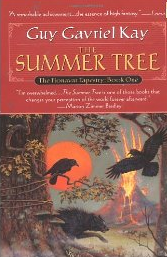 Long ago I read books one and two of Guy Gavriel Kay’s The Fionavar Tapestry but was unable to find the third book. Awhile back, I found copies of all the books and decided to re-read the trilogy. It is going to be very hard for me to divorce my review of The Summer Tree, the first book, from that of the entire trilogy, because my impressions are of the complete trilogy, but I remember thinking that it was the best of the three books.
Five friends attend a lecture by Professor Lorenzo Marcus on the University of Toronto campus. After the lecture, he reveals that he is actually the mage Loren Silvercloak who has come to them from Brennin on another world to ask them to travel there and celebrate the reign of High King Ailell. (Of course, they decide to go.) One of them lets go of the others during the transfer and finds he is separated from the others for much of the action of the novel. On Brennin, it turns out to be the eve of a great battle, during which each of the five find they have their special parts to play.
I had more to say in my notes about my impressions of this book than the plot, which is complicated. I feel that the book, while interesting and beautifully written, is much more immature than the other Kay books I have read. (It is his first.) The strangers coming to save another world idea has been done to death, and the second and third books become even more trite with the introduction of a King Arthur and Queen Guinevere plot, which I find tiresome. The five main characters are relatively uninteresting, and some of the male characters, particularly, are a little juvenile. Finally, the entire trilogy seems dated, particularly in the behavior and attitudes of the characters. My impressions of other Kay books, such as Tigana or The Song for Arbonne, are that they are more rich and subtle.
Day 153: The Shadow Woman
 In The Shadow Woman, a woman is found dead in a park during the Gothenburg Party, a citywide festival that is taking place during a blazing summer. Chief Inspector Erik Winter and his team are having a hard time finding leads or even identifying the body. All they have is footage from a surveillance camera of a Ford Escort and a strange symbol painted on a nearby tree.
Sandwiched into the criminal investigation is the narration of a little girl who doesn’t know where her mommy is and is being kept by strangers. When Winter’s team finally identifies the body, they find that the woman had a little girl. No one seems to know where the child is.
During an investigation that lasts months, Winter and his team begin to find links between the crime and a robbery that occurred 25 years ago. In the meantime, Winter’s long-time girlfriend Angela is thinking of giving him an ultimatum about their relationship.
I haven’t been reading Åke Edwardson’s Erik Winter mysteries in order, making the private lives of the recurring characters a little difficult to follow. The books keep my interest and provide complex puzzles, but I still don’t feel like I get much insight into the personalities of the main characters. The slower pace of Edwardson’s police procedurals is probably more realistic than the speed with which crimes are usually solved in fiction, but the author’s ability to effectively build suspense is also affected by this pace.
Day 152: The Master
 The Master, Colm Tóibín’s engrossing novel about Henry James, is virtually plotless. Over the course of five years, James works, visit friends, and remembers significant events in his life and people who are important to him. At the same time he muses on how the people, tales they tell, or incidents he has observed have informed or will inform his writing.
I have often found James’s work perplexing, feeling as if there is a lot going on under the surface that I don’t understand. A novel about him, therefore, is not an intuitive choice for me. Nevertheless, I found myself extremely involved in this story about a man who appears to have always stood back and watched. In Tóibín’s view, James lived a life of “pure coldness.”
The book delicately depicts a complex man, social on the surface but always at an emotional remove from others, homosexual but so concerned about propriety and public opinion that he never acts on it (perhaps–that is not entirely clear) and avoids situations where he may be tempted. He is sometimes very cold in his inaction, such as when he deserts his best friend, Constance Fenimore Woolson, because she has been too open for his taste about their completely innocent relationship, causing some friends to blame him for her subsequent suicide.
The most fascinating part of the novel, in my opinion, is how it illuminates the way that a writer may take a situation, a sentence, thoughts about how a pair of people interact, and turn them into a complete work of fiction. For example, a tale told to him about two children alone on an estate reminds him of his relationship with his sister Alice. As children, both of them had been abandoned as their family toured Europe and have never been fully included in the events and emotions of the family. These memories finally emerge in the ghost story “The Turn of the Screw.” Similarly, his memories of his intelligent, vivacious cousin Minny Temple are brought back to life in first The Portrait of a Lady and then The Wings of a Dove.
Meticulously researched and beautifully written, The Master is an evocative novel about the inner life of an emotionally crippled writer.
Day 151: Moonfleet
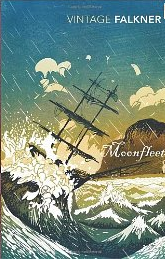 Moonfleet is a boy’s adventure story similar to Kidnapped or Treasure Island. Written by J. Meade Falkner in 1898, it was very popular for many years. I had actually never heard of it but picked it up out of curiosity a couple of years ago.
John Trenchard is an orphan boy who lives with his aunt in the small village of Moonfleet in the south of England in 1757. The village has been dominated by the Mohune family for centuries. There is a legend that Colonel John “Blackbeard” Mohune stole a diamond from King Charles I and that his ghost roams the crypts looking for it.
One day John hears noises from Mohune’s crypt, and when he goes to investigate, finds the landlord of the local inn, Elzevir Block, and Mr. Ratsey, the sexton, who say they are looking for damage from a storm. John assumes they are looking for Blackbeard’s ghost. He finds his way into the crypt through a large sinkhole and gets inadvertantly trapped there overnight. While he is trapped there, he overhears enough to realize that Block and Ratsey are actually smugglers.
John’s aunt assumes he has been up to no good when he doesn’t come back for the night, so she throws him out of the house. Fortunately, Block takes him in. But when Block’s lease expires, the lease goes up for auction and is purchased by Maskew, the unpopular local magistrate. Before Block leaves the area, John accompanies him on one last smuggling venture, during which Maskew, who has lain in wait for the smugglers with the excisemen, is accidentally shot by the excisemen. John is wounded and is falsely accused in absentia of murdering Maskew, so he must flee to the continent.
The rest of John’s adventures include diamond hunting, being imprisoned for theft when he is cheated by an avaricious diamond merchant, working as a galley slave, and shipwreck. Moonfleet is an exciting book with a gripping story line that is still popular with children.
Special Post! Best Book of the Week!
 The Best Book this week is Broken Harbor by Tana French.
Day 150: The Torso
 The Torso is a pedestrian police procedural by Helene Tursten. A torso washes up on a Swedish beach. The investigation finds that a similar murder occurred in Copenhagen, so Detective Irene Huss travels there to consult with the Danish police. Victims are being strangled and then after death dismembered and their organs removed. Not only are the leads to the murderer few, but the police are having difficulty identifying the original torso.
The novel is ploddingly written with no particular suspense. The characters all remain sketchily depicted except Huss, and her every thought is recorded, no matter how mundane. Unfortunately, many of her thoughts are mundane. Every character is thoroughly described including each person’s changes of outfits.
Speaking of Huss’s thoughts, despite having a loving husband and two teenage daughters, she seems to be prepared at one point to launch into an affair with a Danish policeman without any thought at all for her family.
My biggest negative reaction has to do with unlikeliness in the investigation. Perhaps police procedure is different in Sweden than here, but I was surprised to find the coroner providing a profiler lecture based upon one examination of the body and a lot of supposition. For example, there is an assumption throughout that the organs are removed to be eaten, even though there is no proof of that. In addition, the reactions of Huss and other offficers to some sights and remarks seem to be implausibly squeamish, considering their positions. It also seems implausible to me that the team would retain the obnoxious alcoholic cop Jonny, who seems to be incompetent to boot. Rather than assume Swedish procedure and police behavior is that different, I am inclined to believe that Tursten doesn’t know anything about criminal investigations.
Finally, the denoument of the novel is anticlimactic. The murderer has been stalking Huss, so we might expect a terrifying finale. No such thing happens. Although the novel is clearly meant to appeal to those who like dark, gruesome fiction, it completely fails to provide any suspense or atmosphere.
Day 149: Hons and Rebels
 After reading the other Mitfords’ criticisms of this book in The House of Mitford, I expected a biography that was cruel and critical, but Hons and Rebels is mostly an amusing story of Jessica Mitford’s teenage rebellion. The Guinesses (authors of The House of Mitford and Jessica Mitford’s nephew and great-niece), who claimed that Jessica Mitford lied on several points, do not seem to have considered the common phenomenon that people who experience the same things frequently remember them differently, from their own frames of reference. A different recollection of an event in the far past (and in one case an apparent misidentification) is not necessarily lying.
I became interested in finding a good biography of the Mitfords after re-reading several of Nancy Mitford’s novels. I was curious about the kind of family that could have spawned children with such radically different ideas and such extreme characters. Unfortunately, at the time, I was only able to find a couple of biographies written by family members, this being one.
Nancy Mitford, of course, was a brilliant social satirist and author of several light comic novels–and not as politically involved as some of the other girls. Diana left her aristocratic husband, Bryan Guiness, for the infamous British Fascist leader, Oswald Mosley, and was interred with him in prison during World War II for their pro-German sympathies. Unity Mitford became a fan and friend of Adolf Hitler and shot herself in the head the day that Britain declared war against Germany, but failed to kill herself and was mentally disabled for the rest of her life. On the other hand, Jessica as a teenager ran off to the Spanish Civil War with the socialist Esmond Romilly, whom she married. Later she moved to the United States and became a member of the American Communist Party and a famous muckraking journalist.
Hons and Rebels covers Jessica’s childhood, rebellion, later life in the States, and estrangement from the rest of the family. It is light and easy to read, and quite funny. It depicts Esmond and Jessica as extremely naive but equally unprincipled. Mitford does not attack the other family members, as I would have expected after the comments in The House of Mitford. If anything, she looks back at them all nostalgically. In fact, as I commented in my review of the other book, the Guinesses are more prone to attack and criticize the other Mitfords, particularly Jessica and Nancy, and try to mitigate the faults of the Mosleys and the fanaticism of Unity. The only biography I can find written by an unbiased author is apparently superficial and focuses on Unity, so I guess my curiosity about the Mitfords will remain unsatisfied.
Just a note for my consistent readers: I thought that by reviewing one nonfiction book a week, I would be able to continue to write nonfiction reviews indefinitely, but I have now caught up with my nonfiction reading for the past two years, which just shows how much more fiction I read. From now on, nonfiction reviews will appear as I finish the books instead of more regularly.
Day 148: The Map of True Places
 The Map of True Places is another very good book by Brunonia Barry. Zee is a psychotherapist with a shattering past. The death of her patient Lilly, a bipolar housewife who jumped off a bridge, has brought back to Zee memories of her own mother’s suicide. Her father Finch was unfaithful to her bipolar mother with another man, and when Zee was 11, her mother committed suicide by swallowing strychnine. Zee came home in time to witness the fatal convulsions.
Zee goes to visit her father and finds that his Parkinson’s disease has turned to dementia and he has kicked his partner Melville out of the house. She decides to take a leave of absence from her practice to care for Finch. Trying to come to terms with the past and figure out what to do with Finch, she begins to doubt everything in her life. As she finds out the truth about many of the myths in her life, Zee also finds clues about what happened to Lilly in her final days.
This second book of Barry’s is also set in Salem, Massachusetts, and features some of the same characters as in The Lace Reader. I have really enjoyed both of Barry’s books. She creates a strong sense of place in the quirky Salem and populates her novels with complex, interesting characters.

