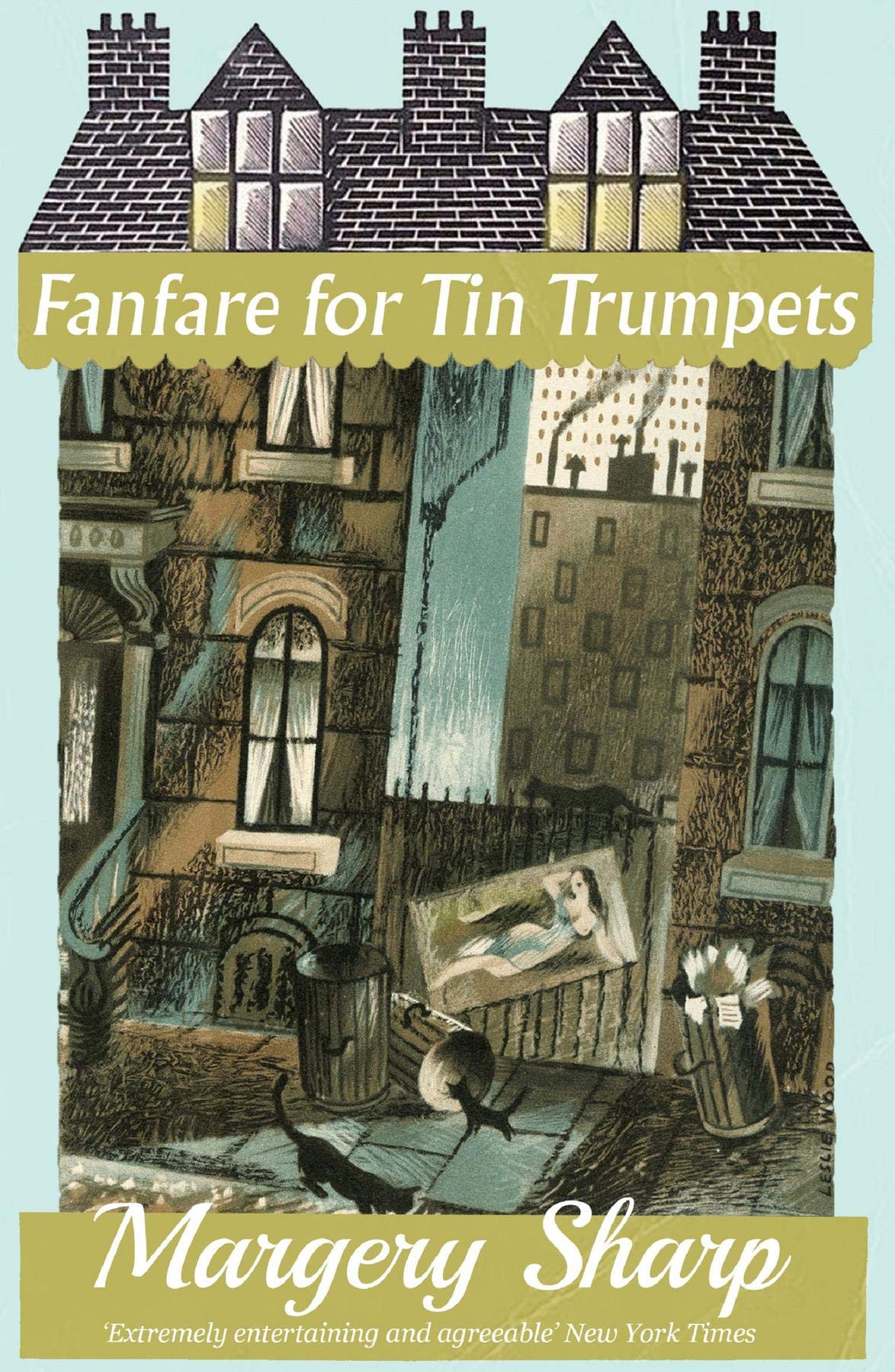
Review 2269: Fanfare for Tin Trumpets

Young Alastair French is offered a place in his family’s stationers business, but he decides to take a room in northwest London with his friend Henry, who is going to be a student. Alastair has £100, and he figures he can support himself for a year while he becomes a writer.

Alastair and Henry move into an apartment building with an assortment of friendly neighbors, particularly Winnie Parker, who is always surrounded by young men. Although he starts a novel, Alastair decides to become a playwright mostly because plays are shorter. He doesn’t do much work but he does write up a scenario.

Then he meets Cressida Drury, an actress, and is immediately smitten. She returns some of his interest when she learns he is a playwright, but it’s hard to tell how much, and he didn’t think of dating when he made his budget.

This is a frothy, funny novel about youthful optimism and first love. It’s a lot of fun.

Related Posts

Harlequin House

Rhododendron Pie

The Foolish Gentlewoman

Review 2268: Silent Spring

I have always intended to read Silent Spring, so its appearance on the list of books published in 1962 gave me a good reason to read it for the 1962 Club. However, publishing my review that week didn’t work out on my schedule. That being said, it works out to be a perfect read for Nonfiction November.

People probably realize that the book was largely responsible for the banning of DDT in the United States, but maybe don’t understand that much more about it.

Carson was a biologist in a time when that particular science was not highly regarded because of the fascination with physics and chemistry as a result of World War II. Particularly in the 1950s and 60s, blanket applications of pesticides and other chemicals seemed to have become the knee-jerk reaction to not only agriculture and forestry pest problems but also to problems of disease. What Carson accomplished in Silent Spring was to bring together the results of widely scattered studies to show that (1) the chemicals are deadly poisons, not just to insects but to all life; (2) applications of the chemicals have been largely ineffective and had unintended consequences; (3) continued application could result in the loss of all life; and (4) there are better solutions that are less costly for the same problems. She tells us about these issues in clear prose that instances many stories of failed or successful programs and experiments.

As I read this book, I had a clear memory of myself as a child riding my bike through a cloud of insecticide that was being sprayed from a truck being driven through my neighborhood. There was no sense on my part or apparently on the part of the sprayers that this could be harmful to me or anyone else outside at the time. Over the years, I’ve wondered why there seem to be more and more cases of cancer than there were when I was younger. Now I think I know why.

If you read this book, you’ll continue to be amazed at the instances where, after a disastrous application of pesticides by the Department of Agriculture to try to solve a problem, the next step was found to be . . . another application of pesticides. It’s a wonder there’s a creature left in our forests and fields, not to mention our waterways. This book is said to be the beginning of the environmental movement. I believe it.

Related Posts

The Bird: A Natural History of Who Birds Are, Where They Came From, and How They Live

The Body: A Guide for Occupants

The Omnivore’s Dilemma

Nonfiction November: Week Three

This week’s host for Nonfiction November is Liz of Adventures in reading, running and working from home. The theme is Book Pairings, and here is its description:

This week, pair up a nonfiction book with a fiction title. Maybe it’s a historical novel and the real history in a nonfiction version, or a memoir and a novel, or a fiction book you’ve read and you would like recommendations for background reading. You can be as creative as you like!

This is a toughie. I can think of some obvious pairings, like Middlemarch and My Life in Middlemarch, or the biographies of authors whose books I have read, or Elif Batuman’s The Possessed: Adventures with Russian Books and the People Who Read Them and one of those Russian books, but I was looking for something more creative.

Here’s what I came up with: The Hare with Amber Eyes: A Hidden Inheritance is the world-renowned ceramicist Edmund de Waal’s nonfiction account of a collection of netsuke that belong to his family and what happened to it during World War II, when the family thought it was stolen by the Nazis. In tracing the collection, de Waal traces his own family history, beginning with Charles Ephrussi, the original owner of the collection, who was the cousin of de Waal’s great-grandfather and also the inspiration for Proust’s Charles Swann.

I’m pairing this with Great House by Nicole Krauss, a collection of linked short stories about the migrations of a desk, which the character Nadia tries to find after giving it away because she cannot write without it. The desk turns out to have a sad history and comes to represent all the objects lost in the Holocaust.

Review 2267: House-Bound

I read Mrs. Tim Carries On just before reading House-Bound, and they made an interesting contrast. They were written about the same time during World War II and both set in Scotland, House-Bound in a fictional city that stands in for Edinburgh and Mrs. Tim in the town base of her husband’s regiment. Both are social comedies, but whereas Mrs. Tim is busy raising her children and doing war work and remaining as upbeat as possible, Rose Fairlaw has raised her children, tends to the depressive, and fully realizes she is looking at the death of her way of life.

House-Bound begins with Rose at the registry hoping to get two servants to replace the two girls who are leaving to work in munitions. It’s clear to her that there are plenty of employers and no one to be employed. When someone remarks that millions of women do their own housework, she decides to try, even though she is fifty and has never done any housework or cooking.

The Laidlaws live in an ancient stone tower with a larger, comfortable Victorian addition. Aside from not exactly knowing how to do the work, Rose seems to have no idea that you might not clean every room every day or that one woman can’t be expected to do what three women used to. But almost immediately she meets Major Hosmer, an American who intrudes himself upon her to make domestic suggestions such as converting the small pantry on the main floor into a little kitchen so she doesn’t have to go up and down stairs to the basement kitchen.

Rose is struggling ineptly with the cleaning and serving her husband disgusting messes, but it appears to occur to no one else in the family to do any work. The family dynamics are important in this novel. Rose was a young mother and widow during World War I when she married Stuart Laidlaw, a widower with a frail only son, Mickey, whose mother died in childbirth. Rose became consumed with caring for Mickey, especially after he almost died, to the evident neglect of her own difficult daughter, Fiona, who has grown up ready to take offence and ready to blame everything on her mother. Major Hosmer is actually an acquaintance of Fiona, and his mistaken idea of her mother is straightened out almost immediately upon meeting her.

Luckily, the registry office comes up with Mrs. Childe, who is willing to teach Rose and work with her three hours a day, but her standards are so high that Rose is exhausted. She become house bound, with no time to do anything else, but Peck extends that idea to the lives of her class—that they are stuck in their ideas and habits.

At first, being someone who has always had to do my own housework (although admittedly not to their standards), I felt impatient of Rose and the others who seemed to thing she was taking on some momentous task. But later I feel I missed some of the comedy in my sympathy for her general conditions. There are some great comic characters here, who are as irritating as they are funny, although I was a little irked at the idea that an American major would push his way into Rose’s house not only to make home improvement suggestions but to make the dinner and do the dishes. I don’t believe that character at all. But Cousin Mary, who is always right, a single woman who keeps trying to force poor exhausted Rose into doing war work—and then there is Grannie Con-Berwick.

Related Posts

Bewildering Cares

The Land of Green Ginger

Mrs. Tim Carries On

Review 2266: Old God’s Time

I started reading Old God’s Time without any idea of what it is about, and at first it seemed to be just meandering inside a retired policeman’s head. But eventually, a story begins to crystalize.

In the 1990’s, Tom Kettle is a retired Irish cop who has spent the last nine months alone in his seaside apartment. He has found the time peaceful, but he’s been retreating into memories of his life with his beloved wife June and his children Winnie and Joseph. He’s not always sure whether has has dreamt of scenes with them or not.

Then two police detectives come to his home to ask him questions about an old case concerning a priest’s abuse of children that was shut down by higher-ups. Oddly, though, they don’t ask him anything but spend the night during a storm and leave.

Next his old chief Fleming stops by to ask him to come in and help them with the case, Slowly, with the discussion of this case, the secrets and sorrows of Tom’s life are revealed. At the same time, Tom gets more involved with his immediate neighbors.

This is an eloquent novel but also a very sad one, with a strong message about the effects of child sexual abuse.

Related Posts

On Canaan’s Side

Days Without End

Edinburgh

Review 2265: Mrs. Tim Carries On

Mrs. Tim Carries On is the second in the Mrs. Tim series, continued after a long break at the beginning of World War II. The narrator, Hester Christie, begins the novel as diary entries after her husband leaves for the front. Her husband’s Scottish regiment is stationed in a small Scottish town, and at first Hester feels she should leave but decides she is of more use there.

The diary is of everyday life that doesn’t seem to be that different from before the war except for war work and worry about loved ones. One of the young officers in her husband’s regiment asks her to invite Pinkie Bradshaw to stay, and Hester is confused by this because she remembers Pinkie as a girl with braces. But Pinkie turns out to be a tall and beautiful seventeen-year-old, practical, too, as she lets one young man after another know they’re just going to be friends. Pinkie stays, and Hester is happy to have her.

After Dunkirk, Tim’s regiment reappears, but without Tim, which leads to some anxiety. Otherwise, the book is calm, pushing the stiff upper lip approach with a few scares, sometimes funny, and entertaining.

Related Posts

Mrs. Tim of the Regiment

Mrs. Tim Flies Home

Mrs. Tim Gets a Job

Review 2264: Tom Lake

On the farm in Northern Michigan that has been in her husband’s family for generations, Lara has been coaxed by her three grown daughters to tell them about her relationship with Peter Duke, a now famous movie star. There has been a triggering event for these stories, but we don’t learn about it for a long time. In any case, these stories take place between sessions of cherry picking and other hard work.

Lara becomes an actress without planning to. When she is in high school helping with auditions for Our Town, the girls trying out for Emily are so bad that she tries out herself and gets the part. Later in college, she takes the part again, and it happens that Ripley, a movie producer, has been persuaded to attend to see his niece. Instead, he decides that Lara is perfect for an upcoming role.

Lara makes a movie, but there is a long delay before it comes out, so she ends up taking the part of Emily again at a summer stock theater in Michigan called Tom Lake. At Tom Lake, she is swept into an affair with Peter Duke, a young, charismatic actor, on her first day. The summer starts out magical, but Lara has a lot to learn about acting, herself, and Duke.

The present-time novel is set during the pandemic, but even though the story has some heart-wrenching parts, its overall atmosphere is so cozy, so happy in its setting, that it feels like the family has its own little nest. You want to go and live with this fictional family. I was born and grew up in Michigan, and although I never lived on a cherry farm, this book made me nostalgic.

Patchett is also a terrific storyteller. This novel is paced brilliantly. The sections where she tells her story seem just about right in length while the rest portrays a warm family life and hard work on the farm. I loved this book.

Related Posts

Commonwealth

State of Wonder

Once upon a River

Nonfiction November: Week Two

Week Two of Nonfiction November is hosted by Volatile Rune. The theme is Choosing Books, and here is its description:

What are you looking for when you pick up a nonfiction book? Do you have a particular topic you’re attracted to? Do you have a particular writing style that works best? When you look at a nonfiction book, does the title or cover influence you? If so, share a title or cover which you find striking. 

Cover for The Wicked Boy

I am not nearly as big a nonfiction reader as I am a fiction reader, so to answer this question, I had to look back at my list of nonfiction books since I started my blog. It’s clear that I like to read books about literary subjects and biographies and memoirs, often by or about literary figures, but although I have read a few, not often celebrity biographies and memoirs. I think in general I just look for nonfiction books that pique my interest in some way, either because of who wrote them or what they are about.

Although the cover generally influences me for fiction books, I haven’t been able to discover that I read any nonfiction books because of their covers. However, I will read books by certain authors: the biographers Doris Kearns Goodwin, Claire Tomalin, and Ron Chernow, for example. I also like true crime novels, but mostly true crime of an older vintage, so I have enjoyed a couple of books by Kate Summerscale (The Suspicions of Mr. Whicher, The Wicked Boy) and have another one on my pile.

Cover for Annals of the Former World

There are also periods of history I’m interested in, particularly the Wars of the Roses. I’ll read histories and biographies about that time.

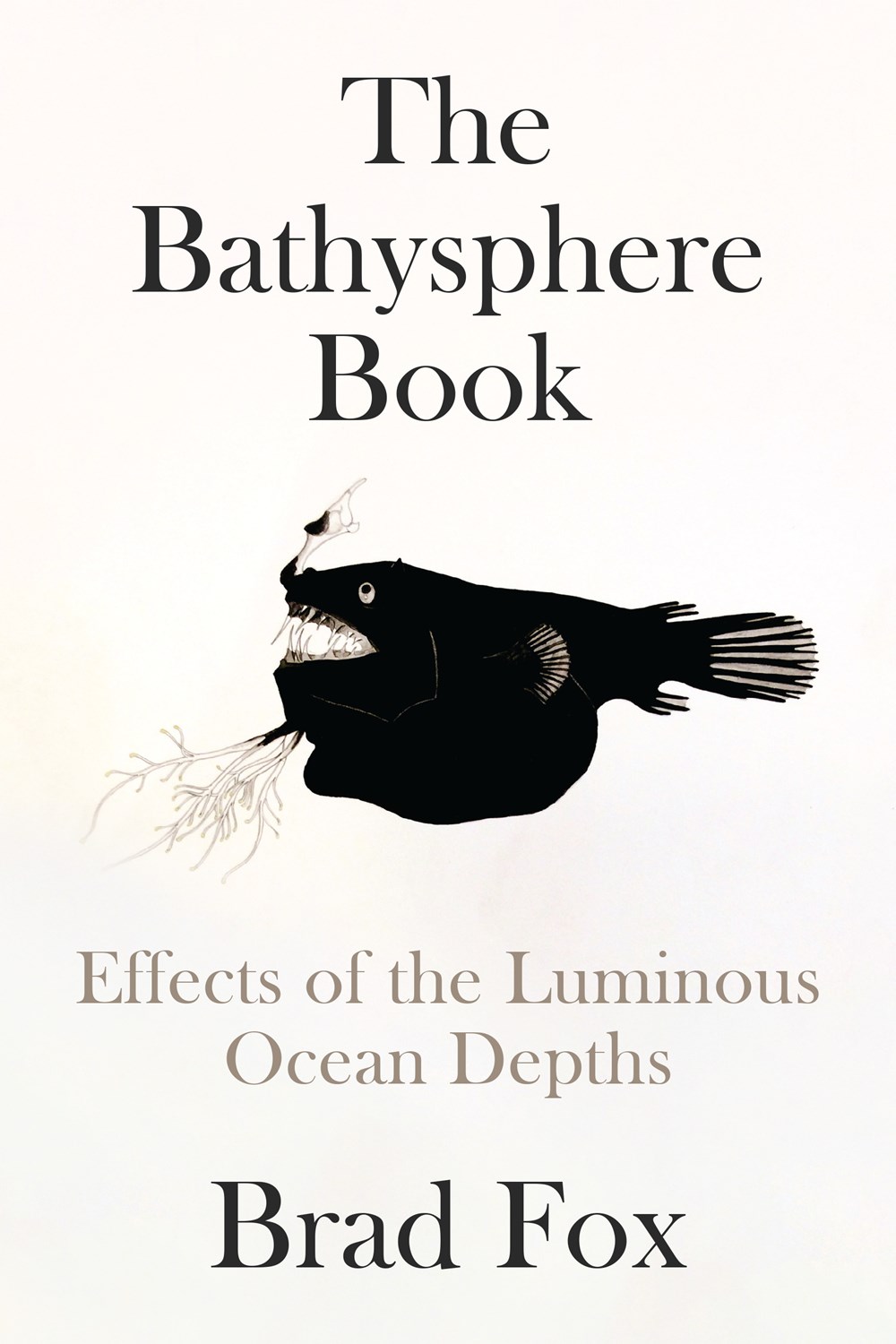
I am not very scientific minded, but occasionally I hear of a book about science that sounds fascinating. I have an upcoming review of The Bathysphere Book that I found really interesting, and it has a great cover illustration.

Ten years ago, I discovered John McPhee’s Annals of the Former World, about how our continent was formed geologically, in four big, fat volumes, and I read every one. Fascinating stuff, and McPhee is a great writer.

Review 2263: The Shadows of London

Cat Lovell and her partner Brennan have a commission to build a new almshouse and some houses where the old almshouse burnt down in 1666. However, workmen find a body in a rubbish pile on the site. Not only does the body need to be identified because it has no face, but a magistrate named Rush closes down the entire site until the inquest. This is unnecessary, but Cat’s employer Mr. Hadgraft, says that Rush originally was a partner in the undertaking and pulled out, so he is trying to get back at Hadgraft. For Cat and Brennan, the situation is urgent, because they only have a few months before winter closes the work down.

Cat’s friend James Marwood now works entirely for Lord Arlington, who assigns him the task of discovering the corpse’s identity. He finds there are two missing men who might be the victims. One is John Ireton, a civil servant who has disappeared. The other is a Frenchman, Monsieur Pharamond (a pseudonym). Both were involved in fleecing a young French lady-in-waiting in Dieppe.

This novel also tells the true story of that lady-in-waiting, Louise de Keroualle, who has attracted the attention of Charles II. Both Lord Arlington and the King of France see a benefit in having a young French, Catholic girl in the King’s bed. But Louise herself is hoping for a way out.

Marwood’s investigations indicate that his and Cat’s old nemesis, Roger Durrell, a tough for Buckingham, might have killed the dead man. Another issue is that James has become infatuated with Hadgraft’s daughter, and Hadgraft seems unexpectedly eager for the marriage. Cat finds herself surprisingly jealous.

This is an excellent series, and another exciting entry in it. I especially liked the ending.

Related Posts

The Royal Secret

The Last Protector

The King’s Evil

Review 2262: The Theft of the Iron Dogs

The Theft of the Iron Dogs is another novel by E. C. R. Lorac that is set in the beautiful Lune valley of Lancashire, along with Fell Murder and Crook O’Lune. In order, it comes after Fell Murder and before Crook O’Lune.

Giles Hoggett has been busy with the harvest for weeks, but it is over, and he decides to walk over to check a cottage he owns next to the river. After he notices that someone has disarranged his woodpile, he goes into the cottage and finds someone has stolen an old coat, hat, and glasses as well as a bag, rope, and the iron firedogs out of the fireplace. In speaking with neighbors, he finds that another cottage owner has had his waders stolen.

Giles is inclined to blame small thefts on a tinker couple, referred to as potters in the North. No one has seen the potter’s wife, Sarah Gold, for some time, and it’s not lost on Giles and his brother George that the missing items could point to the disposal of a body. Hoggett knows that Chief Inspector Macdonald was in the area earlier investigating the fell murder, so he writes a letter to Macdonald expressing his concern.

Macdonald is investigating the theft of clothing coupons that he thinks might involve a criminal named Gordon Ginner, and he takes a weekend off after a trip up to Manchester on this case to check out the situation in the fells. While he is there, he finds a body hidden under tree roots in a deep pool of the river. It is Gordon Ginner.

I especially like these mysteries set in the fells, because they are so atmospheric. It is clear Lorac loved that area of the country. And incidentally, from this one I learned what a fell is. I just had a vague idea that it was a valley.

I received this book from the publisher in exchange for a free and fair review.

Related Posts

Fell Murder

Crook O’Lune

Murder in the Mill-Race