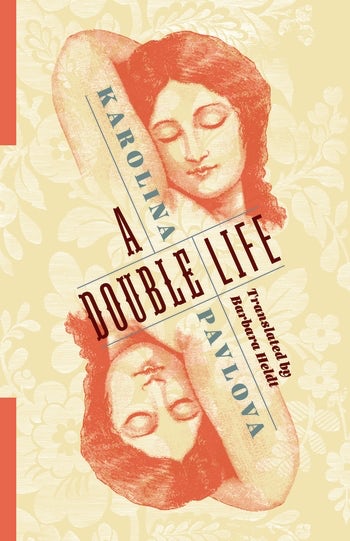
Review 2223: A Double Life

Published in 1848, A Double Life is the only novel written by the Russian poet Karolina Pavlova, who was well known in her time but forgotten by the time of her death. Almost more interesting to me than the novel was the biographical information about Pavlova, who was reviled as a Russian woman for daring to consider herself a poet. I read this novel for my Classics Club list.

Cecily is a young, innocent girl in the top levels of Russian society. Her mother, Vera Vladomirovna, has brought her up strictly to be submissive and ignorant of life. Vera Vladomirovna has noticed Prince Viktor’s interest in Cecily and hopes to marry her to him. But she doesn’t realize that her friend, Madame Volitskaia, intends him for her daughter Olga, Cecily’s best friend.

Upon hearing of the death of a man she never met, Cecily dreams about him that night. These dreams, related in poetry, end each chapter.

The prose narrative is full of satire against polite society, although Cecily doesn’t understand any of it. The poetry is more romantic and mystical, and I didn’t always get the point of it except the end result of it is to awaken Cecily to what life is really like.

The novel is very short, with a strong feminist message for the times. The dream sections are written with a romantic floridity that reminded me of the works of George Sand.

Related Posts

The Victorian Chaise-Longue

Strange Journey

A Footman for the Peacock

Review 2222: Bitter Orange Tree

As Omani university student Zuhour pursues studies and friendships in England, she is haunted by thoughts about the woman she considered her grandmother, whom she neglected and avoided before her death. She revisits her family history, from the time when Bint Aamir, an impoverished relative taken in by her grandfather, was ejected, along with her young brother, from their father’s house at the urging of his new wife.

Back in England, Zuhour befriends Suvoor, a wealthy girl of Pakistani heritage brought up in England. Suvoor is devastated because her sister, Kuhl, has chosen a young man who she deems socially unworthy of their family. But Zuhour grows closer to Kuhl instead of Suvoor.

This novel is a poetic examination of the past and future of this character, where her contemplation of Bint Aamir’s life—in which her father did not permit the only marriage she was asked for—seems to predetermine her own—in which she is in love with her friend’s husband. The most interesting parts for me were the historical ones. The novel refers often to Zuhour’s dreams and sometimes seems dreamlike itself, but I didn’t feel touched by it. I read this book for my James Tait Black project.

Related Posts

A Thousand Splendid Suns

And the Mountains Echoed

In the Shadow of the Crescent Moon

Review 2221: The Expendable Man

Young Doctor Hugh Denismore is driving through the California desert to Phoenix to attend a family wedding when he sees a teenage girl on the highway hitchhiking. He doesn’t want to pick her up but is worried she’ll meet with trouble on the deserted road, so he gives her a ride to Blythe, as he’s not about to cross the state line with her.

On the way, she tells him a pack of lies and claims to be broke, so he buys her a bus ticket to Phoenix when he drops her in Blythe and stops at a motel for the night.

To his dismay, when he reaches the Arizona border the next morning, she is waiting for him and asks for a ride to Phoenix. He drops her off at the Phoenix bus station, but later she finds him at his motel and asks him to give her an abortion. He throws her out.

He has a bad feeling about all of this, but why is he so worried? After her body is found murdered in a canal, his fears are confirmed and the reader realizes he’s a Black man. If the police find out he gave her a ride, he’s sure they’ll try to pin it on him. And they do.

Hughes builds up a great deal of suspense in this one, and she also vividly describes 1960s Phoenix. I have liked her way of introducing strong women in the two books I’ve read by her so far. In In a Lonely Place, two women team up to expose a serial killer, and in this novel, Denismore gets vital assistance from Ellen, another wedding guest. I also thought it was a brave and unusual choice at this time to have a Black protagonist. This is a real nail-biter.

Related Posts

In a Lonely Place

The Horizontal Man

Laura

Review 2220: Our Missing Hearts

After reading two pretty good domestic dramas by Celeste Ng, I wasn’t really prepared for a dystopian novel. Although I occasionally read dystopian fiction, it’s not really my thing. And this one gave me more trouble than most.

Bird is an 11-year-old biracial boy whose Chinese mother, a poet, disappeared from the lives of himself and his father years ago. They are living in difficult times because of PACT, a law that requires everyone to watch others for un-American activities and codifies racism against Asians, particularly those of Chinese ancestry. The historical record for many periods has been blacked out, and lots of books are banned. Bird’s mother Margaret’s poem has become a rallying cry for those against this system, especially against the removal of children from the care of parents deemed unsuitable. Bird doesn’t see that his father—demoted from a linguistic professor to a library book shelver presumably because of his marriage—has been trying to protect him by teaching him not to stand out.

After his best friend’s disappearance, Bird receives a message from his mother. He begins trying to remember her and eventually to find her.

My biggest problem with this book is its dual nature. Young adult novels, except really great ones, tend to have a certain style, and the first part of this novel is so much in that style, written from Bird’s point of view, that I finally googled it to see what genre it fell into. Then Bird finds his mother, and the next section is supposed to be Margaret telling Bird about her life. It is not written as dialogue, and there is a lot of information there that a mother would not tell her 11-year-old son. Okay, I get it—it’s her memories, but the novel keeps repeating that she’s continuing her story. And it’s way too long with too much extraneous information that’s inappropriate for this purpose. About her wild days? Her lovers? The bite marks she made on his father’s neck? Come on.

I was about 2/3 through the novel, but it lost me there. This was a DNF for me.

Related Posts

Everything I Never Told You

Little Fires Everywhere

To Paradise

Review 2219: A Pocketful of Rye

When wealthy businessman Rex Fortescue collapses and dies over tea in his office, the police are surprised to find his pocket full of rye. When they figure out how he was poisoned, they realize it must have been over breakfast not tea. That leaves his family in the frame.

His much younger new wife is having an affair, so she is the obvious suspect—that is, until she collapses over tea. Then Gladys, the house maid, is found with the laundry, strangled and with a clothespin on her nose.

Miss Marple arrives on the scene after she reads of Gladys’s death, having trained Gladys to be a maid. She is the one who makes the connection between the deaths and the old nursery rhyme. But then, what about the blackbirds? Could this have anything to do with the Blackbird Mine, over which Fortescue reputedly cheated a partner?

This is one of Christie’s more ingenious mysteries. It hangs together without seeming absurd even though the murders seem deranged. I also thought the ending was quite effective.

Related Posts

Nemesis

They Do It with Mirrors

Sleeping Murder

Review 2218: Romney Marsh

I’m not quite sure what possessed me to look for this little book. I guess it looked interesting on someone ‘s review blog, although I’m not sure whose. It is a short, descriptive book about Romney Marsh as it appeared in 1950 with a little history and some drawings.

After a descriptive section about the marsh and the towns on the coast, it has a section of drawings with short descriptions of the churches on the marsh. Finally, there are a few drawings of marsh features, towns, and more churches. I would have liked the drawings from the final section to have been placed near the appropriate text, but I understand that placement of all the drawings at the back allowed them to be printed on finer paper. It seemed as if the church section might be useful on a tour of churches of the area.

Although I have never been to Romney Marsh, if I ever went there, I would be sure to take this little book along, if only to see how much it has changed in 70 years.

Related Posts

The Rural Life

Notes from a Small Island

Vanishing Cornwall

Review 2217: The Last Remains

Things seem to be in flux for Dr. Ruth Galloway. Her university in Norfolk has decided to close its archaeology department. Detective Harry Nelson’s wife Michelle has finally left him, and he wants Ruth and Kate to move in with him. But Ruth is reluctant to leave her cottage and doesn’t know what to do.

In a wall of a building being renovated, a skeleton is found. Ruth identifies it as modern because of a plate in its leg, and it turns out to be a woman missing for 20 years. Nelson is dismayed to learn that their friend Cathbad was present at an archaeological campout from which she disappeared all those years ago.

It is still the time of Covid. Cathbad nearly died from it and is having problems recovering. As Nelson’s team questions the former owners of the building where the skeleton was found and the participants of the campout, DC Tony Zhang is exposed to the virus and must isolate.

Nelson’s team finds that the victim, Emily Pickering, was having an affair with Leo Ballard, the archaeology professor leading the campout. He took her to the train station early Monday morning on her way home, but there were puzzling sightings of her on CCTV in other places that day.

Ruth has made a trip to Grimes Graves, ancient mines where the campout took place, and noticed she got a lot of chalk on her pants. The cloths wrapping Emily’s remains also being coated with chalk, Ruth plans to return to Grimes Graves to take soil samples. But she has a lot to deal with at the university, helping with protests initiated by David Brown, who, if the department closes, wants her to move to Uppsala with him.

This is another excellent mystery in this series, and followers may be happy to know that the inertia in the relationship between Ruth and Nelson finally gets unstuck. I won’t say in which direction.

Related Posts

The Locked Room

The Night Hawks

The Lantern Men

Review 2216: Classics Club Spin Result! Miss Mole

I don’t know what readers in 1930 would have thought of Miss Mole—maybe found it a little shocking—but I thought it was delightful. I read it for the latest Classics Club Spin.

Miss Mole is a forty-something spinster of little means. Of yeoman stock, she was well educated but left with little when her parents died. Since then, she’s been working in various genteel, poorly paid positions. When the novel opens, she’s a companion for Mrs. Widdows, but she has difficulty sometimes hiding her true nature under the submissive aspect her employers expect, and she’s fairly sure she’s going to lose her position soon. She goes to tea with Mrs. Spenser-Smith, a prominent citizen in town who is also her cousin. Lillia Spenser-Smith would like her relationship with shabby Miss Mole to remain a secret, so she helps her get a position as housekeeper with the chapel rector Mr. Corder, as she is worried about his two daughters and the incursions of Patsy Withers, who would like to be their stepmother.

Miss Mole finds the Corder household an unhappy one. Corder is an energetic pastor, but at home he expects his family to see no fault in him and he pays no attention to the state of his children. Everything must revolve around him. His oldest daughter Ethel is restless, horsy, and prone to bad temper. She has been supposed to have been running the household but has been paying more attention to her charities. Cousin Wilfred soon appreciates Miss Mole’s sense of humor, but young Ruth is at first mistrusting. Miss Mole decides to help Ruth even though she dislikes Mr. Corder.

Mr. Blankinsop, an acquaintance from Miss Mole’s former lodging, comes to tell Mr. Corder that he is changing churches because he disagrees with him. Although he seemed to want to avoid Miss Mole at the lodging, he begins to seek out her company. She thinks he is in love with a helpless married woman at his lodging.

Energetic Miss Mole does her work well and the Corders’ lives improve, but she has a secret that threatens when a minister of a neighboring chapel, Mr. Pilgrim, appears.

Miss Mole is a great character—intelligent, cynical, but with an ability to find joy in life, coupled with a tendency to lie but also to speak her mind.

Related Posts

Sally on the Rocks

Chatterton Square

Cluny Brown

Review 2215: Demon Copperhead

Everyone has been raving about Demon Copperhead, but I’ve had a more mixed reaction to it. This is because the novel is an update for Dickens’s David Copperfield, which is one of my favorite books.

In one way, this is a good match, because both Dickens and Kingsolver are political writers with social consciences. Dickens’s target was the effects of industrialization on poor children. Kingsolver’s in this novel is the effects on the people of Appalachia of what she sees as a war on agriculture.

Damon Fields, named Demon Copperhead because of his red hair, is a young Melungeon (I had to look it up) boy at the start of the novel. His father died before he was born, and his teenage mother has a very weak control of her sobriety. Residents of Lee County in Southwestern Virginia, they live in a single-wide mobile home owned by the Peggots next door. The kindly Peggots provide most of the stability in young Demon’s life.

Readers familiar with David Copperfield will be familiar with the plot, for it follows that book almost exactly. Although they are very poor, things are going fairly well and Demon’s mother has been sober for two years when she meets Stoner, soon to become Demon’s abusive stepfather. It goes mostly downhill from there, with Demon, after a brief career as a high school football hero, becoming addicted to oxy after an injury.

I couldn’t help noticing differences from Dickens, though. For one thing, the McCob family, Kingsolver’s equivalent of the Micawbers, are not the feckless, lovable, comic characters of Dickens, but a couple who, as Demon’s foster family, illegally send him to work instead of school, illegally charge him rent, and steal his money. (The Micawbers send David to work, too, but that assumed to be at the behest of his stepfather.) That leads to the biggest difference. Although Kingsolver can depict sympathetic characters, she doesn’t really do funny ones, Dickens’s gift. Further, the very young Demon at the beginning of the novel lacks the absolute innocence of young David that makes him so endearing. Demon’s narrative is too cynical.

Finally, Dickens is more willing than Kingsolver to let his story make his political points. Still, it’s a gripping novel with a serious message about the rural addiction problem, the lack of services for rural citizens, and the mistreatment of the poor. Although I read this novel before it made the list, Demon Copperhead is part of my James Tait Black project.

Related Posts

Unsheltered

David Copperfield

The Lacuna