Review 1884: John Saturnall’s Feast

It’s 1625 when young John Saturnall and his mother are chased up into Buccla’s Wood by religious zealots who term her a witch. She is not a witch but a wise woman with ancient knowledge and stories of a magnificent feast that happened centuries before.

When John’s mother is dying in the wood, she sends him to Buckland Manor in the Vale, the home of Sir William Freemantle. There he learns that his mother worked in the manor before she became pregnant with him. He is taken into the kitchen, where he shows promise of becoming a great cook.

Just as John is becoming a Master Cook and Sir William’s daughter Lucretia is reluctantly betrothed to a wastrel in an attempt to save the Vale, the Civil War breaks out. As the Freemantles are supporters of King Charles I, the household has years of suffering before it.

At the beginning of each chapter is an excerpt from The Book of John Saturnall, written using the culinary language of the times. The novel is lushly written, full of the details of running a 17th century kitchen and household.

I was less interested in the unlikely romance, perhaps partly because Lucretia as a character is poorly defined. However, overall I found this novel deeply interesting.

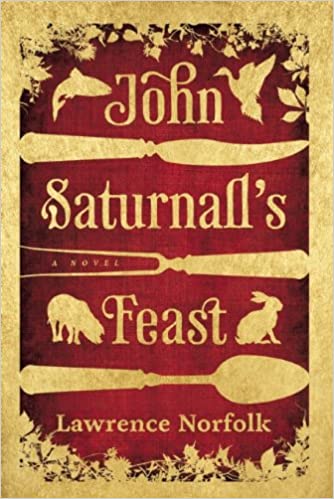
By the way, the Grove Press edition is beautifully presented, with heavy paper, two colors of ink, and gorgeous woodcut-style illustrations.

Related Posts

Corrag

Merivel: A Man of His Time

Salt: A World History

Review 1883: #ThirkellBar! The Headmistress

Owing to financial difficulties, the Beltons have had to lease the house their family has lived in for 150 years, Harefield Park. It has been leased by the Hosiers’ Girls School, which, having been evacuated from London, had shared space with Barsetshire High School.

Mr. and Mrs. Belton have moved into Arcot House, recently inherited by Captain Hornby at his aunt’s death, which is in the village of Harefield. Although it seems odd not to live in their own house, the person who seems to mind most is their daughter, Elsa, who is away most of the time doing something secret.

Miss Sparling, the headmistress of Hosiers’ Girls School, has not only been sharing the school, she has been living with Barchester High School’s dread headmistress, Miss Pettinger, so she is happy to have her own quarters. The community of Harefield is very welcoming, so Miss Sparling quickly gets to know the village families. She is delighted to find out that the vicar, Mr. Oriel, once studied with her grandfather, a noted scholar.

One of her new acquaintances is Mr. Carton, an Oxford don, who goes around making disparaging remarks about female academics. Little does he know that Miss Sparling’s grandfather was an expert on an obscure poet that Mr. Carton is writing a book about. Further, one of Carton’s few sources is an article published by Miss Sparling herself.

At the Belton’s, Captain Hornby begins discreetly courting Elsa, and an unattractive schoolgirl at Hosiers falls madly in love with Commander Belton, the Belton’s oldest son.

As this series continues, the books become more full of incident, new characters, and references to characters already encountered and thus more difficult to describe. In this one, there is a hilarious description of a working party and a new awareness that the young men may die, although we haven’t heard of any war deaths among our favorite characters (except Lettice Watson’s husband, whom we never met), just of the natural passing of older characters such as the original Lord and Lady Pomfret.

A new character who proves entertaining is the pleasant Mrs. Updike, such a clumsy woman that she is constantly injuring herself. And key to the events of the plot is Mr. Adams, who I fear will become one of Thirkell’s types—a vulgar, wealthy manufacturer who is the father of the aforementioned schoolgirl.

Sometimes Thirkell’s prejudices bother me, such as her overt snobbishness and her disparagement of Dr. Morgan on the grounds she is a woman doctor rather than because she is a nitwit. However, although Thirkell has her tropes and stock characters, I feel that somehow her series is gaining a little substance.

On another note, I will have my usual wrap-up topic for this book with its announcement of the next book next Wednesday, but since that is well into July, let me just say now that the next book is Peace Breaks Out, and that my review will appear one day earlier than usual, on Thursday, July 28.

Related Posts

Growing Up

Marling Hall

Northbridge Rectory

Review 1882: After the Fire, A Still Small Voice

After the Fire, A Still Small Voice is Evie Wyld’s debut novel about how family trauma can pass down the generations. In alternate chapters, it follows Frank Collard in the present time and Leon 40 years earlier. Maybe I was dense, but it took me a while to realize that Leon is Frank’s father.

Frank has just split up with his girlfriend when he decides to restart his life. He leaves Canberra and drives to a shack on the eastern coast that his grandparents purchased years ago and where he spent holidays as a boy. He gets an occasional job loading boats. It’s a primitive life, and the loneliness starts to get to him.

Leon trains under his father to be a pastry chef and takes over the bakery after his father, in gratitude for the country that took in himself and his wife, World War II Jewish refugees, volunteers for the Korean War. Leon’s father returns damaged, unable to work, so his parents leave Leon, ending up in the beach shack. Then Leon is conscripted for Vietnam and has his own damaging experiences.

I can’t come up with the reference for this, but I remember several years ago reading a post by someone complaining about women writing like men. The implication was that they were doing so to be taken more seriously by male editors and publishers. In particular, Evie Wyld’s All the Birds, Singing was mentioned with the remark that you didn’t even know if the main character was male or female for some time. I didn’t agree that (1) just because you don’t know the sex of the main character means that the author is writing like a man (look at The Towers of Trebizond) or (2) Wyld was writing like a man in All the Birds, Singing. I certainly didn’t have that impression. However, the feel of After the Fire, a Still Small Voice is very masculine, which makes sense with her male protagonists.

The only other observation I have about the novel is that it seemed a bit all over the place for me. Perhaps this is because of my initial confusion about the relationship between the two main characters. I guess I wasn’t paying attention to last names, and Leon’s isn’t mentioned right away. In any case, for a long time I wondered where the novel was going. Also, I didn’t much like either Frank or Leon, although Leon was okay until Vietnam. But Frank’s problem isn’t really explained, and he has major anger issues.

Related Posts

All the Birds, Singing

The Bass Rock

The Towers of Trebizond

Review 1881: Death in Kashmir

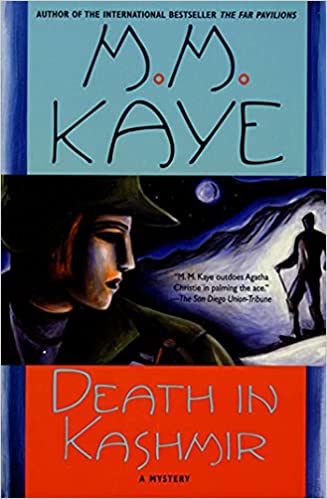
A quote on the cover of Death in Kashmir compares M. M. Kaye to Agatha Christie. A more accurate comparison in terms of the type of novel it is—romantic suspense rather than mystery—is to Mary Stewart, although there is just something about a Mary Stewart book that this novel doesn’t quite have. Still, Death in Kashmir is entertaining enough.

The novel is set in 1947, the year before the British left India, and it provides an interesting look at the life of British upper-class people living there at the time, although the natives are mostly only in the book as servants.

Sarah Parrish goes to Kashmir to attend the last meeting of the India Ski Club at Gulmarg in a primitive hotel that is usually only open in the summer. The outing has already been shadowed by the death that day of Mrs. Matthews in an apparent skiing accident. In the middle of the night, Sarah awakens to a scraping noise and realizes someone is trying to break into the room next door, that of another young woman, Janet Rushton. Sarah quietly hurries to Janet’s door to warn her and is shocked to be greeted by a drawn gun. However, when Janet sees someone has tried to enter by the bathroom window, she confides in Sarah that she is an agent for the government. She and Mrs. Matthews discovered an important secret and were waiting for help from their superiors when Mrs. Matthews was murdered.

A few nights later, Sarah and Janet have joined an expedition farther up the mountain to ski and spend the night in a ski hut. Sarah catches Janet ready to ski off in the middle of the night because she has finally been contacted by her people. The next day, she too is found dead.

Returning to Peshawar after the trip, Sarah tries to forget what she has learned, but she receives a letter from Janet’s attorney enclosing the receipt for her houseboat in Srinagar and telling her the secret can be found there. So, she finds herself returning to Kashmir with her friends Hugo and Fudge Creed. There she encounters all of the people who were on the ski trip, with a few extras, like the attractive Captain Charles Mallory.

The Cold War plot seems a little silly when compared to those of some of the masters, like Le Carré (and may more fairly earn the comparison to Christie, who also has some silly Cold War plots), but it leads to plenty of suspense and an unguessable villain. A small criticism is that both sides seem to have so many helpers that it’s no wonder there was a leak. A bigger caveat is that the explanations at the end go on for quite a while longer than seemed necessary.

Related Posts

This Rough Magic

The Spy Who Came in from the Cold

Code to Zero

Review 1880: The Castle of Otranto

I first read The Castle of Otranto too long ago as assignment for high school and thought it was very silly. However, it was the first gothic novel, written in 1764, and led the way toward a fascination with Gothic culture in a country littered with ruined Gothic churches and abbeys as a result of the so-called “Bloodless Revolution.” So, I put it on my Classics Club list to see what I think about it now.

Well, it’s a silly book. It is represented in the Preface as a manuscript written sometime between 1095 and 1243. Practically the first thing that happens in it is that Conrad, the son of Manfred, prince of Otranto, has a gigantic helmet fall on him out of nowhere and crush him to death on the day he is to be betrothed to Isabella, the Marquiz of Vincenza’s daughter. This is the first supernatural event in a very short book that includes walking portraits, statues crying tears of blood, and various enormous body parts appearing in the castle.

Why? It appears that Manfred’s grandfather took the castle unlawfully, and the legend is that his family may hold it until its real owner grows too large to inhabit it. Hence, the enormous body parts.

This novel exhibits all the hallmarks of the subsequent gothic novels, many of which aren’t that palatable to modern readers—overblown speeches, submissive and virtuous women (Manfred’s wife even being so submissive as to agree to her own divorce), a nearly insane villain in Manfred, a hero in disguise, a lot of fainting, and supernatural events.

Related Posts

The Castle of Wolfenbach

The Mysteries of Udolpho

The Monk

Review 1879: The Good Turn

Garda Peter Fisher doesn’t make the report of a kidnapped girl a priority because the information is conveyed in a garbled form, but when he questions the witness, he begins to take it seriously. When he gets a lead on a possible escape vehicle and Sergeant Cormac Reilly is busy with the family, he goes out alone to intercept the suspect. The suspect drives his vehicle directly at Peter, so he shoots him. Then the girl is found unharmed.

Cormac’s boss, Brian Murphy, refused him extra resources when the girl was reported kidnapped, and now he suspends Cormac, labeling the case a complete fiasco. But Cormac believes Peter reacted correctly and the suspect was guilty. In the meantime, Peter is sent to work under his own father in his small home town.

Peter thinks a murder case has been closed prematurely, so he begins investigating it properly. Soon he begins to suspect someone has murdered two old men and is killing his own grandmother.

Cormac gets on the track of corruption in his station and begins working with Interpol. In the meantime, his relationship with his girlfriend seems to be going south.

This is another interesting crime novel by McTiernan with a complex plot.

Related Posts

The Ruin

The Scholar

The Trespasser

Review 1878: Edinburgh

Fee is a 12-year-old mixed race boy (Korean-American) who feels out of place in his home in small-town Maine. Not only does he not look like his peers, but he likes boys. He is deeply in love with Peter, his best friend.

When Fee joins an elite boys’ choir, he thinks he recognizes in the choir director, Big Eric, a person like himself. But he soon realizes that Big Eric is a predator, who systematically abuses the soloists and keeps them from telling by threatening to cut them from the choir.

Fee conflates his homosexuality with Big Eric’s abuse and is so ashamed that he tells no one even when Peter is given a solo part. Eventually, Big Eric approaches the wrong boy, and the truth comes out. But this also has disastrous consequences for his victims, two of whom commit suicide.

Moving forward in life, Fee continues to be haunted by these events during his teen years and early adulthood. He is finally managing a happier adulthood as a swimming teacher in his home town with a loving partner when he meets a young student who reminds him of Peter and is involved in the early events in a way neither of them understand.

I had mixed feelings about this novel, which I won from Adam of Roof Beam Reader. It is beautifully written and incorporates lore from the Korean side of his character’s background. But it also feels removed from its characters, which is probably necessary as it feels at least somewhat autobiographical. There are some times when the lyrical language doesn’t seem to mean anything and is written more for its sound and images. But mostly, I am disappointed in the ending of the book.

Read no further if you want to avoid spoilers. I don’t usually include them, but I felt I had to in order to express my opinion of the book. It seemed to me that his succumbing to the boy, even though it was mutual and the boy was much older than he had been, is still a predatory act because of the teacher-student relationship. Also, I could not believe that he could teach a student without knowing his last name. There are rosters, reports to be filled out. That was just unbelievable.

Related Posts

Shuggie Bain

A Little Life

A Place Called Winter

Review 1877: Gallows Rock

When I purchased Gallows Rock, for some reason I thought I was getting the second book in Sigurdardóttir’s Thóra Gudmundsdóttir series, but it was actually the fourth book in the Freyja and Huldar series. Oh well.

The body of a man is found hanging at a rock that was historically used for executions. Assuming it’s a suicide, the authorities just want the body removed as quickly as possible, because the Chinese delegation that is soon to arrive will be able to see it across the bay. No one can get up to release the knot, so the body is brought down rather haphazardly. Then they realize the death is not a suicide—the deceased has had a piece of paper stapled to his chest, although only a scrap of paper is still there.

It takes a while to identify the body as Helgi, a wealthy man who works in securities. While the police are struggling with that, Freyja, apparently some sort of social worker, is called to an apartment because a four-year-old boy is reported to have been left there alone. This apartment turns out to belong to Helgi, but the police can’t figure out who the child is. Once they finally identify him, they can’t figure out the connection between the boy and Helgi. In addition, his parents are missing.

Although this mystery is fairly complex, it’s the type that doesn’t provide enough clues for readers to figure it out. It focuses more on the police procedural aspect, even though it gives us enough glimpses into the doings of Helgi’s friends for us to know that something else is going on.

I felt that this novel seemed much less polished than the other Sigurdardóttir novel I read. It takes quite a while for the police to make any progress in their investigation. The characters aren’t very fully developed, perhaps because this has been done in previous books. But my main criticism has to do with the number of explanations of things that are probably self-explanatory, and the sheer number of details that have to be explained at the end, including things that haven’t been discussed before so no one really cares about. There was something clumsy in this.

The novel does have a final surprise, but even that is explained to death instead of being punched in to greater effect.

Finally, this is very picky and it’s not clear to me if it is a writing or a translation problem, but there is a lot of outdated slang, and one case where the word “verdict” is used incorrectly by the police, which I can’t imagine them doing.

Freyja’s link to the story is very weak. She’s essentially babysitting for most of the novel. As for Huldar, he’s such an appeaser at work that his behavior verges on the unprofessional.

Related Posts

Last Rituals

The Mist

Jar City

Review 1876: The Moon-Spinners

When I make up a Classics Club list, I always take the opportunity to add a few old favorites for a re-read. This time, I picked Mary Stewart’s The Moon-Spinners.

Nicola Ferris has gotten a head start on her holiday by accepting a lift to her destination, the village of Agios Georgios on the island of Crete. Since she is arriving a day early, she decides to take a walk up into the White Mountains instead of going into the village. She is enjoying her day when she feels someone spying on her and then she is attacked.

She finds herself in the company of a wounded English tourist, Mark Langley, and his guide Lambis. Mark came across an argument resulting in murder and was wounded by the murderer, who took away Mark’s teenage brother, Colin. Mark does not know who the people were and whether it would be safe to go to the authorities or whether that would jeopardize his brother.

Nicola helps them by taking care of Mark for one night while Lambis fetches supplies from his caique. However, once she reaches her hotel, she realizes that she has chanced into the middle of the wrongdoers—Stratos, the owner of the hotel; Sophia, his sister; and Tony, the English hotel manager. The murderer seems to be Sophia’s Turkish husband, Josef.

As Nicola and her older cousin Frances innocently pursue their holiday, Nicola keeps finding clues about the murder and begins to hope she can find Colin.

You can’t beat Stewart for descriptions of exotic locales, suspenseful plots, and a bit of romance. She’s a great storyteller and a fine writer.

Related Posts

This Rough Magic

Wildfire at Midnight

Nine Coaches Waiting