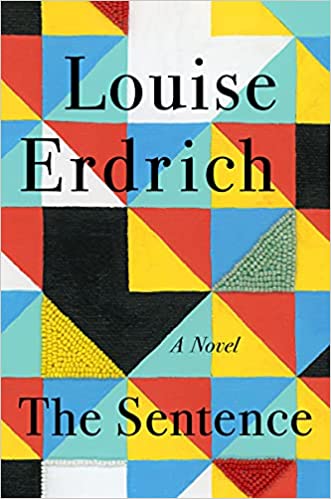
Review 1867: Literary Wives! The Sentence

Today is another review for the Literary Wives blogging club, in which we discuss the depiction of wives in fiction. If you have read the book, please participate by leaving comments on any of our blogs.

We would also like to welcome a new member, Rebecca of Bookish Beck! We are so glad to have her with us!

Be sure to read the reviews and comments of the other wives!

My Review

Tookie spent the first decade or so of her adulthood getting wasted and falling into trouble with the law. When she was arrested by Pollux of the tribal police, though, she wasn’t even sure she had broken the law, or at least she didn’t see it that way. She had borrowed her previous employer’s van to bring the body of her friend’s boyfriend back to her from the woman her boyfriend left her for. But Tookie didn’t know the woman had taped packets of crack into the body’s armpits.

Both other women having lied about Tookie’s involvement in the crime, she had the bad luck to pull a judge who sentenced her to 60 years. What saved her in prison was reading.

Tookie’s lawyer never stopped working for her, so after ten years she was released for time served. She got a job at a bookstore in Minneapolis and married Pollux, no longer a cop.

Flora dies. Tookie describes her as the bookstore’s most irritating customer. The bookstore (which I believe is Birchbark Books, owned by Erdrich) specializes in books written by and about indigenous people. Flora was a wannabe, who claimed indigenous heritage based on a photo of an ancestor who looked possibly indigenous.

After her death, Tookie takes home a handwritten manuscript that Flora was holding when she died. It is difficult to read, but when Tookie makes out a particular sentence, she is horrified. She knows that reading this sentence was what killed Flora. She tries to burn the journal and finally buries it in the backyard.

Flora begins haunting Tookie at the bookstore. At first, no one else notices her, so Tookie is afraid she’s going mad. But then others hear her, and Tookie becomes afraid to work in the bookstore alone. The city becomes more chaotic with the arrival of Covid and later the events surrounding the murder of George Floyd.

This book explores what the living owe the dead, as well as what we owe ourselves. It is a book for book lovers and even ends with lists of favorite books, so of course it appealed to me.

Erdrich’s books can be difficult to read, but even though this one contains some tough scenes, she seems to be softening. Despite some hard subject matter, the novel is almost cozy, with a warm feeling of community centered around the bookstore, a loving marriage, an evolving family life for Tookie, and quirky, likable characters. Its overall feeling is of transcendence. It’s a lovely book.

What does this book say about wives or about the experience of being a wife?

I had to reread this novel for the book club even though I had just read it a few months ago, because I hadn’t read it with our subject matter in mind. On second read, I liked this book even better than I did the first time.

We should all be so lucky as to have a marriage like that of Tookie and Pollux. Although they have a few small spats, for most of the novel, the two have a warm and accepting relationship. There is a little bit of a breakdown because Tookie feels she can’t tell Pollux about being haunted by Flora, but even that turns out to be a misunderstanding.

The biggest impact to their relationship comes with the murder of George Floyd and the resulting chaos around police violence. These events make Tookie face her feelings about Pollux having been a cop, especially because when she reached out to grasp his hands after her adventure with the corpse, he cuffed her. I believe this situation is made worse because of Pollux’s own ambivalence about the events surrounding the Floyd killing and his own former career. Tookie shows her feelings subtly, for example, by not wearing the jingle dress herself but giving it to Hetta to wear, but the couple know each other so well that he understands.

Basically, their relationship is so good that they weather their problems. Troubles come from not speaking about things, but eventually everything is discussed.

Related Posts

The Night Watchman

LaRose

The Bookshop

Review 1866: The Bird Artist

The Bird Artist, I find, is listed as the first in Howard Norman’s Canadian trilogy, of which The Haunting of L. is the third. I’m not sure I understand the grouping, since I have read several other books by Norman and they are all set in Canada, so far. However that may be, I continue to be charmed by his work even though it all seems to explore some dark places.

Fabian Vas is the narrator of the novel, and he tells us right off the bat that he has murdered someone. Then he goes on to describe his life in the remote village of Witless Bay, Newfoundland, where he becomes a bird artist and boat fixer, beginning his story in 1911.

Two complicated sets of relationships affect Fabian’s future when he is a young man. One is that between Alaric, his mother, and Orkney, his father. The other is between himself and Margaret, his longtime friend and lover. Margaret is acerbic, and Fabian seems ambivalent. Alaric hates Margaret, so she talks Orkney into arranging a marriage for him with a cousin he has never met. It is this arrangement that kicks off a series of events ending in some fatalities.

That makes it sound like a dark novel, but it is not. In fact, it has a lightness to it, in tone, in its insights in its characters. It is about betrayal and guilt but also about redemption. Another fine novel from Norman.

Related Posts

The Haunting of L.

The Northern Lights

My Darling Detective

Review 1865: Truth

Of the Peter Temple novels I’ve read, Truth strikes me as the most hard-boiled. It has witty dialogue but not the lightness of some of the others. The ending is lighter but also cynical.

Stephen Villani has just been made the head of the Victoria Homicide Squad, and he’s already exhausted. At a brand new, very expensive condo, the body of a young girl is discovered, in her teens, maybe, and clearly having suffered abuse before her death. Villani is even more affected because she looks like his 15-year-old daughter, Lizzie, who has run away from home.

When his team begins trying to collect data from the building’s security people, they are told there was a big system outage that night because of an opening at the attached casino, so they have no camera footage and cannot tell whose key card was used to enter the condo. Also, the management is reluctant to divulge the names of the owners.

A bit later, they are called to a scene of torture and murder of two thugs in a local gang. The pressure comes down to Villani to concentrate on this crime and drop the investigation of the girl’s murder, but Villani is not willing to do that.

Besides pressures at work, Villani has other troubles. A huge forest fire is threatening his father’s place as well as the forest he and his father planted, and he knows his father won’t evacuate. His daughter Lizzie was returned home but already ran away again. His relationship with his wife Laurie is on the skids. And he is tormented by his relationship with his father, who left him alone at a young age to take care of his younger brothers but has never shown him any affection. Finally, he has kept silent about a major crime committed by a coworker.

Temple never seems to use an unnecessary word, and here the effect is heightened by the tough, affectless cops who only seem to speak in incomplete sentences. The dialogue is witty, although I didn’t understand all of the slang. This is a complex, cynical thriller about family and politics in law enforcement.

Related Posts

The Broken Shore

White Dog

Dead Point

Reading Thirkell’s Barsetshire Series in Order: #13 The Headmistress + #12 Growing Up Wrap-Up

Thanks to everyone who joined in commenting on or reviewing or even just reading along with Growing Up. Although we met some new characters, I enjoyed catching up with some old friends. The participants were

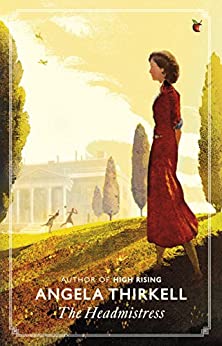
This month’s book is The Headmistress, which I will be reviewing on Thursday, June 30. I am fairly sure I have never read this one before, so I’m looking forward to it.

And here’s our badge.

Review 1864: #ThirkellBar! Growing Up

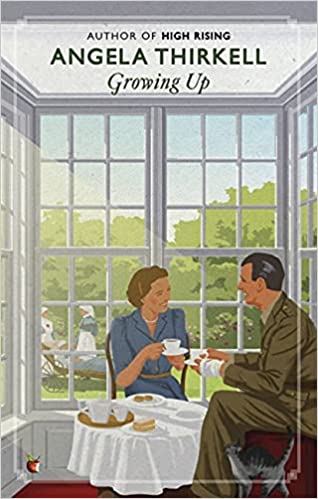
Growing Up takes us to Beliera Priory, the home of Sir Harry and Lady Waring. The Warings have moved to the servants’ quarters, because the Priory has been taken over as a convalescent hospital. Nearby is a secret base, and the Warings receive a request to house an officer who is stationed there along with his wife. Although they are expecting their niece Leslie on a convalescent leave, they agree to billet the couple in their larger extra room.

To our delight, the couple turns out to be Noel and Lydia Merton, and in their exchanges of news with the Warings, we get to hear about almost everyone from the previous books. The Warings have been busy during the war, but the Mertons bring a little extra interest to their lives.

Leslie’s arrival is marked by a stranger carrying her case from the station. In the dark, she can barely see him, but he turns out to be Philip White, now a Colonel, whose disastrous romance with Rose Birkett was a feature of Summer Half. Leslie finds herself immediately interested in Philip.

In this novel, we are treated to the courtship of Selina, the Warings’ maid, by three men (a private young enough to be her son, a sergeant with eye trouble who is a greengrocer by trade, and Jasper, the Warings’s mysterious half-gypsy gamekeeper); the return of Tommy Needham, the fiancé of Lydia’s best friend Octavia Birkett, missing an arm; the goings-on at the Winter Overcotes (which you will be delighted to know is near Summer Underclose) railway station; as well as, of course, the progress of Leslie’s romance. Tony and Mrs. Morland make a brief appearance as do other old friends. Another delightful novel by Thirkell.

Related Posts

Summer Half

Cheerfulness Breaks In

High Rising

Review 1863: Not the End of the World

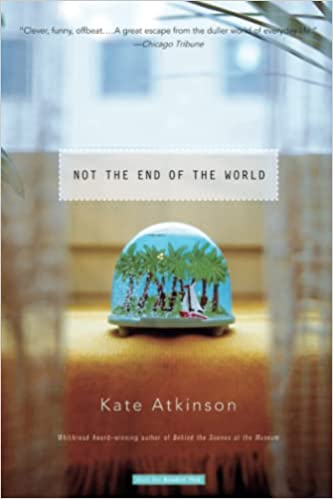
I was fairly sure I had read everything by Kate Atkinson, but I couldn’t remember Not the End of the World. So, I decided to revisit it.

This collection of stories is a relatively early book. Some of the stories are apocalyptic or macabre, some have an element of magical realism, some are whimsical, some capture a moment in ordinary life. Although the stories stand alone, some of them are linked by recurring characters or by more subtle means. I suspect, if you were very attentive, you could find many links. For example, in the first story, “Charlene and Trudi Go Shopping,” the two have a conversation about wedding favors that is repeated in “Wedding Favors” between two different characters. And is the accident driven past by a character in one story the one that kills another character in another story?

Atkinson’s prose is, as always, witty and vivid. I found a few of the characters, like the battling teenage siblings in “Dissonance,” irritating but realistic. On the other hand, a boy who looks like a fish turns out to be the son of Triton. A bold girl removes a cloak from an old lady and the old lady disintegrates. A dead woman tries to get back her life. An adopted alley cat grows bigger and bigger and bigger.

Related Posts

Life After Life

Started Early, Took My Dog

The Bloody Chamber

Review 1862: Strange Journey

Polly Wilkinson, a middle-class suburban housewife and mother, is leaning on her garden gate, tired from housework. She sees a woman in a Rolls Royce stopped in traffic and wishes she was that woman. For a moment, she is, but it doesn’t last long and she thinks the experience is a daydream.

After that, Polly is periodically removed from her life and takes the place of aristocratic Lady Elizabeth Forrester. After some initial confusion about what is happening, she believes Elizabeth is causing this exchange, and she is put in some awkward positions, such as finding herself in the middle of a fox hunt when she can’t ride. She purposefully makes Elizabeth do things she doesn’t usually do, such as play bridge brilliantly, in a sort of revenge. She also returns home to find the furniture moved and her children demanding stories she’s not familiar with. What could be causing these body exchanges?

I wasn’t sure I was going to like this novel, which reminded me of The Victorian Chaise-Longue, but it grew on me. It wasn’t as dismal as the other novel, and I liked how Polly’s more open and positive personality had an effect on Elizabeth’s life while Elizabeth’s confidence helped Polly and her husband’s career.

Of course, the novel comments on class issues, but Cairnes’s representation of Polly’s suburban life is so realistic that I was surprised to find Cairnes came from a background closer to Elizabeth’s. She doesn’t skewer or patronize the suburban characters. If anything, Polly’s frank kindness opens Elizabeth’s eyes to some truths. Sadly, (small spoiler) the class divide is still strong enough in 1930’s England that the women can’t remain friends in the future.

I received this novel from the publishers in exchange for a free and fair review.

Related Posts

The Victorian Chaise-Longue

The Squire

Mamma

Review 1861: Great Circle

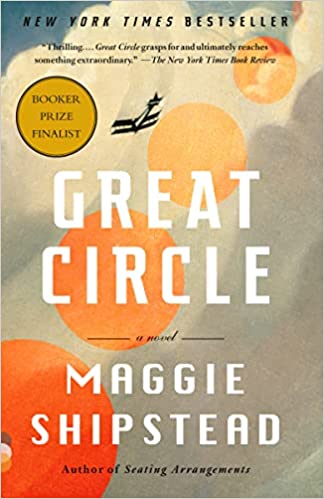
After getting fired from a hit TV series with a cult following for damaging the brand, Hadley Baxter thinks her career might be over. However, she is approached about starring in an independent film about the life of Marian Graves, an early aviator who disappeared in 1950 while attempting to circumnavigate the earth via the poles.

Although the novel sometimes follows Hadley as she tries to figure herself out, its main focus is on Marian and her twin brother, Jamie. As babies, they are on their father’s ship when it sinks, and because he chooses to save them rather than go down with his ship, he serves time in jail. They are raised in Missoula, Montana, by their alcoholic artist uncle, who lets them run wild.

When a pair of barnstormers stop over, Marian is bit by the flying bug. She is already doing men’s work, so she begins working harder to earn enough for flying lessons. But no one will teach her until she meets Barclay Macqueen, a bootlegger.

Great Circle is a broad-ranging novel that takes us from bootlegging in the West to serving mining camps in Alaska to ferrying planes in England before the flight around the world. I found Marian’s story more compelling than Hadley’s but still found the novel fascinating. Since I read it, it has been nominated for the Booker prize, so is part of my project.

Related Posts

West with the Night

Circling the Sun

Straight on Till Morning

Islands in the Stream

Every once in a while, I mention that I’m reading about islands again. For some reason, I have always drifted toward books set on islands or in other remote locations. So, I thought I’d do an extra post for fun, listing all of the books set on islands that I’ve reviewed since I started the blog. I’m not going to count New York City or the main lands of the British Isles, because there would be too many (or any Game of Thrones books, set on mythical Great Britain), or Australia, since it is a continent. I hope I don’t forget any of them.

Asia

British Isles

Caribbean and South America

Mediterranean

North America

Oceania

Scandinavia

And in the upcoming months, expect reviews of more island-set novels, such as The Moonspinners by Mary Stewart (set in Crete), Red Island House by Andrea Lee (set in Madagascar), and The Unseen by Roy Jacobsen (set in a Norwegian archipelago).

Do you like books set on islands, or am I just weird? Which of these have you read?