Review 1860: Luckenbooth

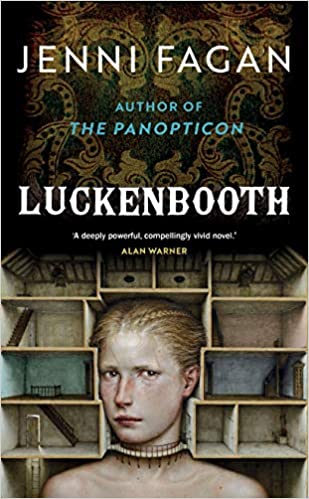
I just loved Jenni Fagan’s other books, so I was expecting a lot from Luckenbooth. Unfortunately, it didn’t quite deliver.

The devil’s daughter launches herself off the island where she was born, using her own coffin for a boat. She arrives at a tenement in Edinburgh to take on the function her father has sold her for, to be the surrogate mother for Mr. Uldam’s child with his fiancée Elise.

This is the first of nine story threads that proceed up the nine floors of 10 Luckenbooth Close, a building of secrets and horrors. The novel has a specific structure. It is split into thirds, with each third featuring the tales of residents on three floors of the building, and each thread advancing a decade in time, beginning in 1910. On the second floor, a transgender woman attends a transgressive party in 1928. On the third floor, a black Southern American works in the bone library of a veterinary school in 1939, and so on. The building hides some horrors that are finally revealed in 1999, when Dot, who is squatting in the derelict building, rips out the walls of the lower floors. But these secrets are no big surprise.

The stories are written in modern vernacular, which I suppose is a stylistic choice, but found it grating, especially for Levi’s letters to his brother. He’s the black American from Louisiana, and besides not sounding 1939ish, he doesn’t sound American, he doesn’t sound black, and he definitely doesn’t sound Southern. In fact, the more I think about it, I feel this choice to use modern vernacular indicates a general attitude of laziness. As an example, Levi chooses to explain things to his brother that his brother would know—like the building being called tenement, as if the U. S. hasn’t had tenements for hundreds of years. In fact, Levi is unbelievably naïve for a black man from the American South. The rich get everything while the poor get nothing? What a surprise!

Another example is that for a gothic novel that is supposed to convey the dark history of Edinburgh, there is an amazing lack of a sense of place (except for in the building) until 1999. Does this suggest that the author thus evaded any research into the appearance of Edinburgh in the past?

I can go on about this, but I just want to bring up a few more things. One is the polemic passages in the novel. There are long passages of ranting about such subjects as the treatment of the poor or women. I would have thought these ideas could have been worked in differently.

Next, I don’t know anything about William S. Burroughs, for example, whether he believed what Fagan has him say. All I know is, after the first few paragraphs when he started talking, I started flipping pages.

Finally, there is a gangster standoff in 1977 where what is said is so unlikely that I could barely stand it. It seems like it might have been a juvenile idea of a “cool” scene.

Related Posts

The Panopticon

The Sunlight Pilgrims

Wylding Hall

A Small Haul from Dean Street Press

Last Friday, I reviewed The Weather at Tregulla by Stella Gibbons, which had been published as part of the Furrowed Middlebrow series by Dean Street Press. So far, I have enjoyed almost every one of the novels I’ve read from that series.

Much to my surprise, I received a comment from Dean Street Press thanking me for a lovely review. I responded by saying “Send more books!” although they hadn’t actually sent the one I reviewed. Two days later, a package arrived, containing these interesting looking classic crime novels.

More fun reading to be had!

Review 1859: Music in the Hills

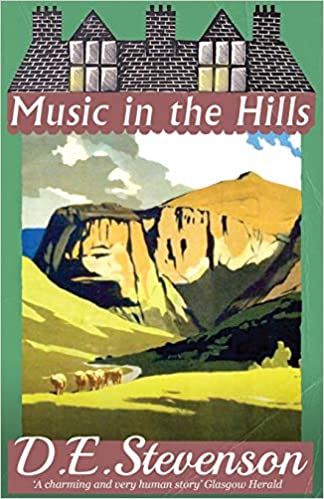
Music in the Hills is the second book in Stevenson’s Dering family series. The first book, Vittoria Cottage, is about Caroline Dering. This book has as its main characters Caroline’s sister, Mamie Johnstone, and Caroline’s son, James. The last book, which I read second, is Winter and Rough Weather.

James has returned from service in Malaysia and wants to become a farmer, so Mamie and her husband Jock have invited him to their farm in the borderlands of Scotland, Mureth, to learn farming. Although James settles in well and loves Mureth, he is unhappy, because he is in love with an art student named Rhoda. He proposed to her, but she has been clear that she’s picking her career over marriage.

This novel is mostly about the everyday events and people on the farm and in the nearby village, nearby in terms of straight distance but a bit remote along a hilly, twisty road. In the novel, as in the next, the landscape is an important character. There are two major subplots, however. One is about sheep being stolen from Mureth. The other is about Holly, the niece of Lady Shaw. She’s making a dead set at James, but there’s something about her that Mamie distrusts.

Another lovely book from Stevenson. I haven’t read Vittoria Cottage for a long time, but it makes me want to revisit it.

Related Posts

Vittoria Cottage

Winter and Rough Weather

Five Windows

Review 1858: The Night Hawks

D. I. Harry Nelson calls forensic archaeologist Ruth Galloway to a site on the coast where a body was discovered nearby by some metal detectorists. The same detectorists, a club called the Night Hawks, have also found a trove containing a skeleton.

Ruth, as the new department head, has hired her replacement, David Brown, who is already irritating her. She finds him coming along to excavate the skeleton despite herself.

Although the young man found along the coast turns out not to have drowned, and in fact, is a local ex-con, the cause of his death is not immediately apparent. Shortly thereafter, two of the Night Hawks report hearing shots at a remote farm. A young policeman is the first onto the scene, where he discovers what appears to be the murder/suicide of a scientist and his wife, Douglas and Linda Noakes. A few days later, the young policeman is dead from an apparent virus, the same as, it turns out, killed the young man found by the sea.

This novel mixes in local folklore with an intriguing mystery. Further, it seems to be moving along Ruth’s relationship with Nelson, the married father of her child, even though they don’t actually spend much time together in this one. I’m still finding this series enjoyable.

Related Posts

The Lantern Men

The Dark Angel

The Chalk Pit

Review 1857: Murder Out of Turn

Murder Out of Turn is the second of the Mr. and Mrs. North mysteries, which were extremely popular in the 40s and 50s.

Pam and Jerry North have invited their friend Lieutenant Bill Wiegand to their cabin on a lake in northeastern New York State. When he arrives, he finds quite a social group of vacationers finishing up a tennis tournament and then having a party. Wiegand walks one of the women home from the party at night and gets lost on the way back. When he is near the cabin with the partiers, he comes across the body of Helen Wilson, whose throat has been cut. Early the next morning, there is a fire in the cabin of Jean Corbin, killing her.

Having called in the state troopers and the Bureau of Criminal Identification, Wiegand finds Lieutenant Heimrich asking for his help. One of the difficulties for the police is not knowing which murder was intended. Everyone is surprised that anyone would want to murder Helen, although Jean is another story. So, did Jean witness something about Helen’s murder or did Helen about Jean’s? When he investigates further, Wiegand can only find one person who might want to hurt Helen, Dorian Hunt, whose father was tried for fraud. Helen, Hunt’s secretary, reluctantly testified against him. On the other hand, there are several people who may have wanted to kill Jean, jealous wives and coworkers and men she had dumped.

I’m not sure I enjoyed this novel as much as the first one, although it was okay. For me, there were too many details and not enough characterization. The Norths frankly don’t do much to solve the mystery, just get involved in some chases. Having Wiegand fall for a woman who hates cops was a little interesting.

Related Posts

The Norths Meet Murder

The Mystery of the Peacock’s Eye

The White Cottage Mystery

Review 1856: Zealot: The Life and Times of Jesus of Nazareth

First, let me say that I am not a religious person, furthermore, that I have a big problem with how many people practice their religion, especially if it involves war. I believe one of my brothers feels the same, so I was surprised when he recommended Zealot to me.

Reza Aslan is not so much interested in Jesus Christ as in Jesus of Nazareth, that is, not in the ministry of Jesus or the beliefs about him, but the actual man—what can be found about him from the earliest and most reliable sources. This examination involves placing utterances and events in their proper context, not as we understand them today.

The result is eye-opening, starting with the story of his birth, for example. For Aslan reveals this story as a construct by the writers of the gospels—all written well after his death—to support messianic claims. The messiah was supposed to be a descendant of David, which meant he had to be born in Bethlehem. There was indeed a tax levied, but on Judea, and it would never have required the populace to travel to pay it, as taxes were levied in the place of residence. Jesus’s parents lived in Galilee and so were not subject to that tax. Jesus was known as Jesus of Nazareth all his life, as he was born in Nazareth.

One by one Aslan knocks down the myths that have risen around the life of Jesus and explains why these myths were created. Instead of the gentle soul that emerges from the gospels, we get a fighter for the poor and a strong supporter of the laws of Moses who never intended his teachings for anyone but Jews.

One of the myths is that Jews killed Jesus, not the Romans. Aslan explains that after his death, the new religion shifted from being a sect that was always meant to be a form of Judaism to one that began to recruit gentiles. As Rome was the base of many of these activities, the writers of the gospels had to find a way to appease Rome. They couldn’t come out and say Jesus was killed by Rome. So, to quote Aslan, “Thus, a story concocted by Mark strictly for evangelistic purposes to shift the blame for Jesus’s death away from Rome is stretched with the passage of time to the point of absurdity, becoming in the process the basis for two thousand years of Christian anti-Semitism.” And wait until you read what this book says about Paul.

This book is an eye-opener, written by an acclaimed scholar of religion.

Related Posts

The Testament of Mary

Go Tell It on the Mountain

Religion and the Decline of Magic

Review 1855: The Scholar

The Scholar is the second novel in Dervla McTiernan’s Cormac Reilly series. Cormac, who left an elite Dublin squad for Galway because of his girlfriend Emma’s opportunity at a local pharmaceutical lab, is still being given cold cases, despite his success with his last case. But of the three sergeants in the squad, Carrie O’Halloran is handling many more cases, so she asks to offload some of them. Reilly gets the Henderson case. He is barely started on it when he receives an alarming call from Emma. On the way to work at the lab, she has found the body of a hit-and-run victim.

Reilly realizes that he should probably not take the case, but it is quickly established that Emma’s car could not have run over the victim. Also, he feels protective of Emma and thinks he can help her if he is in charge of the case. The victim seems to be Carline Darcy, the granddaughter of a giant in pharmaceuticals, or at least Carline’s ID for the lab is in her pocket. However, when the police go to interview her roommates, they find Carline alive, and she denies any knowledge of the girl. Reilly thinks she’s lying.

The girl turns out to be Della Lambert, a dropout of the university. Although she comes from a poor family, she seems to have lots of money. The lab denies any knowledge of her, but Emma is sure she’s seen her there with Carline.

This was another complex mystery with interesting characters, although I found Emma to be enigmatic. She had very little presence in the first novel, but there were hints of something in her past. In this novel, those events are explained.

Related Posts

The Ruin

The Searcher

The Witch Elm

My latest haul (finally) from the British Library Press

After several requests, I finally got another package of review copies from the British Library Crime Classics and Women Writers series. I’m not sure what went wrong with the first few requests, as each time they said they would send some books. Unfortunately, I got more Crime Classics than Women Writers books, when I thought it would be the other way around. However, I am looking forward to some delicious reading.

Review 1854: The Weather at Tregulla

Una Beaumont (again, the publishers got the name wrong on the cover) is 19 and very much still a sulky teenager. She finds her home in a small Cornish village to be absolutely boring. Her father, Captain Beaumont, had promised her that she could live in London and study to be an actress. However, her mother has unexpectedly died and her money was entailed, so the Captain can no longer afford to send Una. Even her distraught father notices that she is more upset by this than by her mother’s death.

The weather in Tregulla is tumultuous, at least in regard to several love affairs. Una meets Terrence Willows, an artist leasing a cottage in the neighborhood, and his sister Emmeline. Terrence is a bit of a bounder, but Una immediately falls in love with him. Emmeline has the kind of looks admired by Una’s friend Barnabas, and she has in fact moved to the area in hopes of getting him to marry her, even though she hadn’t met him before. She is tired of the chaotic existence of her brother and his friends, but when she thinks of Barnabas, she always thinks of his parents’ estate first. Barnabas, although believing he is cautious, is smitten. Finally, his brother Hugo is in love with Una.

At first, I didn’t think I was going to like this novel as well as I did others by Gibbons. I didn’t like Una, and the novel has several more unlikable characters. However, Gibbons is a great storyteller and satirist, and her characters are believably written. Further, some of them improve, particularly Una.

Related Posts

The Woods in Winter

Nightingale Wood

A Pink Front Door

Review 1853: The Broken Shore

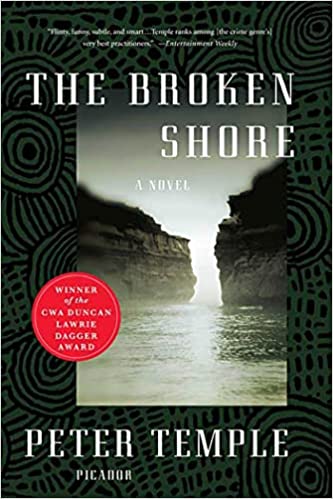
Recovering from severe injuries inflicted in an encounter with a dangerous killer, Detective Joe Cashin has left a big-city homicide squad for his home town in a small Australian port. He is living in the wreck of his grandfather’s house.

His superior officer orders him to take charge in the assault on Charles Bourgoyne. An old man but still powerful and respected, Bourgoyne was brutally attacked in his own home and is in critical condition. The initial hypothesis is that the attack was a robbery gone wrong, as his expensive wrist watch is missing.

Cashin’s role is resented by Detective Hopgood, because the crime happened in Cromarty, in Hopgood’s jurisdiction. When they get a tip that three Aboriginal teenagers from the area tried to hock a watch of the same brand as Bourgoyne’s, Hopgood manages to botch their apprehension so that two of the boys are killed. Cashin is told to take leave, but he continues to pursue the case.

This is a dark and moody mystery written in Temple’s usual fluid and witty prose. It’s quite gripping.

Related Posts

White Dog

Black Tide

Bad Debts