Review 1836: Rhododendron Pie

Ann Laventie comes from an artistic and elegant family, all of whom are witty and have excellent taste. All, that is, except for Ann, who thinks they are wonderful but likes ordinary things and people. While her family disdains their solid Sussex neighbors and stays away from them, she likes them, especially the large and noisy Gayford family. Still, she feels she must be at fault.

A young film maker, Gilbert Croy, comes to stay and pays Ann a lot of attention. After Ann’s sister Elizabeth moves to London, Ann goes to visit her, convinced that she is in love with Croy and determined to come back engaged. But once in London, she begins to notice things. Her brother Dick’s sculptures, for example, all look alike. She absolutely adores a girl that everyone in her siblings’ group of friends shuns.

Rhododendron Pie is Margery Sharp’s first novel, and it’s quite funny as it explores the bohemian world of her upbringing versus the more mundane. Ann is an appealing heroine, and frankly I liked the Gayfords a lot better than the Laventies, especially in their reaction to Ann’s engagement. Her mother, though, an invalid who is mostly just a presence in the novel, gives a wonderful speech at the end. A fun one from Margery Sharp. I’m glad to have read it for my Classics Club list.
Related Posts

Harlequin House

Cluny Brown

The Stone of Chastity

Review 1835: Kidnapped

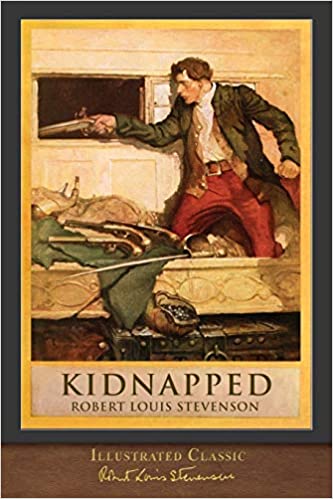
His mother long dead and his father recently having passed away, young David Balfour is ready to set out to seek his fortune. But family friend Reverend Campbell gives him a letter from his father to take to an Ebenezer Balfour of Shaws near Edinburgh. David hopes that if he has a wealthy relative, the man will help him to a career.

When David arrives at Shaws, he finds it incomplete, almost a ruin, and Ebenezer Balfour to be unwelcoming. He is David’s uncle, but right away he sends David up a ruined staircase almost to his death. Then, once his uncle has agreed to go with David to a lawyer, Mr. Rankiller, to discuss David’s inheritance, he has David kidnapped by an unscrupulous sea captain, who is supposed to take him to work as a white slave on a plantation.

North of Scotland, the ship David is on runs over a small boat in a storm, and the only survivor of the boat is Alan Breck Stewart, a Highland Jacobite who has been collecting money for his exiled chief. He has saved his belt full of gold, but David overhears the ship’s officers planning to kill the man for his money. David alerts Stewart, and the two hold off the crew in the roundhouse, ending with a much-depleted crew. Ultimately, this results in a shipwreck.

Beached in the far northwestern Highlands, David and Alan must avoid capture by the English army while they journey to Edinburgh to reclaim David’s inheritance and find Alan another ship for France.

This novel was my favorite Stevenson book as a child, so I was curious how I would view it now. I enjoyed it very much. David and Alan are interesting contrasting characters, and the novel gives a good idea of living in the Highlands in 1751. It’s full of adventure, too, a fun read.

Related Posts

Treasure Island

The Black Arrow

Travels with a Donkey in the Cévennes

Review 1834: Last Rituals

Thóra Gudmundsdóttir, a Reykyavik attorney, receives an unusual request. A German university student has been found murdered under unusual circumstances, and his family isn’t satisfied with the police investigation. Although the murderer has supposedly been arrested, the family doesn’t think he did it. They want Thóra to work with their German representative, Matthew Reich, to see what she can turn up.

Thóra soon learns that the student, Harald Gottlieb, was obsessed with Medieval witch hunts. His apartment is decorated with bizarre artifacts from his grandfather’s collection of torture instruments and folk spells. His own body is covered with piercings and markings as well as embedded objects. His thesis is supposed to be a comparison of witch burnings in Germany and Iceland, but Thóra and Matthew find his research more scattered.

Despite his appearance and apparently rowdy behavior, Harald seems to have been well-liked by his fellow students although not by all the faculty. He has founded a historical society centered around witchcraft practices, and the members of it all give each other alibis for the night of the murder—they were all out clubbing together.

Although because of its macabre subject matter and occasional creepiness, this mystery seems as if it is going to be fairly grim, I would place it closer to the cozy category. We get to know Thóra’s kids and find a source of humor in Thóra’s surly receptionist Bella (although I thought Sigurdardóttir could have skipped the fat jokes). Also interesting is Thóra’s growing relationship with Matthew.

This is a pretty good mystery, too. I enjoyed this novel and will look for the next one.

Related Posts

Jar City

The Mist

The Indian Bride

Review 1833: Unsettled Ground

Twins Jeannie and Julius Seeder live precarious but contented lives with their mother Dot in the cottage where they were born. At 51, neither has much education. Jeannie was kept out of school so frequently with rheumatic fever that she never learned to properly read and write. Julius only attended school until 15. Jeannie and her mother keep a market garden while Julius earns what he can through various odd jobs. Their mother has taught them to be independent and not borrow money.

When Dot dies unexpectedly, however, the twins are thrown by one thing after another. They had always understood that their cottage was theirs for life, rent-free, because their landlord, Mr. Rawlings, was partially at fault for their father’s horrendous death. However, almost immediately after Dot’s death, Mrs. Rawlings arrives to tell them they owe £2000 for back rent. The man they sell vegetables to informs Jeannie that Dot owed him money, and the husband of her mother’s best friend says she owed him £800. But they can find no money in the house. Then, right before the wake, a thuggish young man tells them they are being evicted in a week. They have no money for a funeral.

Although Jeannie finds a job doing a woman’s garden, she is paid by check and has no idea how to cash it. The electricity has been disconnected. But Jeannie and Julius are too proud to ask for help or let anyone know what’s going on.

This story about people living on the margins of society had me utterly rapt. I could not do anything but wonder how it would all end. Fuller has done it again with another powerful, absorbing novel.

Related Posts

Our Endless Numbered Days

Swimming Lessons

Bitter Orange

Review 1832: The Lantern Men

Anthropologist Ruth Galloway has taken a job at Cambridge, and she and her daughter Kate are living with Frank, the American historian she met several books ago. She has made this move for a promotion but also to make a break from Harry Nelson, Kate’s father and her married occasional lover.

But fate pulls her back to Norfolk and the Saltmarsh, which she dearly misses. Nelson has got a conviction against Ivor March for two murders of beautiful tall blond women, but he thinks March murdered two more women whose bodies were never found. Although the two women’s bodies were found in the backyard of March’s girlfriend, Chantal Simmonds, and his DNA found on them, he has insisted he is innocent, and he has several acolytes who believe him.

Now March has told Nelson he will divulge the burial place of the other two women on the condition that Ruth perform the forensics rather than Ruth’s ex-boss Phil. Ruth agrees, and when she disinters the bodies, she finds three, not two.

The deaths seem to center around a group of people who used to live in a commune. The men called themselves the Lantern Men and went out to rescue lost women. But the legend of the Lantern Men is more sinister.

This series continues to be excellent, both in the mysteries and in the private lives of the recurring characters. Although Griffiths pulls a little bit of a fast one in the identity of one character, I didn’t hold it against her. My only regret is that when I read this book I only had one more book to read in the series until the next one came out.

Related Posts

The Stone Circle

The Dark Angel

The Woman in Blue

Review 1831: The Tolstoy Estate

Paul Bauer, an army surgeon during the World War II German invasion of Russia, finds himself stationed at Yasnaya Polyana, the ancestral estate of Leo Tolstoy. It is set up as a field hospital.

The men are startled to find a woman on the estate—Katerina Trubetzkaya, the Head Custodian. She and the estate workers refuse to leave. Bauer, who speaks a little Russian and is an admirer of Tolstoy, finds himself almost immediately falling in love with her.

This novel details the six weeks of the German army’s occupation of Yasnaya Polyana. Toward the middle, the book jumps ahead in the form of letters to tell what happened to the characters.

I enjoyed this novel. I thought that the descriptions of the field hospital and the characters’ activities seemed convincing. Particularly convincing seemed the descriptions of the cold. Conte does a good job of humanizing the German soldiers while still including some inflexible and dogmatic soldiers and some true Fascists. For example, the commander, Julius Metz, is slowly becoming unhinged from treatments of amphetimines.

Despite the novel being described in grandiose terms on the cover, I felt there was something slight about it. The love affair it was centered on wasn’t very convincing, for one thing, and I didn’t like how the letters broke the forward action of the plot and somehow seemed to trivialize the story. They certainly destroyed any suspense about whether the main characters would survive.

Since Tolstoy seems to be important to Conte, perhaps he could have found some way to sustain this importance. He says in the acknowledgements that both the Soviet and German soldiers were “acutely conscious of the site’s cultural, ideological, and even metaphysical significance,” but in the novel, of the Germans only Bauer and Metz, in his weird way, seem to be. I read this for my Walter Scott prize project.

Related Posts

The Girl from the Channel Islands

Abigail

The Zone of Interest

Reading Thirkell’s Barsetshire Series in Order: #11 Marling Hall + #10 Northbridge Rectory Wrap-Up

Looks like hardly anyone had time to read along or comment on Northbridge Rectory last month, a bittersweet little novel, and well worth reading. I hope I’ll get some more participation this month. (I got more after posting this the first time.) My steadfast commenters were

Our book for April is Marling Hall. I hope some of you will join me in reading along. I’ll be posting my review on Friday, April 29.

And here’s our little badge.

Review 1830: Breathing Lessons

Anne Tyler is concerned with the lives of ordinary people—in this case a middle-aged couple, Maggie and Ira Moran. The novel explores a common confusion of middle age—how we got where we ended up in life.

After attending an unusual funeral, in which Maggie’s best friend Serena attempted to recreate her wedding day—Maggie talks Ira into detouring to visit their ex-daughter-in-law, Fiona, and their granddaughter, Leroy. The situation with these two is unfortunate, for the Morans have not seen their seven-year-old granddaughter since her third birthday. However, Maggie is convinced that son Jesse and Fiona still love each other, and all they need is a little nudge to get back together.

It is immediately apparent that Maggie is a somewhat scattered thinker, while Ira is more practical. It takes a while to learn, though, something that Ira understands—Maggie is so prone to look at the positives that she doesn’t see things as they are but as she wants them to be. Unfortunately, this includes getting carried away to the point of lying about things.

This wasn’t my favorite Anne Tyler book, but it depicts some characters who seem very true to life (but are also similar to the couple in The Amateur Marriage). Maggie is, I think, supposed to be lovable, but I sympathized with Ira and thought his patience was phenomenal. Jesse is a fairly typical boy-man, another one of Tyler’s types, lacking in responsibility but whose irresponsibility may have been encouraged by Ira’s lack of faith in him. Maggie fails to see that Fiona not only left Jesse, she left the whole family because of its dynamics.

Related Posts

The Amateur Marriage

Redhead by the Side of the Road

A Spool of Blue Thread

Review 1829: Insomniacs, Inc.

Full disclosure: Peggy Schimmelman is my cousin’s wife, and I received an ARC in exchange for a free and fair review.

Jack and Marilyn are a retired couple living in a Northern Californian suburb. They are political conservatives who have lived there many years and are disappointed at the direction the neighborhood is taking as more racially and politically diverse people move out from the city. Alejandra, across the street, has junk collecting on her property and is Hispanic. Jack wonders if she is “an illegal.” Michael is a musician who plays loud music and has people coming and going at all hours. They do not approve of Rachel, a gay woman whose lover recently died, and Lisa, who is closer to their age, seems unfriendly. They can never remember the name of the little old Asian woman who lives next door. Ching? Chang? Chung? (It turns out to be Zhang.)

They are soon appalled to learn that their neighbor Michael is dead. Rumors abound, and they hear that he was murdered—fed a Thai peanut dish when he is allergic to nuts.

Marilyn is not impressed when Detective Andy Thacker appears, especially as his focus seems to be more on dessert than on the crime. But he lets fall several clues about the case, asking about a strip club, an elementary school, and some porn sites. Soon, Marilyn, who begins suffering from insomnia after a prowler is spotted in the neighborhood and Alejandra receives a letter containing racial slurs, finds herself reluctantly teaming up with Alejandra and Rachel, the three meeting in the middle of the night to try to solve the crime.

Insomniacs, Inc. is a light-handed cozy mystery with an engaging heroine that explores the themes of political and racial divisiveness. The novel suffers a bit from its characters’ inability to do much detective work themselves, a problem that pops up occasionally in mystery novels that feature amateur detectives. It also has a little too long of a wrap-up at the end. Overall, however, I found it well-written and entertaining, exploring some important themes of our current times with a light hand. I’m afraid I guessed the culprit fairly early, but there were lots of complications that I didn’t figure out, including motive.

Related Posts

Scot Free

Shoot to Thrill

Death Among Friends