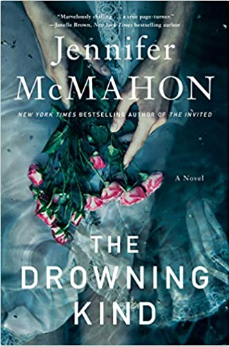
Review 1820: The Drowning Kind

Jax’s sister Lex has been calling a lot lately. Jax knows that means Lex is off her meds and in one of her manic phases. So, Jax, who has been estranged from her sister, doesn’t answer the phone. Lex’s messages are cryptic and incomprehensible, something about measurements. Later, Jax’s aunt calls to tell her that Lex is dead, drowned in the spring-fed pool behind her house. Since Lex has spent much of her life in the pool, suicide is assumed.

Back in Vermont for the funeral, Jax finds the family home a wreck, filled with notes and other documents Lex collected about the history of the house. The house had been their grandmother’s, the place where the two sisters spent every summer. One reason Jax was angry was because the house was left to Lex, whom she believes everyone liked best. Jax decides to try to find out what happened to Lex, what Lex discovered. It all seems to center around the pool, which has a local reputation of being cursed. Several people have drowned in it.

In 1929, Ethel and Will Monroe take a romantic trip to a new hotel next to a spring-fed pool. The spring has a reputation for granting wishes and healing. Ethel has been trying to conceive, so she goes to the pool and says she will give anything to have a child.

Back in 2019, Jax finds wet footprints in the house and catches glimpses of something in the pool. She also figures out that Lex has been measuring its depth, although the girls have always been told it was bottomless.

In general, this is a nice, creepy story, although I felt that maybe it signaled the truth of the pool a little too early. Of course, that adds to the suspense, as the reader knows more than Jax does. Another good one for McMahon.

The Invited

Burntown

The Winter People

Review 1819: Dirty Birds

Just before I read Dirty Birds, I attempted to read Quichotte by Salman Rushdie, and I was surprised by the parallels. Both protagonists are on a quest to make a woman love them. Although Rushdie’s protagonist is old and Murray’s is young, both are naïve and deluded. Road trips are part of each novel, and so is satire—Rushdie’s for the cult of personality and big pharma, among other things, Murray’s for the Montreal art scene and the young man as artist. I found Murray’s book more successful and a lot funnier.

Milton Ontario is a hapless young man who is not only utterly average but characterized by the extent of his naiveté and inexperience. He gets an idea in his head that he wants to be a poet, even though he writes atrocious poetry (at first dedicated to the love of his life, Ashley, and later to the love of his life, Robin), so he sets out from his small town for Montreal and a tiny room he has rented sight unseen in a dilapidated, filthy house full of students and would-be artists. There he attempts to enter the art scene and falls in love with Robin, the maker of a seven-minute documentary entitled Dirty Birds, who is almost unaware of his existence.

Milton stumbles through a series of horrendous jobs horrendously performed and meets a cast of rowdy, raucous characters. He inadvertently starts a riot and gets to meet his hero, Leonard Cohen, only to find he is a mob boss (where I think the novel starts to go a bit astray). In among all this silly action is a series of footnotes enlightening us about the history of Canadian mistreatment of indigenous peoples, Newfies, and French-Canadians, among others.

Although I think it gets a little carried away with itself (and I didn’t like the part about the late, great Cohen), for the most part, this novel is a hoot.

Quichotte

Cluny Brown

The First Bad Man

If I Gave the Award

Since I have posted my last review of the shortlisted books for the Booker Prize of 2019, it’s time for my feature where I decide whether the judges got it right. The nominees for that year include a dystopian novel, several novels that experiment in form and two that experiment in narrative style, and one fantasy/satire.

I often start this post with the books I liked least, but in this case, I have a little problem with that, and that is to decide which ones I disliked the least. In fact, on the list for this year, there are none that I thought were entirely successful and several that I actively disliked.

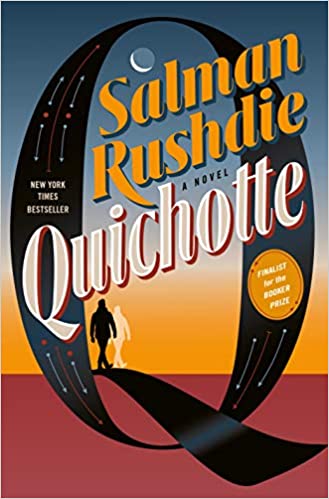
So, I’ll start with the one that is freshest in my mind, Quichotte by Salman Rushdie. This fantasy/satire about an elderly man on a road trip (that doesn’t get anywhere) with his imaginary son was a DNF for me. I felt Rushdie constantly winking at me as he proceeded with his ponderous humor that wasn’t funny at all.

The other novel I disliked intensely was An Orchestra of Minorities by Chigozie Obiama. I thought this novel, about a man who will supposedly do anything for love, was riddled with sexism and outright hatred of women. Its hints of Igbo culture are interesting, but also slowed down the forward impetus of the novel.

Now, we get to the novels that I thought were ambitious but not quite successful. Elif Shafak’s 10 Minutes 38 Seconds in This Strange World tackles violence toward women in an unusual way, but I found its change in tone to be jarring. In addition, the concept of the first part of the novel, which represents the 10 minutes and 38 seconds of brain activity in a dying person in 200 pages (short period of time, long time of reading), just didn’t work for me.

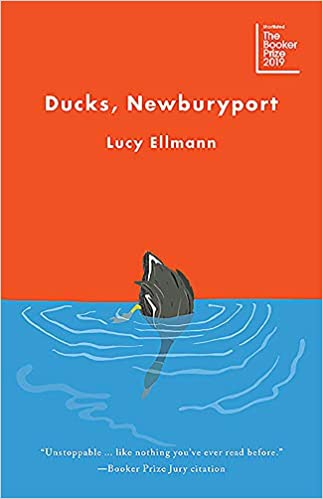
Ducks, Newburyport by Lucy Ellman was experimental by anyone’s reckoning. This novel, which is basically one 1000-page sentence (except for a few intervals that are written normally) broke every rule about writing I can think of. It was oddly compelling, enough to make me finish, but I’m not sure it provided much payoff for all the effort.

I didn’t actually say this in my review of The Testaments, but I really felt it was a bit of a sell-out by Margaret Atwood, only written to satisfy the fans of The Handmaid’s Tale television series. I felt it very conveniently wrapped things up and was far less of a landmark book than her original novel. It was also the most traditionally written book of the shortlisted novels for 2019. However, it was Atwood, so it was compelling reading.

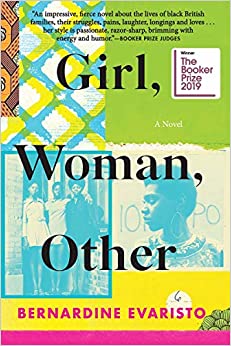
That brings us to Girl, Woman, Other by Bernardine Evaristo, a cowinner of the award with The Testaments. This novel of linked short stories about women is also experimental in form, having hardly any periods. I called it a semi-successful experiment in form and writing style, but it did include some powerful stories. In a year that was hard to pick favorites, I guess this would be my pick. Since this novel was a cowinner of the award, I guess that makes the judges half right.

Review 1818: Quichotte

I was fairly sure I was going to hate Quichotte. I did not much like Midnight’s Children or Don Quixote for that matter, which Quichotte retells. However, this novel is part of my Booker project, so I opened it with hope.

Quichotte is Ismail Smile, an elderly consumer of all things TV who becomes infatuated with Salma R, a young TV star. He decides to go on a quest to earn the love of his beloved. This is a road trip, and for a partner he takes Sancho, his imaginary son. To add another layer, Quichotte is himself an imaginary character, created by Brother, a writer of spy novels who has decided to change his genre.

This novel is one full of circumlocution. As we meet each character—and we meet a lot of them—we go off on the tangent of that person’s life story. Further, there are lots of subplots, for example, the one about Smile’s cousin and employer, whose pharmaceutical company has developed a drug even more dangerous than OxyContin and who has himself developed a similar model to that of the makers of Oxy, delivering it in huge quantities to small rural communities.

The genre for this novel is fantasy and of course satire. Fantasy is not my genre, and although I wouldn’t have thought the same was true about satire, I have not enjoyed the satirical entries on the various shortlists. They all feel the same to me: ponderous, overblown, and written by old men. Definitely lacking subtlety. Even the reviewer from The Guardian remarked that the book was funny but not as funny as Rushdie thought it was. That is exactly how I feel about it, except I didn’t think it was very funny. I sensed Rushdie winking all the time.

Still, I was enjoying parts of the novel, although it didn’t seem to be getting anywhere. Then Sancho decided he wanted to be a real boy, and guess who popped up? Jiminy Cricket. At that point I had to restrain myself from throwing the book across the room (only because it was a library book), and I stopped reading.

The Finkler Question

You & Me

The Broom of the System

Review 1817: The Ruin

Twenty years ago, Cormac Reilly drove out to an isolated cottage on his first call as a policeman. He thought he was doing a welfare check, but because of some muddle, he arrived to find two terrified children, Maude Blake, 15, and her brother Jack, 5, and their mother, dead of an apparent overdose. With no phone service available, Reilly broke protocol and took Maude and her badly injured brother to the hospital. Then Maude disappeared. Reilly has always felt he didn’t do enough for them.

Now Reilly has taken a job in Galway to be with his partner, Emma, who was offered a prestigious position in a lab. This move is a demotion for him, because he had been part of an elite squad in Dublin. There is something not right in the Galway office, though. Instead of taking advantage of his experience, his chief is assigning him cold cases and the officers are treating him oddly with the exception of Danny McIntyre, an old classmate. Soon he hears that someone is spreading false rumors about him.

Then the old case raises its head again with the death of Jack Blake, who apparently drowned himself in the river Corrib. Cormac is not assigned this case, though. After Maude reappears and insists that her brother’s death was not a suicide, he is told to pursue her for her mother’s murder.

McTiernan’s first novel, The Ruin is engaging and atmospheric. I liked it a lot.

The Searcher

The Witch Elm

The Trespasser

Review 1816: Sight

Hmmm. I find it hard to evaluate Sight because even though it explores very personal thoughts and feelings, it appealed mostly to my intellectual side not my emotion. And I have the greatest response to the latter. Some readers on Goodreads compared Greengrass to Rachel Cusk, and I can understand the comparison.

Sight is concerned with seeing below the surface, both in the obsessions of the main character and in the stories she tells about Roentgen, Freud, and John Hunter, an early anatomist. The unnamed character is at first painfully and neurotically conflicted about having a child, feeling the desire for the child while at the same time fearing the responsibilities of parenthood, but even more so fearing that she will not connect with her child. All the while, she lets us know that in another time she has already had this child and is expecting another one.

We learn that the narrator’s mother, the daughter of a psychiatrist who is an unrelenting self-analyst, had her dreams interrogated so thoroughly as a child that she stopped having them. Thus, her mother attempts to live only on the surface. Greengrass explores how we can know another person, or even ourselves, through the focus of motherhood, daughterhood, and through ruminations about scientific discoveries.

She writes in a lovely, meticulous prose, although she often prefers long, complicated sentences. Like her microscopic observations, though, her style seems distanced from the reader. I read this novel for my James Tait Black prize project.

Outline

4321

Umbrella

Review 1815: The Black Arrow

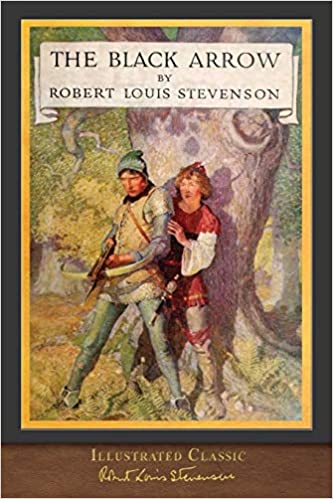
I occasionally collect children’s books, mostly those with good illustrations, and a few months ago I started thinking about the books that used to be readily available, all adventure stories by various authors but illustrated by N. C. Wyeth. I decided to look for some of those, and the ones I bought were both by Robert Louis Stevenson, Kidnapped (my personal favorite) and one I’d never read, The Black Arrow.

Young Dick Shelton has lived under the wardship of Sir Daniel Brackley for most of his life and is loyal to him even though he seems to switch sides in the Wars of the Roses rather frequently. But mysterious attacks against his men by a group calling themselves the Black Arrow begin to awaken Dick to feelings of just resentment against Sir Daniel. For he has used the war and his position to cheat people out of their property.

Dick is on his way from Sir Daniel’s encampment when he encounters a boy named Jack Matcham whom he met in the camp. The boy (who everyone but Dick can see is really a girl) asks Dick for his help to get to Holywood. Dick helps Jack, but they fall back into Sir Daniel’s hands. Once there, Dick begins asking about the death of his father, for he has heard rumors that Sir Daniel was responsible.

This is an entertaining adventure story, and I’m not sure why it isn’t as highly regarded as Treasure Island (which has never been one of my favorites). The only thing I can think of to make it not as popular is the archaic speech Stevenson uses, which, while probably not that authentic, did not strike me as inauthentic, if that makes any sense. The novel features plenty of action, some appealing characters and some villains, and Richard of Gloucester (eventually to become Richard III) even makes an appearance as a young man.

Treasure Island

Witch of the Glens

Richard III, England’s Black Legend

Review 1814: Temptation

From before his birth in a Hungarian village in 1912, Béla is unwanted. His mother, away working in Budapest, pays Rozi to care for him. But when his mother can’t pay, Rozi doesn’t feed him. So, at age seven, he begins stealing to feed himself.

Rozi also makes him work instead of going to school, that is until he, thirsting for knowledge, goes to the schoolteacher. At school, he begins finding success, until an incident results in him being shipped off to Budapest to live with his mother.

Béla must forget about schooling in Budapest, because his mother has found him a job in a fancy hotel. Unfortunately, as an apprentice he is not paid, and he and his mother are barely scraping by, scrambling to pay rent and eating seldom.

At work, Béla meets Elamér, who begins instructing him in Socialism. Although the Democratic Socialist party is legal, the right-wing government behaves as if it is not. Then Béla is distracted by his infatuation with Her Excellency, a beautiful member of the nobility who uses the boys in the hotel for sex.

Within a background of a country sliding toward chaos and Fascism, we follow Béla in his enthralling journey toward political self-awareness. This picaresque novel is vital and exciting. What a great story!

Jamrach’s Menagerie

American War

The Spoilt City

Review 1813: Literary Wives! I’m Fine and Neither Are You

Today is another review for the Literary Wives blogging club, in which we discuss the depiction of wives in fiction. If you have read the book, please participate by leaving comments on any of our blogs.

Be sure to read the reviews and comments of the other wives!

Literary Wives Needs Your Help!

Recently, we’ve had some members resign, and we will miss them. Now we feel we are getting a little small for a club unless we can recruit a few new members. If you are interested in becoming one, please let one of us know.

What Does Membership Involve?

Although we started out as all wives, that’s not a requirement. Now we would just like people who are interested in reading and discussing how literature depicts wives and marriage. You will need to have your own blog on which to post your reviews so that we can link to it. We read four books a year and try to post our reviews on the same day. These days are the first Monday in March, June, September, and December.

When Would I Begin Working with the Club?

Our next book review isn’t until June, so it’s up to you to decide how much time you need to finish the book. However, right now, we are just beginning to select books for the next couple of years. Members are more engaged at this time in looking at lists of books, reading about them, and voting for their choices. We only do this every other year, but we will begin this process as soon as we get new members.

My Review

What seems at first to be a funny chick lit novel becomes a little more serious with a plot twist. Lately Penelope Ruiz-Kar feels like she’s barely keeping her head above water. She’s the main supporter of her family while her husband Sanjay sells an occasional article. But her job as a fundraiser for a university is stressful and requires a lot of overtime. (Although, just a little comment. The character mentions 50 hours a week, which for people in high tech is not a lot of overtime. Things are changing, though, which is good.) Sanjay doesn’t pick up much of the slack at home, and her youngest child, Miles, wakes her up every night, having wet his bed. She just feels exhausted.

She envies her best friend Jenny Sweet, who seems to lead a perfect life. Although Jenny’s husband Matt travels a lot for work, he seems to adore her, and they are financially better off than the Kars. But Penelope’s illusions are shattered when Jenny dies of an accidental overdose of opiates. Penelope wonders how she could not have noticed that Jenny was in trouble.

When Matt tells Penny that his marriage was in terrible shape despite appearances, she begins to think she needs to work on hers. After a discussion with Sanjay, they decide to give each other a list of things they would like the other to change. I wonder how they thought that would turn out?

This novel is entertaining and well written, but despite a few glitches at first, it went for too easy resolutions. Everyone should have such a near-perfect husband. The end result felt like chick lit after all.

What does this book say about wives or the experience of being a wife?

Literary Wives logo

Pagán picks a common problem—the difficulties of a working mother. And these difficulties seem realistically portrayed, especially for a woman whose husband’s role as a house husband has largely lapsed without his taking on other duties. This is a fairly good marriage despite the couple’s difficulties, because Sanjay reacts reasonably to Penny’s suggestions (there are many husbands who wouldn’t), and even though they’re in a slump, he’s affectionate to her. It is actually Penny’s personal problem that interferes most with her job and at home, and that’s her pretending everything is okay and not asking for what she needs.

The miracle, and the thing that seems a little unrealistic to me, is that when she begins asking, she begins getting what she needs.

Related Posts

Wife 22

Dept. of Speculation

On Beauty

Review 1812: The Sunlight Pilgrims

Dylan MacRae has had a tough few months. Both his mother and grandmother have died, and he has been unable to save the family business, a small art cinema in London. That’s not all, because the melting of the polar icecaps is causing a new Ice Age, and the upcoming winter is forecast to be brutal.

Dylan has discovered that his mother purchased a small caravan in Scotland off the books before she died, so that he would have a place to live. On the eve before the cinema and his flat above it are repossessed, Dylan packs a suitcase containing a few things as well as the ashes of his mother and grandmother and takes a bus to the Clachen Fells in the Highlands of Scotland.

Upon his arrival, Dylan falls in love at first sight with Constance, another resident of the caravan park. She is an independent survivalist with a teenage trans daughter named Stella and two lovers. Temperatures continue to fall.

Dystopian novels aren’t usually my thing, but I became so involved in the lives of Dylan, Constance, and Stella that I enjoyed this novel of life doing its best to prevail in brutal conditions. Fagan has a talent for creating appealing characters. This is another winner from the author of The Panopticon.

The Panopticon

Greenwood

The Year of the Flood