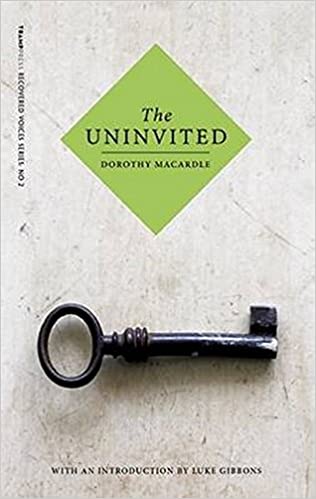
Review 1796: The Uninvited

The movie The Uninvited has long been the Halloween movie of choice for me and my husband. It is vintage 1930’s with Ray Milland and a great ghost story. However, I had not read the book until now.

Roderick Fitzgerald and his sister Pamela have been fruitlessly looking for a house in the west country that they can afford when they come across Cliff End. Although it needs work, it is so beautiful that they are sure they can’t afford it. However, it has not been occupied for 15 years, and Commander Brook reluctantly agrees to their price. He does say, though, that there have been “occurrences.”

All is well at first, and the Fitzgeralds are happy fixing up their house, but eventually the occurrences begin—a light in a room that had been the nursery, a sighing sound, the scent of mimosa, and more terrifying, an enervating cold in the studio and the attempt of an apparition to form. The Fitzgeralds begin to learn the story behind the home—that it belonged to the Commander’s daughter, Mary Meredith, and her artist husband, that an artists model died there after attempting to kill Mary, whom most people treat like a saint, and that Mary died soon afterwards.

The Fitzgeralds soon meet Stella Meredith, the Commander’s granddaughter, and befriend her. She has yearned to visit the house, but after she does, the manifestations grow stronger. Soon, the Fitzgeralds believe they have a choice between making the manifestations disappear by understanding what they want or giving up the house.

Although this novel didn’t really make my hair stand on end, it is a good ghost story. The characters are interesting, and the descriptions of the Devon coast are striking. I enjoyed the book very much.

Dark Enchantment

The Unforeseen

The Uninhabited House

Review 1795: American War

In 2074, Sarat Chestnut is only six when her father is killed by a terrorist bomb while trying to get a permit for his family to move into the north and safety. The Chestnuts live in a United States divided by civil war with its coastlines eroded far back from global warming. As residents of Louisiana, they reside in a purple state, a state that while it belongs to the North (blue states) has many Southern sympathizers (reds).

After Benjamin Chestnut’s death, Martina, Sarat’s mother, is told that the fighting in East Texas is coming nearer and she should retreat to the refugee camp at Camp Patience in Mississippi. As a resident of Camp Patience, Sarat grows up witnessing terrible events and is slowly groomed by Mr. Gaines to be a terrorist.

In between the chapters about Sarat, El Akkad includes documents about the war leading readers to realize that even more horrific events are ahead and, to me at least, telegraphing Sarat’s fate.

Like most good dystopian novels, this one puts our world troubles into perspective and holds a warning for us. Although dystopia is not really my genre, I found this novel riveting. I read it for my James Tait Black project.

The Parable of the Sower

The Year of the Flood

The Testaments

Review 1794: Fell Murder

The Garths have been at Garthmere, a farm on the fells of the Lake District, from before Flodden Field. The patriarch, Robert Garth, is a hard man of 83, stubborn and hot-tempered, who will not agree to the modernizations proposed by his daughter, Marion. He has long been estranged from his heir, oldest son Richard, who moved away to Canada. His middle son, Charles, lost every penny out in Asia to the Japanese invasion and loafs around unless put to work. His youngest son, Malcolm, is frail and spends his time keeping bees and writing poetry.

It is 1944, and Richard returns to the area, on leave from the Navy. He meets his father’s bailiff, John Staple, on the fell. He doesn’t want to see his family—he just wanted to look at the land—so he asks Staple not to tell them he is there. But he is overheard by Malcolm. A few days later, Robert is found dead, shot and left inside an old outbuilding.

Chief Inspector Macdonald is called on the scene after initial interviews by Superintendent Layng, who is not good at handling the reticent farmers. Although Macdonald gets along better, he finds himself with either too many or too few suspects and no proof against anyone.

If Fell Murder has a fault, it is that the murderer is too easy to guess, being the only unlikable main character. This was often a fault of Georgette Heyer’s mysteries, too, but I still enjoyed reading them. Oh, there’s one other problem, the handling of a boy of limited intellect, but that’s due to the change in times. Just a warning.

Of these British Library Crime Classic reprints, I’ve discovered E. C. R. Lorac to be one of my favorites, because of her attention to setting and character. This is a good one.

Two-Way Murder

Murder in the Mill Race

The Chianti Flask

Reading Thirkell’s Barsetshire Series in Order: #9 Cheerfulness Breaks In + #8 Before Lunch Wrap-Up

Reading Before Lunch last month was lots of fun. Here are the people who participated or made comments:

  • Liz Dexter
  • Penelope Gough
  • Historical Fiction Is Fiction

This month’s book will be Cheerfulness Breaks In, which I remember as a favorite book, although I have not read it in a long time. I’m looking forward to it, and I hope I’ll get some company reading it. I’ll be posting my review on Monday, February 28, and look forward to your comments.

And here’s our little badge, if you want to post it on your review.

Review 1793: Dare Not Tell

Full disclosure: Elaine Schroller is a friend of mine, and I received a copy of her novel in exchange for a free and fair review.

In 1939, Sophie and Joe Parker are about to make a sort of pilgrimage to Villers-Bretonneaux, France, the site of the most vicious battle Joe fought in during World War I, the one that gives him nightmares.

In 1916, Sophie Holt is a young American nurse volunteering in a hospital in Paris when she meets Second Lieutenant Joe Parker on leave from the Australian army. Joe is married, but they begin a friendship through letters that lasts the duration of the war. Joe’s wife Annie dies in the flu epidemic, but when Joe goes to look for Sophie at the end of the war, he finds that she’s married a British surgeon and moved to England.

The first third of the novel covers this relationship and follows the two until they get together after Sophie is widowed. Then it shifts in tone and purpose as Joe’s PTSD comes to the surface with the trip to France and the couple notice odd things going on in the valley around Chamonix.

It may be that this strong focus on their relationship creates some issues for me—in particular, that of characterization. Although both Sophie and Joe are likable characters, there is no sense of the personality of any of the other characters. For example, Sophie’s best friend only appears in one scene and later is reported killed. Sophie adopts her son, who is only mentioned in the novel and maybe speaks once, and Joe’s son hardly appears. And so on until it gets to Chamonix, so that I missed from this novel a real sense of what its other characters are like.

Until the trip to France in 1939, there is also little sense of the characters’ surroundings. That changes with descriptions of the landscape, and the novel, which seems to lag a little in the transition, picks up quite a bit.

Schroller has done a lot of research about the role of Australian soldiers in World War I France, that is clear. In her next book, I hope she works more at filling out the secondary characters and the sense of the world around them, both in setting and in the life of others.

The World My Wilderness

No More Parades

Goodbye To All That

Review 1792: #ThirkellBar! Before Lunch

Before Lunch is one of Thirkell’s Barsetshire Series that I have not read before. It possesses both the charm and slightly acid humor of the previous novels and a new sense of sadness.

In this novel we meet the Middletons. Jack is a trying man who often has to be soothed by his wife, Catherine. Jack’s sister Lilian Stoner, a young widow, is coming to stay in an adjacent house with her stepchildren, Denis and Daphne, who are almost as old as she is. The three have a loving relationship, all understanding that Lilian’s marriage was a difficult one.

The major focus of the plot in this novel is who will Daphne marry, for she meets two men she likes very much. Mr. Cameron is the partner of Lord Bond in their architectural firm. Although he is in his forties, Daphne thinks he’s the nicest man she knows. Cedric Bond, Lord Bond’s son and heir, also gets along with Daphne very well, but Daphne keeps hearing about another young lady named Betty in connection with him. Both men are smitten by Daphne.

Along with this plot, a lot is going on. The overbearing Lady Bond is leading a protest against the unwitting purchaser of a parcel of land called Pooker’s Piece (I love the place names in this series, particularly the oft-mentioned “Winter Overcotes”), where he plans to erect a tea shop and a garage (which rumor eventually converts to a road house). The countryside is outraged, as it is a favorite place for rambling.

The entire county is also preparing for the Agricultural Show, and Daphne talks cows with the best of them. She also takes a secretarial job with Lady Bond.

Denis takes a liking to Lord Bond, who is as kind as he is long-winded. Denis has been an invalid, but in the summer country air he begins to improve, and he is looking for backing for a ballet for which he is composing the music. He treats Lord Bond to Gilbert and Sullivan evenings when Lady Bond is away. He also has a secret of the heart.

Catherine and Lilian begin a friendship that is comforting for them both. We also briefly meet some of the characters from previous books, including Lord Pomfret, now a grieving widower, the Leslies, and Roddy Wicklow. And Thirkell does not fail to provide another irritating character (besides Lady Bond), Miss Starter, an ex-royal attendant who fusses constantly about her diet.

I think I liked this novel best so far, but I know one of my favorites, Cheerfulness Breaks In, is coming up.

The Brandons

Pomfret Towers

Summer Half

If I Gave the Award

Cover for Bring Up the Bodies

Now that I have reviewed the last shortlisted book for the 2012 Booker Prize, it’s time for my feature where I decide whether the judges got it right. This shortlist is another mixed bag of genres, two historical, two set in the 1970’s, and two contemporary. One is experimental enough to render it almost incomprehensible while another sometimes reads as if pages were taken from a textbook.

As I often do, I’ll start with the books I liked least. My least favorite of the nominees was Umbrella by Will Self. With an idea that should have been interesting, based as it is on Oliver Sacks’s Awakenings, this novel is so concerned with its devices that it is very difficult to read. It shifts point of view in mid-sentence, sometimes in mid-word, and uses stream-of-consciousness confusingly.

Narcopolis by Jeet Thayil is set in late 1970’s or early 80’s Bombay, about a young man exploring the city’s opium dens and brothels. Although I found some of the characters interesting, I was not interested in the overall subject matter, and when the novel became philosophical, it read as if it came out of a textbook.

My main objection to Swimming Home by Deborah Levy is that I found the situation unbelievable. When vacationers find a disturbed girl occupying their vacation house, they invite her to stay even though she is clearly a fangirl of the poet husband. The entire atmosphere of the novel is foreboding, and the placement in time of an initial scene is confusing.

Cover for The Garden of Evening Mists

The Lighthouse by Alison Moore is another menacing novel, about a sad, gray man who goes on a hiking trip out of nostalgia for happy times with his father. He unwittingly gets into a situation between a woman and her jealous husband. Although I didn’t like any of the characters, I found this novel oddly compelling.

I enjoyed The Garden of Evening Mists by Tan Twan Eng about post-World War II Malaya. It immersed me in the story of a Malayan judge suffering from aphasia who is revisiting her memories.

That leaves the winner of that year’s prize, Bring Up the Bodies by Hilary Mantell. This novel was the second installment of Mantell’s trilogy about Thomas Cromwell, dealing with Anne Boleyn’s frantic attempts to hold onto her throne and her life. It is an absolutely enthralling story of Tudor politics and intrigue. So, this time, yes, the judges got it right.

Review 1791: The Lighthouse

Hapless Futh is recently separated from his wife and is taking a vacation that he is ill prepared for—a walking trip in Germany when he hasn’t been hiking in decades. This holiday, like many things in his life, he has chosen because it reminds him of one of the few happy times with his father. Personally, he seldom picks up on nuances and misses many things.

After a series of odd encounters on the North Sea ferry and in the Netherlands, Futh arrives at the starting point of his walking tour—Hellhaus. There, a misunderstanding at his hotel results in his being ejected before breakfast. He has arranged his tour in a circle with his luggage being transported day by day to the next hotel, so he must return to Hellhaus.

As he proceeds on his tour, contemplating his mother, who left him and his father when Futh was a young boy, and the history of his marriage, we check in periodically with Ester, the landlady of the hotel in Hellhaus. Even though her husband is jealous, she occasionally sleeps with the guests. Years ago, she left her fiancé for his brother Bernard, but now she feels unappreciated.

These are sad, gray lives. Even so, this novel is oddly compelling, and my feeling of dread built with every step back toward Hellhaus. It is also elegantly spare in style.

I read this novel for my Booker project.

Swimming Home

Hot Milk

Umbrella

10th Anniversary Post! Top Ten Books of the Year!

Whoo hoo! It’s my 10th blogging anniversary! As is my habit, I am posting my Top Ten of the Year for this post. I make these selections from the Best of Ten lists throughout the year, and this year, some things stand out about those selections. For one thing, I had several repeat authors this year, Jess Kidd, Rumer Godden, Claire Fuller, and Maggie O’Farrell. Since I limit my Top Ten of the Year list to only one book by an author, that makes for some more difficult picking.

This year’s list is another mixed bag. Three of them are classic novels, written in the first half of the 20th century. Two are set at least partially in the future, and both of them strongly feature trees. One is a reworking of the Oedipus myth. One has a touch of the fantastic. Two are historical novels, and two are partly historical. One is a Pulitzer Prize winner. One is set in Kashmir, one partially in the Orient, one in Washington state, and one in Malaya and Australia. It was a great reading year.

Anyway, here they are, in order of when I reviewed them: