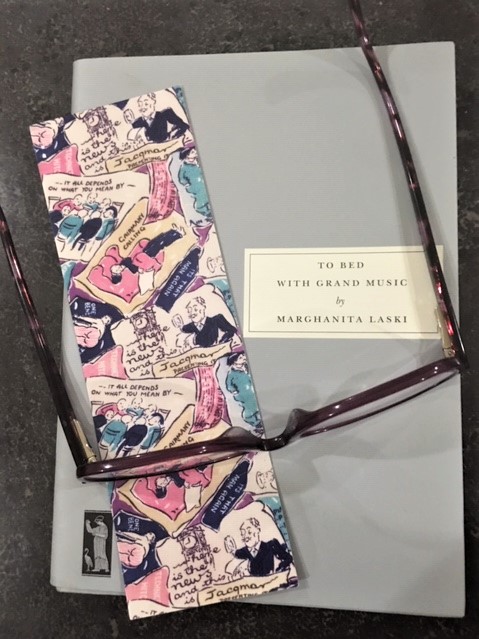
Review 1757: To Bed with Grand Music

To Bed with Grand Music opens with Deborah Robertson in bed with her husband Graham swearing perfect fidelity before his deployment to Cairo during World War II. Graham more honestly doesn’t promise that but says he won’t sleep with anyone that matters. At first, Deborah contents herself at home, but when, in her boredom, she begins snapping at her little son, Timmy, her mother suggests she get a job.

Her mother is thinking about a job nearby in Winchester, but Deborah makes arrangements to visit a friend in London, Madeleine, and see about a job there. Intending to go home on the evening train, she ends up getting drunk and spending the night with a man.

Shocked at herself, Deborah is determined to stay home, but she has a talent for convincing herself that what she wants to do is right, so it’s not too long before she turns down a job in Winchester only to take a lower-paying one in London. From there, she begins a career of connecting with men of increasingly higher rank.

Deborah is definitely an antihero. She starts out selfish and nervous and becomes deceitful, amoral, and avaricious as she goes on. Her faint motherly instincts become almost nonexistent. This is an insightful, sardonic character study of a particular type of woman.

The Victorian Chaise-Longue

A Fugue in Time

Vanity Fair

Review 1756: The Cold Millions

Best of Ten!

Sixteen-year-old Rye Dolan and his older brother Gig are wanderers through the Northwest, among thousands of other men looking for work when they can get it, in 1909. Indeed, the town of Spokane is teeming with them. It is a thriving town that has grown rapidly, and at first glance it seems to consist only of fabulously wealthy mine owners and the destitute.

The mine owners only accept workers through corrupt employment agents. Men pay a dollar, a day’s pay, for a referral for a job they may not get, and most of the money gets kicked back up the chain to the employer. Gig is a member of the IWW, or Wobblies, who are trying to recruit members to their union during a Free Speech Day that protests against the employment agents, the poor pay and working conditions, and the corrupt Spokane police department.

Rye isn’t so sure he believes in the union, but on Free Speech Day when the police begin beating and arresting the protesters, he is inspired to jump on a soapbox next to Gig and sing the union songs. So, he and Gig are arrested and thrown into jail along with 500 other men, into packed cells and brutal conditions.

Rye, because of his age, gets out of jail early with the help of a lawyer and Elizabeth Gurley Flynn, a crusading 19-year-old union firebrand (an actual historical figure). However, Rye sort of unwittingly makes a deal with Lem Brand, a mine owner, to give him information in exchange for getting Gig out of jail.

This novel vividly depicts the kinds of conditions that made unions evolve in the first place and the fight the unions had to stay in existence. Does that sound unexciting? Well, this novel has an appealing center around the two brothers, features a historical figure we should know more about, and is full of intrigue, action, and skullduggery. It is harrowing at times, alternating narrators among several characters who don’t always end up alive at the end of their narratives. I was enraptured.

Beautiful Ruins

The Paragon Hotel

The Long Take

Review 1755: The Snow-Woman

For nearly half a century, Maude Barrington has been grieving for her three brothers who died in World War I. To the rest of the world she has been cold, letting friendships fall away, living with just her maid Millie, and having just a few neighbor acquaintances.

Then one day, an old frenemy, Lionel Crozier, invites himself to tea. Thinking of him as malicious, Maude doesn’t know what to expect but is not surprised when he arrives with a hugely pregnant young woman from a lower class named Teddie Parker. Soon, the girl begins to give birth on Maude’s couch.

Once Teddie has been dispatched to the hospital, Lionel tells Maude he wants her to come to France, where an old friend, Charles, a famous expert on modern art, is dying. Although Maude has done nothing for years, she agrees to go, and thus begins a kind of opening up, where she reconciles with old friends.

This experience continues when she arrives home and gets more involved, through Millie, with Teddie and her family. The result is the revelation of long-held secrets and a new life for Maude.

Although I wondered why Maude wasn’t curious about how Lionel knew Teddie or why he would have brought her to Maude’s house, and although I also wondered at some point where the novel was going, it turned out to be thoroughly satisfying and heart-warming. Another win for Gibbons.

The Woods in Winter

A Pink Front Door

Nightingale Wood

Review 1754: Narcopolis

The narrator of Narcopolis arrives in Bombay in the 1970’s or early 80’s after he’s been thrown out of the United States. He finds Rashid’s opium den, where he meets such characters as Dimple, a hijra, or transsexual woman, who prepares the opium and works in a nearby brothel; Rashid, who has the best opium in Bombay; and Rumi, a low-level criminal. The novel is made up of linked short stories that follow the various characters until returning to the narrator many years later.

Pimps, pushers, and junkies are not my favorite subject matter, and I would not normally choose this book to read, but it is part of my Booker prize project. By around page 50, when the narrator attends a ridiculous lecture by a poet/artist named Xavier, I realized I had no idea what was going on and almost quit reading. However, soon I was taken up by the much more interesting stories of Dimple and Mr. Lee.

I was jarred to find one Goodreads reviewer referring to this gritty book as nostalgia, considering it mostly deals with drug addiction and sexual exploitation. Still, by the end of the novel, which takes place closer to the present, things are so much worse that I got his point.

I felt that the characters’ speech, when philosophical, sounds like it comes out of a textbook, and in other moods is unrealistic in other ways. I also thought that there was no reason to subject readers to such things as Xavier’s speech, the entire plot of the book written by Mr. Lee’s father, most of the characters’ dreams (I hate reading about dreams in fiction), the long description of a new form of poetry, and so on.

Did I like this novel? Not very much.

The Ministry of Utmost Happiness

Sea of Poppies

Arctic Summer

Review 1753: Faro’s Daughter

Max Ravenscar is exasperated when his aunt, Lady Mablethorpe, comes to consult him about Adrian, his young cousin for whom he is a trustee. She reports that Adrian has fallen in love with a girl from a gambling den and means to marry her. Ravenscar assumes the girl will have to be bought off.

When he meets her in her aunt’s home, which has indeed been converted into a gambling den, he is surprised at her well-bred appearance and demeanor. However, when he makes his offer, he finds she has turned into a termagant.

Deb Grantham, for her part, has no interest in entrapping naïve young men into marriage. Nor is she interested in Lord Ormskirk, who unfortunately holds some of her aunt’s debts and the mortgage to her aunt’s house. However, she is so angered by Ravenscar’s proposals that she decides to pretend she wants to marry Adrian and to behave as vulgarly as possible.

Even though this is not one of my very favorite Heyer novels, it is still great fun. It has some potentially melodramatic twists to it that are saved from seriousness by a feisty heroine who is not to be defeated.

Frederica

Sylvester, Or the Wicked Uncle

The Talisman Ring

Review 1752: 10 Minutes 38 Seconds in This Strange World

Elif Shafak is one of the most widely read Turkish women writers. I have only read one of her books so far, so when I saw 10 Minutes 38 Seconds in This Strange World on my Booker prize list, I was interested to revisit her. However, I’m not entirely sure what I think of this unusual novel.

The convention of the first part of the novel is that Leila, a sex worker in Istanbul, has been murdered. Her brain is active for 10 minutes and 38 seconds while she revisits scenes from her life, each chapter representing a minute of brain activity. These chapters are separated by short sections about the lives of her five friends, who all in some way live on the fringes of society.

My first reaction was an impatience with this idea, that 10 minutes was to be represented by nearly 200 pages of text. I have a real problem with attempts like this in fiction to represent a short amount of time with several hours worth of reading. In this case, though, I got used to the idea but felt that the sections introducing the friends are an inelegant solution to our barely seeing them in the first part of the novel while the second part deals with how they handle the aftermath of Leila’s death.

And the change of tone in the second part is what bothered me most. For, we go abruptly from an elegiac tone in the first part while we learn about Leila’s difficult life to one of almost madcap comedy as a bunch of lovable misfits try to give Leila an ending she deserves. To me, this felt like a grinding change of gears.

It is brave of Shafak in her country to write about violence against women, especially since I understand she is being investigated by the Turkish authorities for it (or was when I read this months ago), but her supporting characters seem almost like caricatures to me, possibly because we don’t see that much of them in the first part. I felt like the second part of the novel almost undercuts the first part.

The Bastard of Istanbul

The Towers of Trebizond

Dance with Death

Review 1751: Last Friends

This final novel in the Old Filth trilogy gives us the last pieces in the puzzle of the complex relationships described in the first two books. It tells of the origins of Terry Veneering, the lifelong rival of Edward Feathers (known as Old Filth) who finally became a friend.

Last Friends begins in the same place as Old Filth, with the memorial service for Edward Feathers. Much of this novel is presented through the eyes of two minor characters in the trilogy, Dulcie and Fiscal-Smith. Veneering is a mysterious figure in the other two books of the trilogy, his origins unknown but subject to many rumors. It turns out that Fiscal-Smith has known him from boyhood in a northern manufacturing town, the son of a schoolgirl and a Russian dancer rumored to be a gentleman, who was badly injured as a young man and had to be supported by his wife.

This final tale is enthralling and brings a fitting ending to this great trilogy.

Old Filth

The Man in the Wooden Hat

The Singapore Grip

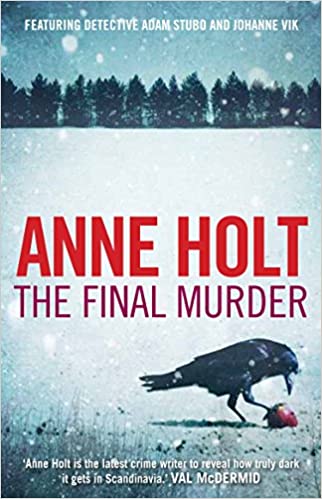
Review 1750: The Final Murder

Anne Holt’s Stubo and Vik series books are so far suspenseful, and her characters are convincing. I enjoyed The Final Murder but found it a bit far-fetched.

Johanne Vik and Adam Stubo are a couple five years after the events of the last book, and Johanne has just given birth to their daughter. She hasn’t been sleeping, and she is worried that the new baby may exhibit symptoms of the undiagnosed condition of Kristiane, her first child.

A TV personality is found dead in a bizarre murder with her tongue cut out, split, and placed in an elaborate origami bowl. Despite the efforts of Adam’s team, they cannot find anyone who bore her a grudge. Then a rising young politician is found crucified. The team begins to be afraid they have a serial murderer of celebrities.

Something about the murders seems familiar to Johanne. After the third one, she realizes that it is not just about celebrities—someone is re-creating five unrelated murders that Johanne’s FBI mentor regularly talks about in his lectures. We readers periodically check in on the murderer and know that she is a woman.

To explain my problems with this mystery, I have to reveal a spoiler, so stop reading now if you don’t want to know more. The murderer is actually targeting Johanne with these murders, trying to see if she can catch her. I found the re-creation idea a little iffy, but this plot point seems more like the old-fashioned diabolical mastermind challenging the detective—sort of Holmes/Moriarty—the kind of thing that has always seemed ridiculous and unlikely to me. I also felt frustrated by the ending, which I will not reveal.

Don’t misunderstand me, though. I still enjoyed reading the book and look forward to the next one, although I find Johanne a bit neurotic.

Punishment

The Mist

The Water’s Edge

Review 1749: The Life of Sir Walter Scott

I happened to read a comment that Sir Walter Scott had led a sad life, which made me realize that I knew nothing about him. So, I looked for a biography, but I might have done better to look for a used book. I was concentrating on not getting a print on demand book but ended up with one anyway. Boy, I hate those things.

I wouldn’t necessarily call Scott’s life sad. He overcame childhood disease that sounds like polio and resulted in a withered, weakened leg. However, because of strenuous exercise, he became remarkably fit until the strains of later life.

He was also crossed in love but overcame that as well, and two years later formed a lifelong attachment to his wife, Charlotte. He remained warm friends with the man who married his first love, Wilhelmina Stuart.

In actuality, Scott was successful at everything he did until the stresses of later years resulted in several strokes. Even then, he was amazingly productive. However, a collapse of a series of businesses, for which he was in no way responsible but took responsibility for, resulted in the ruination of him and his partner in a printing company, and he was doggedly repaying his debts the last few years of his life.

The book is interesting enough for about half the time, but the problem with it is that the author is obsessed with the biography written by Scott’s son-in-law, Lockhart. Although Wright frequently criticizes Lockhart’s wordy, “journalistic” writing style, this book would have been half as long if Wright wasn’t concerned to refute practically everything Lockhart said about Scott, even to the point of repeatedly calling Lockhart a liar. The problem with this for readers who have not read the Lockhart book is that they therefore don’t care.

As for my edition by Borgo Press, it was full of typographical errors and oddities, probably as a result of an old text being machine-read with no subsequent human editing.

Charles Dickens: A Life

Jane Austen: A Life

Thomas Hardy