I understand Peter Temple’s Jack Irish series is classified as hard-boiled crime, which is usually too much for me, but Temple’s writing is so effortless and funny and his characters so interesting that reading these books is a pleasure.
In this second book of the series, Jack is trying to help Des Connors, an old friend of his father. Des’s son Gary has borrowed all of Des’s savings and disappeared. Further, he has mortgaged Des’s house and not paid the bills. If Jack can’t find Gary, Des will be homeless and penniless.
Jack is also involved with his friends Harry and Cam in finding and betting on unlikely racehorses. While involved in this pursuit, they uncover serious cheating at the track.
One of the pleasures of this series besides its carefully constructed plots and punchy dialogue is the full life Temple has constructed for Jack. There is his bunch of elderly pals at the bar, who are obsessed with his dad’s old footie team, his woodworking apprenticeship under his severe teacher, Charlie, his disreputable clients, and his love life. This isn’t going so well as Linda Hillier has taken a job in Sydney.
As Jack looks for Gary, the plot becomes more and more tangled, and he keeps encountering dead bodies. These are really fun, exciting thrillers.
I hope everyone who participated this month had a fun time reading Summer Half. It is one of the less well-known of the series, so I was hoping we would get more first-time participation. The people who commented or participated are as follows:
The next book, Pomfret Towers, is another reread for me, and in fact I’ve reviewed it before, but I am still looking forward to it. If nothing else, this project has allowed me to place people better as I go through the series and remember if I’ve met them before. I will be posting my review of this book on Tuesday, November 30, and I hope some of you will join me in reading it.
Happy reading, and here again is our little badge.
In its Afterword, Rumer Godden calls Cromartie vs. the God Shiva a twin to Coromandel Sea Change. It is partially set in the same location, the Patna Hotel on the Coromandel Sea, and has some of the same characters. When I realized this, I was excited, because I loved that book.
Michael Dean is chosen by his law firm to represent the government of India against Mr. Cromartie, a Canadian art dealer who is alleged to have purchased a stolen statue of the God Shiva worth a quarter of a million dollars. The statue was purchased from him, but now he is suing for money, so the government has to prove it was stolen.
Michael travels to the hotel. The statue was originally found when the hotel was built, so the owner made a shrine for it in the hotel ballroom. A noted archaeologist, Dr. Ellen Webster, had examined it several years before and told Auntie Sanni, the hotel manager, that it was valuable. A few years later, she realized it had been substituted for a good fake. When Michael questions the employees about it, they are all oddly evasive, and Auntie Sanni advises him to leave it alone. Dr. Webster arrives with her yearly tour group, and Michael falls in love at first sight with her assistant, Artemis.
This novel is a peculiar mixture. It evokes the flavors and smells of the village as do most of Godden’s India-set novels, but it turns into more of a mystery story. I don’t think it is quite as successful as some of her others, although it was nice to return to the Coromandel Sea. I believe this is my last book in my project to read Rumer Godden’s India novels.
It’s the mid-1950’s, and Lexie Sinclair has already made arrangements to leave her family home in Devon when she meets Innes Kent. He is a stylish magazine editor whose car has broken down on their road. When she tells him she is coming to London, he asks her to look him up. Instead, he looks her up.
Lexie takes up an exciting life as part of the Soho art scene. She and Innes are the loves of each other’s lives even though he is married. His wife has, however, taught her daughter Margo to hate Lexie even though she and Innes have been split up for years.
In present-day London, Elina and Ted have just had a baby. The birth was difficult, and Elina is having a hard time coping with the pressures of motherhood. At the same time, Ted, whose memory is notoriously poor, has begun having flashes of memory that do not correspond to what he understands of his life. Slowly, these two stories connect.
Maggie O’Farrell is always wonderful, I find, but this novel had me sobbing. It is beautiful and tragic as it explores the themes of motherhood and family secrets.
It’s time for Summer Half, the fifth book in Angela Thirkell’s Barsetshire series. Readers may or may not be excited to learn that this is another book with Tony Morland, now about 14 years old, as a character.
Colin Keith’s father wants him to read law, and Colin likes it, but he feels guilty not earning his own keep at the ripe age of 22. So, he meets with Mr. Birkett, the headmaster of Southbridge school, and arranges to take a job with him. Then he learns that his father has arranged a place for him in the chambers of Noel Merton. The timing is fine, though, for Colin to work the summer half at Southbridge and start in chambers in the fall.
(As a side note, I saw that Colin’s older brother is a young lawyer named Robert who makes a few brief appearances. Is he going to turn into the mysterious figure Sir Robert who is mentioned but does not appear in several novels later on and finally turns up in Enter Sir Robert? I guess only time will tell. My curiosity is piqued.)
Colin’s immediate coworkers are Everard Carter, the master of his house, and Philip Winter, who unfortunately is engaged to Rose Birkett, a beautiful but selfish nitwit. At the last minute, Colin is given a class that Philip wanted to teach, so Philip isn’t disposed to welcome him. Also, he is jealous, and Rose flirts with any man who comes near her.
It is the volatile relationship between Philip and Rose that occupies much of this novel, as well as the hijinks of the boys. However, Carter is also smitten, by Colin’s sister Kate, but he thinks she prefers Noel Merton. Making an appearance for the first time is Colin’s other sister, Lydia, a loud, bouncing 16-year-old, who I believe is a major character in Cheerfulness Breaks In, one of my favorites in this series.
Although some of the school talk went over my head, this is another delightful entrant in the series. It gives us in Rose someone we can heartily dislike only to feel a little more nuanced toward her at the end. Meanwhile, all the other characters are eminently likable.
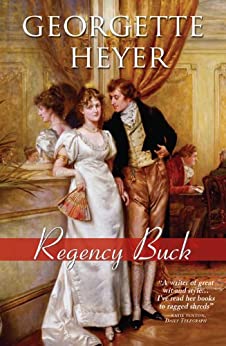
On her way to London with her brother Peregrine, Judith Taverner mistakenly stops in a town hosting a prize fight and has an unfortunate encounter with a man in a curricle. When the siblings reach town and call on their guardian, Lord Worth, they find that he is the man in the curricle. Their father mistakenly designated their guardian as the fifth Earl instead of his friend, the fourth, who has died.
Judith is headstrong and determined to make a splash in London society. Although Lord Worth gives them assistance with suggestions and introductions, he and Judith continue to clash. Judith’s cousin Bernard Taverner warns her that Lord Worth may have designs on her fortune, which is large enough in itself but even larger if something happens to her brother Perry. Then Perry is first challenged to a duel and later his carriage is attacked. Judith and Worth are getting along better, but does someone have designs against Perry?
Most of Heyer’s Regency romances tend to either be funny or have an element of mystery (although they all have amusing dialogue). RegencyBuck is one of the latter, with an engaging heroine, a mysterious plot, and as usual, perfect period detail.
Libby Jones knows that she is adopted and that on her 25th birthday she’ll receive some sort of inheritance. However, she is floored to find she has inherited a house in Chelsea that is worth millions.
The house has a dark history, though. Twenty-four years ago, Libby was found in a cradle in the house with four dead people, an apparent cult suicide. Her teenage brother and sister were missing.
Alternating with Libby’s discoveries is the narrative of Henry Lamb, her brother, who was 10 years old when first Justin and Birdie and more fatefully, David Thomsen and his family moved into the Lambs’ house. Slowly, David begins bringing Henry’s infatuated mother and weak father under his thumb.
We also hear from Lucy, another former inhabitant of the house, who is barely surviving, homeless on Italian streets with her two children and her dog. She needs to get to England and to do so, must beg for help from her abusive ex-husband.
This novel feels like it is building to a suspenseful ending, but its ending is surprising and ambiguous. I wouldn’t exactly class it as a thriller, but it is dark and interesting.
The Man in the Wooden Hat is the second novel in the Old Filth trilogy. Old Filth examines the entirety of the life of its main character, Edward Feathers, while this novel takes a closer look at his marriage with Betty. As with Old Filth, The Man in the Wooden Hat appears to be straightforward, but there is a kick at the end.
At the beginning of the novel, Eddie has sent a letter containing a marriage proposal to Betty, who is vacationing in Hong Kong while Eddie has been working in London. Betty accepts his proposal when he arrives in Hong Kong, where he makes only one condition, that Betty never leave him.
Only hours later, Betty meets Eddie’s rival, Terry Veneering, and falls immediately in love with him, although he is married with a son, Harry. She also falls in love with nine-year-old Harry. She is determined to marry Eddie; however, she spends a night with Terry before the wedding. Unfortunately, he leases a house for their rendezvous from Albert Ross, Eddie’s best friend, a Eurasian dwarf. Ross finds her purse there. He does not tell Eddie but returns the purse to Betty and tells him she must never leave Eddie. He knows of all the loss in Eddie’s life.
So begins their marriage. I did not dislike Betty despite her infidelity; in fact, I liked her, although it’s hard to decide what to think about Veneering. The novel follows the entirety of their marriage, which is reticent and notable for Eddie’s absences for work. Betty, who was born in China and subject as a child to detention by the Japanese, finds she cannot have children.
It’s hard to explain how this sort of everyday novel can be so absorbing. We think we know everything about the Featherses. But Gardam tilts everything slightly in the final chapter.
If you’re not familiar with the plot of The Bride of Lammermoor, you might be wondering why I picked it for the Classics Club Dare 2.0, Time to Get Your Goth On. It’s not a gothic horror story common for the time but one of Sir Walter Scott’s historical novels about a doomed love. However, the ending, which I’m not revealing, puts it in a more appropriate category as do the dark local legends and prophesies of withered old dames (perhaps witches), not to mention the ruined tower.
Edgar, Master of Ravenwood, is from a proud Scottish family of distinguished lineage. His profligate father, however, did his best to waste the family estate and finished things off by fighting on the wrong side of the revolution. With other parties in power, lawsuits filed against the estate by William Ashton, Keeper of the Great Seal of Scotland, have resulted in almost all of the Ravenwood property being turned over to Ashton and in an early grave for Ravenwood’s father. The impoverished Master has sworn vengeance against Ashton.
Ashton, however, is a politician, and he hears that the political situation is changing. Things may be looking up for the Marquis of A___ and thus for his relative, the Master. After the Master saves Ashton and his beautiful daughter Lucy from a wild bull, Ashton tries to befriend him, even encouraging him to spend time with Lucy and Ashton himself considering the benefits of a marriage between the two. Against the Master’s better judgment (and supernatural warnings), he begins to fall in love with Lucy. They become betrothed, but Lucy wants it kept secret from her family.
Some meddling from a neighbor who is not a friend of the Master’s leads Lady Ashton, staying with friends away from home, to hear the rumors that her daughter is engaged to him. She is his implacable enemy, so she swoops home to Ravenwood Castle just as the Marquis of A___ comes for a visit. The Master has been residing there at Ashton’s invitation, but Lady Ashton unceremoniously throws him out. He has already agreed with Lucy, however, that he will consider himself betrothed until she herself releases him. Then he goes off to make his fortune.
This novel was quite hard going for me at times, particularly in the sections and whole chapters that are in Scottish vernacular. These are the parts concerning the common people, and some of them are supposed to be funny, especially the ones about the machinations of Caleb Balderstone, the Master’s only servant, as he tries to hide what everyone already knows—that his master is destitute. I just felt they slowed down the action as well as being hard to understand and not that funny.
The action, however, eventually gets going and really picks up toward the end of the novel. I read the second half twice as quickly as the first.









 What? Me Read?