Reading Thirkell’s Barsetshire Series in Order: #4 August Folly + #3 The Demon in the House Wrap-up

Thanks so much to those people who participated in reading or commenting on the third book in the series, The Demon in the House. I am so sorry that some of the would-be participants in the U. K. were unable to find a reasonably priced copy. I didn’t anticipate that as a problem, although I have had to pay a bit more for some of the books farther on in the series. Here are this month’s participants:

Liz Dexter of Adventures in Reading

Penelope Gough

Yvonne of A Darn Good Read

Our next book is August Folly. I will be posting my review for that on Thursday, September 30 (too bad, because of the name, that it wasn’t scheduled for last month!). I hope that you will be able to participate. At least this book shouldn’t be as hard to find.

And here again is our little badge if you would like to post it on your review.

Review 1715: #ThirkellBar! The Demon in the House

This third book of Thirkell’s Barsetshire series returns to the village of High Rising and Laura Morland and her young son Tony. Tony is now thirteen, and he is of course the demon in the house.

The novel is set during four holiday seasons that make up most of the year, during which Tony creates as much havoc as is humanly possible. During the Easter holidays in the first section, Tony talks his mother into getting him a new bike. He has grown out of his old one but is not yet tall enough for an adult bike, so she compromises by renting one from Mr. Brown. Then, knowing his talent for falling into trouble, she waits, agonized, to hear about his lifeless body being picked up from the road.

During the course of the novel, several of the old friends from High Rising are on the scene. We also meet new ones, though, in particular Master Wesendonck, Tony’s friend from school, who manages to be silent throughout the novel while proving himself to be loyal and sweet.

Lest we be afraid that there will be no romance in this novel, there is one, but it is very understated. The novel is mostly about Tony’s hijinks. Tony is the same ebulliant, know-it-all motormouth, but some of his adventures seem a little young for thirteen. Still, times have changed, and children now are probably a lot more sophisticated. In any case, this is another charming and funny entry in the series. I hope that the readers who are not on Team Tony will still want to continue with the series.

Related Posts

High Rising

Wild Strawberries

Diary of a Provincial Lady

Review 1714: Girl

Best of Ten!

Maryam is a young girl attending a girl’s school in Nigeria when Boko Haram attacks the school and drags off the girls. At the Jihadist camp, the girls are gang-raped and otherwise brutalized while they are forced to work as slaves. Eventually, Maryam is forcibly married to a young jihadist.

But that’s only the beginning of this deeply involving novel, for after a harrowing escape and a restoration to her family, Maryam finds herself treated almost as badly at home.

This novel is a break away from O’Brien’s usual Irish novels although not from her fluid prose. It is short—I read it in a few hours—and riveting. I read it for my James Tait Black project.

Little Bee

An Orchestra of Minorities

And the Mountains Echoed

Review 1713: The Narrow Land

As a young child, Michael Novak was rescued during World War II and sent to the States as part of a program for orphaned children. There, he was adopted by the Novaks. At 10, he is still extremely fearful and full of routines he follows to calm himself. So, he is resistant when Mrs. Novak tries to put him on a train, the first step in a journey to spend the summer on Cape Cod with the Kaplans. Finally, he decides to go.

On the island in 1950 live the artist Edward Hopper and his wife Jo. Although they tend to be standoffish with the vacationers, Michael forms a friendship of sorts with Jo. And it’s really the relationship between Edward and Jo that this book is about.

Edward has been having a dry spell, and he seems preoccupied with trying to find a woman he painted a few years before. She is right under his nose in the person of Katherine Kaplan, Mrs. Kaplan’s daughter, who is dying of cancer. He has seen her and noted the resemblance, but she is no longer dyeing her hair blond. He is an introvert who spends most of his time in his own head.

Jo is extremely jealous of him and thinks he pays too much attention to Olivia, Mrs. Kaplan’s daughter-in-law, when it is really Olivia paying attention to him. Jo is in fact irrationally and violently angry at times, particularly when she feels she had to abandon her career when she became his wife. Although Jo has some moments of self-awareness, I really think Hickey treats her harshly as a character. Granted, I know nothing about the couple’s life, but Hickey shows her making a fool of herself at a party with her airs and graces and spiteful remarks about other people.

Hopper is not very nice to Jo and belittles her art, although I read about that and found she had some standing as an artist.

This novel, which I read for my Walter Scott project, was slow moving, and for a long time I couldn’t tell whether it was going anywhere. Sometimes that doesn’t bother me, but in this case I had a hard time staying interested. The novel does have a payoff in the end, but it is more character study than plot-based.

Related Posts

That Old Cape Magic

The Blazing World

Suzanne

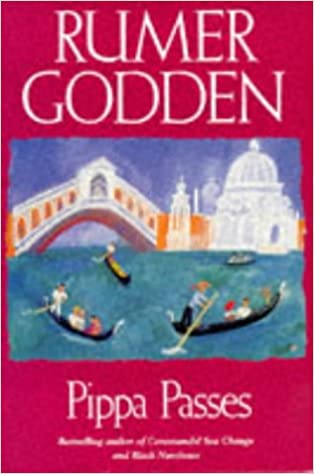
Review 1712: Pippa Passes

I have been reading the Indian novels of Rumer Godden, so I’m not quite sure how Pippa Passes got in there. It was published in the 1990’s and is set mostly in Venice. It doesn’t seem to have much to do with the Browning poem except by its being about a young, innocent girl. It does relate, however, to many of Godden’s novels that have a theme of the loss of innocence.

Pippa Fane is a 17-year-old ballet dancer who is new to the corps de ballet of an up-and-coming company from the English Midlands. The company is getting ready to tour Italy, and Pippa, as the newest member, doesn’t expect to be invited to come, but she is, at the insistence of Angharad Fullerton, the ballet mistress. Pippa’s friend, Juliette, warns her to beware of Angharad, but since the mistress has only been kind to Pippa, she pays no attention.

Pippa is enchanted at first sight of Venice and disappointed that Angharad expects the girls in the corps to do nothing but work and rest. When the other girls try to get her to go out the first night, she argues that Angharad told them to stay in and is left behind and taunted as Angharad’s pet. But instead, Angharad and the other company leaders take her out when they find she’s been abandoned.

Pippa’s star is beginning to rise with the company, but she has also met a gondolier named Niccolo who fascinates her. The company gives her a solo part after another dancer is injured, and at the same time Niccolo wants her to sing with his band.

I wasn’t as interested in this novel as I have been in the others by Godden that I have been reading. For one thing, it seems absurdly outdated for the 90’s, as Niccolo and his band make a splash dressed like gondoliers and singing such songs as “Santa Lucia” and “I Feel Pretty” from West Side Story. Yet, there’s no indication that the novel is set earlier. Also, although the information about the workings of the ballet company is interesting, I don’t think it was necessary to include pages describing the action of The Tales of Hoffman. And for the 1990’s, Pippa seems far too naïve about the intentions of both Angharad and Niccolo, and some readers may understand the novel as slightly homophobic. It’s possible that the novel was written many years earlier, but then there should have been some indication that it was set, say, in the 1950’s, if it was.

Related Posts

The Peacock Spring

The River

Death in Venice

Review 1711: The Women of Troy

I enjoyed very much the novel by Pat Barker that precedes this one, The Silence of the Girls. It was the story of Achilles at Troy told by Briseis, one of the women captured in the siege of Troy and the surrounding countryside. Later, though, when I read a criticism that a novel supposedly about the Trojan women was mostly about Achilles and Patroclus, I had to agree.

At first, The Women of Troy didn’t seem to have much to add. It takes up the story with the Trojan horse and the fall of Troy. Achilles’ son Pyrrhus is the focus of this novel, a young man trying to live up to his father who is very unstable. However, we do see more of the women, and besides the characters Barker has invented, we find out about Hecuba, Andromache, and Cassandra, the royal women.

link to Netgalley

Still, although I found The Women of Troy mildly interesting, I don’t think it added very much to the original story. It covers a period when the Greeks are stranded by a fierce wind on the shores of Troy so cannot go home until they bury Priam’s body and the wind breaks.

Related Posts

The Silence of the Girls

The Song of Achilles

House of Names

Review 1710: Classics Club Spin Result! The Woods in Winter

I might have saved The Woods in Winter for a chillier time of year, but its number was chosen for me for the latest Classics Club spin. It’s a lovely tale.

Ivy Gover (not Gower, as it says on the back cover of my Furrowed Middlebrow edition), three times a widow and a charwoman, is living in a tidy but small North London flat when she receives a letter. Not being able to read well, she takes it to her employer, Miss Helen Green, who tells her she has inherited her great-uncle’s cottage out in Buckinghamshire for her lifetime.

Ivy abruptly moves to the country but not before stealing a neighbor’s dog that she has heard barking for months and finds living in its own dirt. Although the cottage is primitive and has a hole in its thatch, she moves right in and begins befriending the local animals. For she has a touch with wild things and for healing, as Lord Gowerville finds out when she magically cures his dying dog. The next day, he sends someone over to fix the thatch in her roof.

As Ivy befriends the birds, a fox, and eventually a boy, her neighbors also have their adventures. The vicar is suddenly taken with Pearl Cartaret, one of two sisters who open a tea shop. Helen is sometimes nearby pursuing an affair with an elusive young man. Angela Mordaunt, a “spinster” brought up by her mother more as a well-bred boy than a girl, catches the eye of Sam Lambert, a kind farm laborer.

This novel was the last one published (in 1970) during Stella Gibbons’ lifetime and displays a longing for the England of 40 years before, when most of it is set. I just loved it. It is funny yet astringent, has some engaging and other very lifelike characters, and contains lyrical descriptions of the countryside around Ivy’s cottage as well as a conservationist conclusion. Ivy herself is a spunky individualist. I liked her a lot.

Nightingale Wood

A Pink Front Door

Bramton Wick

Review 1709: The Redeemed

The third book of Pears’ West Country Trilogy and the book I read for my Walter Scott Prize project, The Redeemed begins in 1916. Leo Sercombe, now about 16, joined the Royal Navy at the beginning of the war as a boy seaman. In a battle, his ship, the Queen Mary, is sunk, and he is one of only 20 crew members rescued.

His father’s former employer’s daughter Lottie begins training as a veterinarian with Mr. Jago. He believes that soon the veterinarian college will be opened to women and she will be the first graduate.

The novel works slowly toward the reunion of its two main characters. There is one incident where this reunion is delayed because of a misunderstanding. It’s the type of plot device used frequently in movies, where the problem could be solved in a few words, and I think using it was a bit lazy.

Although Pears continues with his spare, understated writing style that is so eloquent, I found after a while that his minute descriptions of work, whether it be birthing a foal or floating a sunken ship, were losing my attention. Finally, the long-awaited reunion seemed somewhat anticlimactic. Pears’ style is very detached, maybe too much so. Although I was always interested in what happened to the characters, I probably could have been more so. Of the trilogy, I think the first book was the strongest.

Related Posts

The Horseman

The Wanderers

All the Birds, Singing

Review 1708: Leaving the Atocha Station

Adam Gordon is an American pursuing a project in Madrid in 2004. He only hints at the project’s purpose, but he spends most of his time taking drugs, visiting museums, and doing what he calls “translating,” in which he takes lines from other people’s works, substitutes words, and moves things around. He is supposed to be a poet on a grant to write a long poem about how the Spanish Civil War has affected poetry, but he is not doing any research and knows very little about Spanish poetry.

In fact, Adam lies almost all the time. He doesn’t consider himself a poet but a fraud. He is self-loathing and is constantly manipulating his face or thinking up things to say to seem deep. He talks about not feeling anything or experiencing the experience of the event rather than the event itself.

This novel, which seems more like a disguised memoir, is funny at times. It asks a lot of its audience intellectually, and at times I got lost in its logical circumlocutions. The narrator is not very likable, but he grows on you, and he undergoes a sudden transformation at the end.

Would I recommend this book? Only to certain people. I would like to say, though, that its cover design, which starts with snippets from The Garden of Earthly Delights on the right and then smears the colors of each snippet into a shape of a train, is fabulous.

This is a book I read for my James Tait Black Prize project.

Related Posts

The Lesser Bohemians

The New Sweet Style

All That Man Is