Reading Thirkell’s Barsetshire Series in Order: #2 Wild Strawberries + #1 High Risings Wrap-up

Cover for Wild Strawberries

Thanks to all who participated in yesterday’s round-up of book one in the series:

Please let me know if I missed anyone else and I will add them. I hope we will pick up more participants as we go.

Having chosen Wednesdays to announce each book in my project, I would normally have posted this on the first Wednesday in July, but that day is the 7th, which is quite a way into the month. So, I thought I’d give everyone a head start by announcing it today. The book for July is Wild Strawberries, and I will be posted my remarks on Friday, July 30. I hope a few of you will join me by reading along.

And here’s our little badge.

Review 1684: #ThirkellBar! High Rising

I have long been saying I will read Angela Thirkell’s Barsetshire novels in order, but I just keep potting way at them as I encounter them. So finally, I decided to go back and read them all, in order, and I hope some others of you will join me at least part of the way. High Rising is the first one.

Mrs. Morland is a widow who has supported her three sons by writing what she calls “good bad books,” featuring skullduggery in the fashion industry. Her old friend, George Knox, is a widower and also an author, of serious historical works.

It is Laura Morland’s habit to work in London while her young son Tony is in school and come to High Rising when he is on holiday. When she and Tony arrive for the Christmas holidays, she learns there is a disturbing new resident at Low Rising. It is George’s new secretary, Una Grey, who is efficient and sweet to George but behaves officiously as if she were the mistress of the house even to George’s quiet adult daughter, Sybil. It is clear that Miss Grey is aiming at marriage with George, and she immediately treats Mrs. Morland as an enemy and rival.

The plot of High Rising is mostly concerned with this situation, but it also introduces more sympathetic characters. There is Miss Todd, who has been doing all the caretaking of her dying mother and works half-time as a secretary for Mrs. Morland. Dr. Ford is in love with her but thinks the difference in their ages makes him ineligible. Miss Todd herself believes she is the type of woman that men don’t marry.

Adrian Coates is Mrs. Morland’s editor. Although he is a good deal younger than she is, early in the novel he proposes. But Laura has no interest in marrying again and thinks he will make a much better match for Sybil Knox.

There are lots of characters, but one of the funniest is Tony, Laura’s single-minded young son. He is absolutely besotted with railways, and Thirkell does a great job of making him a believable motormouth of a boy.

Most of Thirkell’s books are notable for a subtle wit, but this one is a lot funnier than I remembered. I also felt really invested in the problems of these characters. This novel makes a nice start to the series.

So, who read High Rising along with me, and what did you think?

Related Posts

A Winter Away

Bramton Wick

The Native Heath

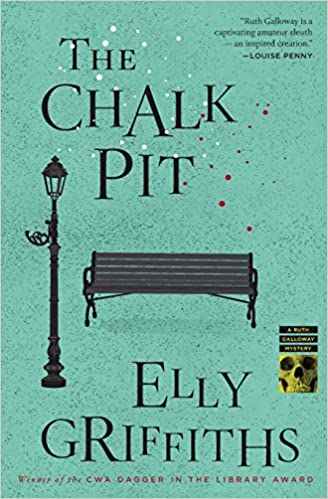
Review 1683: The Chalk Pit

Forensic anthropologist Ruth Galloway is asked to look at some human bones that were discovered in old chalk mining tunnels below Norwich. Although at first glance she believes they may be medieval, they also show signs of having been boiled. Tests show them to be more modern, perhaps 10 years old or less.

Around the same time, a homeless man named Eddie visits DCI Harry Nelson because he is worried about his friend Babs, who has not been around for two weeks. As the team asks around for Babs, Judy talks to another homeless man named Bilbo, who says Babs may have gone underground. Within a day Eddie is found stabbed to death in front of the police station and Bilbo has disappeared.

The team’s attention is taken away from these events by the disappearance of Sam Foster-Jones, a suburban housewife who vanished from her home after someone came to the door, leaving her four small children alone. Nelson has a feeling that this disappearance is related to that of Babs and the deaths of Eddie and Bilbo.

This series, always entertaining, has improved steadily, especially in regard to the difficulty of guessing the solution. Ruth remains a likable character, and I still enjoy all the secondary characters in the series.

Related Posts

A Dying Fall

The Outcast Dead

The Woman in Blue

Review 1682: Titus Andronicus

I knew nothing about Titus Andronicus except that it is a blood bath. And it is, too, with rape, murder, dismemberment, and a woman being served her sons’ corpses in a pie.

The introduction to the play in my Riverside edition points out that the play was long poorly regarded and even by some thought not to be the work of Shakespeare. But more lately its reputation has been rehabilitated.

Titus Andronicus is a Roman general who has been fighting the Goths for years—having lost 20 sons in battle—when he returns to Rome. The emperor has recently died, and the citizens of Rome want to elect Titus, but he gives his support to the emperor’s brother Saturninus, who is duly elected but resents Titus for this.

In rapid succession and a confusing first scene, Saturninus says he will marry Titus’s daughter Lavinia while openly ogling Tamora, the captured queen of the Goths that Titus has brought back with him. Titus has just sacrificed her son to thank the gods for his triumph. Then Bassianus, the brother of Saturninus, comes in and claims Lavinia as his own, supported by some of Titus’s sons. Titus kills his own son Mutius for acting against the emperor. Although Saturninus rebukes Titus for slaughtering his own son, he still banishes Titus’s other sons for supporting Bassianus’s claim to Lavinia.

Saturninus marries Tamora, and she begins to plot her revenge against Titus for killing her son, aided by her lover, the villainous Moor Aaron. Aaron convinces Tamora’s sons Demetrius and Chiron to murder Bassianus and rape Lavinia during a hunt. They improve upon this plan by cutting off her tongue and hands, and then they frame Titus’s sons for Bassianus’s murder. More villainy follows, but once Titus has had enough, he gets his own revenge.

There aren’t very many striking passages in this play, but it is very tightly plotted. I could see some similarities to Coriolanus, another Roman revenge tragedy. I think the play might be quite horrifying and effective when performed. This play is one of the last books on my second Classics Club list.

Related Posts

Coriolanus

Hamlet

King Lear

Review 1681: Mamma

Diana Tutton only wrote three books. All of them feature dysfunctional families, although Guard Your Daughters is a quirky but relatively traditional romantic novel. Mamma is more unusual.

Joanna has been a widow for 20 years, because her husband died unexpectedly in the early days of their marriage. Although only 41, she has a 20-year-old daughter, Libby, with whom she has a close and loving relationship.

Joanna has just moved when Libby comes for a visit and informs her that she is getting married—to an Army major named Steven. The marriage is to be soon, because Steven expects to be deployed overseas within a few months.

At first, Joanna is not sure what attracted Libby to Steven. She finds him unattractive, and at 36, he is closer to her age than Libby’s. However, circumstances throw them together to live with her, and she begins to understand that she and Steven have more in common than Steven and Libby. With her feelings for Steven growing, Joanna must figure out how to navigate this emotional situation.

Tutton depicts these relationships skillfully, in a way that makes you feel only sympathy for the characters. It is an empathetic and emotionally astute portrayal.

I received a copy of this novel from the publishers in exchange for a free and fair review.

Related Posts

Guard Your Daughters

Expiation

Mary Lavelle

Review 1680: The Darkest Evening

During a blizzard just before the winter solstice, Vera Stanhope misses a turn on the way home and encounters a car off the road with its door open. Inside is a baby. Vera realizes she is near the drive to her cousin Janet Stanhope’s stately home, so she takes the baby and goes to the house.

Once Vera has established that neither the Stanhopes nor their housekeeper Dorothy knows who the child is, she summons Holly to open up a case. Then Neil Heslop, the tenant farmer, comes in to inform them that he’s found a dead woman in the snow.

The woman, Lorna Falstoner, has been brutally struck in the head. She is established as the baby’s mother, but no one knows what she is doing on the property. She is unmarried, and the team can find no one who knows the identity of the baby’s father. Vera becomes convinced that finding this information will lead them to the killer.

With its frozen setting, The Darkest Evening is atmospheric and mysterious. I had no idea of the identity of the murderer. Cleeves is becoming a master of the red herring.

Related Posts

The Seagull

The Moth Catcher

Harbour Street

Review 1679: Evelina

I haven’t read much 18th century fiction, but when I made my Classics Club list, I wanted to pick books from a variety of centuries. So, I picked Evelina.

Evelina’s heritage is unfortunate. Her grandfather married a vulgar woman much below his class and died without providing for his daughter, Caroline, leaving everything to his wife. When Caroline was old enough, her mother tried to force her to marry a cousin. Caroline instead eloped with Lord Belmont, but when her grandmother cut her off without a penny, Lord Belmont threw her off and denied they were legally married. After her mother’s death, Evelina was raised in isolation by the elderly Reverend Mr. Villars, who had been her grandfather’s tutor and had also raised her mother.

When Evelina gets an invitation from Lady Howard to visit London, Mr. Villars is reluctant to let her go because of her family history. But Mrs. Mirvan, Lady Howard’s daughter, offers to take great care of her. Evelina makes some social errors at her first appearances, for example, agreeing to dance with Lord Ormond when she has already turned down Lord Lovel.

Evelina is immediately attracted to Lord Ormond but she is barely able to speak to him at the dance and keeps making mistakes or having people impose upon her, so that she fears she creates a wrong impression. She herself is the typical 18th century heroine, virtuous, compliant, and innocent.

Later, her vulgar and coarse grandmother, Madame Duval, appears in London and demands her attendance. Evelina meets a series of ill-mannered and socially inferior cousins who keep putting her into embarrassing situations.

This novel is a social satire that pits the innocent, gentle Evelina against a number of snobbish or sexually aggressive members of the upper class and against the crassness of her relatives in the merchant classes. Some modern readers may struggle with the elaborate speech. That didn’t bother me, but my patience was a bit tried by the middle section of the book, in which Evelina is on a long visit to her grandmother and rude cousins. In that section as well as those featuring Captain Mirvan, I had a hard time believing anyone would behave so badly.

Related Posts

The Expedition of Humphry Clinker

Georgiana, Duchess of Devonshire

The Mermaid and Mrs. Hancock

Review 1678: The World My Wilderness

Seventeen-year-old Barbary Deniston has grown up running wild in occupied France and was a member of the enfante maquis of the French Resistance. Now that the war is over, she doesn’t seem to know the difference and is still involved with the maquis, which is hunting down collaborators. Her mother, Helen, was neglectful while happy with her stepfather, but now that he has died, they’ve had a falling out. Helen decides to send her to London to live with her father, Gulliver. Also going is her stepbrother Raoul, who is to study and learn his uncle’s business.

Barbary is a fish out of water in her father’s upper-middle-class home. He is too busy with work to pay attention to her, and his wife, Pamela, dislikes her. In many ways immature, Barbary believes her parents would reunite if it weren’t for Pamela and her baby son, so she is determined to dislike them. Her father enrolls her at the Sloane and just assumes she goes there, but she and Raoul roam the streets and find a ruined section of London that reminds them of home. Soon, they are associating with deserters and thieves.

Macaulay treats all of her flawed characters with empathy, but it was hard for me to relate to Barbary. However, this novel made me realize how chaotic post-war France and London must have been. I haven’t read any other books that deal with that subject.

Related Posts

The Wardrobe Mistress

The Death of Bees

Warlight

Review 1677: Sisters

September and July move suddenly from Oxford with their mother to a decrepit and dirty house on the moors. They have lived there before—the house belongs to their father’s family—but to July the house seems freighted with a depressing atmosphere and full of odd noises.

Something bad happened at school, but July can’t remember what it was. Her depressed mother spends all her time in bed, leaving July and September to fend for themselves. Judging by their games, I thought at first that the girls seemed only about ten or eleven, but we find out later they are several years older. September is the leader, insistent and fiery, sometimes cruel. July is the appeaser, but she has trouble with her memory and sometimes has waking dreams.

In a section from their mother Sheela’s point of view, we learn that she worries September might be demonstrating the same kinds of traits that made Sheela afraid of the girls’ father. Her relationship with him, it appears, was of both love and hatred. Sheela has also worried about the closeness between the two girls, which shuts her out. They behave like twins even though they are 10 months apart.

This novel is a fabulously atmospheric character study. It pulls us forward, making us wonder what is going on. What happened at school? What will happen next? The writing is at times poetic in quality.

Related Posts

Everything Under

Mountains of the Moon

All the Birds, Singing