Review 1653: The Parisian

Midhat Kamal is the son of a wealthy textile merchant from Nablus in Palestine. His father more or less deserted him with his second marriage after his mother’s death and lives in Cairo, visiting a few times a year. When Midhat is 19, in 1914, his father decides he should study medicine in France and arranges for him to stay with a French professor of anthropology, Frédéric Molineu, in Montpellier.

Unfortunately, Midhat falls in love with Molineu’s daughter, Jeanette. Although his feelings seem to be returned, Midhat discovers a betrayal that makes him flee Montpellier for Paris. In Paris, he works on developing a reputation as a bon vivant and womanizer, only peripherally involved in his friends’ discussions about Arab nationalism.

Nonetheless, returning to Nablus, he almost immediately adopts the life his father demands, learning how to run the Nablus store in preparation for moving to Cairo and finding a wife. Events, however, will turn the course of his life again.

Although the novel covers the beginning of the fight for Arab nationalism against the British and French, which sounds interesting, as well as the time period of World War I, Hammad is hampered by her choice of main character, for Midhat is so self-absorbed through most of this book that he hardly seems to know what’s going on around him. This detachment affects the readers’ relationship to the novel, making me feel detached from its actions. Further, although there is a weak link between the first part of the book and the rest, there seemed to be little connection except that Midhat’s self-absorption is related to this character he has created for himself, the Parisian. I found the love affair unconvincing in any case.

For a historical novel set in an interesting time and place, there is very little sense of that time or place. So, not a big recommendation from me for this novel, which I read for my Walter Scott project. It is well written, but although important things happen in the novel, the action is at such a remove that it feels as if nothing is happening, if that makes any sense.
Related Posts

Palace Walk

The Map of Love

The Forty Days of Musa Dagh

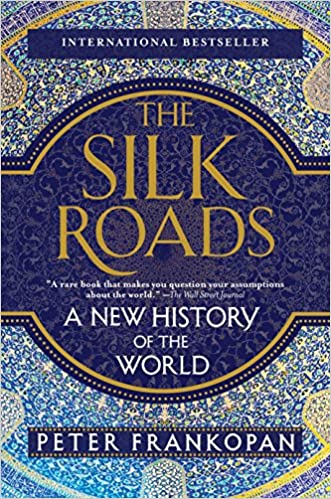
Review 1652: The Silk Roads: A New History of the World

In the opening of The Silk Roads, Peter Frankopan talks about his uneasiness with the narrow focus of his historical studies in school, to Europe and the countries affecting Europe. This struck a chord with me, because I remember discussing this with my father when I was in high school. “Why don’t we learn about China or Japan?” I remember asking, and I didn’t even think of Central Asia or the Middle East. So, The Silk Roads seemed as if it would be very interesting to me.

Frankopan shows that while Europe was a backwater, the countries of Central Asia and the Middle East were vibrant with trade, of goods, culture, and ideas. His thesis is that this area of the world has long been its heart and is becoming so again.

The subject matter of this book is interesting, in a way that changes one’s preconceptions. Frankopan’s writing style, though, is clear but very matter of fact, with no attempt to be stylistically interesting or eloquent.

Although I’m sure this is a simplistic statement, it seems as if there are two ways of approaching historical content. One is to relate it more as a series of stories. The other is to throw in every fact that supports your thesis. Unfortunately, at least the later chapters use the second approach, making the last few chapters sort of a slog for me. For example, most of the last chapter is just lists to show the ways Central Asia has become wealthy. I believe that Frankopan’s ideas are important, but I sometimes found this book putting me to sleep.

The irony is that Frankopan’s book is, after all, westerncentric, especially the last half, which focuses on the mistakes England and then the U. S. made in the Middle East.

Related Posts

The Great Game: On Secret Service in High Asia

The Great Railway Bazaar

Tales from the Queen of the Desert

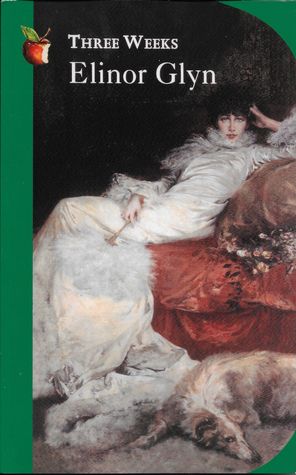
Review 1651: Three Weeks

I realized earlier this month that the deadline I set myself for finishing my Classics Club list is coming up this summer, with about a dozen books left. I’ve been reading lots of classic novels, just not necessarily the ones on my list. I have also read many of the ones on my list but just haven’t posted my reviews yet. So, I decided I was going to have to accelerate my schedule of reviewing and reading them in hopes of getting all my reviews posted on time. Here is one of them.

Elinor Glyn was a romance novelist at the turn of the 20th century whose works were considered scandalous at the time. Three Weeks is the story of a young English man who has an affair with an older Russian queen.

Naïve young Paul Verdayne fancies he is in love with the parson’s daughter, so his mother ships him off for a tour of the continent. He is young and sulky and hates Paris but, being a sportsman, enjoys Switzerland. While in Geneva, he becomes fascinated with a striking woman who is traveling only with her servants.

This mysterious woman, about ten years older than Paul, takes him in hand and begins opening his mind to art and ideas. Soon, they begin a torrid affair. But this affair must remain secret, because there is danger.

First, I found it difficult to buy that this sophisticated, cultured woman would fall madly in love with a gauche, uncultured young man whose only interest is his dog and horses and whose only attraction is his good looks.

Next, Glyn’s writing is florid and overwrought. It is often cloying and downright silly. The style resembles that of writers from the Romantic movement, which was well over by the time Glyn was writing. I have an idea that Glyn may be the type of writer Forster was mocking in A Room with a View.

Finally, the idea that Paul could become informed and educated just by spending three weeks with his mistress is ridiculous. The novel doesn’t say that he is interested in being more informed but that he comes back from his experience poised and culturally literate, enough so as to impress people with his elegance. Right.

In short, this is a really silly book.

Related Posts

Chéri

The Last of Chéri

Dolly: A Love Story

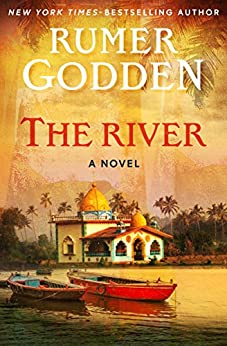
Review 1650: The River

Harriet and her family live along the river in a town in India. Harriet is dismayed at the changes in her sister Bea, who is becoming a young lady and is no longer fun to play with. Her brother Bogey spends his time looking at insects and animals in the garden. Victoria is just a baby. Harriet spends some time each day writing in her book that she keeps hidden away, and she also is fascinated by her parents’ guest, Captain John, who was injured in WWI. Captain John, however, likes Bea best.

This little novel has a plot, but it is mostly atmospheric and descriptive, of the garden and house, of life on the river. I was just a short way in when I realized that I had seen the movie based on it by Jean Renoir. I said, “If there’s a snake, I’ve seen this.” There was a snake.

The semi-autobiographical novel is about Harriet waking up from childhood and complete self-involvement and learning to become a writer. It is beautiful and touching.

My Virago Modern Classics version also included two short stories, “Red Doe,” about Ibrahim, a bakriwar nomad who is on the way to another encampment to claim a wife, and “The Little Black Ram,” about Jassouf, a bad boy who is tamed by being give a black ram to care for.

Related Posts

Coromandel Sea Change

A God in Every Stone

Sea of Poppies

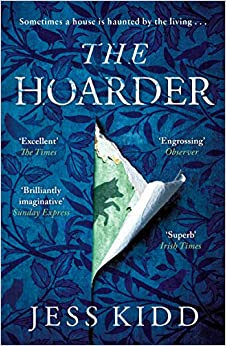
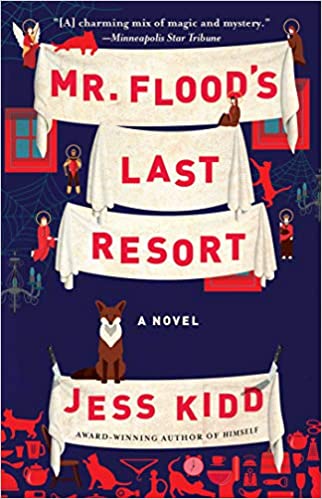
Review 1649: The Hoarder (aka Mr. Flood’s Last Resort)

Best of Ten!
Let me just start out by saying I hate the trend of changing the name of a book from the British edition to the U. S. edition. In this case, I got caught out buying both versions of this novel just because I didn’t realize they were the same. I loved this novel, but I don’t need two copies of it. If they are going to do this, the least they could do is warn us in really big letters on the cover.

____________________________

As with Things in Jars, it took a bit of time before I plunged myself into the eccentric world of The Hoarder. But when I did, I was all in.

Maud Drennan is a care worker whose job it is to feed the difficult Cathal Flood and attempt to make some headway in cleaning his house, for the old man is a hoarder. There are odd rumors surrounding Flood, not only about his recent behavior—he is supposed to have tried to brain carer Sam Hebden with a hurley—but also about his past—his wife died after falling down the stairs.

Maud herself is a little eccentric. She is followed around by the ghosts of saints, particularly St. Dymphna and St. Valentine, and her best friend is Renata, an agoraphobic transgender woman with an elaborate wardrobe. It is Renata who suggests that perhaps it was Cathal Flood who pushed his wife down the stairs.

Certainly, something is going on, because Maud is approached by Gabriel Flood, Cathal’s son, who is looking for something in the house. Then, Renata and Maud discover that Gabriel had a sister, Maggie, who disappeared as a teenager. Maud’s sister, we learn, also disappeared, so Maud becomes immersed in an investigation and attempts to search the blocked-off portions of Cathal Flood’s house.

This novel is a bit gothic, a bit funny, a bit haunting, and Kidd’s writing is brilliant. Love this one. Need more.

Related Posts

Things in Jars

The Vet’s Daughter

The Rathbones

Review 1648: Joanna Godden

At first, I wasn’t sure I was going to like Joanna very much, in this novel that is essentially a character study. She is large and brash. She likes to wear bright colors and to impress people. She is a fine figure of a woman.

As a young woman, she inherits her father’s sheep farm on Walland Marsh in far southeastern Kent. From the first, she will take no advice. She’ll run her farm the way she wants, and she scandalizes the neighborhood for firing her father’s shepherd of 28 years, for painting her wagons and her house yellow, and for other such offences against tradition.

At first, she makes some costly mistakes in her willingness to experiment. She hires a shepherd just because she likes his looks, but he is too docile and inexperienced to warn her when she’s about to make a big mistake in breeding. She sends her little sister Ellen away to a posh boarding school and gets back a sulky, discontented young woman who thinks she is too good for the farm.

I couldn’t help growing to love this heroine, though. She is bumptious but well-intentioned, pushy but kind. By the end of the novel, I was touched and sorry it was coming to a close. I read it for my Classics Club list and hope to find more by the author.

Related Posts

Far From the Madding Crowd

Miss Marjoribanks

Chatterton Square

Review 1647: The 1936 Club! Jamaica Inn

When Mary Yellan’s mother is dying, she makes Mary promise to go live with her Aunt Patience in Bodmin. However, Aunt Patience’s reply to her letter after her mother’s death tells her that she no longer lives in Bodmin. Her uncle is the landlord of Jamaica Inn out on the moors.

When Mary tells the coach driver her destination, he advises her to stay in Bodmin. Jamaica Inn is a place of ill repute. Mary feels, though, that she must keep her promise to her mother.

She finds Jamaica Inn a ramshackle, brooding inn with no customers. Patience, her mother’s sister, has changed from a vivacious, pretty woman to a terrified drudge. Her uncle, Joss Merlyn, is an overbearing bully with signs of being a habitual drunk.

Days after arriving at the inn, Mary must help serve the most disreputable bunch of men she has ever seen. Later, Joss advises her to stay in her room with her covers over her head. But she looks out the window and sees evidence of smuggling.

But the secrets of Jamaica Inn go far beyond smuggling. Mary looks for a way to safely remove herself and her aunt. In the meantime, she meets and is attracted to Joss’s younger brother, Jem.

It’s been many years since I read this novel, which I reread for the 1936 Club. I found it to be a truly exciting thriller.

Related Posts

Rebecca

Castle D’Or

I’ll Never Be Young Again

Review 1646: The 1936 Club! The ABC Murders

Of course, you must pick an Agatha Christie for the 1936 Club, and my choice was The ABC Murders. In this novel, it appears at first as if Christie is telling us everything but motive. However, she has some tricks up her sleeve as usual.

Captain Hastings returns from South America to find Hercule Poirot retired but still taking the occasional case. Soon, one arrives in the form of a letter, which challenges Poirot and tells him to look for news from Andover on a particular date. On that date, an old woman named Mrs. Ascher is killed by being bludgeoned over the head. On the counter is an ABC map.

The next letter refers to Bexhill-on-Sea. On the specified date, Betty Barnard is strangled on the beach and an ABC is found underneath her body.

In between entries from Captain Hastings’ journal, we briefly follow a man named Alexander Bonaparte Cust.

Round about page 75, I got an inkling about something that might be happening, and I was right. But the whole picture was more complicated than I guessed.

This wasn’t my favorite Christie. For one thing, the solution was just too complicated. For another, I didn’t feel as if Christie’s characterizations were as rich as usual.

Related Posts

Appointment with Death

By the Pricking of My Thumbs

Murder at the Vicarage

Classics Club Spin #26

It’s time for another Classics Club Spin. I have been trying to finish my list in time for my deadline, which is coming up at the end of June. I’m not going to make it, but I’ve been scheduling in books that I read months ago to try to get most of the books reviewed by then, and I have been reading like crazy to finish the others. With any luck, I’ll only be a month or so late. That means that my list for this spin is going to be repetitive.

To participate in the spin, you post a numbered list of 20 of the books from your Classics Club list (or in my case, however many books you have left over and over to make a list of 20). The Classics Club picks a number, and that determines the book you’ll read for the spin. So, here is my list! We are posting these lists by April 18th, and the deadline to read the chosen book is May 31.

  1. The Sea Hawk by Rafael Sabatini
  2. The Last of the Wine by Mary Renault
  3. The Viscount de Bragelonne by Alexandre Dumas
  4. The Brothers Karamazov by Fyodor Dostoevsky
  5. Evelina by Frances Burney
  6. The Duchess of Malfi by John Webster
  7. Titus Andronicus by William Shakespeare
  8. The Sea Hawk by Rafael Sabatini
  9. The Last of the Wine by Mary Renault
  10. The Viscount de Bragelonne by Alexandre Dumas
  11. The Brothers Karamazov by Fyodor Dostoevsky
  12. Evelina by Frances Burney
  13. The Duchess of Malfi by John Webster
  14. Titus Andronicus by William Shakespeare
  15. The Sea Hawk by Rafael Sabatini
  16. The Last of the Wine by Mary Renault
  17. The Viscount de Bragelonne by Alexandre Dumas
  18. The Brothers Karamazov by Fyodor Dostoevsky
  19. The Duchess of Malfi by John Webster
  20. Titus Andronicus by William Shakespeare