Review 1618: The Prince

I put The Prince on my Classics Club list mostly out of curiosity. Now that my curiosity has been satisfied, I can well understand some of the controversy surrounding it.

Machiavelli wrote the book for the newly arisen Medici family, and the last chapter is basically a plea for Lorenzo di Medici to rise up and conquer Italy. The Prince is a treatise on power: how to get it, how to keep it, what to do with it. It is utilitarian rather than moral. For example, it advises princes that they need not honor their promises once they are in a position of power if the promises are not in their best interests.

Although Cesare Borgia was considered ruthless and cruel even in his own time, Machiavelli several times holds him up as a model and clearly venerates him. But then, his ideas are not ours, for he tells a story of a principality being won. The principality needed good government, so the prince put in charge a man known for his ruthlessness and rapacity. Once the area was settled, the prince “wiped out” his lieutenant. Good work!

The book is regarded as a realistic analysis of the pursuit of power. This is why it is still widely studied. It is written in a straightforward style, assertion followed by example.

Related Posts

In the Name of the Family

Blood & Beauty

The Malice of Fortune

Review 1617: The Western Wind

On Shrove Tuesday 1491, Henry Carter awakens the local priest of the village of Oakham, John Reve, to tell him he’s seen a body floating in the river. For four days, Tom Newman has been known to be drowned, but the villagers have not been able to recover the body. When John and Henry return to the river, however, the body is gone.

Although there is no evidence to suggest that Newman’s death was other than an accident or suicide, the dean, who has taken it upon himself to investigate, is convinced that Newman was murdered. His reasoning is that Newman, as the wealthiest, most productive man in town, is unlikely to have committed suicide and that there was no reason for him to be by the broken village bridge so early in the morning unless he was meeting someone. Before the day is out, the dean has selected two possible murderers and is trying to force Reve to pick one, even though Reve believes neither is guilty.

The novel moves backward in time to the day of the drowning, during which time the villagers’ secrets are revealed—John Reve’s among them. The novel is deeply interesting for its view into the thinking and superstitions of the Medieval mind. I read this absorbing novel for my Walter Scott project.

Related Posts

Fair Helen

The Owl Killers

The Chalice

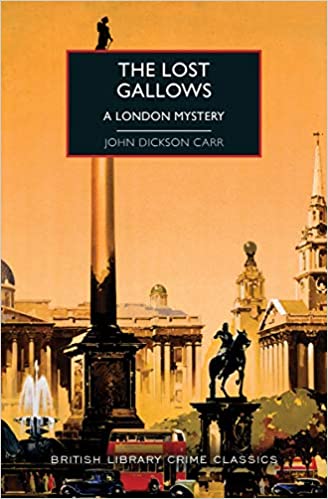
Review 1616: The Lost Gallows

The famous French detective Inspector Bencolin and his friend Jeff Marle are sitting with Bencolin’s friend Sir John Landervorne in the Brimstone Club in London while Bencolin tells a strange tale of a man seeing a gallows in the fog. Upon leaving the room, they find a toy model of a gallows there. Later that evening, Marle encounters a wealthy Egyptian, El Moulk, on the floor of his rooms in the club. He appears terrified.

On the way back from the theater that evening, Marle is nearly run down by El Moulk’s limousine. When he looks into the window, he sees the chauffeur is dead. Returning to the club where the car has stopped, they receive a message saying that El Moulk will die on the gallows at Ruination Street.

The three investigate the case along with Inspector Talbot, trying to rescue El Moulk and locate Ruination Street even though they become convinced that the Egyptian is guilty of a heinous crime for which someone is taking revenge.

Like many Golden Age crime novels, this one is extremely complicated, almost to the point of the ridiculous, as the perpetrator takes a bizarre revenge. However, it is fast-paced and even contains a love interest for Marle. I believe that long ago I read a locked room mystery by Carr. I liked this one a lot better.

I received this book from the publishers in exchange for a free and fair review.

Related Posts

Weekend at Thrackley

Thirteen Guests

Calamity in Kent

Review 1615: Swimming Lessons

Best of Ten!
I was interested in reading Swimming Lessons when it came out, but I never actually got hold of a copy. Then I read Fuller’s next novel, Bitter Orange, and liked it so much that I had to read Swimming Lessons.

Gil Colman, a famous writer who hasn’t written anything for years, is now elderly and dying of cancer. He has discovered letters from Ingrid, his wife who was presumed drowned years ago, tucked away in his thousands of books, many of which were removed from his house by his daughter Nan and sold to a bookstore. He is in the bookstore, having discovered one of the notes, when he thinks he sees Ingrid out in the street. Rushing after her, he gets injured.

That is the setup of the novel. From there, chapters alternate between the letters telling the story of their marriage from Ingrid’s point of view and Gil’s daughter Flora’s point of view as she returns home because her father is in the hospital. She tries to learn more about Ingrid, who she believes is alive. Although the sections about the current time and Flora’s struggles are interesting, most enthralling are Ingrid’s letters to her husband, describing a marriage in which, as a naïve girl thirty years Gil’s junior, she falls into a life she does not want, of marriage and children, to a husband who is serially unfaithful, and who, in a way, co-opts her past.

This is a fascinating and haunting story about the secrets of a marriage.

Related Posts

Bitter Orange

The Wife

The World’s Wife

Review 1614: A Pink Front Door

Stella Gibbons’s books always start out seeming to be froth, but there is an edge to them, I’ve found. Still, she handles her characters’ foibles with compassion.

In A Pink Front Door, her heroine, Daisy Muir, is engaging, but she has one big flaw. She tends to make the problems of a set of misfits her own, much to the discomfort of her husband, James. At the beginning of the novel, she’s trying to keep one silly friend, Molly, from running after men, in particular an Eastern European refugee named Tibbs, who keeps losing both jobs and his lodging. Lodging is difficult to find in post-war London, and the next thing Daisy knows, she has Don, a man she barely remembers from Oxford, at her front door. Don and Katie and their three young children have just lost their lodgings, and Don hopes Daisy can help.

Daisy remembers “little Katie” from university, the most promising student of her year. Later, Katie reflects that she became stupid with love and made only a poor third. Don, however, is only a few months from finally taking his exams to qualify as a chemist, and Katie hopes to find a quiet place where he can work. If he passes, he can take a good job and they can begin a better life, but until now, they have been living in cramped, noisy, unpleasant quarters.

Daisy thinks of a former neighbor and friend of her father, Mrs. Cavendish, a horrible snob who has an entire upper floor free. Mrs. Cavendish, like many of the upper classes, has fallen on comparatively hard times and has lost her last servant. She agrees that the family can move in but insists that the hard-pressed Katie spend some time every day cleaning in exchange for the low rent that is all they can afford. The house is inconvenient. Katie must haul all their water and coal upstairs. It is also not laid out for children. But it is quiet, and Don is finally able to work.

While Daisy is embroiled in the difficulties of her friends’ lives, Molly has homed in on James and has begun dropping by Daisy’s house especially when Daisy isn’t there, making tea for James and babysitting James Too. James himself, usually tolerant of Daisy’s projects, has begun to lose his patience.

Gibbons has an eye for social follies and foibles, and she employs it here with effect. I enjoyed this novel and was touched by its conclusion.

I received this book from the publisher in exchange for a free and fair review.

Related Posts

Nightingale Wood

Not at Home

Miss Buncle’s Book

Review 1613: O, The Brave Music

Seven-year-old Ruan Ashley leads a bleak existence. Her unhappy mother seems to care little for her, preferring her sister Sylvia. Her father is a dour nonconformist minister. They have little money and live in a poor area of a Yorkshire factory town. Ruan is misunderstood, a dreamer who loves reading, especially poetry, and thirsts for beauty.

Things look up when Rosie, the daughter of a wealthy factory owner, comes to visit with David, a boy Rosie’s father has adopted. They take her for a visit to their home up in the moors, where she and David run wild. Family illness calls for her to remain there for the summer.

Ruan’s life becomes one of loss, but it is also mixed with some times of great contentment. Daring it all, she remains herself, a person who refuses to conform to expectation.

This novel is touching as well as lyrical. It is a true ode to life, written in 1940 and looking back 40 years.

I received this book from the publishers in exchange for a free and fair review.

Related Posts

Lolly Willowes

Stoner

They Were Sisters

Review 1612: Abigail

Gina is a fourteen-year-old girl who is adored by her father, General Vitaly, and has led a carefree life in Budapest. Then some changes occur. Her adored governess, Marcelle, must leave home because she is French and thus on the opposite side of World War II. Then, her father enters her into Matula, a school for girls in the provinces. He does this with no warning, and Gina is at a loss to understand why he has chosen a cheerless, strict Calvinist school.

Upon arrival, Gina is stripped of her possessions and given charmless garments to wear. Her hair is cut off. The other girls in her class seem friendly at first, but after a horrible first day, she has a melt-down and blurts out a class secret. After that, no one will speak to her.

One of the school traditions, at least among the girls, is that if you write a note asking for help and put it in the vase held by a statue named Abigail in the garden, she will help you. This tradition is one of the things Gina finds ridiculous in her first days, but after a while, she comes to believe that someone, perhaps one of the staff, probably is helping.

When Gina becomes so miserable at school that she can’t take it, she plots to run away. She is prevented by one of the teachers, König, whom she despises. Soon, her father comes to see her and tells her a secret, something that requires her to stay in the school. She realizes she must try to make peace with her classmates.

This may sound like a standard novel about life in school, but it is an adventure novel that actually becomes quite suspenseful. The identity of Abigail wasn’t very hard to guess. It is Gina who is oblivious to all the clues until the last sentence of the novel. There is certainly a cast to pick from, including Susanna, the beautiful and strict prefect; Mr. Kalmár, the handsome young teacher who is in love with her; and Gedeon Torma, the director, the source of the cheerlessness and strictness. This is also Mitsi Horn, a former student who is a legend at the school.

Despite knowing who Abigail was almost from minute one, I really enjoyed this novel. Gina, headstrong and oblivious, is still appealing, and the plot is an interesting one.

Related Posts

Salt to the Sea

The Book Thief

The Nightingale

Review 1611: Flights

Olga Tokarczuk’s Drive Your Plow over the Bones of the Dead was unusual, but Flights is in another category altogether. It is an attempt to escape the boundaries of the conventional, linear novel.

It is written in snippets. Some of them are stories, some little vignettes or descriptions, some philosophical discursions, some lectures. Some of the snippets are observations from the narrator, an unnamed Polish woman who likes to be constantly traveling, often to visit museums of curiosities, particularly those that show the workings of the human body. Others are stories about people she meets on her journeys or just stories about people. Some of the threads recur in the novel; most do not.

Anchoring all this is the theme of movement. Most of the stories are about people on their way somewhere else, occasionally to another stage of being.

This novel was widely acclaimed by reviewers and won the Man International Prize. How it will strike ordinary readers is hard to guess. It’s not easy. I found parts of it interesting and other parts, particularly the lectures on travel psychology, which I doubt anyone would ever listen to, incomprehensible, as if someone were reading from a dense professional manual.

Related Posts

Drive Your Plow over the Bones of the Dead

Outline

Ducks, Newburyport

Review 1610: The Talisman

The Talisman is one of Sir Walter Scott’s adventure novels set during the Crusades. In terms of how much it’s based in actual history, I would say not much. For one thing, Scott has bought the myth of the Knights Templar being evil and makes the Templar Grand Master the villain of this novel. However, my 1907 edition of the novel is being marketed as a boys’ adventure story, so its roots are more in the tradition of the old-fashioned romance, in the medieval sense of the word, than based in actual history. I know very little about the Crusades but enough to have spotted several things that were wrong. However, I also don’t know what sources Scott may have been using for his historical background.

On the crusade with Richard the Lion Heart, Sir Kenneth is a poor Scottish knight of no illustrious family who has fallen in love with Edith Plantagenet, a lady far above his station. King Richard being ill, Sir Kenneth travels to see a holy man and healer whom the court ladies are visiting. While he is there, Edith gives him a sign of her favor.

He returns to the Christian camp bringing Saladin’s doctor with him to cure Richard. Richard is quickly cured and almost immediately gets involved in a dispute about his banner. The jealous Austrian Duke has placed his banner next to Richard’s and Richard is furious. He removes the Duke’s banner quite rudely and orders Sir Kenneth to guard his own.

Sir Kenneth is guarding the banner when he receives a message from Lady Edith asking him to come to her immediately. At first, he refuses, but then he thinks this may be his only chance to see her, and he will be gone only a few minutes. He decides to leave his dog to guard the banner. But when he arrives, he finds out that Queen Berengaria has summoned him in Edith’s name as part of a bet and a joke. Kenneth returns to his post to find the banner gone and his dog wounded. Now he’s in big trouble for disobeying orders.

Aside from this silly plot, there is also the one where King Richard’s Christian rivals are plotting against him. Eventually, they send an assassin after him.

This novel is a farrago of nonsense that just gets sillier as it goes on, and it is also written very floridly, combining archaic-sounding speeches with the flowery, elaborate speech of the East. Interestingly enough, Scott was heavily criticized for inventing a Plantagenet (Edith) but not for the more egregious historical errors in this novel. It is not Scott at his best.

Related Posts

Guy Mannering

Waverly

The Templars: The Rise and Spectacular Fall of God’s Holy Warriors