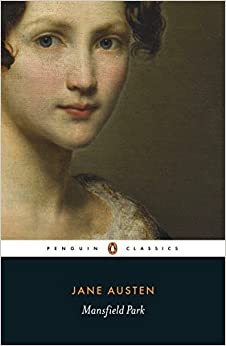
The Best Book for this period is Mansfield Park by Jane Austen!
Reviews, reviews, and more reviews

The Best Book for this period is Mansfield Park by Jane Austen!
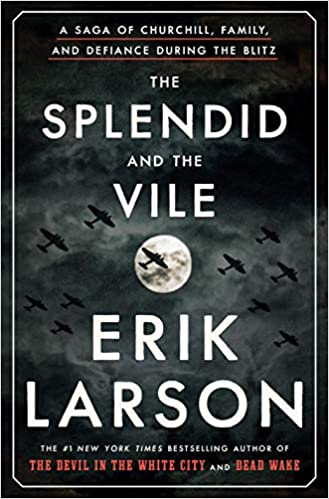
Most of the books I’ve read by Erik Larson have juxtaposed two seemingly unrelated events and shown how they affected each other. In The Splendid and the Vile, Larson takes a different tack, deciding to write about Churchill during the Blitz. His book fairly closely follows Churchill from his first days as Prime Minister until the United States entered the war. It also follows some people closely connected with Churchill as well as others who kept diaries during the war, including some of the German high command. This is his juxtaposition, the British versus the Germans.
Because the book is based on diary entries as well as other sources and follows events almost day by day, it feels very personal and interesting. Aside from some regular people asked to keep diaries during the war, readers get to know John Colville, Churchill’s secretary; Mary Churchill, Churchill’s teenage daughter; as well as Göring and Goebbels. There are colorful characters on both sides, not least Churchill himself.
Although I have a general knowledge of this war, this book is more particular while still being absorbing and sometimes even entertaining.
In the Garden of Beasts: Love, Terror, and an American Family in Hitler’s Berlin
Dead Wake: The Last Crossing of the Lusitania
No Ordinary Time: Franklin and Eleanor Roosevelt: The Home Front in World War II

At a small county fair in the early 1800’s, a drunken Michael Henchard sells his wife and child to a sailor. Twenty years later, his wife and her daughter come seeking him, the sailor having disappeared at sea and the two being nearly destitute. When they arrive at Casterbridge, they find he is wealthy and the town’s mayor.
To his credit, Henchard looked for his wife and child twenty years ago, but they had emigrated to Canada. Wanting to make amends, he suggests that Susan Newson, as his wife calls herself, and Elizabeth Jane stay in Casterbridge. He will appear to court Susan and will marry her.
At the same time, he meets a young Scotsman, Donald Farfrae, and likes him so much that he offers him a job. But Henchard has a hasty temper and a jealous, unforgiving nature, and as Donald becomes successful, Henchard takes a dislike to him that grows into enmity. A final issue is caused by another incident from Henchard’s past.
Henchard is not a likable character. Although he is often repentent of his actions, his temper creates situations, like the sale of his wife, that lead to his downfall. This is an interesting novel for Hardy, whose main characters, although flawed, are usually more sympathetic. Still, it is an absorbing and dramatic story about a man who is his own worst enemy.

In 1927, Peter Duvette accepts a job as a photographer’s assistant in Churchill, Manitoba. The day he reaches the remote town, he meets his boss, Vienna Linn, and Linn’s fianceé, Kala Murie. Kala is in the middle of a lecture about spirit photography, in which the spirit of the deceased person appears in photographs of family or friends. After the lecture, Linn and Murie are getting married.
So, Peter is surprised when that night he ends up in bed with the bride. It’s not too long before Kala tells him that Linn makes money by causing disasters that he photographs for a rich client. So far, these disasters have mostly been train wrecks.
Quirky isn’t exactly the word for this novel, because it is about a truly evil person. But it is certainly hard to predict where it will go. It’s eerie and atmospheric while still presenting a moving love story. This is the third book I’ve read by Howard Norman, and I’ve greatly enjoyed them all.

One day after forensic archaeologist Ruth Galloway hears of the death in a fire of an old school friend, Dan Golding, she receives a letter from him asking her to come look at some bones he’s found. He also expresses fear but does not say what he’s afraid of.
Ruth asks DCI Harry Nelson if he would find out whether there was anything suspicious about Dan’s death. He finds that Dan was murdered, flammable material stuffed through his letterbox and his front door locked on the outside.
Ruth then receives a call from Dan’s department head, Clayton Henry, asking her to look at the bones. The university is near Blackpool, and Ruth is embarrassed to learn that Harry is going there for a vacation with his family, but she decides to go anyway. She immediately begins receiving threatening texts.
When Ruth arrives at the university with her daughter Kate and friend Cathbad, she soon learns that Dan thought he found the bones of King Arthur in the ruins of a Roman town. The tomb is certainly convincing, but when Ruth sees the bones, she realizes they’ve been switched. So, where are the original bones and what’s going on?
This jaunt out of Norfolk is atmospheric, and the idea for the mystery is clever and original. I guessed the identity of the murderer but only because the person seemed the least likely suspect. It looks like there will be some shifting around of recurring characters, too, which happens in real life but seldom in mystery series and should be refreshing. As usual, I enjoyed this mystery.

When I was a girl, I discovered some old Gene Stratton-Porter books of my mother’s, and I just loved them. Later, in high school, I had a job at the public library, so I resolved to read all of her books. However, one of those books put such a bad taste in my mouth that I stopped reading her.
Skip forward 50 years and I found an old copy of one of her books in good shape in a used bookstore, so I bought it. I finally got around to reading it, only to discover on the very first page that this was the same book that turned me off in the first place. How did it strike me now? You shall see.
Linda Strong is in the halls of high school in Los Angeles when she is accosted by an upperclassman, Donald Whiting, who asks her why she wears such odd shoes. She in turn raises an issue with him that I will address in a bit.
Linda is an independent girl who was brought up by her father exploring the desert environs of Southern California, learning how to identify and use plants and how to live in the wilderness. Her parents died four years ago, and she has been living with her older sister, Eileen, who has been systematically robbing Linda of her inheritance to pay for her own clothes and entertainment. Hence, Linda in high school makes a shabby, eccentric appearance, but her shoes are for comfort.
Eileen has also deprived her best friend, Marian, of her boyfriend, which she did as soon as John became successful. Marian is leaving for San Francisco, where she has a job in an architect’s office and has entered an architectural contest. But the plot takes a turn when John brings over an old friend, writer Peter Morrison, who is looking for a place to settle, and Henry Anderson, an architect.
This book is really almost all subplots. I was going to say that the main plot was the relationship between Linda and Eileen, but that plot goes into abeyance for quite some time. There is a romance of some uncertainty, of course, and a plot about a stolen drawing of Marian’s. But my objection to the novel mostly concerns Linda’s issue with Donald. For this novel contains a ridiculous, racist subplot about Japanese adults being sent to attend California high schools so that they can best the American students academically and make them feel inferior. It is one of the stupidest plots I have ever read, and the book is one of the most racist I have ever read, a blueprint to the thinking of white supremacists. Not only does Linda believe all kinds of paranoid things about the Japanese, but she lets others have it as well—African Americans, Mexicans, and Communists. I usually try not to judge books out of their time, but I’ve read plenty of books from this time period (1921), and this one is just despicable. All these horrible attitudes are expressed by an otherwise appealing heroine, which I think makes it worse. I am again disappointed in this author, who has written several really good books for young adults.
I was having difficulty reading another book, so I decided to take a break by rereading Mansfield Park, which is on my Classics Club list. In these days, Austen’s heroine, Fanny Price, is not admired, but she is a true and admirable product of her environment and circumstances.
At nine, Fanny is brought to live at Mansfield Park as an act of charity, for she is a poor relation. She is taught to be grateful for this charity and to have no expectations for herself. Sir Thomas Bertram is an upright, stern man whom she and her cousins fear. Lady Bertram is languid. Fanny’s Aunt Norris, who suggested they give her a home in the first place, actively dislikes her and favors her female cousins, particularly Maria.
Fanny is very shy and miserable at first, but the younger son of the house, Edmund, takes her under his wing, is her friend and educator.
As a young lady, Fanny is happy to be of service and not used to her needs or inclinations being attended to. Then two things happen at about the same time. Sir Thomas goes away on a lengthy business trip, and Mary and Henry Crawford arrive to stay with the Grants at the parsonage. Edmund, whom Fanny loves, is immediately attracted to Mary, but Fanny is dismayed by the sister and brother’s lack of principles. Maria Bertram is engaged by then to a rich but stupid young man, but Henry Crawford flirts with both Bertram sisters, playing one off the other. Mary’s behavior is more or less impeccable, but she expresses unprincipled ideas. Edmund seems blind to her faults.
Fanny is one of Austen’s more thoughtful heroines. Will she ever be appreciated for her qualities of affection, duty, and principle? Will Edmund marry Mary or recognize Fanny’s superior qualities? Well, we can all probably answer that, but the journey there is wonderful, as Austen’s novels tend to be.
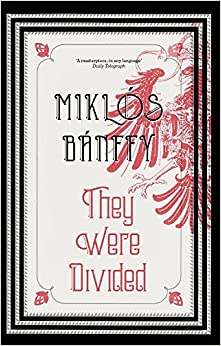
They Were Divided is the third book in Míklos Bánffy’s Transylvanian Trilogy about the fortunes of Hungary and its leaders coming up to the First World War. It again follows two young noblemen, Laszlo Gyeroffy and Balint Abady, but it is mostly about Balint.
I got a little bogged down in They Were Found Wanting, the second volume of this series. I think that was because I wasn’t particularly interested in Balint’s affair with the married Adrienne, which occupied much of that volume. In that book (small spoiler for the second book), Adrienne kept delaying her request for a divorce from her husband out of fear of a man who was becoming more and more unstable. Now, he has been consigned to a mental hospital, which means that Adrienne cannot legally divorce him. So, Balint and Adrienne are forced to discreetly continue their affair.
On the political front, the Budapest legislature continues its obstructive techniques, not allowing any legislation relating to modernization. But Balint is more and more concerned about the events in other countries that he fears are leading to war. The Hungarian politicians continue to behave as if nothing outside their country affects them.
As for Laszlo, having gambled away most of his inheritance and been cheated of the rest, he has settled down in a small cottage on his estate to drink himself to death.

This novel has some amusing moments and is full of eccentric characters, but it is essentially serious. It depicts a society that has ceased to take care of its property and obligations, including its obligations in government, and spends all its time in frivolous activities. It does have one conversation that made me wince, where Balint insists that historically, nobles did not abuse their serfs because it would be against their own interests. It’s hard to tell whether this is supposed to show Balint’s own naïveté or whether Bánffy really believed this, or perhaps the novel is trying to show what a particular type of Hungarian believes (although I am fairly sure that Balint is Bánffy’s alter ego). Obviously, Balint, anyway, doesn’t compare that thought with his own observations of the Hungarian nobles gambling away their inheritances and mismanaging their government.
Did I enjoy this series? It provided me with a window into a time and place I knew very little about. It was more interesting than not. It was evocative in describing scenery, settings, and characters. At times the series went slowly, but this book clipped along pretty well until the last few pages, when Bánffy was trying hard to get the moral in.
Between the Woods and the Water: On Foot to Constantinople: From the Middle Danube to the Iron Gates

When I opened up The Long Take, which I was reading for both my Walter Scott prize and Booker prize projects, I was not delighted to discover it is mostly a poem. However, it is fairly easy to read, so my next challenge was a search for the plot.
Walker, a World War II veteran from Nova Scotia, first arrives in New York City in 1946. He haunts skid row and dive bars as he tries to find a place for himself. Later, after an invitation, he travels to Los Angeles and gets a job with a newspaper.
This novel is more atmospheric and thematic than plot-driven. It is about droves of homeless ex-soldiers occupying the downtown areas of all the large cities Walker visits. It is about Walker’s feelings about what he saw and did in the war. And it is about the gutting of downtown Los Angeles to make room for parking lots and freeways and the racism underlying the planning decisions.
The Long Take is beautifully written. It is not a noir work, as described on the cover, but it is gritty and depressing.

There is always something that keeps my attention in Louise Erdrich’s books, although often they are very sad. In 1953, the United States Congress announced a program of “emancipation” of more than 100 First Nations tribes that was expressed as a program to put indigenous people on an equal footing with other Americans but was actually a way to yet again abrogate treaties and take land. Louise Erdrich’s grandfather helped save the Turtle Mountain Chippewa from this fate all while working full-time as a night watchman. The Night Watchman is Erdrich’s novel about this event.
Thomas Wazhashk, a member of the tribal council, receives a copy of the bill and figures out its intent from its bland, bureaucratic language. He gets the council to collect signatures on a petition and begins collecting information to support the tribe’s stance that its members are too poor to care for themselves so local authorities will have to take on the burden if the federal government doesn’t, this obviously a ploy to get support from state and local authorities to oppose the bill. While he works, he is visited by an owl and the ghost of an old friend who died as a boy after being imprisoned in the basement of a state boarding school.
As usual with Erdrich, aside from the main plot, the novel is full of interesting characters and subplots. Pixie Paranteau takes time off from work to try to find her sister Vera, who has vanished in Minneapolis after leaving to marry her boyfriend. On the train, she encounters Wood Mountain, a young boxer on his way to a fight, but when the fight is cancelled, he decides to make sure Pixie is all right.
Millie Cloud is the woman whom Thomas asks to share the results of the survey on the living conditions of the tribe that she wrote for her doctoral dissertation. She is socially awkward and dresses in geometric patterns.
This novels felt more hopeful than some of Erdrich’s even though it also contained scenes of brutality. My attention was engrossed by it.
Book reviews of mainly modern & contemporary fiction
Writer and Historian
There is nothing more satisfying than reading a book while sipping a hot cup of tea.
A historical fiction book blog
Emerging as an artist
Liz Dexter muses on freelancing, reading, and running ...
For mostly adult, literary, fiction; focusing on historical, contemporary, biographical, and women.
"Well, there’s so much to read, and I’m so far behind." Wallace Stegner
Read to live and live to read
A bookish blog (mostly) about women writers of the nineteenth and twentieth centuries
A Celebration of Russian Literature
Reading: it's personal
Based in Romania, reading all over the world. Mostly fiction, some memoires and a little bit of poetry.
Adam Burgess
"Vivre le livre!"
"History is a vast early warning system." Norman Cousins
Scottish Book Blogger
"She had read novels while other people perused the Sunday papers" - Mary Elizabeth Braddon
A word after a word after a word is power. --Margaret Atwood
Books • Opera • Art • History
FOR DISCERNING READERS
Your online source for Jane Austen and her legacy
A Community of Classics Lovers
A blog about Irish books, writers, writing and everything in between.
 What? Me Read?