Review 1566: Coromandel Sea Change

Best of Ten!
Rumer Godden was around for so long as an author that when I couldn’t find the book by her that I had on my Classics Club list, I thought nothing of substituting Coromandel Sea Change. Even when I noticed a publication date of 1991, I assumed it was a reprint. It wasn’t, however, which brings up something I’ve been thinking about, and that’s how do we decide something is a classic if it’s not tested by time? I associate Godden with the 30’s through 50’s, when she was very active, and which I considered long enough ago to put her on my list. Oh well. We had this discussion on the Classics Club blog, in fact, this book was the one that gave me the idea. In any case, it is a wonderful, atmospheric book.

Newlyweds Blaise and Mary Browne arrive at Patna Hall on the Coromandel Sea evincing different reactions. Mary is enchanted by this view of the “real India,” while Blaise is enraged that their rooms are not in the main hotel and offended by the bathroom arrangements. As a couple, they seem particularly ill-suited—the young Mary is eager to observe ordinary people and take part in their customs while the older Blaise, a diplomat, is interested only in schmoozing with important people. Very soon, they are bickering like children while the other guests and hotel staff look on in dismay and Kuku, the young assistant manager, hopes to get her chance with Blaise.

The hotel is busy with an upcoming parliamentary election, and Mary meets Krishnan, one of the candidates, out on the beach one night. He is young and charismatic and seems genuinely concerned to help his people. Mary is happy to oblige when the campaign asks for her help, but Blaise is offended and misinterprets her interest.

In this novel, the stories of Mary and Blaise are not the only interest. The hotel staff are important, and the country itself is vividly evoked and almost a character. The election is charming in its own way. Even a donkey named Slippers, an elephant named Birdie, and a squirrel have their places. Mary is likable, although very naive, while Blaise is pretty unbearable.

Despite the sad ending to this novel, I found it colorful and charming. It made me want to visit the Coromandel Sea. Research has told me that the area was virtually destroyed by the tsunami in 2004, but apparently Chennai, mentioned in the book, is considered a top location to visit by Lonely Planet, so perhaps the area has recovered. In any case, perhaps it isn’t the paradise described by Godden anymore.
Related Posts

The Ministry of Utmost Happiness

In a Strange Room

The Lives of Others

Review 1565: A Struggle for Fame

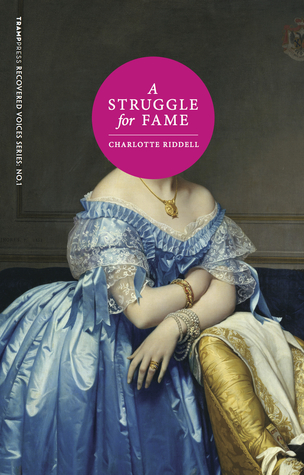
After reading The Uninhabited House, I looked for more books by Charlotte Riddell and came across the Recovered Voices series published by Tramp Press and this book, A Struggle for Fame. A Struggle for Fame is Riddell’s semi-autobiographical novel about the publishing industry.

Although Glen Westley is the main character in the novel, it follows the progress of two Irish young people who meet on the ship from Ireland and both end up in London’s literary milieu. Through poor investments, Glen’s father has lost the family home and all his money. She determines that they will travel to London so she can try to make a living as a writer.

On the ship, they meet Barney Kelly, a young chancer who is looking for a way to make money.

Glen works hard at good literary fiction and is repeatedly rebuffed by editors even while being told she has promise. Barney, on the other hand, falls into an opportunity to write articles for a journal. The novel makes clear that Glen has much more ability than Barney, but he is able to make a living at writing much earlier than Glen. It is clear from the beginning that the novel is about Glen’s rise and fall, but we are drawn in to see what happens.

A lot of characters are vividly drawn and quite Dickensian in their idiosyncrasies. It is fairly obvious that Riddell is depicting, sometimes satirically, publishers and authors she knew. Although written in 1883, the novel has observations about gender and ability that still apply today.

Related Posts

The Uninhabited House

The Blazing World

The Muse

Review 1564: Dangerous Ages

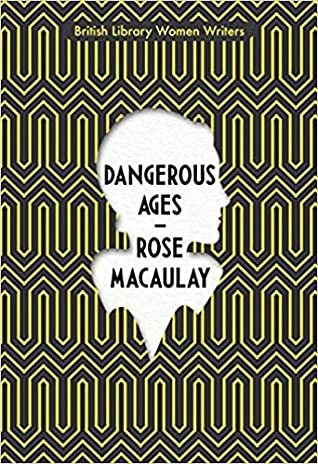
Thanks to Simon Thomas’s posts (Stuck in a Book) on the new British Library Women Writers series, I was able to request some review copies. I received Dangerous Ages, which, according to the novel, are all of them. This novel examines the lives of women in the early 1920’s.

Neville is 43, a woman who gave up her medical studies as a young woman to marry and raise a family. That job done, she finds herself feeling adrift, with no purpose, and views her mother, Mrs. Hilary, as an object lesson. She must find work and decides to return to studying medicine.

Mrs. Hilary is a silly woman who always pretends she has read important books and is knowledgeable on all subjects. At 63, she has nothing to do, because she defines herself as a wife and mother. Now she is a widow whose children are grown. She is jealous of anyone being intimate with Neville if her son Jim isn’t around and is jealous of Neville’s intimacy with Jim. She thinks psychoanalysis, which is being talked about, is horrid until she realizes it means someone will listen to her stories.

Nan, Neville’s younger sister, has been courted by Barry for ages. She finally decides she loves him, but instead of telling him so, she goes off to Cornwall to finish writing her latest book, never thinking that Barry might give up on her.

Gerda, Neville’s daughter, is ardently engaged in left-wing activities. The question is, when she falls in love with a man of a different background, whether she will compromise her principles, which reject all the values of her parents’ generation.

Macaulay’s novel is rooted in the early 1920’s, as characters examine hot topics of the time. I had to laugh at the scenes where Mrs. Hilary’s psychoanalysts inundate her with Freudian jargon that she has very little understanding of. That most of these women are frustrated in their aims should not be surprising, for this is a satirical look at the position of women in society. Only Neville’s sister Pamela, who refuses to be bothered, and Neville’s grandmother, who says she is past all that, seem happy.

Simon Thomas’s Afterword provides some insight into views of psychoanalysis in the early 1920’s, which is interesting.

I enjoyed this novel very much. It feels like light, lively reading while dealing with experiences that are universal, no matter the generation.

Related Posts

The Towers of Trebizond

Consequences

South Riding

Review 1563: #1956 Club! Palace Walk

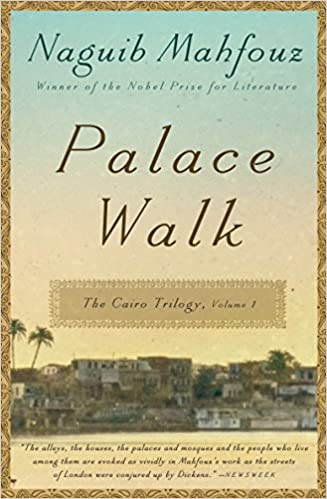
I experienced quite a bit of culture shock reading Palace Walk, which made me realize that although I have read books set in Egypt about Egyptians, all but one were written by Western writers, and that one, Map of Love, was much more modern. Palace Walk is about Ahmad Abd al-Jawad and his family, and I believe it’s Mahfouz’s own family thinly disguised.

The novel is the first of three in Mahfouz’s Cairo Trilogy. It begins with al-Jawad’s wife, Amira, getting up at midnight to help her husband get ready for bed after his usual night of carousing and womanizing. Although her husband is a good friend and convivial participant in nightly drinking bouts, at home he is an angry tyrant to his wife and children. I found it interesting that although he has the reputation of a righteous and observant man, no one seems to think his drinking and womanizing make him a hypocrite.

Mahfouz was a writer in the Realism school and as such explores both the good and bad facets of his characters’ personalities (although it sometimes seems like Realists concentrate on the gritty). The novel develops slowly, introducing us to al-Jawad, Amina, and his five children—Yasin, a government clerk who immerses himself in sensuality like his father but with less control; Fahmy, a university student who is serious and ardent; Khadiya, the older, sharp-tongued daughter; Aisha, the younger, beautiful daughter; and Kamal, a schoolboy who may be Mahfouz’s alter ego.

Beginning in 1917 near the end of World War I, the novel at first focuses on purely family concerns such as Fahmy’s desire to be affianced to Maryam, the neighbor girl; Aisha’s receipt of an offer of marriage before Khadiya’s, when their father has decreed that the younger girl will not be married before the older; and Yasin’s mother getting married again, which Yasin thinks is obscene, since she has been married several times. In these domestic incidents, the family constantly faces their father’s anger and intransigence. Mahfouz frequently tells us of his good points although they are not often demonstrated. In fact, there is a lot of explanation going on about the thinking and characters of the family members, some of it quite repetitive.

As the novel develops, external events become more important, especially the Arab Revolution of 1919 against the protectorate of the British. This more outward view makes the second half of the novel move along more quickly.

Certainly, al-Jawad’s actions toward his wife and children are shocking, and Mahfouz makes clear that he is stricter than most others by the comments of al-Jawad’s friends. Yet, it is also clear that no one would interfere in his treatment of his family, since it is his right to behave as he wishes. As an example of some of the things he does, Amina, who has only left the house a few times in 23 years of marriage, takes the opportunity of her husband’s absence on a business trip to visit a nearby mosque. Because Kamal guides her out of her route so that he can visit a pastry shop, she becomes disoriented and faint and is hit by a car. After she recovers, her husband banishes her from the house for leaving it without asking him (and believe me, he would have said no).

His son Yasin, the leaf not falling far from the tree, thinks later in the book when his wife is not happy with his nights out that it is the husband’s right to do anything he wants and the wife’s to obey. Nice.

The trilogy is supposed to be about the effect the father’s tyranny has on his family. I read it for the 1956 Club, and I suppose I will go ahead and read the other two novels. It certainly provides an intimate look into family life and customs in early 20th century Egypt.

Related Posts

The Map of Love

Blood & Sand

Letters from Egypt

Review 1562: #1956 Club! The Fall

I’ve never read any Camus before, so I decided to read The Fall for the 1956 Club. This I can say: after reading The Kreutzer Sonata, The Prague Cemetery, The King Without a Kingdom, and The Fall, I’ve decided I hate novels that are monologues.

An unnamed person meets Clamence, an ex-Parisian lawyer, in an Amsterdam bar. Clamence begins his monologue explaining how his life changed. He began as a successful lawyer for the defense—handsome, genial, charitable, always doing good—and a womanizer. As he talks, we see that his charitable impulses are rooted in self-regard. His discourse becomes more and more cynical until . . . .

Well, I don’t know, because 50 pages before the end, I realized I was struggling to pay attention, and I stopped reading. His “witty” discourse may have been ground-breaking in 1956, but in 2020, it just seems banal.

Related Posts

The Kreutzer Sonata Variations

The Prague Cemetery

The King Without a Kingdom

Review 1561: #1956 Club! Sprig Muslin

Seven years ago, Sir Gareth Ludlow’s fiancée died tragically. Since then, he hasn’t met any woman who would make him forget her. He knows it’s his duty to marry, though, so he decides to propose to his shy friend Lady Hester Theale.

On his way to Lady Hester, he meets a beautiful young lady in some difficulty. He learns that in trying to force her grandfather to let her marry, she has run off with the aim of becoming a governess. When her supposed employer turned her away, she presented herself at the inn where he meets her proposing herself as a chambermaid.

Gareth is afraid that Amanda is too inexperienced to know what dangers she may encounter, but she will not tell him her grandfather’s name, so he takes her to Hester. Hester’s family assumes he has brought along his mistress, and her roué uncle spirits Amanda away the next morning.

Sprig Muslin is Heyer at her most ridiculous and fun, as Amanda’s fibs land her and Sir Gareth into serious trouble, requiring, of course, more and more fibs. As usual, her characters are lovable and her wit engaging. I always love reading Heyer, This one, I reread for the 1956 Club.

Related Posts

The Talisman Ring

Cotillion

Cousin Kate

Review 1560: #1956 Club! The Towers of Trebizond

Best of Ten!
The Towers of Trebizond, which I read for the 1956 Club, is said to be Rose Macaulay’s masterpiece. When I first began reading it, I was surprised at this, for it seemed to be a light comedy about eccentric people traveling in Turkey. To be sure, the narrator, Laurie, is erudite but relates the story in gushes of information, whimsy, and wit. But oh, when Laurie describes the wonders of past civilizations or her love of the rituals of the Anglican (high) church (I’m picking “her,” to discuss later), you see that there is more to this novel than humor.

Laurie and her Aunt Dot are on a trip to Turkey, accompanied by Father Chantry-Pigg. Laurie and Aunt Dot are writing a book about Turkey, Aunt Dot hopes to enlighten Moslem women by converting them to the Anglican church, and Father Chantry-Pigg, whose inappropriate last name becomes a running joke, wants converts. On the way, they pick up Aunt Dot’s friend Dr. Halide, who is also interesting in the liberation of women. Oh, and Aunt Dot brings her camel.

This may not sound funny, but all of the characters except Laurie are so obsessed with their hobby horses that the conversations are delightful. Later, we meet David, who has taken advantage of his ex-lover Charles’s death to steal the material Charles has written about Turkey and publish it under his own name—only Laurie has found Charles’s notebook in his old hotel room.

The central conflict for Laurie is that she is a believer in her church, but she has left it because of a long-lasting affair with Vere, a married man. Her heart yearns for the church, but she feels unable to break with Vere, whom she loves deeply.

This novel is beautifully written, witty, and finally bittersweet. I was unable to follow some of the detail about the church, and being American, I don’t have the classical background to understand all the references Laurie throws in about ancient civilizations. However, I greatly enjoyed this novel, which goes much deeper than it initially seems it will.

I wasn’t aware of this at first, but apparently there is an issue about Laurie’s sex—is she male or female? Perhaps this didn’t occur to me because my illustrated Folio Society edition makes the decision that she’s female. But what does occur to me is this: doesn’t the question imply sexism? That is, I can only imagine this question was raised because Laurie thinks nothing of, say, riding a camel across Syria by herself. But then, neither does Aunt Dot have any problem with walking across the Iron Curtain just to see what it’s like on the other side. I got no sense at all of a masculine personality in Laurie. Finally, Laurie’s bar to returning to the church is adultery, not adultery and homosexuality, and although Macaulay teases us for a while by not revealing Vere’s sex until the end, she finally does so. I think this whole sex issue is just caused by some people’s assumptions that a woman couldn’t be this adventurous in 1956.

Related Posts

A God in Every Stone

Guard Your Daughters

The Forty Days of Musa Dagh

Review 1559: In the Rocky Mountains

Quite a few years ago, I bought an old 19th-century boys’ adventure book, On the Banks of the Amazon by W. H. G. Kingston. In reading it, I was struck by its combination of adventure, interesting information about plants, animals and natives of the area, and engraved illustrations. As a result, I put together a small collection of these books from the late 19th and early 20th centuries, trying to find ones in the Our Boys’ Select Library edition of the first one.  (In case you’re wondering why there is a ship and a lion on the cover of a book about the Rockies, they all have the same cover.) I intended to read them all but never got to any of the others. Then when we moved to Washington, they got lost.

That was four years ago, and a few months ago my husband finally unearthed them from an unpacked box of his books. He brought In the Rocky Mountains up to show me, and I decided to read it.

Before the action of this book, Ralph and his sister Clarise were on their way west with their parents to start a new life, but both their parents died en route. Their wagon train was rescued by a group of men, and one of them turned out to be their Uncle Jeff, who had gone west years before and not been heard of again. Now, Ralph and Clarice, Clarice’s servant Rachel, and Uncle Jeff and his men live on a commodious ranch in the foothills of the Rockies, and Uncle Jeff and his men help supply settlers coming through the nearby pass.

A friendly native named Winnemak comes to warn them that a large band of “Arapahas” (by which I assume he means Arapahos) and Apaches have banded together (did they ever, I wonder) and plan to attack their compound. At first, Uncle Jeff is unworried, but the ranchers, along with a small group of cavalry, are overcome and must flee into the wilderness.

Most of this action is designed to lead us to Yellowstone, for the pass to the fort is overtaken by the enemy, so Ralph and his companions must go north, where they end up stranded for the winter in Yellowstone Valley. This leads us into descriptions of the wonders of Yellowstone.

This novel was published in 1901, a good 20 years after the other one I read, and I fear it isn’t quite as good. For one thing, although I try not to judge books by their times, there is a good deal more judgmental treatment of the indigenous peoples than in the book about the Amazon even though it is mixed with having some “good” native characters (which is of course defined by their friendliness to the “harmless” whites). It also expresses an uncritical affirmation of Manifest Destiny, containing a statement (sorry, I didn’t mark the passage to be able to quote directly) that the white men were doing nothing more than trying to get themselves some land when viciously attacked by the natives.

Okay, so maybe all that is to be expected, as well as the stereotypical treatment of the African-American servant and the Irish and German soldiers. On the other hand, the friendly natives express themselves in fluent and educated English, which is surprising for this book, with the exception of saying “Ugh!” as a greeting. (Did they really do that, do you think?)

A fairly minor error is made in illustrating and naming various deer Ralph sees. He talks about seeing wapiti, which is another name for elk, but the illustration is more like a standard deer. Then he clearly describes and illustrates a moose but calls it an elk. Oh dear. As far as I know, those names are not interchangeable. (A friend tells me now that this may be a mismatch between American names for these animals and British ones; however, the book is set in the U. S., so I think it should use the American names.)

I think the thing that for me interfered most with this adventure was a strong Christian message that comes through especially at the end. Ralph and Clarice convert Winnemak from his wicked ways, with no acknowledgment that these peoples have their own beliefs and religion that are just as valid, and Winnemak becomes a missionary. Ugh, as they (don’t) say. I can only suspect that as Kingston got older, he felt compelled to add a moral message. I don’t remember anything like that in On the Banks of the Amazon and I hope I don’t see it in the others, which I still intend to read.

I wrote my review a few months ago, and since then I read an old copy of Walter Scott’s The Talisman, also marketed as a boys’ book and published in 1907. I was really interested to notice in the advertising pages at the back of the book a title In the Heart of the Rockies by G. A. Henty, which appears to have at least a partially identical plot to W. H. G. Kingston’s book only calls its hero Tom instead of Ralph. I looked to see if the names were pseudonyms of the same writer, and they were not. The Kingston book was published a few years before the Henty book, so I’m wondering if a little plagiarism wasn’t going on.

Related Posts

The Loon Feather

Treasure Island

Immortal Wife

Review 1558: Classics Club Spin Result! Kennilworth

Here’s another book for RIPXV!

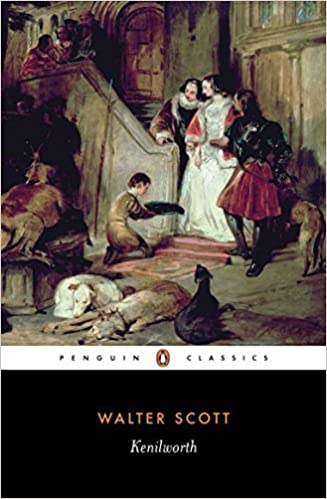
Reading Kenilworth for the Classics Club Spin made me contemplate the question of how important it is in a historical novel to stick to the historical facts. Of course, historical novels are fiction, so by definition something is invented. And there have been really interesting historical novels where the author purposefully changed some facts to speculate on other outcomes. But do historical novels have the license, just for a more dramatic story, to change what actually happened?

Kenilworth is the novel that famously reawakened interest in the story of Amy Robsart’s death. Amy Robsart was the wife of Robert Dudley, the Earl of Leicester, during the reign of Elizabeth I. Amy’s death is the classic mystery of did she fall or was she pushed? At the time of her death, the rumor in court was that Leicester colluded in her death because he believed he could then marry Elizabeth.

In the novel, Amy is a young bride who has run away from home for a marriage with Leicester that is secret because he is afraid for his position in court, having married without royal permission. Amy’s jilted fiancé, Tressalian, comes looking for her on behalf of her father, believing that Amy was seduced away from her home by Varney, Leicester’s master of horse.

Varney is the villain of this piece. He has Amy kept as a virtual prisoner, and eventually Amy has reason to fear for her life. So, she flees to Kenilworth, Leicester’s estate, where he is preparing to entertain Elizabeth and the court.

I fear that Scott has woven a romance with very little basis in fact, as he did with a Crusader-based novel I’ll be reviewing in a few months. First, in Kenilworth, Amy and Leicester are newly married when in fact they were married about 10 years. Next, their marriage was no secret; in fact, she was allowed to visit him in the Tower of London when he was imprisoned by Queen Mary as a relative of Lady Jane Grey. Did Leicester have a hand in her death? I read a novel a while back that posited that (it may have been Alison Weir’s The Marriage Game, but I’m not sure), but we’ll never know. More recently, historians are inclined to believe that she simply fell down the stairs. By the way, she was not being kept captive in a moldy old house but visiting friends.

So, that is a strongish negative for me, at least. I could accept a premise that Leicester ordered his wife’s death because we don’t know, but playing with the chronology of the marriage for drama’s sake (and to have a younger, dewier heroine) and making it a secret (as it was also in a movie I saw several years ago) is throwing in a bit too much fiction.

On the positive side, Scott’s descriptions of the Elizabethan court are vibrant and his attempts at Elizabethan dialogue are convincing. Also, if he was not distorting history I’d say that his plot is quite suspenseful. At the time of its publication, historians slammed The Talisman just because Scott created a fictional Plantagenet, even though he did much worse things historically in that book and in this one.

Related Posts

Guy Mannering

Waverly

The Marriage Game