Review 1549: The Strange Case of the Alchemist’s Daughter

Readers Imbibing Peril XV was just announced for books in September and October, and just by coincidence, here is my first entry.

Theodora Goss must really like Victorian and earlier monster stories. In The Strange Case of the Alchemist’s Daughter, she brings together characters inspired from Robert Louis Stevenson, H. G. Wells, Mary Shelley, and Bram Stoker, adding in Sir Arthur Conan Doyle and Nathaniel Hawthorne for good measure.

Mary Jekyll’s mother has just died, and Mary has been left in near poverty. While going through her father’s papers, she finds that her mother was paying monthly sums for the support of Hyde. Thinking that if Mr. Hyde was alive, he might be responsible for the series of grizzly Jack the Ripper murders, she goes to Sherlock Holmes to find out how she might investigate and claim the reward for solving the case.

Dr. Watson comes with her to the address on the invoices to what turns out to be a home for fallen women. There they find, not Mr. Hyde, but a teenage girl named Diana Hyde, who calls her sister.

When Mary and Diana continue to investigate their father’s papers, they take up with Beatrice Rappachini, whose father changed her to breathe poison; Catherine Moreau, half woman, half panther; and Justine Frankenstein. They all begin working with Holmes and Watson to try to solve the killings.
At first, this seemed like a fun book for light reading. It was written in a jaunty style, with characters interrupting as Catherine writes their story, and it seemed entertaining and clever. By 50 pages in, I felt I had figured out everything important, just not the details. By 100 pages in, the story was beginning to flag. The characters didn’t have discernible personalities. It struck me that Holmes, for example, is described as being full of himself when he hasn’t behaved that way.

I finally stopped about halfway through, because I still had 200 pages to read and I wasn’t enjoying myself. What had started out seeming a clever idea got old and was too over the top.


Related Posts

Dust and Shadow

The Bloody Chamber

The New Annotated H. P. Lovecraft: Beyond Arkham

Review 1548: Daddy: Stories

The description of Daddy says that its stories explore the balance of power between the sexes. I did not find that to be the theme of every story, although it is for some. The book does explore the psyche of some unlikable people, many of whom are privileged and belong to show business or to the edges of the business. This is a world I’m not much interested in, so I felt little connection to these stories.

In “What Can You Do with a General,” John, who used to have anger issues, struggles to connect with his grown children over the holidays. In “Los Angeles,” Alice, a sales girl for a small store that plays up sexy women in the dress of its employees and its decor, begins selling her own underwear to men. In “Menlo Park,” Ben, who was fired from his job in disgrace, runs into trouble again while editing the autobiography of a controlling millionaire. In “Son of Friedman,” a once-famous director attends the opening of his son’s abysmal film with his old best friend, a still-famous actor. In “Nanny,” Kayla deals with the fall-out of having been caught having an affair with her married employer, a movie star.

link to NetgalleyAnd so on. I can see that the stated theme works for most of these stories except “Son of Friedman,” which, as with some other stories, is about the relationship between fathers and children. I found this collection disappointing after Cline’s excellent novel, The Girls.

Related Posts

The Girls

Beautiful Ruins

A Circle of Wives

Review 1547: The Mistress of Husaby

In this second volume of Kristin Lavransdatter, Kristin has finally won through on her determination to marry Erlend Nikulaussön. The novel starts with them journeying to Erlend’s estate of Husaby to take up their residence. Kristin finds the estate poorly managed and the serving people slovenly and lazy, so she goes about setting all to rights.

To gain Erlend, though, Kristin has committed many sins, and much of the first part of the novel deals with her relationship to God. Although the preoccupations in this section certainly reflect the times, I found them to be heavy going. Later, though, the novel caught more of my imagination as it dealt with Erlend and Kristin’s marriage, her relationship to her father, and the political situation under first a regent, and then King Magnus.

This trilogy approaches its story by employing an old-time style of writing that does not seem forced and works for its subject. It is clear that Undset was an expert on 14th century Norway. Although at times I found it a little hard to follow, especially in the implications of the dialogue, the novel is very interesting.

Related Posts

The Bridal Wreath

The Greenlanders

The Last Hours

Review 1546: Murder in the Crooked House

I made several attempts to read Murder in the Crooked House, but it irritated me so much that I stopped even before the famed detective came on the scene. It was published in 1982, but it reminded me more of the super-complicated mysteries of 40 or 50 years earlier that concentrate mostly on the puzzle.

First, Shimada introduces the maze-like house built by the eccentric millionaire Kozaburo Hamamota, a house so absurdly unlikely that it is laughable. Then, he introduces us to a plethora of characters, barely bothering to differentiate them. By 100 pages in, I could only tell apart a handful of them.

Without further ado, including any explanation of the relationships between the characters, he has a strange phantom appear at an upper-floor window followed by the murder of the chauffeur. Two bumbling detectives arrive.

Even the way the characters are introduced, with one character giving an elaborate introduction of everyone else, seems totally contrived. I give up.

Related Posts

Number9Dream

1Q84

Thirteen Guests

Review 1545: They Were Found Wanting

They Were Found Wanting is the second book of Bánffy’s Transylvanian Trilogy. It again follows the fortunes of cousins Balint Abady and Laszlo Gyeroffy, Hungarian/Transylvanian noblemen, although it spends much more time with Balint.

In the first book, Balint began an affair with Adrienne Uzdy, married to a cruel and unstable neighbor of Balint’s Transylvanian estate. They resolved to part in that book but come together early in the second book. Balint wants Adrienne to divorce Uzdy, but Adrienne fears Uzdy will become violent. Moreover, she will likely lose custody of her daughter.

Laszlo started on the path of destruction in the first book after his cousin Klara rejected him because of his gambling. He has been cheated out of most of the profits from his estate by Azbej, a crooked lawyer, and he is drinking what little money he has. Early in the book, Dodo Gyalakuthy, who is so wealthy that no one will propose to her, asks him to marry her. Laszlo is stung by this and refuses, not realizing that Dodo loves him.

Balint is a member of the Hungarian Parliament, and much of this book is devoted to the machinations of the political parties, who manage to accomplish nothing because of their efforts to prevent the work of the other party. All the while, Balint is conscious of disquieting events in the outer world as it heads to World War I.

I struggled with this book a bit and actually read three other books while I was trying to finish it, something I seldom do. For one thing, there was a much stronger emphasis on Hungarian politics, but I didn’t understand all the ins and outs or sometimes who was whom. The first book came with about 100 pages of explanatory material, but I seldom read things like that and would hope a novel would be understandable without it.

For another thing, the major emphasis was on the affair between Balint and Adrienne, and I wasn’t much interested in it. Although Bánffy certainly can depict vivid characters, Adrienne isn’t one of them. She is almost there only to be the object of Balint’s yearning. You never get much of a sense of what she is like.

Finally, in some ways, Balint began this affair in a reprehensible way, and when he decides they should marry, he is merciless with the emotional blackmail. Otherwise likeable, he is not a nice lover in this book.

Throughout, the most interesting thing to me are Bánffy’s descriptions of customs and life in Transylvania. I am interested in how the third book will come out. Thank goodness it’s not nearly as long as either of the others.

Related Posts

They Were Counted

Between the Woods and the Water: On Foot to Constantinople: From the Middle Danube to the Iron Gates

The Great Fortune

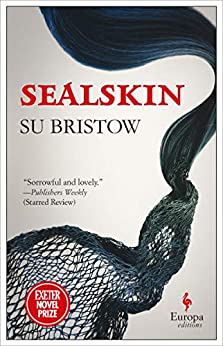
Review 1544: Sealskin

Ever since I heard Joan Baez sing “Silkie,” I have been fascinated by stories of selkies. They don’t seem to feature very often, but a few years ago, I reviewed an intriguing one in The Sea House.

In Sealskin, Su Bristow explores the legend, in particular one about a man who finds a selkie and hides her sealskin so he can keep her. This novel is set in as realistic a way as you can get in a story about a selkie (except in The Sea House).

Donald is a misfit in his Scottish fishing village because of a skin disease. Although his uncle Hugh would like him to crew with him, he avoids going out on the fishing boat because of taunts from the crew. He spends most of his time avoiding the other villagers.

One night he goes crabbing and sees seals on a rocky ledge. They take off their skins and become young maidens and dance. Thinking of the value of the sealskin, Donald steals one, and when the maidens are frightened into donning their skins and swimming away, one cannot leave.

Donald captures the selkie and in a fit of madness, rapes her. When he takes her home to his mother, Bridie, she tells him he can’t send the girl back because she knows she is with child. Bridie tells him he must marry the girl, whom they name Mairhi, and pretend he met her months before in another village.

Mairhi cannot speak but shows she is very unhappy. Donald doesn’t want to marry her, despite his mother’s warnings, so he goes back to find her skin, but it is gone.

Although I have an objection to love stories that start with a rape—a technique that used to be used often in romance novels—Bristow handles this story of love and personal growth tremendously well. It’s a touching novel about consequences.

Related Posts

The Sea House

A Strange Scottish Shore

At the Water’s Edge

Review 1543: The Bookshop

I decided to read The Bookshop after seeing the movie of the same name. The two are very similar, but the movie doesn’t convey the subtlety of the book, which is a little more remorseless.

Post World War I, the widow Florence Green decides to open a bookshop in her East Sussex village of Hardborough, which does not have one. For the premises, she purchases the Old House, which has been vacant for seven years and is in need of a lot of work. It is also rumored to be haunted.

Her aims seem worthy and harmless, but no sooner does she purchase the Old House than a local worthy, Mrs. Gamart, invites her to a party only to inform her that she, Mrs. Gamart, intended the Old House for an arts center. Florence has no idea who she’s dealing with when she asks Mrs. Gamart why then she didn’t buy the house any time in the past seven years and refuses to let it go.

This novel seems to be light fare, but it has some cynical observations about small-town gentry and betrayal. It is short, fully engaging, sparely and beautifully written, and sad.

Related Posts

Sofia Petrovna

Expiation

Fidelity

Review 1542: Wild Fire

After a strange incident on the beach when kids taunted an autistic boy, that boy, Christopher, finds the nanny of another family hanged in an outbuilding on his family’s property. His parents, Daniel and Helena Fleming, have not found a welcome in the small village of Deltaness, especially since the previous owner hanged himself in the same outbuilding after they built their new house.

Jimmy Perez comes out to the scene and realizes immediately that the girl, Emma Shearer, was murdered, because there is nothing in the building she could have stood on to hang herself. She was the nanny for the Moncrieff children and had been with them since she was 17.

Jimmy summons the CSI team and his boss, Willow Reeves, to the scene. But when Willow arrives, she has news for him. She is pregnant, and he is the father. Jimmy, still confused by the death of his fianceé, Fran, has an unpredictable reaction.

Working on the case, the team has difficulty getting any sense of Emma. It is early established that she had a relationship with Daniel Fleming, but although he admits to having been obsessed with her, he claims they did not have an affair.

This was one of Cleeves’s difficult mysteries, especially as, although there are hints, the perpetrator is not very present in the book. Sadly, this is the last book in the Shetland series, but it’s possible that we’ll see more of Jimmy and Willow.

Related Posts

Cold Earth

Thin Air

Dead Water

Review 1541: The Sun Down Motel

Best of Ten!
In 1982, 20-year-old Viv has run away from her home in Illinois to go to New York City. Out of money, she stops in Fell, New York, and takes a job on the night shift of the Sun Down Motel. Very soon, two things become certain—the motel is haunted, and a lot of girls get murdered in Fell.

In 2017, Carly finds out after her mother’s death that her mother had a sister who disappeared in 1982. Carly decides to travel to Fell, New York, to try to find out what happened to her. When she makes a trip to the Sun Down Motel to ask about Viv, she ends up taking a job on the night shift. Soon, she is investigating a series of women’s deaths beginning in 1979 and ending in 1982.

I don’t very often give five-star ratings in Goodreads and especially not for genre fiction, but this one is terrific. It’s wildly atmospheric, with its haunted old motel, and it has an ending that puts it a step higher than most of the genre. It has a compelling mystery and two exciting endings, one in each time period. A touch of romance doesn’t hurt it, either. I had great fun reading this book.

Related Posts

The Broken Girls

Lost Among the Living

Silence for the Dead

My Latest Haul

Last month I was busy writing to publishers to request review copies of their newest books. Just this week, I reaped the rewards of a few emails with shipments from some of my favorite British publishers! I can’t wait to dip into these. In fact, I already have, reading Dangerous Ages right away.

The books I received are as follows:

From the new British Library Women Writers series, I received My Husband Simon by Molly Panter-Downes and Dangerous Ages by Rose Macaulay.

The Furroughed Middlebrow series of Dean Street Press sent me Somewhere in England by Carola Oman and Beneath the Village Moon by Romilly Cavan.

From Persephone Press, I received One Woman’s Year by Stella Martin Currey.