Review 1533: The Mystery of the Peacock’s Eye

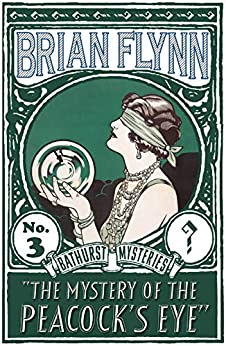
A mysterious man dances with Sheila Delancy at the Hunt Ball, the same night the Crown Prince of Clorania is rumored to be there. Some months later, a young woman is murdered in a dentist’s chair in Seabourne, and Detective Bannister is called away from his vacation to take charge.

A few weeks before, Anthony Bathurst is requested by the Crown Prince of Clorania to look into a case. Someone is attempting to blackmail him over an affair with a young woman. Soon, Bathurst begins to suspect that the two cases are related.

While I enjoyed the first book in this series, I thought this one was a bit of a cheat. That’s because only one piece of information links the killer to the case, and we don’t get to hear that conversation. The plot has a clever concept, but there’s no way a reader could guess the solution.

Related Posts

The Billiard-Room Mystery

Death Has Deep Roots

The Red House Mystery

Review 1532: Tidelands

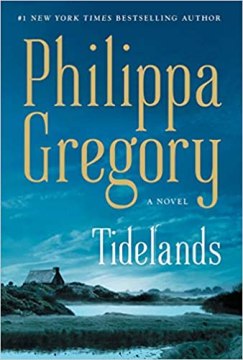
For years, I read Philippa Gregory’s books faithfully, but at some point I decided that she was just cranking them out, so I stopped. I felt that less attention was going to such things as fully realized setting and well-rounded characters.

Recently, however, I noticed that she was doing something different with Tidelands, so I thought I’d give her another try. This book is set in the 17th century and features a heroine living in poverty.

Alinor is a wise woman—a healer and a midwife who does not deal in magic and charms and is very concerned, as she has to be, about her reputation. It is in jeopardy, because her husband has disappeared, and if he has deserted her, she will be considered a loose woman. So, on Midsummer’s Eve at midnight, she goes to the church believing she will see the ghost of her husband if he is dead.

She does not see her husband but a total stranger. He is a young man, a gentleman in difficulty, who introduces himself as James Summer but is a Catholic priest in a time when Catholicism has been banned in England. He is traveling and was supposed to find refuge with Sir William Peachey, but Sir William is not home. Although she is Protestant, Alinor is not much concerned with religion, so she gives him refuge overnight in her shed and leads him through the marshes in the morning to consult with Sir William’s steward.

As a result of her actions, Sir William gives her son a place as his son’s companion. This is a step up for him, and she is grateful. James Summer masquerades as a tutor for Sir William’s son, but he is really there to help free King Charles, in prison on the Isle of Wight.

Unlikely enough, I thought, James and Alinor fall in love. James begins to lose faith in his religion and his king as events progress. But he is a priest, and Alinor is married, and on the Isle of Wight, he encounter’s Alinor’s husband, who does not intend to return.

For a long time I found the situation unconvincing and considered dropping the book. The ending, however, was surprising and affecting, so I’ve changed my mind. I’m willing to try the second book of this series.

Related Posts

Merivel: A Man of His Time

Lark

Corrag


Review 1531: The New Annotated H. P. Lovecraft: Beyond Arkham

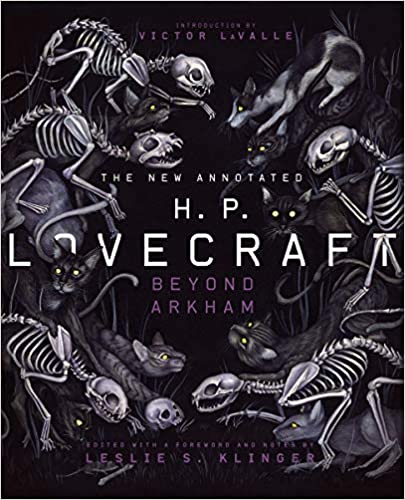
I picked up this collection of gothic stories from the library so that I could read one of them, “The Doom That Came to Sarnath,” for the 1920 Club. Then I decided to read the rest of this beautifully presented book.

It’s hard for me to know what to say about it, because this type of gothic horror story, which used to appear in such magazines as Weird Tales, is just not my thing. On the other hand, it is almost definitely for people who like this genre. I prefer my scary stories to be about things that could happen or about ghosts, but Lovecraft is clearly drawn to grotesque creatures, dark family histories of the most freakish, and ancient rituals and beliefs become reality.

That he was deeply knowledgeable in the latter and often based his stories in actual locations or history is attested to by the many annotations and pictures in the margins of this book. That his writing is heavily dependent on description, some of it highly florid, is also certain. He loves using adjectives and adverbs, many of them unlikely, such as describing ruins as “hideously ancient.” In fact, he seems to have a fascination and repugnance for old things, both at the same time—or at least his narrators do.

The earlier stories are very short, only a couple of pages, while the later ones get longer and longer, so that I finished about half of the book but more than 3/4 of the stories.

Some of the more notable stories are “The Shunned House,” based on an actual house in Providence, in which the inhabitants seem to die off; “The Rats in the Walls,” combining a haunted house story with one of his favorite themes of a dark, hidden family history; and “The Outsider,” about a being who discovers he lives in a crypt. One of the stories, “Ex Oblivione,” described as a prose poem, I was unable to finish, but the rest were entertaining enough, just not my thing.

Related Posts

The Doom That Came to Sarnath

The Bloody Chamber

Tales of Mystery and the Macabre

Review 1530: The Last of Chéri

The Last of Chéri is the second novella by Colette about Chéri and Léa. I try to avoid spoilers, but in this case I can’t avoid one, although it is actually about the previous novella, Chéri.

At the end of Chéri, Léa, Chéri’s middle-aged lover, made a sacrifice of her own love by separating from the young Chéri so that he could grow up. Now, it’s six years later. World War I has intervened, during which Chéri received a medal he didn’t exactly earn. His wife, Edmeé, is heavily involved in running a hospital and is in love with its lead physician. During the war, Edmeé and Charlotte, his mother, took over managing his fortune, a task that he was good at, and he doesn’t know how to ask for it back. His friends have been killed or have gone to work. In short, Chéri feels no purpose in life. The old ways of living for pleasure are dead, and in any case, he finds them boring.

Chéri hasn’t thought of Léa for years, but with her he was loved. He wonders if he can return to her.

I frankly didn’t much like the Chéri of the first novella, but I have more sympathy with thirty-year-old Chéri, even though I regret the solution he finds for his problem. Ultimately, this book is an indictment of how he was raised, and I eventually found it touching.

Related Posts

Chéri

Red Pottage

The Collector’s Apprentice

Review 1529: The Second Sleep

There are some authors whose books I’ll buy immediately, and Robert Harris is one of them. This means that I haven’t always read what the book is about, and I seldom read the jacket to remind myself before I begin reading, even if I did when I bought the book. Generally speaking, Harris writes excellent historical novels. So, I was reading along, thinking I was in the 15th century, when I suddenly realized I was reading a dystopian novel set far in the future.

After a cataclysmic event, the world has gone through another dark age, and England has emerged into a pre-industrial-age society ruled by the church with a culture that is superstitious and suspicious. Christopher Fairfax is a young priest who has been dispatched by the bishop of Exeter to a small village, Addison St. George, to see that the recently deceased local priest, Father Lacy, is buried.

Upon his arrival, he notices right away that Father Lacy was a heretic, for he finds a library and a collection devoted to the past, before the Apocalypse. Such studies are considered blasphemous, yet the father has a cache of such objects as plastic straws, Barbie dolls, and iPhones.

Fairfax also begins to fear that Father Lacy’s death may have been different than an accidental slip from a feared local structure called the Devil’s Chair. When he investigates, he finds a huge mass grave where Father Lacy had been digging, but it looks like Father Lacy was chased up the slope, which then collapsed.

This is an atmospheric novel, but I didn’t enjoy it as much as I have Harris’s previous novels. For one thing, the idea of the world going into a familiar religious-based Dark Age after a cataclysm isn’t exactly original. For another, the ending is quite abrupt, and I’m not sure how I’m supposed to interpret what Fairfax and the others ultimately find. It’s disturbing, yes, but what does Harris mean by it? I was also confused about something unexplained concerning the title. Harris includes a quote at the beginning of the book that tells us that Western Europeans used to sleep twice each night, waking and returning to sleep after midnight. During his first night in the village, Fairvax awakens to realize that the villagers have all gotten up and gone out, despite an apparent nationwide curfew. All along I was expecting some weird explanation for this. Instead, Fairfax himself is incurious about it, and what the villagers are doing is never explained. Yet there’s the book’s title, which I assume does not refer to this event but to the second dark age.

Related Posts

Oryx and Crake

The Testaments

Parable of the Sower

Review 1528: The Janus Stone

In the second Ruth Galloway mystery, Ruth is called to a dig at a site of a mansion being converted to luxury flats, because bones are discovered under a doorway. The bones are a child’s, and Ruth is inclined to believe that the grave is more recent than otherwise.

DCI Harry Nelson begins looking at the building’s past as a children’s home. During that time, a teenage boy and his five-year-old sister disappeared. But the teeth put the death a little earlier, when the original family resided there.

This case hits Ruth a little more personally because she is pregnant. The child is Harry’s, the result of an emotional night during the last case, but Harry is married. Then someone begins leaving unpleasant surprises for Ruth.

Like with the first book, I easily guessed who the culprit was, in fact, almost as soon as the character appeared. It is hard for me to tell whether this would be obvious to most readers. I am interested in the characters, though, so I enjoyed the novel and look forward to reading more of the series.

I do want to say something about my Quercus paperback edition, which was not impressive. About halfway through the book, I came across a sticker that was printed over by the text of the book. Later, a half page cut zigzag fell out of the book. When I turned to that page, I found that half of the text was on the zigzag page and half was on the page fastened into the book, which was whole, leaving a zigzagged half-blank page. If the loose half page had fallen out of the book before I got it, I would not have been able to read that page.

Related Posts

The Crossing Places

Red Bones

206 Bones

Review 1527: They Were Counted

They Were Counted is the first volume in Miklós Bánffy’s Transylvanian Trilogy, about the decline of Hungary leading up to World War I. This book follows the events in the lives of two cousins, Balint Abady and Laszlo Gyeroffy. Both are noblemen who feel like outsiders in Hungarian society, Balint because he is Transylvanian and Laszlo because his prospects are not so good.

Balint has been working in the diplomatic service, but he decides to run for Parliament, never suspecting after he wins that votes have been bought on his behalf. He is dismayed to find that the Hungarian Parliament’s two parties are more concerned with scoring off each other than with getting anything done. Early on, too, there are hints that Parliament’s independence is threatened by the Austrian King Franz Joseph.

Likewise, when Balint decides to take more interest in running his estate, he has no idea that the lawyer Azbej, who has been helping his mother run the estate, has been making so much money off it. When he goes to Translyvania for forest management and with ideas about improvements for the peasant villages, he is unable to make much progress as he is seen as a Hungarian interloper.

Finally, Balint has discovered that he is in love with his old friend, Adrienne. Unfortunately, she has married since he was working abroad. Moreover, she has been sexually mistreated by her husband.

Lazslo is a musician who has withdrawn from law school and devoted himself to catching up on his musical studies. He is also in love with his cousin Klara but has no idea that her stepmother will not accept him as Klara’s suitor. Laszlo’s plans to become a composer are derailed when he gets involved with gambling.

This novel paints a picture of Transylvanian and Hungarian society of the time, with descriptions so vivid that I felt as if Bánffy was describing people, rooms, and landscapes that he knew, as he probably was. There are lots of characters, and it is sometimes difficult to remember who all of them are. I also found it a little difficult to understand the politics. Still, I found the novel very interesting.

Related Posts

The Spoilt City

Between the Woods and the Water: On Foot to Constantinople: From the Middle Danube to the Iron Gates

Dracula

Review 1526: Olive, Again

Best of Ten!
Reading Olive Kitteridge years ago was a revelation to me, first about structure—how Strout could create a novel of a bunch of loosely connected stories—and second about her empathy for her characters, ordinary people in a small Maine town. Finally, there was that force of nature, Olive herself.

Olive, Again is no disappointment. This novel is structured much the same as Olive Kitteridge, stories about Olive and stories in which she is a secondary character or is simply mentioned or thought of. Olive herself is an old woman, who nevertheless toward the beginning of the novel embarks on her second marriage. The novel revisits her difficult relationship with her son, who brings his family for a disastrous visit that gives Olive insight into their relationship as well as that between herself and her first husband, Henry.

Olive is still her straightforward, brusque self, but many of the stories are about troubled people who feel better after encounters with her. Because they live in a small town, people who are the focus of one story appear or are mentioned in the others. For example, in “Helped,” Suzanne Larkin, from a disturbed family, has a heartfelt talk with her father’s lawyer, Bernie, whom Olive meets when she is living in an assisted living facility later in life.

Characters from some of Strout’s other books appear here, too, perhaps more characters than I remembered. Certainly, there are Jim and Bob Burgess from The Burgess Boys, a story about Jim and his wife visiting from New York, as well as Isabelle from Amy and Isabelle, whom Olive befriends in assisted living.

This is another warm and empathetic novel about complex but ordinary people. Strout is a master crafter of a tale.

Related Posts

Olive Kitteridge

The Burgess Boys

Amy and Isabelle

Review 1525: Manga Classics Les Misérables

I never wanted to read Les Misérables after seeing an old movie that started out with Jean Valjean bashing in the head of a kindly priest who had taken him in, all during an attempt to steal the church silver. That made me turn it off. However, just for grins, I decided to give the Manga Classics version a try.

This, of course, is the story of the redemption of the escaped prisoner Jean Valjean and his pursuit by the policeman Javert, set against the background of the Paris Uprising.

Obviously, I can’t tell how faithful it is to the original even though I have also seen the musical, but there are a lot of characters, so I’m guessing they made a good attempt. The art is not as beautiful as I’ve found in a few graphic novels (although it’s classic Manga style), but the characters are well drawn and easy to tell apart, and the story is easy to follow. I haven’t read any other Manga, so I can only compare it to other types of graphic novels, and it is definitely more dependent upon text than some that I have read (but not all).

As to the quality of the edition, there were some pages in which the tops of the letters were chopped off, although you could still read them.

Did I enjoy it? It was okay. The story seems full of schmaltz, but it was interesting enough for me to consider putting the original on my next Classics Club list.

Related Posts

Agatha: The Real Life of Agatha Christie

Adamtine

The Ukrainian and Russian Notebooks