A Century of Books: How Am I Doing? August Report

In January, I foolishly decided to join Simon Thomas’s Century of Book Challenge, even though I knew that reading 100 books, one for each year in a century, from 1925-2024, would be tough because last year I only read 169. So, how am I doing?

Here are the holes in my project with the books listed for this month below. If you want to see the details, see my Century of Books page.

I read a lot fewer books in August than usual because first, I was traveling, and second, I got sick.

  • 1925-1934: entries needed for 1928, 1929, and 1931
  • 1935-1944: entries needed for 1939 and 1944
  • 1945-1954: entries needed for 1945, 1948, 1949, and 1950
  • 1955-1964: entries needed for all years except 1956, 1958, 1959, and 1962
  • 1965-1974: entries needed for 1967, 1969, 1971, and 1973
  • 1975-1984: entries needed for all years except 1975, 1976, and 1978
  • 1985-1994: entries needed for all years except 1987, 1992, and 1988
  • 1995–2004: entries needed for all years except 1998, 1999, and 2004
  • 2005-2014: entries needed for all years except 2009, 2010, 2012, and 2014
  • 2015-2024: complete!

Since July 31, I have read the following books:

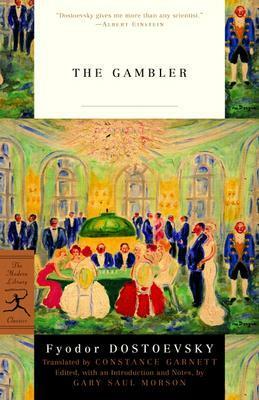
  • The Gambler by Fyodor Dostoevsky from 1866 (too early to count for this project)
  • Envy by Yuri Olesha from 1927
  • Their Eyes Were Watching God by Zora Neale Hurston from 1937
  • A Chelsea Concerto by Frances Faviell from 1959
  • The Book of Lamentations by Rosario Castellanos from 1962
  • Broken by Karin Slaughter from 2010
  • The Raging Storm by Ann Cleeves from 2023
  • The Witching Tide by Margaret Meyer from 2023
  • The Bee Sting by Paul Murray from 2023
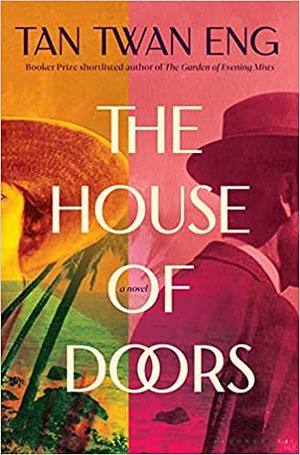
  • The House of Doors by Tan Twan Eng from 2023

If I Gave the Award

Now that I have posted my review of the last of the shortlist for the 2020 Pulitizer Prize for Fiction, it’s time for my feature in which I decide whether the judges got it right. The Pulitzer Prize tends to choose only three books for its shortlist, so in some ways the choice is easier, in some ways more difficult. In this case, two of the choices were ones I really liked.

Let’s start with the one I didn’t like as much, The Topeka School by Ben Lerner. Now, there is nothing intrinsically unlikable about Lerner’s books, it’s just that they’re all about himself, as evidenced by his alter ego, Adam Gordon, being the protagonist for all and having a biography very similar to his own. I’m saying this on the basis of two books, but I think it’s true. The novels are somewhat funny, poking subtle fun at himself, and he is obviously into wordplay, but I guess I just don’t like him very much. In this case, the novel focuses on Adam’s high school years, his relationships with his friends and girlfriend, and his prowess on the debating team.

The choice between the other two novels is difficult for me. The Dutch House was my favorite Ann Patchett novel until she wrote Tom Lake, and frankly, they’re pretty much a tie for me. It’s about the disastrous effects on his children of a father’s lack of understanding, almost a willful blindness, of both his first wife, the children’s mother, and his second. It’s about the consequent loss of his children’s inheritance, the Dutch house, and their fascination with it. And it’s about the closeness of siblings who only had each other to rely on. I really love this book.

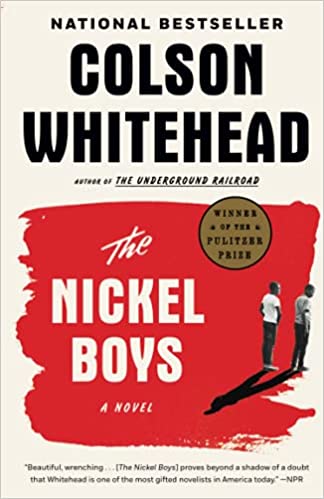
I was gripped, though, by The Nickel Boys by Colson Whitehead, the winning book. It’s a historical novel about the mistreatment and even murder of black boys in a Florida school for boys, aka, a detention center, based on the true history of the Dozier School for Boys. Its protagonist, Elwood Curtis, is a right-minded boy who makes the mistake of accepting a ride from a stranger in what turns out to be a stolen car. Once incarcerated in the school, he begins collecting a record of the abuses he sees.

It’s not hard to see why the judges picked The Nickel Boys over The Dutch House, a more personal novel. But that’s what I like about it. Both novels touched me emotionally, so I guess this time I declare a tie. I didn’t love The Nickel Boys as I loved The Dutch House, but it is extremely powerful. They are both very good novels.

Review 2470: The Topeka School

It’s unfortunate for me that Ben Lerner’s books seem to be devoted mostly to exploring his own psyche, as evidenced by his main character’s biographical details matching his own, because I’m not much interested in his psyche. Sadly, his books keep ending up on the shortlists of the projects I’m pursuing. This one is from the shortlist for the 2020 Pulitzer prize.

In The Topeka School, we encounter Adam Gordon, the protagonist of Leaving the Atocha Station. In this novel, he is sometimes older, sometimes younger than in the other, but the bulk of the novel is set in 1997, when Adam is a senior in high school.

Adam is the son of two psychoanalysts who work at the Foundation, a prestigious psychiatric hospital. His mother Jane has become famous by publishing a popular book about the relationships between men and women, and his father Jonathan works mostly with disturbed teenage boys. Adam is navigating relationships with friends, sex with his girlfriend Amber, and preparations for debating competitions.

Lerner has a fascination with words, and words play an important part in the novel. For example, Adam’s high school group includes a boy named Darren he’s grown up with who is behind developmentally. Although the group has been taught not to leave Darren out, inclusion involves submitting him to indignities, like leaving him to walk home from the lake after a party. But mostly, he is called names. Names are what hurts him most.

Aside from being a champion debater, Adam likes to participate in rapping with his friends (I’m probably using the wrong words) even while realizing that he and his upper-middle-class friends have little in common with the people they’re imitating and no true understanding of the idioms they’re using.

We also periodically check in with Darren, who has feelings he can’t express. And there’s Jane, who begins receiving abusive phone calls from men after her book is published. She responds by pretending that the phone connection is poor, so she can’t hear, which eventually makes them hang up.

One of the funniest scenes in the book is the first one, where Adam is in a boat with his girlfriend at night. He is pontificating about something only to realize that his girlfriend has left the boat and swum to shore. Later, when he finds her again, she tells a story about sneaking out of the room while her stepfather is talking, and he doesn’t notice that no one is there. Adam does not at this point understand what this story has to do with him.

Then there is a type of debating described in great detail, where the object is to present as many points as possible as fast as possible even if they are ridiculous, because the opponent loses points for missing an argument. And at several points, characters speak gibberish .

All the while, there is a tension going on between Adam’s pro-feminist familial upbringing and the hyper-masculine society he’s lived in as a young man. Unfortunately, although Jane is a great character, she isn’t very important in the novel. Nor are the other women. Only Adam is important.

The novel explores the past of the family and how it affects the present, using Jonathan, Jane, and Adam as narrators. But really, almost all of it is about Adam.

Related Posts

Leaving the Atocha Station

Edinburgh

Straight Man

Review 2469: Turn, Magic Wheel

I became interested in Dawn Powell after hearing a story on NPR about her being buried in an unmarked grave in Potter’s Field after being a well-known writer. That made me look for one of her books, and I found this one, a social satire about 1930s New York.

Dennis Orphen has just published his latest book, based on the life of his best friend Effie, the ex-wife of a famous Hemingway-like writer, and only thinly disguised. It is not until he sees Effie’s reaction that he realizes she might not take it well.

Although Andy Callingham left her years ago for Marlene, Effie is still waiting for him to return. His likes have become hers, and she endlessly talks about their past. Dennis reflects that she was once independent enough for Callingham to leave, but he wonders what is left of the Effie she was before.

While Dennis meets his married lover, Corinne, visits the social scene (whose members are probably easily recognizable to Powell’s contemporaries), and visits his publisher in a series of fairly brutal satiric scenes, Effie is summoned to Marlene’s hospital bed. Marlene has fled because of Andy’s interest in a young Swedish actress, but now she is dying. The hospital calls Effie because they share a last name.

For the first time since he left, Effie contacts Andy to summon him to Marlene’s deathbed. While they wait, Effie is subjected to Marlene’s ramblings, just as besotted as Effie’s own. Will Andy come or not? If he does, who for?

For me, the funniest thing about this book is its depiction of “Hemingway,” who I always knew was an egotistical jerk. I’m sure if I was more familiar with the 30s social scene, I would recognize other characters. No one in this novel is absolutely likable, although Dennis comes out better than he starts, and Effie is simply deluded.

As for the writing, it’s sharp, with witty dialogue, betraying a wicked eye.

Related Posts

Mrs. Martell

Lucky Jim

The Fawn

WWW Wednesday!

I meant to do WWW Wednesday last week, but I was traveling and sick, not a good combination. So, here goes today. What is WWW Wednesday (not my original idea)? It is simply a post about what I just read, what I’m reading now, and what I think I’ll be reading next. If you would like to join in, leave a comment about your recent reading experience.

What Am I Reading Now?

I am reading The House of Doors by Tan Twan Eng and finding it very interesting. It’s so far about a visit that Somerset Maugham made to Penang in the 1920s, but I think it’s going to change soon to be about Sun Yat Sen. I am reading it for my Walter Scott Prize project, but I so much enjoyed The Garden of Evening Mists that I probably would read it anyway.

What Did I Just Finish Reading?

I just finished rereading Their Eyes Were Watching God for my Literary Wives club. I found that I felt pretty much the same about it as I did last time, but I found that reading almost the whole book in dialect was really tiring. Maybe that’s because I haven’t totally recovered yet, but it’s true that dialect is hard on the reader.

What Will I Read Next?

If it arrives before I start another book, I will read The Gambler by Fyodor Dostoevsky for the 2024 Dostoevsky Read-a-Thon hosted by Russophile Reads. I thought I had a copy, but I seem to have almost all Dostoevsky except that. Then I thought the public library would have it, but no, although in general it is a much better library than the one in Austin was while we lived there. (They finally have a new one after talking about it forever.) If it doesn’t arrive before I finish The House of Doors, then I will probably give myself a break from literary books and read Broken by Karin Slaughter, the next in her Will Trent detective series.

What about you? What are you reading?

Review 2468: The New Magdalen

In The New Magdalen, Wilkie Collins has written a sensation novel that is by definition quite melodramatic. The subject, as you might guess from the title, is the reformed prostitute.

That’s what Mercy Merrick is, although she first appears as a nurse on the battlefield of the French/German war. An Englishwoman, Grace Roseberry, is stranded there on the way to England to live with her father’s friend, Lady Janet Roy, after her father’s death. Unfortunately, she was robbed on the way and has only her letter of introduction.

Grace confides in Mercy and then pressures her to confide in her, but she is not at all sympathetic to Mercy’s story of being forced by starvation into prostitution. Mercy reformed after hearing a sermon by Julian Gray, but every time she took a respectable position with the full knowledge of her past by her employers, she lost it once the servants or neighbors found out.

Mercy has loaned Grace some clothing. When after an attack, Grace is pronounced dead by the French doctor, Mercy takes her clothes and letters of introduction and assumes her identity, trying to get a better future.

Several months later, Mercy (now called Grace, confusingly) is Lady Janet’s adopted daughter and is betrothed to Horace Holmcroft. However, she can’t find it within herself to set a date without telling Horace the truth.

Then Julian Gray arrives. It turns out he is Lady Janet’s nephew. He has taken an interest in the case of a woman who has been hospitalized in Germany and claims to have been on her way to live with Lady Janet. Of course, this is the real Grace.

In Mercy’s absense, Grace appears and accuses her of stealing her identity. But Lady Janet doesn’t believe her and finds her offensive. And in fact, Collins depicts her as a horrible person.

That’s the message, really—the despicable virtuous woman versus the saintly ex-prostitute—for Mercy eventually decides to make things right.

Some of the Victorian values in this one are hard to stomach, but Collins knows how to keep readers interested in his story.

Related Posts

The Dead Secret

Hide and Seek

Basil

Review 2467: The Birds of the Innocent Wood

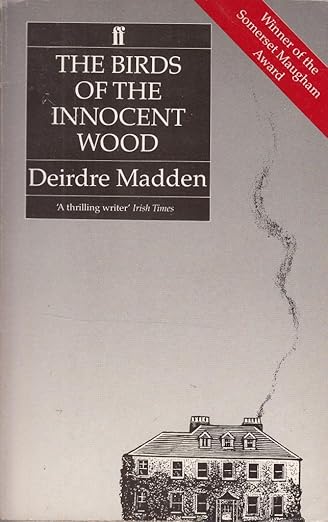
Jane has grown up with no one to love or to love her, which has made her have difficulties relating to others even though she is lonely. Her parents died when she was very young, leaving her to an unloving aunt, who put her in convent school when she was five. When she left school, her aunt only wanted her to take care of her in her old age. But Jane meets James, a young farmer, and hopes to make her own family.

Years later, Jane has died and her twin daughters, Sarah and Catherine, each have a secret that involves the other. They live with their bereft father on the farm, Sarah doing most of the work because Catherine is ill.

This is a beautifully written novel about people’s essential loneliness and unknowability. Madden is not a revealing writer. Rather, she offers glimpses into her character’s minds. This is a novel to ponder.

Related Posts

The Wren, The Wren

Faith Fox

Sight

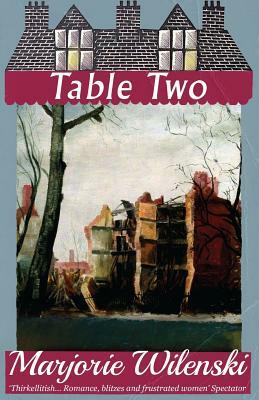
Review 2466: Table Two

One of the main characters of Table Two is more of an antihero. It’s Elsie Pearne, a bitter, disillusioned middle-aged woman who works for the Translation Office of the Ministry of Foreign Intelligence. She is intelligent and hard working, but she has a chip on her shoulder and a tendency to paranoia and doesn’t understand that it’s her own behavior that makes people dislike her.

She works at Table Two of the translation office with some eccentric coworkers. One blasts the room with cold air every morning while another can’t stop talking. A third takes delight in others’ misfortunes.

At the beginning of the novel, London has not had much of a problem yet with bombing, so the Ministry employees are simply bored and frustrated during the frequent occasions when they have to take shelter during the workday. But soon that changes.

Offsetting the character of Elsie is that of Anne Shepley-Rice, a young woman of the upper class who comes to work in the department. Elsie takes a fancy to her and takes her under her wing. But although Anne is grateful, she is much less invested in the friendship than Elsie is.

In the workplace, a plot centers around who is going to be appointed the Deputy Secretary of Table Two once the competent Mrs. Jury leaves for family reasons. The question is important because the Director, Miss Saltman, although a pleasant manager, is hopelessly disorganized, and Mrs. Jury does most of her work.

On the personal front, Anne feels she is hopelessly in love with Sebastian Kimble, her long-time friend and neighbor. Not only does Seb show no signs of wanting to settle down, but Anne’s family has lost its money, so she feels she is no longer a catch.

Although I’ve read quite a few novels set during World War II that are contemporary to that time, this is the first one that deals so much with the workplace. It is acerbically funny but also could be about a modern workplace, dealing with the same concerns of getting along with disparate people.

Elsie is not likable, and she creates her own problems, but I couldn’t help feeling sorry for her at times. Anne is sympathetic but a bit milk-toasty.

Related Posts

Mrs. Tim Gets a Job

The Halt During the Chase

Forest Silver

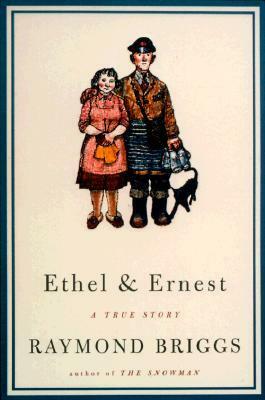
Review 2465: Ethel & Ernest

Ethel & Ernest is a completely charming graphic biography about the lives of Briggs’s parents from their meeting in 1928 until their deaths in 1971. The drawings are delightful, and the characters of the two emerge from the story.

Ethel is a lady’s maid and Ernest is a milkman when they meet. They marry two years later. The book shows their upward mobility starting with their purchase of a house that actually has a bathroom, to their astonishment, and continuing with their modifications and additions of appliances. Ernest is staunchly working class and pro-labor, while Ethel has pretentions to more, but through all, they are loving.

Through childbirth, World War II, and the Blitz, the privations of post-World War II Britain, and so on, the couple stick together and remain loving. The book has quite a bit of humor to it and is also touching. I was charmed by it.

Related Posts

Agatha: The Real Life of Agatha Christie

Ducks: Two Years in the Oil Sands

Britten and Brülightly

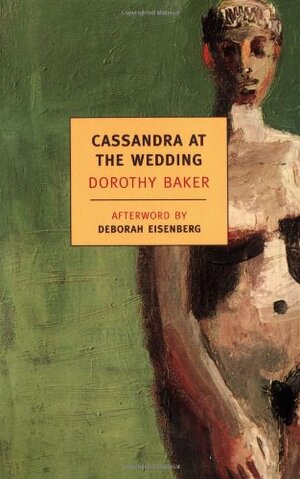
Review 2464: Cassandra at the Wedding

At the beginning of this novel, we meet Cassandra Edwards preparing to attend her twin sister’s wedding. Although her narrative is clever, entertaining, and disarmingly truthful, it is clear something is wrong.

Slowly we learn it is Cassandra’s intention to talk Judith out of the wedding, which she views as a horrible mistake. The Edwards have lived on their ranch as a self-contained until, intellectual, cultured, staying away from the affairs of others. When the girls began studying at Berkeley, Cassandra at any rate spent a lot of time with others, trying new things out. Despite having always tried to maintain their individuality, they finally decided, at lease according to Cassandra, that they only needed each other would move to Paris. But first, Judith decided she would try one year by herself studying music in New York. And now she has returned with a fiancé.

When Cassandra arrives at the ranch and we see the two women together, it seems clear that Cassandra is the less mature and more egotistical. She doesn’t seem to be able to see the situation from any point of view but her own. She is like a whirlwind of talk and distress, trying to push Judith toward her own goal. Cassandra does something drastic at the end of this section, but I don’t want to give it away.

In the second section, Judith narrates. We learn that although she loves Cassandra , contrary to what Cassandra believes, Judith wants to bet away from her. Judith is the calmer, more mature twin, and she finds Cassandra exciting but exhausting. I seems clear that Cassandra has attributed some of her own attitudes and ideas to both of them.

Cassandra may sound like an irritating character, but somehow she is appealing. We enjoy being with her as she navigates the rough seas of more maturity. I very much enjoyed this book, which has likable characters and looks honestly at the difficulties involved in finding an identity, especially if you’re a twin, and becoming one’s own whole person.

Related Posts

Beneath the Visiting Moon

Rhododendron Pie

Rebecca