Review 2463: The House Opposite

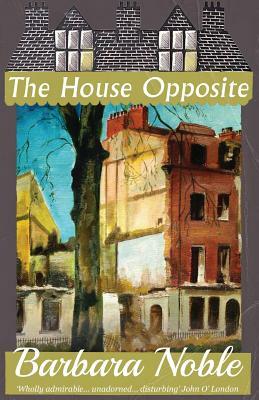
I didn’t like the main character of The House Opposite at first. Elizabeth is having an affair with her boss, a married man with two children, and she sees his wife and children only as people who get in the way of her happiness. She’s dating a young serviceman, Bob, simply to hide her affair. She apparently referred to the boy across the street as a “pansy” in his hearing, and the remark has made him doubt his sexuality.

Nevertheless, she’s friendly to her coworkers and as she begins to help with the war—working as a warden and helping in the hospital—she begins to grow on me. As warden, she is partnered with Owen, that same boy she insulted, and it is the developing friendship between the two that is a focus of the novel—that and her own self-evolution.

One of the interests of this novel is the detailed descriptions of what it was like to live through the Blitz in London. Although other novels recount an incident or two, most of the characters in this novel have chosen to stay in London and sustain many attacks, most of them even staying in their homes and feeling a little superior to those who seek shelter.

Although Elizabeth takes a long time to recognize that her lover is a stinker, she otherwise shows herself to be quite likable. There are a lot of themes, involving Owen growing up, Elizabeth humanizing her lover’s wife and children, Owen’s father’s involvement in the black market, and so on.

Related Posts

The Midnight News

Company in the Evening

Spam Tomorrow

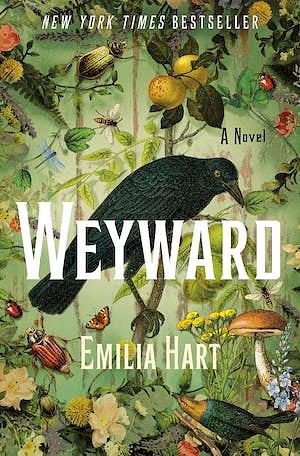
Review 2462: Weyward

Bookish Beck has a meme called “book serendipity” where she finds things in common between books she’s read recently, and I have a doozy. Not to give too much away, but this is the second book I’ve read in two weeks where women decide that the only way to deal with their abusive husbands is to murder them.

This novel is set in three time frames. In 1619, Altha is being tried for witchcraft. In 2019, Kate has discovered she is pregnant, so she has decided she must leave her abusive boyfriend, Simon. She has inherited a cottage from her Aunt Violet that he doesn’t know about and she has quietly saved some money, so she goes. In 1942, Violet has grown up isolated, not even allowed to go to the village and never told anything about her mother. At 16, she is jealous of her brother Graham, who is allowed to study interesting topics while she is forced into a traditional feminine role. She wants to travel the world and study bugs, but her father has apparently already chosen a husband for her.

Back at the cottage, Kate begins looking into her family history, into the women who called themselves the Weywards and have an unusual connection to animals.

This is an interesting novel with supernatural overtones that are fairly slight. I was interested in all three stories, although I found the outcomes of Altha’s and Kate’s stories fairly easy to guess. In this novel, I wasn’t as disturbed by the husband murder as I was in the other novel, in which I thought the wife could have easily gotten away. In any case, almost all the men in this novel are rotten to the core. So yes, I liked this novel fairly well.

Related Posts

Recipe for a Perfect Wife

The Harpy

The Family Upstairs

Review 2461: Agatha Christie: An Elusive Woman

I usually take much longer to read a work of nonfiction vs. fiction—up to a week as opposed to two or three days—but such was the power and readability of historian Lucy Worsley’s prose that I was astonished to finish this book one day after I started it. Of course, many people may want to know about the days Christie was missing, and she deals with that, but there is much more.

Christie lived an interesting life, and Worsley tells us about it, from the pampered, loved child of wealthy parents, to the loss of her father and the family fortune when she was 11, the World War I nursing and dispensary work, the ill-planned marriage to Archie Christie, and so on. Worsley’s main message is that Christie understood people to hide their actual selves and she presented her own masks, as well as evolved during her life into different personas. That was why she presented as shy when she had a lot of self-confidence, why she said little about her disappearance, why she told everyone she was a housewife rather than an author, and so on.

I’m fairly sure I have already read a biography of Christie, but this one was much more interesting. It is written in a lively style but looks thoughtfully at some of the problems posed by other writer’s remarks, and is thoroughly documented.

Related Posts

Agatha: The Real Life of Agatha Christie

Jane Austen at Home

The Secret Rooms

A Century of Books: How Am I Doing? July Report

In January, I foolishly decided to join Simon Thomas’s Century of Book Challenge, even though I knew that reading 100 books, one for each year in a century, from 1925-2024, would be tough because last year I only read 169. So, how am I doing?

Here are the holes in my project with the books listed for April below. If you want to see the details, see my Century of Books page.

  • 1925-1934: entries needed for 1927-29 and 1931
  • 1935-1944: entries needed for 1939 and 1944
  • 1945-1954: entries needed for 1945, 1948, 1949, and 1950
  • 1955-1964: entries needed for all years except 1956, 1958, 1959, and 1962
  • 1965-1974: entries needed for 1967, 1969, 1971, and 1973
  • 1975-1984: entries needed for all years except 1975, 1976, and 1978
  • 1985-1994: entries needed for all years except 1987, 1992, and 1988
  • 1995–2004: entries needed for all years except 1998, 1999, and 2004
  • 2005-2014: entries needed for all years except 2009, 2010, 2012, and 2014
  • 2015-2024: complete!

Since June 26 I read the following books:

  • These Old Shades by Georgette Heyer from 1926
  • The Listening House by Mabel Seeley from 1938
  • Miss Granby’s Secret by Eleanor Farjeon from 1940
  • Village Story by Celia Buckmaster from 1951
  • The Fountain Overflows by Rebecca West from 1956
  • The Heather Blazing by Colm Toíbín from 1992
  • The Voyage of the Narwhal by Andrea Barrett from 1998
  • The Time of Women by Elena Chizhova from 2009
  • Memorial by Bryan Washington from 2020
  • Glory by Noviolet Bulawayo (DNF) from 2022
  • Hungry Ghosts by Kevin Jared Hosein from 2022
  • In the Upper Country by Kai Thomas from 2023

I’m on vacation this week and next, so I haven’t been making much progress lately.

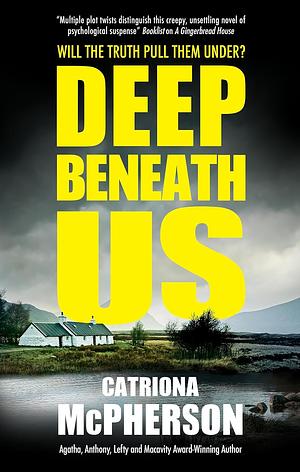
Review 2460: Deep Beneath Us

As a teenager, Tabitha had a mental breakdown and had to be hospitalized. Now her husband has left her for another woman. He has divulged her history of mental illness to her employer, who fired her for not divulging it when she was hired. This loss has resulted in the loss of her home and as a result, the custody of her son. She has returned to her family home on a remote moor because she has nowhere else to go, and at the beginning of the novel, she has decided to recede into madness. She feels a rumble and thinks she imagined it, but it is someone trying to blow up the dam.

Gordo hears the explosion and goes to the police to report it. That’s why the police are nearby when Tabitha realizes she can’t get her cousin Davey to answer his door. They find Davey inside, an apparent suicide, having taken the insulin left over after his mother’s death. At the cottage, Tabitha meets Davey’s friends Gordo and Barrett, with whom he regularly collected trash on the beach.

Tabitha, Gordo, and Barrett can’t make sense of Davey’s death nor of the police assumption that Davey tried to blow up the reservoir dam. Even though Tabitha finds a note, Davey doesn’t seem to be the type of person to commit suicide. Later, Tabitha is astonished to learn she has inherited Davey’s cottage—and delighted because it means she can offer her son a home, which he immediately agrees to accept. Then she and her new friends are astonished again to find that Davey has been hoarding all the junk the three men have picked up off the moor for the last 15 years.

Barrett is delighted to find his ex-wife wants to leave his two daughters with him, and with Tabitha’s son, the teenagers insist that Davey was murdered. As the adults and teens look into it, they end up digging into the tangled past of Tabitha’s family—the distant mother, the two brothers who were estranged for years and then apparently committed suicide on the same day (or did they?), the two cousins who eloped, one of them Davey’s brother, the other Tabitha’s sister, Tabitha’s near death as part of her father’s suicide—and why Tabitha remembers almost nothing.

This novel isn’t as much of a thriller as an extremely atmospheric and tangled mystery as Tabitha and her friends try to sort out the truth of her family’s past. Although the sequence of events around Davey’s death ended up seeming unlikely to me, my doubts didn’t interfere with my enjoyment of the novel.

Related Posts

A Gingerbread House

In Place of Fear

The Mirror Dance

Review 2459: The Book of Dede Korkut

Whenever I make up a new Classics Club list, I try to include some very early works. This one was probably written in the 12th or 13th century, but it draws from much earlier stories of the Oghuz Turks. The stories are said to be told and assembled by Dede Korkut, a shaman and bard.

The book comprises twelve stories and an additional work called “The Wisdom of Dede Korkut.” It seems that all of these early heroic stories, no matter what country they come from, are very similar, mostly concerned with fighting. Although the stories vary between more formal language, slang, and poetic language, they have formulaic sections. For example, several stories begin with a formula like this, only varying the names:

Beyindir Khan son of Kam Ghan had risen from his place. He had pitched his white pavilion on the black earth. His many-coloured parasol had reared toward the sky. In a thousand places his silken carpets had been spread.

All of the stories are addressed to the Khan, and most end with a sort of religious blessing directed at him. The characters often declaim, and when they do, there is a formula I found quite charming. It says something like “Thereupon Kanli Koja declaimed; let us see, my Khan, what he declaimed.”

Most of the stories, as I said, are about fighting. Sometimes a warrior is captured, and then years later a brother or son goes out to get him back. It seems that the captive is always sent out to fight the warrior, and once they figure out who they are, they unite and kill the captors. In one story, a hero informs his mother that he’ll only take a bride who will jump on her horse before him, ride before him to his enemies, and then chop off their heads before he gets there. When he finds a girl who does just that, he gets mad at her. But they make up.

All these heroes seem to have very short tempers and kill almost everyone they meet. One guy spends about six pages boasting of his exploits but inserts into the boasting several times how much he hates warriors who boast. I suspect there’s a sense of humor involved in that.

If you’re interested in reading a couple hundred testosterone-filled pages, this is the book for you.

Related Posts

Folk Tales of the Native American

The Books of Jacob

The Bastard of Istanbul

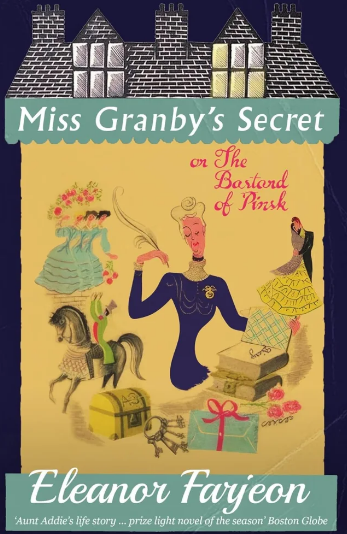
Review 2458: Miss Granby’s Secret or the Bastard of Pinsk

I was thrilled to learn that Dean Street Press was continuing its Furrowed Middlebrow imprint. This novel is an entertaining entry in that line.

In 1912, Pamela receives a bequest from her great-aunt Addie Granby of a house and a box of keepsakes and papers. Aunt Addie had been a well-known romance writer, but her modern great niece doubts that her spinster aunt ever understood the facts of life. Pamela finds hints that Addie had a romance when she was 16 with someone named Stanislaw. She also wrote her first novel.

The entirety of the novel, entitled The Bastard of Pinsk, is included within this novel. It begins with a conscientious list of terms that some polite young man has given her definitions for. As an example, “bastard” is given as “a very noble Hero of Royal Blood.”

The novel within the novel is made funny by the naïveté of its author, who writes in a Romantic, florid style and flings about words she doesn’t know the meaning or connotations of. Her Romantic upbringing and reading in the Gothic tradition are manifest in the ridiculous plot. If I have any criticism, it’s that it’s a bit too long. However, it picks up as it goes along.

Twenty years later Pamela learns that her friend Adey has been nursing an old man—her Aunt Addie’s Stanislaw! Now, she thinks, is her opportunity to find out about Aunt Addie’s past.

I received this book from the publisher in exchange for a free and fair review.

Related Posts

Beneath the Visiting Moon

Anne of Green Gables

My Brilliant Career

What I Think of NYT 100 Best Books by Readers

Cover for A Little Life

Last week, the New York Times published the list of the top 100 books of the 21st century as determined by their readers. I was one of the readers who submitted my top 10 list, although I admit that I didn’t think of some books I might have included. I thought I’d take a look at this new list from several angles .

Which Books Were Also on My List

The books on this list that were also on my list are these:

Not so good, but I did a little better if you add in the books that were on my shortlist but got scratched off to get down to 10:

What Other Books Were on My List

I tend to have eccentric tastes, so I wasn’t surprised that some of the books I put on my list weren’t included on the top 100 at all. The rest of the books on my top 10 were:

Which Books Did I Wish I’d Thought Of

Of course, I noticed books on the list that I might have put on my list if I’d thought of them:

Which Books Are Still on My Pile

There are a couple books that I actually have on my pile to read. (In fact, one is next, but I haven’t brought it along with me on my trip because it’s so fat.) So, I haven’t read them yet but intend to:

  • Lessons in Chemistry
  • The Bee Sting

Which Books I Think Are Overrated

There are lots of books on this list that I admire. It’s just difficult to bring a list down to 10 books from all those written since 1999. However, let’s get down to it. There are lots of wildly popular books that I think are overrated. In my opinion only, here are the ones from this list. Don’t get mad at me if they’re your favorites. I’m just saying they shouldn’t be on a list of the best books of the century.

Review 2457: Westwood

Margaret Steggles is a girl who yearns for beauty in her life. She is a schoolteacher moving to London for a new job, and she has been taught by her mother not to expect marriage. She tends to drift into reveries when contemplating beautiful scenery, literature, or music.

A small accident brings her into the chaotic household of Hebe and Alex Nislund. She finds Hebe beautiful but rude and is disappointed by Alex, who is a famous painter, because he seems so ordinary. Their housekeeper, Grantey, learning where Margaret lives, walks her home, because Grantey is returning to her primary place of employment, where she is an old retainer of Hebe’s parents, the celebrated playwright Gerard Challis and his wife Seraphina. Grantey invites her to stop by to visit at their home, Westwood, which is just up the hill from Margaret’s Highgate neighborhood.

A famous playwright is heady stuff for Margaret, who loves Challis’s plays. Although she doesn’t drop in on Grantey, she meets Zita, a German refugee and servant from Westwood, in the hardware story trying to find someone to mend a fuse before a party begins. The store can’t help, but Margaret can. She meets Gerard Challis and is struck by hero worship.

But Gerard is a pompous, humorless, unaffectionate, and selfish man who delights in carrying on chaste affairs with beautiful young women until they become demanding, at which point he dumps them without ceremony. He has coincidentally set his eye on Hilda, who just happens to be Margaret’s best friend. Hilda has plenty of admirers, though, and isn’t impressed, even though he is clearly wealthy and has told her he is single and his name is Marcus. This rejection of course makes him more eager.

Margaret is accepted into the Challis household as a friend and visitor, especially after the Nislund house is bombed and they all move in, too. Margaret enjoys being there even though they mostly treat her as a convenient person for helping take care of Alex and Hebe’s three small children. Margaret’s friendship with Zita can also be difficult because Zita is volatile, but they go to beautiful concerts together.

Margaret has also started helping John, a coworker of her father. He has been struggling to care for his mentally challenged daughter while his housekeeper is ill.

This novel made me laugh out loud sometimes, especially at the descriptions of the plots of Challis’s plays. The introduction tells us that Challis is based on a real person. I’d like to know who! (It turns out to be some guy named Charles Morgan.) In other respects, I really enjoyed this novel about Margaret’s development in self-respect and her shedding of her romantic myopia. This is a good one!

Related Posts

A Pink Front Door

Nightingale Wood

The Swiss Summer