Review 2444: Ibiza Surprise

I know I must have read this novel back in the days when it was named Dolly and the <Whatever> Bird, Dolly being Johnson Johnson’s yacht and <whatever> being whatever they politically incorrectly called each book’s female narrator, thinking they were being hip. Anyway, I enjoyed this reread years later.

Sarah Cassels may be the daughter of Lord Forsey, but she’s been broke most of her life. She wants nice things, and the only way she can get them, she reckons, is by marrying a rich man. Although on the lookout, she is likable and doesn’t seem rapacious. In the meantime, she is working as a caterer and sharing a flat with a girlfriend.

Sarah gets word that her father has committed suicide on Ibiza. But when she receives a last letter from him, she’s not so sure it was suicide, because she doesn’t think he wrote it. She can’t imagine why anyone would murder him, though. He was just a harmless drunk who earned his way with his friends by his entertaining chatter.

Sarah meets Mr. Lloyd, the wealthy father of her school friend Janey, at her father’s funeral. That’s when he realizes she was Lord Forseys’ daughter and tells her that her father was staying with him in Ibiza when he died. Mr. Lloyd invites her to Ibiza to visit his daughter, but she only agrees if he’ll let her cook. She decides to go to Ibiza to find out why her father died.

Dunnett’s plots tend to be complicated, so it’s hard to provide any more of a synopsis. I’ll say one thing further. Sarah finds out that her brother Derek’s firm believed a piece of stolen machinery was taken by her father. Derek was in Ibiza the weekend her father died, so the family reunion is bumpy—and there’s more family than that.

She also, of course, meets Johnson Johnson, the internationally renowned portrait painter. He’s staying at the same yacht club where her father died.

These mysteries are written using a light tone with sharp dialogue and complex plots. The story involves jet setters and some wild parties, but it ends in an ancient religious ceremony. The descriptions of Ibiza are vivid and make me wish I could have visited 50 years ago.

Related Posts

The Game of Kings

King Hereafter

Station Wagon in Spain

If I Gave the Award

Having reviewed the last of the shortlisted books for the 2023 James Tait Black Award, I am ready for my regular feature, in which I decide whether the judges got it right. I have to say that in terms of my own reading enjoyment, the 2023 shortlist was a tough one.

Bolla by Pajtim Statovci, set in Kosovo before and during the Balkan War, is about a love affair between two male students, one Serbian and one Albanian. Although it was beautifully written and ultimately touching, I so disliked its main character that I had difficulty reading it.

Indifference to the main character was my problem with Bitter Orange Tree by Jokha Alharthi. In this dreamy novel, the main character, an Omani student in England, contemplates the life of the woman she considered her grandmother and finds parallels with her own. I was more interested in the historical parts of this novel than in the contemporary ones.

I found the histories of lesbian women in After Sappho by Selby Wynn Schartz to be interesting. However, there were just too many characters for me to keep track of, and the vignettes about the women were too short for me to really feel like I could differentiate the women from each other.

The winner of the award for this year was Barbara Kingsolver’s Demon Copperhead, a modern retelling of Dickens’s David Copperfield set in rural Southwestern Virginia. Although I had problems with this novel as well, it was certainly a spellbinding tale. So, this time I have to say that the judges got it right. Although they don’t seem to publicize the longlist, this selection makes me wonder what was on it.

Review 2443: After Sappho

I read After Sappho for my James Tait Black project. It is experimental, written in short vignettes that jump around in time and from person to person. It tells the stories of lesbian women, mostly literary figures, trying to make a place for themselves. It begins in the late 19th century with women fascinated by the poet Sappho. Some of them study Ancient Greek, some dress like ancient Greeks or re-enact ancient plays, some travel to Greece.

The novel is vividly written in first person plural or in third person, at times slyly ironic, sometimes engaged in word play, often invigorating and with lots of sexual metaphors. It is interesting, telling of repressive laws against women, particularly in Italy, and reporting actual aggressively misogynistic “scientific” or political statements by men. It goes on to tell of the accomplishments and tragedies and love affairs of its protagonists, largely ignoring the men in their lives. For example, from this novel, you wouldn’t know there was a Leonard Woolf, just a Vita Sackville-West.

Although I found the novel very interesting at first, there were so many characters that I couldn’t keep track of them or remember which events happened to which ones. I could only track the ones I was already familiar with. For example, the novel begins and ends with Lina Poletti, even though she disappears about halfway through, so she is obviously important to Schwartz, but by the end I couldn’t remember her. I felt like I needed a chart.

And yet, I feel that with more character definition, I might have remembered all of them, but these short vignettes that tell of an activity or something they said didn’t really provide a cohesive picture to me of what the women were like.

So, I applaud this novel’s daring devices, but they didn’t really work for me.

Related Posts

The Hours

Crudo

LOTE

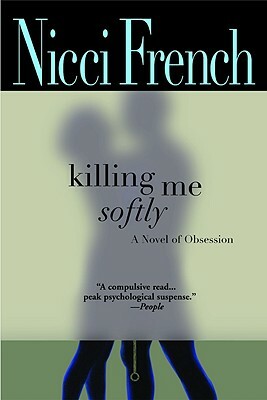
Review 2442: Killing Me Softly

Although I have lost track of it, I followed Nicci French’s series featuring psychoanalyst Frieda Klein for some time. So, when I was looking through my To Read list for books published in the missing years for my A Century of Books project, I picked out Killing Me Softly, which is a stand-alone.

Alice Loudon is bored with her job, but she is happily involved in a relationship when she locks eyes with a startlingly attractive man while crossing the street. When she comes out of her workplace later, he is waiting for her, and they begin a torrid affair. His name is Adam Tallis, and he is a well-known mountaineer. He is intent and possessive, but it’s as if Alice is possessed by him. At one point, she tries to break it off, but she ends up instead breaking up with her boyfriend.

Sex is an important part of their life, and Alice finds herself agreeing to practices that are farther and farther from the norm. She drops most of her friends and can’t concentrate at work. In addition, she and Adam are receiving threatening messages.

Alice finds that Adam is the hero of an incident he has refused to talk about, in which several people died on a mountaineering trip when a storm came up. But there’s a lot Adam won’t talk about, and Alice begins to believe that he has secrets.

Nicci French is a master at building suspense, and this novel is no exception. Although Alice is not an entirely likable character—she pulls several deceptions over people to get at the truth—we can’t help but be on her side.

Related Posts

Thursday’s Children

Friday on My Mind

Dark Saturday

If I Gave the Award

Real Life by Brandon Taylor was the last of the books shortlisted for the 2020 Booker Prize that I had to review, so having done that, it’s time for my feature where I decide if the judges got it right. For 2020, the shortlist included one dystopian novel, one historical novel, and four that are more or less contemporary. One of the novels was set in Zimbabwe, one in India, one in Ethiopia, and one in Scotland, the others in the United States. Two involve unlikable heroines.

I didn’t dislike any of these novels, but there were a couple I didn’t actually like that much, either. These were two quite different novels, The New Wilderness by Diane Cook and This Mournable Body by Tsitsi Dangarembga. The New Wilderness is a dystopian novel about people who go to live in the wilderness after climate change leaves their city air too dangerous to breathe. They are forced to leave no trace, and the living conditions are brutal, but it was the lack of character development and what I felt was unlikely behavior of the people that left me cold. I was most interested in the character of Bea, but she disappears from the novel early on and it centers on her daughter, whom I didn’t find interesting.

As far as This Mournable Body is concerned, I think part of my problem is that it is the third in a series, which I didn’t know before reading it. So, I found it difficult to follow at times. It is about Zimbabwe during the rule of Mugabe, but it is mostly concerned with Tambudzai, an embittered and unlikable woman who always thinks, because of her education, that she deserves more than she is getting. Yet when she does get a job, she does poorly because she thinks she deserves more.

I find myself grouping these novels in pairs this time. The next two I liked better. Real Life was written with a morose atmosphere that was hard to get past. It’s about a young Black gay man trying to work in a graduate program in science at a university where almost everyone else is White. Although the main character has a lot to put up with, peers who are trying to sabotage him and his experiments and lots of slights and racist comments, I found it frustrating that instead of explaining things to his friends or standing up for himself, he kept telling people everything was fine. He seemed to think this was a way to fit in, but instead he undercut himself. Also, I am not a fan of explicit sex scenes of any kind.

Burnt Sugar by Avni Doshi follows the activities of a woman who grows up to be an artist from her girlhood days when her mother moves into an ashram to be the lover of the guru. There, she was alternately neglected and mistreated, brought up mostly by another woman. Now her mother is beginning to experience dementia so is left to the care of her daughter. I found the main character unlikable, but I also said I found the novel fascinating, which I don’t remember in retrospect.

I have to put The Shadow King by Maaza Mengiste and Shuggie Bain by Douglas Stuart in my last and best group. The Shadow King is a historical novel about Ethiopia’s war with Italy just before World War II. It follows the fate of Hirut, a young girl who belongs to the household of Kidane, a leader in the revolt against the Italians. Although I was slow to warm to the novel, I came to feel that it was powerful and effective.

As for Shuggie Bain, which was the 2020 winner, about a young poor gay Scottish boy, well, I feel the judges got it right this time. The Bains are deserted by their father, and their elegant mother becomes an alcoholic. One by one, Shuggie’s older siblings leave, and he is left to try to care for his mother. I found this novel moving, gripping, and heart-breaking.

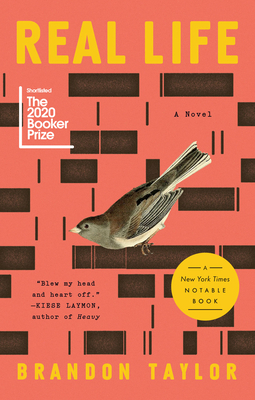
Review 2441: Real Life

Almost from the beginning of this novel, I was struck by how morose it seemed. Yet I couldn’t quite figure out why it seemed so much more dour than novels with similar stories, like A Little Life or Shuggie Bain. Both of the main characters in these novels are White, while Wallace, the main character of Real Life, is Black, but is that the difference? It doesn’t seem like it should be.

Wallace is the only Black student in a graduate biochemistry program at an unnamed Midwestern university that is probably the University of Wisconsin at Madison. He has been having problems in his program. His supervising professor, Simone, seems to disapprove of him, and he has been blamed for the carelessness of another student, Dana. Simone seems to think Dana is a star. Later in the novel, Dana makes a racist remark to him and then reports him as being a misogynist.

Wallace and his fellow graduate students seem to be working toward their degrees expecting real life to begin once they get them. Wallace, though, is considering how much he wishes to continue despite knowing the degree is his best chance to succeed, as a Black queer man from a poor family.

Wallace has a group of friends he hangs out with, but they are all White and he doesn’t really feel he fits in with them. He is attracted to Miller but doesn’t even know if Miller likes him.

This novel minutely documents a few days in Wallace’s life. The writing is detailed, whether describing Wallace’s experiment, which has been contaminated, perhaps intentionally by Dana, or a character’s eating habits, or a gay sex scene. Wallace faces quite a few slights and insults in just three days, but he doesn’t really defend himself or point them out. He feels he is trying to fit in, but he keeps himself removed from everything, including his friends, by always saying everything is fine, even when it’s clearly not. I felt frustrated several times by his refusal to tell his side of the story or stand up for himself.

I also didn’t understand the violence in his eventual sexual relationship with Miller (who insists he is not gay). In fact, I often didn’t understand characters’ interactions with each other.

Although I believe this novel ended on a slightly more positive note (or did it? it was certainly ironic), it seemed in some ways that Wallace makes things more difficult for himself. Also, although he certainly faces incidents of racism, he also often makes broad judgments about White people, including his friends. I personally also do not enjoy explicit sex scenes, but that’s just me. I read this novel for my Booker Prize project.

Related Posts

A Little Life

Shuggie Bain

To Paradise

WWW Wednesday

I got this idea from The Chocolate Lady, and it’s turned out to be a bit different and fun, so I’ll continue with it.

The idea is to talk about what you’re reading now, what you just read, and what you plan to read. If you’d like to do that, too, please leave a comment.

What Am I Reading Now?

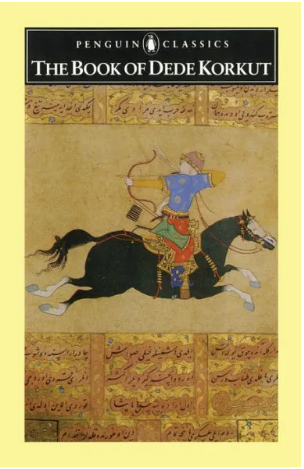
I just started reading The Book of Dede Korkut, an anonymous 14th- or 15th-century work that calls on Turkish tales from much earlier than that. When I make up my Classics Club list, I try to find very early works to put on it, and this one surfaced last time. I am just reading the third of twelve tales, supposedly written or drawn together by the shaman and bard Dede Korkut, and so far, like with most early tales, there’s a whole lot of smiting going on.

What Did I Just Finish Reading?

In celebration of the revival of Dean Street Press’s Furrowed Middlebrow imprint, I just read The House Opposite by Barbara Noble. From 1943, this novel does the best I’ve ever read of conveying what it was like to live in London during the blitz. It’s about a friendship between neighbors that starts out as indifference and even enmity.

What Will I Probably Read Next?

Unless something drastic happens, the next book on my list is Deep Beneath Us by Catriona McPherson. Although McPherson has several series going, my favorites are her stand-alone thrillers. They are sort of cozy thrillers, if that’s not an oxymoron, usually set in rural Scotland. Whenever one is going to be published, I always purchase it pre-publication. This one just arrived last week.

What about you? Have you read any of these? Do they seem tempting?

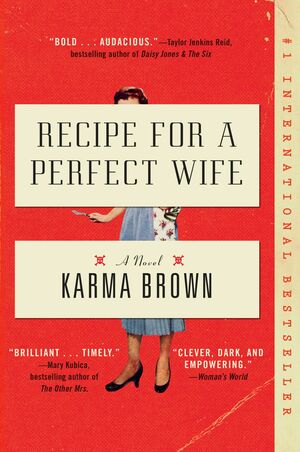
Review 2440: Literary Wives! Recipe for a Perfect Wife

Today is another review for the Literary Wives blogging club, in which we discuss the depiction of wives in fiction. If you have read the book, please participate by leaving comments on any of our blogs.

Be sure to read the reviews and comments of the other wives!

This month we welcome a new member, Kate of booksaremyfavoriteandbest!

My Review

In the present time, Alice Hale has no desire to move to the suburbs, but she finds herself doing so anyway, pushed along by her husband’s desire for a family and a white picket fence. Since she lost her job, she doesn’t feel as if she has as much say in the marriage. This situation is made worse because she told Nate she quit because she wanted to write a novel. Actually, she was fired after a stupid indiscretion, and she hasn’t written a word.

In the 1950s, Nellie Murdoch and her husband have moved into the same house that Alice and Nate buy later. She slowly begins to recognize that her husband, Richard, is controlling. Her culture tells her that this is her fault, but then he begins to be abusive.

Trying to adjust to having the whole day on her hands, Alice begins learning to garden and discovers a cookbook that belonged to Nellie’s mother. She begins cooking recipes from it. For his part, Nate is pressuring her to get pregnant, but she can’t bring herself to tell him she is not ready.

I was somewhat interested in the fates of these two women, but I was much more sympathetic to Nellie than to Alice, who seemed to be creating a lot of her own problems. Overall, though, I felt the novel was okay but nothing special. I had the biggest reaction to the revolting quotes from the old marriage manuals that headed each chapter.

What does this book say about wives or about the experience of being a wife?

These are two marriages with serious problems. The marriage of Nellie and Richard is more straightforward. Nellie does everything she can to be a good wife and housekeeper, as defined by the 50s (although to my memory things were starting to open up about then). However, Richard is an abuser and a philanderer. There isn’t much she can do about this except decide to leave him. She chooses another way, and I think we’re supposed to think her solution is fitting, but I didn’t. I don’t want to reveal it, but since she said she had the resources to leave, I think she should have done that.

I don’t see much hope for Alice and Nate, either. Alice pretty much lies her way through three-quarters of the book, some of the lies seeming totally unnecessary. On the other hand, Nate keeps stepping over the line in his desire to have a child and later exhibits some behavior that is much worse, supposedly done out of concern. (It seems to me that some guys think that if a wife isn’t working, she has no say in her own future.) But Alice doesn’t object, so although he should know he’s being too pushy (they seldom do), he doesn’t, and she doesn’t tell him.

By the end of the novel, Alice has found herself, but although there is some resolution, I foresee eventual resentments. Of course, Nate’s underhanded dealings toward the end of the novel are fairly unforgivable.

Finally, I don’t know what to think about Alice’s slowly turning herself into a replica of a 1950s housewife. Her excuse of “research” is nonsense. It seems like a such a step backwards. Certainly wives are still dealing with some of the same problems they’ve always had, but why go back? And why behave like a 50s housewife, which is sort of what she does until the end.

I know this book is supposed to be funny, but it seemed to be hitting some sore points for me, so I didn’t find it so.

Related Posts

The World’s Wife

How to Be a Good Wife

The Amateur Marriage

Review 2439: Classics Club Spin Result! The Prophet’s Mantle

I picked this book out of my collected works of E. Nesbit for the Classics Club as one of her first novels for adults. In fact, it is her first novel. So, I wasn’t aware until I looked for a hardcopy that it was publicized under the name of Fabian Bland. In fact, I was confused, because some editions showed both names, so I thought they were two different people. I don’t agree with the custom some publishers use of listing works under the most well-known name just to make more money, but I have had to revise my listings of this work because of this error and listed both so as not to confuse.

In the prologue to this novel, Count Michael Litvinoff prevents Armand Percival from drowning himself after gambling away all his money. Litvinoff takes Percival as his secretary to Russia. But Litvinoff is the author of a pamphlet that the Russian authorities deem dangerous, so the two have to flee. On the trip, it is reported that the secretary is killed by their Cossack pursuers.

It takes a while to see the connection between this story and the body of the novel, which begins with two brothers, Richard and Roland Ferrier. Their father leaves his mill to both of them, hoping to keep them friends, as they are rivals for the same girl, Clare Stanley. If they can’t run it together, the business will fold.

However, Richard believes a rumor in the village that Roland is responsible for the disappearance of Alice Hatfield, the assumption being that she left because she was pregnant. When Roland learns this, the two become unreconciled and the mill is closed. It’s clear from the beginning that Roland knows nothing about Alice, though.

In London, we again meet Count Litvinoff, a Nihilist (although Nesbit doesn’t seem to understand what one is, and although there is a lot of discussion about revolutionary principles, no one actually states what the characters believe) who has published several books and has been speaking around town. Clare Stanley is in town, and she is trying to attract the count, but after she hears a talk by another Russian, Mr. Petrovich, she begins to be interested in the cause. It soon becomes clear that it is Litvinoff, not Roland, who is responsible for Alice’s plight.

It’s not long before several plots are going. Who will win Clare? What will happen to Alice? Who is the mysterious Petrovich? Is Litvinoff a hero or a villain? Will Richard and Roland make it up? And what about the poor mill workers?

Despite its revolutionary theme and good intentions, I fear the mill workers get the short shrift. This novel goes in too many directions to really do a satisfactory job in 159 (small print) pages. I guessed all its secrets almost immediately, and only Litvinoff has anything approaching a rounded character. The novel is supposed to have a stunning romantic ending, but I wasn’t interested enough in the characters to care much. I think Nesbit’s young revolutionary fervor (she was a Fabianist) gets in the way of this being effective fiction.

Related Posts

That Lass O’Lowrie’s

Challenge

Sofia Petrovna