Review 2239: Love Comes Home

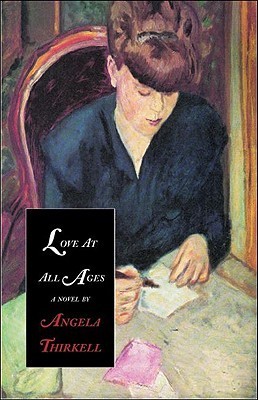
Jane Cranstoun is enjoying her stay in London with friends George and Kitty Mariner when she is summoned home by her mother because of the return from finishing school of her sister, Love. Jane is not really looking forward to going home, where she is expected to take charge of numerous commitments made by her mother, but also because she has begun to hope for a proposal of marriage from John Marsh, a young naval officer.

At her farewell party, Jane gets her proposal and accepts it but asks John to keep it a secret until her parents get to know him better. He has recently accepted a post that is nearer to her parents’ house in Scotland, so he agrees.

On the train north Jane meets Peregrine Gilbert, whom she takes to be shy and uninteresting, not realize he has become her neighbor. Then she meets him again the next morning and tries to send him off for trespassing.

When John appears, Love begins monopolizing him and throwing Jane together with Peregrine. In fact, there was a scene before he appears when I was certain Love already knew John. But that turns out not to be the case, even though it’s clear Love means to marry him before she even meets him. Silly misunderstandings lead to a broken engagement, and this situation was clumsily handled, I thought. In fact, although Love explains later that she thinks Jane and John are not well suited, she has decided this before she ever meets John.

I have enjoyed reading Clavering, but this one, I think, is the closest to a standard pattern romance than the others. I didn’t like Love, who takes over the story gradually until it is more about her. I also didn’t like John or later Kitty when she reappears. The only characters I liked were Jane and Peregrine and the girls’ brother, Meggie. Love is supposed to be 19, but she acts more like 14. I was a little disappointed in this one.

Related Posts

Susan Settles Down

Touch Not the Nettle

Yoked with a Lamb

Review 2238: Castle Rackrent

Castle Rackrent is a novel I picked for my Classics Club list. Published in 1800 although set before 1782, it is an early example of the use of an unreliable narrator.

That narrator is Thady Quirk, a servant to the ancient Irish Rackrent family, but the novel is also annotated by a scholarly character called the Editor. Thady informs us in the first paragraph that he’s known as “Honest Thady,” a phrase that puts us on the alert.

Thady quickly runs through the older history of the family and then tells in greater detail the story of the last three owners of the Castle, Sir Murtagh, Sir Kit, and Sir Condy. These are satirical tales of mismanagement either by penny pinching and bleeding the tenants or by wasteful consumption. Thady is vehement in his avowals of support for the family and in this role makes some astonishing assertions, such as, about Sir Kit who married a woman for her money and then locked her away for seven years because she refused to give him her jewels, “He was never cured of his gaming tricks, but that was the only fault he had, God bless him.”

This novel is a light commentary on the class system and its abuses, as the series of barons get up to all manner of hijinks while the servants (particularly Thady and his son) arrange to purchase assets at low prices. It is moderately funny but is considered by critics to be an astonishing first novel by a woman at this period.

Related Posts

Evelina

A Double Life

The Good People

Review 2237: The Mirror Crack’d from Side to Side

It’s been interesting rereading a few Jane Marple books after I so recently viewed the television versions, because although I have known the identity of each murderer, I’ve been better able to judge how fair Christie is playing. That is, are there clues to the solution? In The Mirror Crack’d there are.

The villagers of St. Mary Mead are agog to hear that the famous actress, Marina Gregg, has purchased Gossington Hall (the site of The Body in the Library) and will be hosting the local fête. Miss Marple’s friend Mrs. Bantry, who used to own the house, will be a special guest.

At home, Miss Marple is a bit unhappy. She is no longer allowed to garden, and her doctor thinks she shouldn’t live alone. The solution is the kind but obnoxious Mrs. Knight, who talks in the plural and hovers and doesn’t listen to Miss Marple. One day Miss Marple sends her out shopping so she can escape and goes to investigate the new housing development. She has a fall and is helped by Heather Badcock, a foolish woman who doesn’t consider how her actions affect others.

At the fête, just after Heather has introduced herself to Marina Gregg and is again telling her how she met her, her drink is spilled. Marina gives Heather her own, and after Heather drinks it, she quickly dies. It is poisoned, but was the victim intended to be Heather or Marina? Neither woman seems to have serious enemies.

I think that this novel has one of the most powerful endings of Christie’s novels. You’ll also be happy to know that Miss Marple finds a way to rid herself of Mrs. Knight.

Related Posts

A Pocketful of Rye

They Do It with Mirrors

Nemesis

Review 2236: The Sun Walks Down

In 1883 Australia, the Wallace girls are at a wedding and Mathew Wallace is out working. Only six-year-old Denny and his mother are home when she sends him out to gather fuel. A huge dust storm comes up, and instead of staying where he is, he goes in the direction he thinks is home. And he is lost.

The family doesn’t realize he is lost right away, but when they do, Mathew takes off in the direction Denny went, along with Billy, his Aboriginal farmhand. Soon, almost everyone in the area is searching for Denny.

This novel doesn’t have a strong plot. Instead, it follows a mixture of characters during the search. There is Cissy, Denny’s headstrong sister, who joins the search; Constable Robert Manning, newly married, and his wife Minna; Foster, Manning’s superior officer, who ignores his trackers’ advice and follows the wrong trail; Karl and Bess Rapp, two painters who are traveling in the Australian bush looking for subjects to paint; and so on.

This is a beautifully written novel that shows insight into human nature and powerfully describes the Australian landscape. I read it for my Walter Scott prize project.

Related Posts

Homecoming

The Secret River

Salt Creek

If I Gave the Award

As I have just posted my review of News of the Dead, the last of the shortlisted books for the 2022 Walter Scott Prize for Historical Fiction, it is now time for my feature where I decide whether the judges got it right. The shortlisted books are set in 16th century Scotland; 8th, 19th, and 20th century Scotland; 20th century Trinidad, and 20th century Germany, California, and Switzerland. For this year, most of the entries were strong ones.

The book set in 20th century Trinidad, Fortune by Amanda Smythe, is the fictionalized story of a true one, a love triangle that resulted in a disaster. I felt that the characters in this novel were not very interesting and the setting not vividly described. Also, the writing was rather mundane. However, this book was the weakest entry on the shortlist.

The writing in The Magician by Colm Tóibín was not at all mundane. This novel is more difficult to evaluate in the context of my having to pick the best one, because I said only good things about it in my review, but it didn’t make as much of an impression on me as some of the others. A biographical novel about the writer Thomas Mann, the book was intuitive and meditative in tone and Tóibín’s writing is always excellent.

The winner this year was News of the Dead by James Robertson, and I’m guessing it was picked because of its scope. It tells the story of a remote Scottish glen through manuscripts written about a figure in the 8th century, a family in the 19th century, and an individual in the 20th, and how these people found refuge. It was well written, and I certainly found it involving and was unexpectedly touched by the second and third narratives. However, I wasn’t very interested in the first, about a supposed local saint.

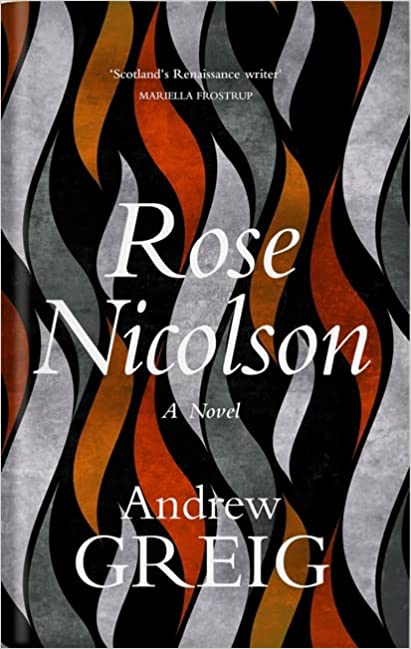
Despite the three really good books in this year’s shortlist, it wasn’t difficult for me to pick my favorite because of the lasting impression it gave me despite being the book I read first, in August 2022. That is Rose Nicolson by Andrew Greig. It is set in the difficult times of 16th century Scotland, when people are still fighting about religion, about a young man’s love for an extraordinary young woman who is in danger of being thought a witch just because of her intelligence. I am a big Greig fan, and this was one of his best (although I might put in a word for his Fair Helen).

Review 2235: News of the Dead

One of the things I like about my shortlist projects is that they bring me into contact with books and authors I probably wouldn’t encounter otherwise. Certainly, I would never have run into News of the Dead if not for my Walter Scott Historical Fiction Prize project.

News of the Dead tells the story of one remote, secluded place—fictional Glen Conach—over the ages, mostly through a set of documents. The oldest is a book written in the middle ages about a Christian hermit the locals call St. Conach even though he’s not recognized as such by any authority. The Book of Conach tells the stories of lessons and miracles performed by the man, who died around 770 AD.

Another narrative is set in 1809 from the diary of Charles Gibb. Gibb is an antiquarian who has wangled himself an invitation to Glen Conach House ostensibly to study and translate The Book of Conach. His real goal, however, is to sponge off the Milnes, the current owners of Glen Conach House, for the summer. He rather cynically observes Glen Conach and his lady and daughter as they do him, at first. But slowly the situation changes.

The third narrative begins slightly pre-Covid and mostly concerns an elderly woman named Maja and her eight-year-old neighbor, Lachie, who likes to visit her. When Covid sets in, she decides to write him a letter telling the story of a girl who came to the glen as a child after World War II.

I did not have much patience for the stories about St. Conach, although it was clever how Robertson used variations of the stories to show how they change. It also, frankly, doesn’t reveal much about daily life except for superstition and wildness.

The other two narratives were a lot more interesting. Gibbs’s began at a fairly cynical level yet what we learn after it stops is surprisingly touching. And Maja’s story had me on the edge of my seat.

There were times when I wondered where this novel was going, but ultimately I found it a lovely examination of refuge. I also want to point out that all three narratives sound like they were written by different people, which they should in good fiction, and which is too often not the case.

Related Posts

Rose Nicolson

Luckenbooth

Ulverton

Review 2234: The Shadow King

All I can say is, this is a powerful and eloquent book. It took me a while to get into it, but it was worth the wait.

In 1975, Hirut, an older Ethiopian woman, is on the way to meet a former enemy, Ettore, an Italian photographer who was part of Mussolini’s invading army in 1935.

In 1935, the great Ethiopian warrior Kidane has taken orphaned Hirut into his household. However, his wife Aster is almost insane with jealousy of her and thinks Hirut has stolen a necklace Aster gave Kidane at their marriage. In searching for it, she finds Hirut’s rifle, the only possession she still has of her father’s. Kidane, coming upon the incident, confiscates it for the poorly equipped Ethiopian army, for they know the Italians will soon invade, eager to be avenged for their 19th century humiliation.

Although Hirut’s personal situation worsens, all of them are caught up in the war. The household flees to the highlands, where Kidane and his men carry on guerilla attacks against the army of Colonel Fucelli.

Meanwhile Emperor Haile Selassi is ineffective, spending most of his time listening to the opera Aida. When he finally leaves the country, his troops are discouraged until Hirut notices how much the musician Minim looks like the Emperor. Kidane sets him up as a shadow king to help inspire his people, and his guards are the warrior girls Hirut and Aster.

In the Italian camp, Fucelli forces the photographer Ettore to record his cruelties, including the innocent people he has hurled off the cliffs. At the same time, Ettore is worried about what he is hearing about the treatment of Jews in Italy, as his father is Jewish.

I was a little confused about the women warrior theme, as at first it doesn’t look like Hirut is going to do much actual fighting. Also, it seems to be the fashion now to write about war from both sides, as though some sides hadn’t done things that were unforgivable, and I don’t have much sympathy with that. However, ultimately I was carried along by this novel and felt it was powerful. I was unaware before that the behavior of the Italians in Ethiopia was so brutal.

This was a novel I read for my Booker Prize project.

Related Posts

Cutting for Stone

Life and Fate

The Invisible Bridge

Review 2233: News of the World

Shortly after the Civil War, Captain Kidd, 72-year-old veteran of three wars, rides around Texas reading the news in small towns. He was previously the owner of a print shop in San Antonio, but during the war, the Confederate government forced him to invest in their government bonds, so he ended up bankrupt.

Most of Texas is very dangerous, prone to raids by Native warriors and lawless. He is in Wichita Falls when a freight driver he knows asks him to take a girl—who was captured by the Kiowa four years earlier and has now been returned under threat—to her relatives near San Antonio. The driver has found her hard to control and has no freight to take to San Antonio. The Captain reluctantly agrees.

The girl, kidnapped from German immigrants, is named Johanna and is going to her aunt and uncle. However, she remembers nothing of her previous existence and is wild about being taken from the Kiowa.

The Captain and Johanna come to understand each other on this dangerous, difficult journey of around 400 miles. They have to cope with floods and such dangers as an attack by three men who want Johanna for a prostitution ring.

I had already seen the excellent movie starring Tom Hanks, but News of the World is even more involving. I was interested to re-encounter Simon the Fiddler, who is the main character of Jiles’s most recent book. Having looked at some of her other books, I see that she has set several of them in the same area and time, with characters who make brief appearances in each other’s novels.

I just loved this book. Jiles has created two unforgettable characters, and the novel is ultimately powerful and heart-warming. Descriptions of the land are lyrical, from its harsh aridity to its lushness.

Related Posts

Simon the Fiddler

The Son

The Sisters Brothers

Reading Thirkell’s Barsetshire Series in Order: #28 Love at All Ages + #27 Close Quarters Wrap-Up

Thanks so much to the people who are plodding along with me to the finish. I have to admit that the last couple of books were not as sparkling as the rest of the series, but now we are almost at the end. So, thanks for your comments about Close Quarters.

I notice that Goodreads describes the next book, Love at All Ages, as the last one! However, all of the sources I looked at before beginning this project also listed one more. So, I’ll be posting my review of Love at All Ages on Friday, September 29, with one more to go after that.

Review 2232: Sing Me Who You Are

Harriet Cooper’s mother has died, and she is moving to a bus made into a caravan that she inherited from her aunt. She does not own the land it is on but is certain her cousin Magda won’t sell it.

Harriet is welcomed exuberantly by Magda’s husband Gregg and more reservedly by Magda, with whom she has a complex but caring relationship. As Harriet settles in, she and Gregg exchange memories of Scrubbs, a friend with whom she is still in love although he has been dead for years and preferred Magda, Harriet being younger and plain.

Although this novel was written in the 1960s, it still deals with issues from the war. Aside from Gregg and Scrubbs having been captives of the Japanese, the town council, which Magda is on, is dealing with issues of agriculture versus home development for a growing population.

I very much enjoyed this novel about a middle-aged woman trying to start a new life at the same time as trying to sort through old injuries. I found it interesting and touching.

I received this novel from the publishers in exchange for a free and fair review.

Related Posts

The Woods in Winter

Miss Mole

The Snow-Woman