Review 1877: Gallows Rock

When I purchased Gallows Rock, for some reason I thought I was getting the second book in Sigurdardóttir’s Thóra Gudmundsdóttir series, but it was actually the fourth book in the Freyja and Huldar series. Oh well.

The body of a man is found hanging at a rock that was historically used for executions. Assuming it’s a suicide, the authorities just want the body removed as quickly as possible, because the Chinese delegation that is soon to arrive will be able to see it across the bay. No one can get up to release the knot, so the body is brought down rather haphazardly. Then they realize the death is not a suicide—the deceased has had a piece of paper stapled to his chest, although only a scrap of paper is still there.

It takes a while to identify the body as Helgi, a wealthy man who works in securities. While the police are struggling with that, Freyja, apparently some sort of social worker, is called to an apartment because a four-year-old boy is reported to have been left there alone. This apartment turns out to belong to Helgi, but the police can’t figure out who the child is. Once they finally identify him, they can’t figure out the connection between the boy and Helgi. In addition, his parents are missing.

Although this mystery is fairly complex, it’s the type that doesn’t provide enough clues for readers to figure it out. It focuses more on the police procedural aspect, even though it gives us enough glimpses into the doings of Helgi’s friends for us to know that something else is going on.

I felt that this novel seemed much less polished than the other Sigurdardóttir novel I read. It takes quite a while for the police to make any progress in their investigation. The characters aren’t very fully developed, perhaps because this has been done in previous books. But my main criticism has to do with the number of explanations of things that are probably self-explanatory, and the sheer number of details that have to be explained at the end, including things that haven’t been discussed before so no one really cares about. There was something clumsy in this.

The novel does have a final surprise, but even that is explained to death instead of being punched in to greater effect.

Finally, this is very picky and it’s not clear to me if it is a writing or a translation problem, but there is a lot of outdated slang, and one case where the word “verdict” is used incorrectly by the police, which I can’t imagine them doing.

Freyja’s link to the story is very weak. She’s essentially babysitting for most of the novel. As for Huldar, he’s such an appeaser at work that his behavior verges on the unprofessional.

Related Posts

Last Rituals

The Mist

Jar City

Review 1876: The Moon-Spinners

When I make up a Classics Club list, I always take the opportunity to add a few old favorites for a re-read. This time, I picked Mary Stewart’s The Moon-Spinners.

Nicola Ferris has gotten a head start on her holiday by accepting a lift to her destination, the village of Agios Georgios on the island of Crete. Since she is arriving a day early, she decides to take a walk up into the White Mountains instead of going into the village. She is enjoying her day when she feels someone spying on her and then she is attacked.

She finds herself in the company of a wounded English tourist, Mark Langley, and his guide Lambis. Mark came across an argument resulting in murder and was wounded by the murderer, who took away Mark’s teenage brother, Colin. Mark does not know who the people were and whether it would be safe to go to the authorities or whether that would jeopardize his brother.

Nicola helps them by taking care of Mark for one night while Lambis fetches supplies from his caique. However, once she reaches her hotel, she realizes that she has chanced into the middle of the wrongdoers—Stratos, the owner of the hotel; Sophia, his sister; and Tony, the English hotel manager. The murderer seems to be Sophia’s Turkish husband, Josef.

As Nicola and her older cousin Frances innocently pursue their holiday, Nicola keeps finding clues about the murder and begins to hope she can find Colin.

You can’t beat Stewart for descriptions of exotic locales, suspenseful plots, and a bit of romance. She’s a great storyteller and a fine writer.

Related Posts

This Rough Magic

Wildfire at Midnight

Nine Coaches Waiting

Review 1875: Death of a Bookseller

Published in 1956, Death of a Bookseller has long been unavailable except for costly used editions. I was surprised by the publication date, because in many ways the book reads like a much older novel. It employs a rather formal, factual narrative style, and although it is more of a police procedural, it espouses notions about policing that seem naïve and decidedly rosy compared to the probable reality. Also, it refers to phrenology as if it were a considered a science when it was largely debunked by the 1840’s.

Sergeant Wigan decides to take up a hobby, and the one that appeals to him is collecting books. In learning about them, he develops a friendship with Michael Fisk, a buyer and seller of rare books. He has a collection of very rare ones at home, quite a few about the occult.

When Fisk is found murdered in his home, Wigan is assigned to help the Detective Inspector because of his interest in books. He notices that someone has stolen a rare edition of Keats from his collection, but later learns that someone may have also stolen one of Fisk’s books on the occult, substituting in its place a book of little value.

Very quickly, a runner named Fred Hampton is arrested for the crime with serious evidence against him. Hampton claims he is being framed, and Sergeant Wigan tends to believe him, but the D. I. thinks he has his man. However, he gives Wigan permission to continue investigating on his own time. Wigan does so with the help of Charlie North, another runner.

This novel is interesting in its information about the bookselling trade and has a complex plot, although the clues didn’t seem to me more likely to point at one one suspect over another until the very end. One extremely unlikely plot point was the seriousness with which some characters treated the supernatural angle, as Fisk was apparently trying to raise the devil when he was killed. This feature was another thing that made the book seem more like a 19th century mystery.

I received this novel from the publishers in exchange for a free and fair review.

Related Posts

The Bookman’s Tale

The Red House Mystery

The Cornish Coast Murder

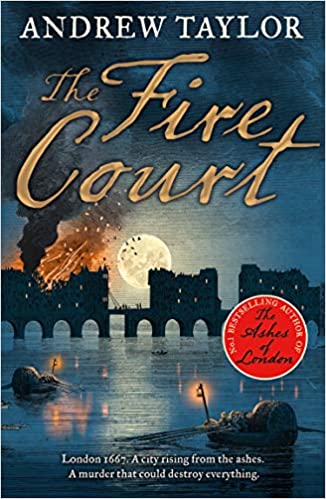
Review 1874: The Fire Court

The second book in Andrew Taylor’s Marwood/Lovett series, The Fire Court begins shortly after the Great London Fire that was the setting of the first book. James Marwood’s father wanders off in his senility and discovers a salacious scene in chambers near where the Fire Court sits—a lascivious painting of a woman dressed like a whore stretched out on a couch.

His father comes home with blood on his sleeve babbling about what he has seen, but James thinks he has experienced a senile delusion. However, a few days later the body of a woman is discovered nearby in a pile of rubble. She is dressed up like a whore, but she is not one. She is Celia, the widowed niece of Mr. Poulton, a client of Mr. Hakesby.

Hakesby has given refuge to Cat Lovett, who has fled her family. She is now going by the name of Jane Hakesby, supposedly Mr. Hakesby’s cousin and servant. But Mr. Hakesby is very frail, suffering from an ague. Cat has been helping him with his architecture work, and he badly needs the custom of Mr. Poulton, who has a case before the Fire Court.

The Fire Court’s mission is to make decisions quickly about competing rights of property so that London can be rebuilt. Mr. Poulton wants to develop some property called Dragon yard that is mostly owned by himself and his niece Celia, and Hakesby is drawing up the plans. But Philip Limbury, an upperclass personage with influence at court, has some rights to Dragon Yard and also wants to develop it. Marwood is sent to look into the death of Celia, and he soon realizes that his father must have seen her murdered in the apartments of Mr. Gromwell, his father’s description of where he went being so vivid. Marwood begins to believe there is some sort of conspiracy going on involving the Fire Court, and both he and Cat are soon in danger.

Although I felt the characters in this book took too long to realize they were involved in real estate conspiracies, this was another complex and interesting novel in this series. The 17th century setting seems convincing, and James and Cat are interesting characters.

Related Posts

The Ashes of London

Merivel: A Man of His Time

The Bookman’s Tale

Review 1873: Juggernaut

Esther Rowe is a Canadian nurse who has just finished delivering a patient in Cannes and finds herself having to make a decision. Will she return to snowy New York or try to find a job in beautiful, warm Cannes? She decides on Cannes and soon accepts a post with Dr. Sartorius even though he seems intimidating.

Celebrating her new job by getting a drink at an expensive café, she overhears a conversation between a young man and a beautiful woman. He is telling her he has a job in Argentina, and she doesn’t want him to go. Later, the woman comes to Dr. Sartorius’s office for an injection. She is Lady Clifford, the much younger wife of Sir Charles Clifford, a wealthy manufacturer.

Not long after Esther starts working for Dr. Sartorius, he informs her that he is closing his practice to care for Sir Clifford, who is suffering from typhoid along with other ailments. However, he invites her to come along as the day nurse.

She hasn’t worked there long when she beings noticing odd things. Lady Clifford doesn’t pay much attention to her husband but insists on giving him his milk every day. The house is frequented by Arthur Holliday, the young man Esther saw with Lady Clifford at the café. Roger Clifford, Lord Clifford’s son, arrives unexpectedly after Lord Clifford suffers a downturn. He never received the cable sent to summon him home.

Although it isn’t very hard to figure out what’s going on in the Clifford house, Esther is a strong, feisty heroine and the novel depends more on psychology than the complex plots more usual in 1928, when Juggernaut was written. Also, there is an understated romance, and the last 50 or so pages are extremely suspenseful. Juggernaut is Campbell’s first book, and I am looking forward to more.

I received a copy of this book from the publishers in exchange for a free and fair review.

Related Posts

The Mayor’s Wife

Some Must Watch

The Iron Clew

Review 1872: The Bass Rock

Told in three compelling narratives that take place over centuries, The Bass Rock is a novel about the history of violence toward women. The novel is located on the banks of the Firth of Forth, an area of Scotland dominated by the Bass Rock.

Early in the 18th century, the local priest comes upon some young men raping a very young girl, Sarah. The priest rescues her, but the young men claim she must be a witch because she enchanted them and forced them to do it. Soon, the men have burned down the priest’s house, and the entire household must flee toward the beach.

Post-World War II, Ruth and her husband Peter have recently moved into the big house in North Berwick. Ruth doesn’t quite understand the reason for the move, since Peter works in London. He says it is for the benefit of his sons by his previous marriage, Christopher and Michael, but they are being sent off to school. Soon, newly wed Ruth finds herself left very much on her own with only the housekeeper Betty for company. She begins to discover some secrets in the family.

After Ruth’s death as an old lady, Michael’s daughter Viv is hired by the family to sort through the things left in the house so it can be sold. She has recently had some mental issues and feels like she is the family failure. Almost despite herself, she befriends Maggie, a homeless occasional sex worker who has an interesting take on things. Maggie tells her there is a ghost in the house.

This is a powerful novel. Although its theme is grim, its main characters are relatable and sometimes likable. I loved All the Birds, Singing, and this is another winner from Wyld.

Related Posts

All the Birds, Singing

The House Between Tides

The Vanishing Act of Esme Lennox

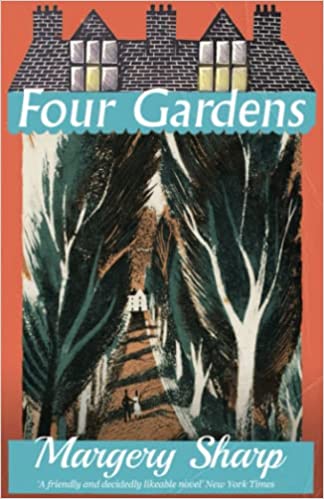
Review 1871: Four Gardens

Furrowed Middlebrow calls Four Gardens one of Margery Sharp’s most beloved books. At first, I thought the novel was just okay, but gradually it won me over. It’s essentially a character study of Caroline, a woman born into the Victorian era who has to learn to adapt to more modern times.

The novel begins with Caroline as a teenage girl, still in the 19th century. She comes from an ordinary middle-class family and recognizes a big divide between herself and the people she knows and the others from the Common, the area where the wealthier people live. She and her family, for example, work on the annual festival, but they are not invited to it.

In the neighborhood is a deserted house with extensive gardens. Although it is trespassing, Caroline sneaks in there and meets Vincent, an upper-class boy. During the summer, she runs off to meet him in the garden. But once he sees her with her family, he stops coming.

Beginning with this disappointing first romance, Four Gardens follows Caroline as she marries, has children, meets with a change of fortune, gets through World War I, and continues into middle age and older. She is an endearing heroine, realistically experiencing the changes of the times. It’s an affectionate and lovely novel.

Related Posts

Harlequin House

Rhododendron Pie

Cluny Brown

Classics Club Spin #30

The Classics Club has announced another spin. To participate, members post a numbered list of 20 of the books from their personal lists, to be posted by this Sunday, June 12. The club announces a number, and that determines which book to read by Sunday, August 7.

So, with no more further ado, here is my list:

  1. The Castle of Otranto by Horace Walpole
  2. Cecilia, Memoirs of an Heiress by Fanny Burney
  3. The Moonspinners by Mary Stewart
  4. The Aeneid by Virgil
  5. Phineas Finn by Anthony Trollope
  6. Miss Mole by E. H. Young
  7. Weatherley Parade by Richmal Crompton
  8. Sleeping Murder by Agatha Christie
  9. Love’s Labours Lost by William Shakespeare
  10. Sense and Sensibility by Jane Austen
  11. Merkland, A Story of Scottish Life by Mrs. Oliphant
  12. The Saga of Gosta Berling by Selma Lagerloff
  13. Grand Hotel by Vicki Baum
  14. The Deepening Stream by Dorothy Canfield Fisher
  15. The Ten Thousand Things by Maria Dermoût
  16. Tis Pity She’s a Whore by John Ford
  17. The Return of the Native by Thomas Hardy
  18. Castle Rackrent by Maria Edgeworth
  19. Iza’s Ballad by Magda Szabo
  20. A Double Life by Karolina Pavlova

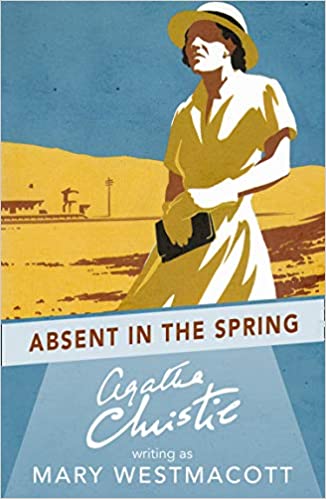
Review 1870: Absent in the Spring

For some reason, I always thought that the novels Agatha Christie wrote as Mary Westmacott were romance novels. Absent in the Spring, however, is a character study with an edge, reminding me more of some of the novels of Elizabeth Taylor.

Middle-aged Joan Scudamore gets stranded for several days at a guest house on her way from Baghdad to London. Before this happens, there is a revealing encounter between her and an old school friend, Blanche Haggard. Joan is judgmental toward Blanche, thinks she looks old and untidy and blames her appearance on the unfortunate choices she has made in life. Blanche cheerfully admits her bad choices but says she has enjoyed her life. She also hints at something about Joan’s daughter Barbara. We realize we like Blanche more than Joan.

During the five days Joan is stranded, she begins reconsidering her self-satisfied attitude, realizing some truths about herself and her family that she has hidden from herself. It is clear to the reader that she has bullied her husband and children, but she sees her behavior as doing her best for them. She thinks she has helped them to happy lives, but she has tried to make them all do what she thinks is right.

The big question is whether Joan can change her attitude. Let’s just say the novel is much more in the Realism school than Christie’s mysteries.

And by the way, let me just state my objection to this book being relabeled under Christie’s name. On the cover of my edition, the Christie name is more noticeable than Westmacott. Although I see no harm in acknowledging somewhere that they’re the same person, this is a marketing ploy that I don’t agree with. She wrote the book under the name Westmacott, so that should be the predominant name.

Related Posts

Appointment with Death

A View of the Harbor

Tales from the Queen of the Desert