
 The Best Book for this period is The Priory by Dorothy Whipple!
Category: books
Day 1195: The Long Song
 Several years ago, I greatly enjoyed Andrea Levy’s Small Island. So, I was happy when I saw that The Long Song was in both my Walter Scott Prize and Man Booker Prize projects.
July is fathered upon her slave mother, Miss Kitty, by the overseer on Amity, a Jamaican sugar plantation. It is early in the 19th century, so July is a slave, too.
July and Miss Kitty are field slaves, but when July is nine years old, the master’s sister, Caroline Mortimer, takes a fancy to her. She takes July away from Miss Kitty to train her as a house slave and calls her Marguerite. The novel is written as July’s memoir, as she recalls the final days of slavery on the island and its transition to freedom.
At first the tone of this novel bothered me. It seemed too sprightly and playful for subject matter that is sometimes appalling. It really tears into its white characters, too, who are portrayed at best as hypocrites but more often much worse. Eventually, though, its sly sense of humor got to me, and I laughed out loud. Still, I did not feel as involved by this novel as I did with Small Island.
Related Posts
Day 1194: House. Tree. Person.
 I scented gaslighting very early on in Catriona McPherson’s newest cozy creepster, House. Tree. Person. That did not spoil my enjoyment.
Ali McGovern has a trauma in her past and hints of a nervous breakdown. Her family is in a precarious financial position, too, because her husband, Marco, used her successful salon to prop up his failing restaurant. So, they lost both. When Marco falsifies her credentials to get her a job at Howell Hall, a mental hospital, she goes along with it, thinking she won’t get the job. But she does.
She comes home after her first day at work to a different problem. Her fifteen-year-old son, Angelo, is implicated somehow in the discovery of a body on the grounds of an old abbey across the street from the McGovern’s flat. The police think he knows something about it. Marco seems to know what is going on, but neither Marco nor Angelo will tell her.
At work she meets a cheerful and supportive staff, but her boss, Dr. Ferris, finds fault with her slightest action. In a catatonic patient, Sylvia, Ali thinks she sees signs of consciousness. She also believes that something is going on with Julie, a teenage patient who claims she’s being held there against her will.
Catriona McPherson has become one of my favorite writers for suspenseful and spooky but light reading. Her characters are engaging, and she creates a strong sense of place in small-town Scotland. House. Tree. Person. is another page-turner from her.
Related Posts
Day 1193: Pompeii
 I was just as short way into Pompeii when I realized I had read it before, probably when it first came out. Leave it to Robert Harris to make a page turner out of a story that everyone knows the end to.
The novel begins a mere two days before the horrendous eruption of Vesuvius. Marcus Attilius Primus is the newly arrived aquarius for the area—the engineer who is responsible for maintaining and operating the aqueduct that provides water to the towns along the bay. His predecessor mysteriously disappeared two weeks before. Soon after the beginning of the novel, Attilius discovers that the aqueduct has stopped running. He mounts an expedition to Vesuvius to try to find the break.
On the course of his urgent journey to repair the aqueduct, Attilius runs afoul of Numerius Popidus Ampliatus, a powerful citizen of Pompeii. He is also attracted to the man’s daughter, Corelia. When in his work on the aqueduct, Attilius figures out what is happening on the mountain, he has to avoid assassins sent by Ampliatus as he endeavors to rescue Corelia.
The novel also follows Pliny, who as admiral takes the fleet across the bay in an attempt to make observations and rescue people.
Harris has done his homework, and his descriptions of the eruption are terrifying. He must have had the time frame right, but my only quibble is that Attilius has to cover so much ground before he gets to Corelia, I can hardly imagine she would still be alive when he got there. This is another well written, suspenseful novel by Harris.
Related Posts
Day 1192: The Priory
Best of Five!
Saunby is an old estate that belongs to Major Marwood. It was once a priory, and the ruins are still there. The major is a poor landlord and manager who cares only for cricket. Although he has hundreds of pounds of unpaid bills and the house is falling to bits, he spends a huge amount of money every year in hosting two weeks of cricket matches.
The major is most unhappy about how the house is being run. His sister, Victoria, who is supposed to be in charge of the house, pays attention to nothing but her art, producing one atrocious painting after another. His two daughters, Christine and Penelope, are happy in their isolation up in the nursery, making odd-looking dresses and ridiculing the neighbors. The servants do what they want. Everyone in the household is completely self-absorbed.
So, the major decides it is time he remarried, principally to get someone to take care of the house and keep expenses in check. He has his eyes upon Anthea Sumpton, a woman no longer young who he is sure will be sensible.
Unfortunately, Anthea is in love with him and doesn’t understand he is making a marriage of convenience. Soon, she will have a rude awakening.
Everyone in this novel is due for a rude awakening, however, as the focus of the novel moves to Christine and what happens when she falls in love with Nicholas Ashwell. He is one of her father’s cricket players who has been raised to be as selfish as her family is.
This novel is also somewhat an Upstairs/Downstairs novel at first, when the new maid, Bessy, falls in love with Thompson, who helps with the cricket. He returns her feelings but doesn’t reckon with the rejected Bertha.
This novel is the best kind, the type in which characters develop and you change your mind about them. Beginning in the late 1930’s, it is also winding its way slowly toward the war. I found the novel beautifully written, involving, and ultimately touching, as a dysfunctional family learns to become slightly more functional. I have enjoyed all of Whipple’s novels, but I think I liked this one best, so far.
Related Posts
Day 1191: Coffin, Scarcely Used
 Although I am not familiar with Colin Watson’s work, when I read the title of Coffin, Scarcely Used, I just had to request the novel from Netgalley. Watson began writing in the late 1950’s and published more than a dozen books by the early 1980’s. This novel is his first.
No one thinks anything of the death of businessman Mr. Carobleat until the more unusual death of Mr. Gwill, the proprietor of the local paper and Carobleat’s next-door neighbor. Mr. Gwill was found in a field near an electric plant, apparently electrocuted. Inspector Purbright of the Flaxborough police wonders if the death could be suicide, but this seems an unusually cruel way to go. Purbright is also interested in the comments of Mrs. Poole, Mr. Gwill’s housekeeper, hinting at some kind of supernatural events from next door.
 When Inspector Purbright begins looking into Mr. Gwill’s affairs, he is struck by some advertisements Gwill has clipped from his own paper that seem to be coded in a particular way. Whatever Gwill was involved with, it seemed to also involve several other local businessmen—Dr. Hillyard, the undertaker Mr. Bradlaw, and the lawyer Mr. Gloss.
This mystery is fairly complicated, but aspects of it are relatively easy to figure out. I was well ahead of the inspector in regard to what was going on with the ads but did not guess what else was going on. The novel is characterized by a wry sense of humor, particularly in discussions among the various police. I found it mildly entertaining.
Related Posts
Best of Five!
 The Best Book for this period is Edgar & Lucy by Victor Lodato!
Day 1190: LaRose
 Set in 1999 on a North Dakota reservation, LaRose is about how a community, but in particular two families, are affected by a horrible accident. Out hunting a deer on his property, Landreaux Iron kills Dusty, the young son of his best friend, Peter Ravich, when Dusty falls out of a tree as Landreaux takes his shot.
To try to make amends, Landreaux, who has turned to the old ways to throw off addiction and straighten out his life, offers the Ravich family his own young son, LaRose, to raise. Nola Ravich, Dusty’s mother, is eaten up with hatred against the Irons, even Emmaline, who is her half sister. But having LaRose helps. Emmaline, however, can’t be expected to give up her son forever.
LaRose is the latest in a long line of LaRoses, all of whom had a special connection with the spirit world. LaRose finds himself able to help Nola and her neglected daughter, Maggie, even though he is only a small boy.
Another significant character is Romeo, who long ago was Landreaux’s best friend. He bears Landreaux a grudge because of an incident years before. Slowly, he works at his resentment despite the Irons having taken in his son Julius to raise.
Although I occasionally got distracted by how diffuse the plot is and how many directions it goes, in the main I enjoyed this novel. It isn’t nearly as depressing as a lot of Erdrich’s work, and it paints a powerful portrait of these two families. Dealing with forgiveness, of oneself and others, grief, guilt, and other human complexities, it is a strong novel.
Related Posts
Day 1189: Speak, Memory
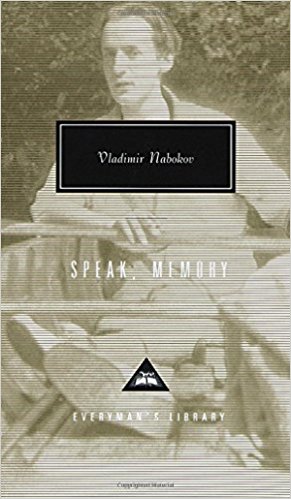 Although I admire Lolita, I went into Nabokov’s memoir with some trepidation. The three of his novels I read showed such a preoccupation with what he calls “nymphets”—beautiful preteen girls—that it was disturbing. It’s one thing to write a novel about a sexual predator and quite another to have the theme recur in all of your works. So, even though I knew that his partially autobiographical novel, Look at the Harlequins!, was ironically meant—that is, he depicted himself as people thought he was, not as he was, I’m wasn’t sure what to expect from Speak, Memory.
And it is unusual. Instead of narrating his life in a linear fashion, as you might expect, it instead explores themes in his life. So, there are earlier chapters listing the accomplishments of his ancestors, describing his governesses and tutors, later ones about his obsession with butterfly collecting, his efforts to write his first poem, and so on. The result is an odd dichotomy—for we still understand little of the day-to-day of his life while gleaning lots of details about the things he loved best and a vague understanding of the larger arc. I think he truly doesn’t want to tell much that is personal.
I most enjoyed the earlier chapters about life on his family estate outside St. Petersburg. His life there is depicted as idyllic, and it’s hard to know if it actually was or if it is in memory because he can’t return to it. Because of course his wealthy, elite family had to flee Russia after the Russian revolution.
As in Look at the Harlequins!, he tells nothing about his wife, Véra, although he addresses her directly at times. He does tell about his feeling for his son and about the parks in Europe they visited when his son was small.
So, I found large portions of this book interesting and beautifully written. The man has the largest vocabulary of any writer I’ve ever encountered. Other chapters, like the one about the butterflies, where I would have had to look up every other word to understand it, or the one about chess puzzles, were not so compelling. Still, I started another book before this one and set it aside to finish this. Such is the power of a great writer even when you’re not always interested in the subject matter.
Related Posts
Day 1188: Horse Heaven
 For me, Jane Smiley’s work is a little unpredictable. While I consider her A Thousand Acres to be one of the best books I’ve read, I haven’t liked others as much. To my surprise, though, I really enjoyed Horse Heaven.
In this novel, Smiley attempts a difficult feat—she wants to show all the nooks and crannies of horse racing by depicting quite a number of characters. There are owners, trainers, riders, jockeys, bettors, and veterinarians. There are also horses, a handful of which are important to the plot.
The novel isn’t plot heavy. We’re not headed toward a showdown among the major players at the races. Instead, each character has his or her own plot trajectory. The shifty trainer Buddy will do anything to win a race but suddenly finds Jesus. Elegant owner Rosalind is married to loud and gauche Al and has an affair with her trainer, Dick. Irish trainer Deidre thinks of herself as bitter and brusque but is adored by the people who work for her. Zen horse trainer Farley falls madly in love with rider Joy, who feels most comfortable alone. Elizabeth is an animal psychic who gets tips on the races from a retired racehorse.
I complained in Smiley’s Last Hundred Years trilogy that there were too many characters to get to know. But here, even though you see them in little vignettes, you do begin to care about them.
And I cared even more about some of the horses. Without actually anthropomorphizing them, Smiley gives them discernible characters. I was particularly captured by Justa Bob, an intelligent, reliable horse who begins a downhill slide mostly because of the carelessness of his owners. Smiley does’t focus just on champions. There is Mr. T., the retired horse; Froney’s Sis, a young filly who is timid and a slow learner; and Epic Storm, a horse who is fast but dangerous and mean.
If you like horses, I think you will love this book, but even if you don’t, Smiley shows us a fascinating, complex world. The novel is written in a breezy style with quite a bit of humor.

