
 This week’s Best Book is Four Letters of Love by Niall Williams! Also recommended is How to Be Both by Ali Smith!
Category: books
Day 1080: Moonglow
 Michael Chabon’s newest novel is supposedly inspired by his grandfather’s stories before he died. But I don’t think we’re supposed to take that literally, if only because he also says the novel was inspired by the stories of his mother’s uncle. In any case, it is a wandering, fascinating story of a complex life.
Grandfather’s stories begin with that of his arrest, when he was fired from his job to provide a place for Alger Hiss, newly out of jail, and attacked the corporation’s vice president. He was left with a hospitalized mentally ill wife and their teenage daughter. But the story wanders back and forth in time from his grandfather’s childhood in Philadelphia, his experiences searching for German scientists at the end of World War II, his work in the space industry. And always, there is his interest in the moon and space travel.
As always, Chabon manages to tackle some weighty topics while entertaining us like crazy. In this novel, he tackles German atrocities during the war and the stain they put on our own space program. Still, Grandfather’s life reads very much like an adventure story.
I really enjoyed this novel, much more so than I did Telegraph Avenue. Sometimes I enjoy Chabon more than other times, but I always find the journey interesting.
Related Posts
Day 1079: Murder in the Dark
 One of our pleasant discoveries since moving is to find that the local PBS station schedules lots more murder mysteries than Austin did, including our favorite, “Midsomer Murders.” On another channel, we also discovered the “Miss Fisher Mysteries,” based on the Phryne Fisher series by Kerry Greenwood being reissued by Poison Pen Press. When I saw that Netgalley was listing three of the series, I promptly requested them.
Phryne Fisher is a sort of flapper detective in this Australian series set in 1920’s Melbourne. Murder in the Dark is the 16th in the series. For those of you who have been watching the TV series, I have to warn you that this novel bears very little resemblance to the episode of the same name.
Christmas is nearing when Phryne begins to receive threats related to the Last Best Party, a house party given by siblings Gerald and Isabella Templar. Someone does not want Phryne to attend and even sends her a Christmas present of a poisonous snake. Of course, this makes Phyrne determined to attend.
When she speaks to Gerald about it, he admits that someone has sent him death threats. Soon after she arrives at the house, Gerald’s adopted son, Tarquin, disappears, as Isabella’s adopted daughter, Marigold, has already done. Although they thought Marigold had run away, Tarquin seems devoted to Gerald. Phryne also begins a sort of scavenger hunt, as she receives clues, supposedly from the murderer, that each lead to the next.
Phyrne soon finds out from her sources that someone has hired a hit man. Unfortunately, the description of the man is so vague that it could apply to most people.
In the sybaritic atmosphere of the party, Phryne tries to find the clues and locate the hit man before he kills someone. Since the guests include members of the upper classes, polo players, musicians, hashish smokers, the acolytes of the hosts, and even a goat lady, there are a lot of characters roaming about.
This novel was a pleasant enough light reading experience. The culprit wasn’t readily guessable because there was so little information about the plethora of characters. And indeed Greenwood cheats a bit by having, count ’em, three different culprits. I did glancingly guess the identity of the person who hired the hit man but dismissed the idea because it didn’t seem to make sense.
 One character who doesn’t appear in the TV series (oops! not until after I wrote this) is Phryne’s lover, an elegant Chinese man named Lin Chung. In this book, at least, he seemed to be completely unnecessary, perhaps only around to make Phryne’s behavior at the party seem more scandalous. But maybe he is more important in some of the other books. In any case, the TV show centers around a flirtation between Phryne and the police inspector, Jack Robinson, that does not seem to be present in the novels. Or maybe I’m talking from too little exposure to Phryne’s world.
Normally, I would avoid mysteries like this that go into great lengths to describe Phryne’s clothes and are too detailed about her love affairs. I have two more to read, so we’ll see how well I can stand it. In any case, these novels are like popcorn, light and fluffy.
Related Posts
Day 1078: How to Be Both
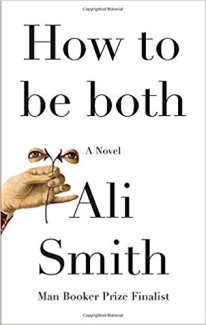 I thought How to Be Both was only a bit experimental until I read that the book, which is divided into two related stories, appears in some editions with one story first and in the other editions with the other first. I can see that switching the order of the stories would change the novel quite a bit.
In the version I read, a Renaissance artist watches a boy who is really a girl look at one of the artist’s paintings hundreds of years after the artist has died. The artist follows the girl through a few incidents in her life. As the painter follows her, we learn about the painter’s own life.
I am purposefully not using a pronoun to refer to the artist, because we learn fairly early that the painter is a woman passing as a man to receive art instruction and be able to work as an artist. Only a few people know he is a woman, and he comes down through posterity as a man.
In the second story, a teenage girl named George is grieving the death of her mother. As she copes with her feelings, she remembers conversations between them. Shortly before her death, her mother took George and her brother Henry to Italy just so she could see the work of the painter from the first story.
This novel is about the role of art in our lives, but it is also about finding ourselves and about the relationships between mother and daughter. George’s mother tries to challenge George by presenting her with provocative ideas. Some of these ideas are difficult to grapple with.
Although during the first pages I didn’t think I was going to like this novel, I found both of the stories and the connection between them deeply interesting. This novel is another surprising shortlister (surprising for me, that is) for the Booker Prize that I probably would not otherwise have read. I’m glad I did.
Related Posts
We Are All Completely Beside Ourselves
Day 1077: Four Letters of Love
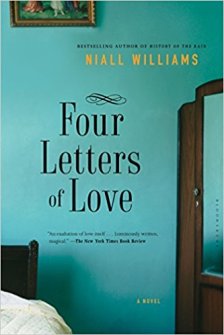 Best Book of the Week!
I was so enchanted by History of the Rain that after finishing it, I soon looked for other novels by Niall Williams. Four Letters of Love is his first.
Nicholas Coughlin is a boy when his father abandons his career as a civil servant to paint, saying that God wants him to. For two summers, he leaves Nicholas and his mother home alone while he goes out to paint. The rest of the year, he obsessively reworks the paintings he did in the summer.
Then Nicholas’s mother dies, but stays to haunt the house. His father intends to go out as usual and leave Nicholas home alone for a few weeks, but Nicholas follows him. His efforts all along are to try to capture some of the attention of this obsessed, abstracted man.
Isabel Gore is the daughter of a schoolmaster on an island off the coast of Galway. Her brother Sean is a gifted musician, but one day after playing for hours while she dances, he has a fit and after that is mute and wheelchair bound. Isabel blames herself for Sean’s condition.
The Master sets all his ambitions on Isabel’s academic career and sends her to Galway to a convent school. But Isabel has a streak of wildness in her and sometimes walks off from school. On one such expedition as a teenage girl, she meets Peader O’Luing. He is a poor excuse for a man, but she doesn’t see that and falls in love.
The novel makes no secret that it is moving toward the meeting of Nicholas and Isabel. To get there, it tells their stories with some whimsy, some pathos, and a touch of magical realism. Although the writing style and voice are not as distinctive as that of History of the Rain, the novel is still beautifully written. I enjoyed it very much.
Related Posts
Day 1076: Money to Burn
 It may be difficult to find a book by Elizabeth Cadell these days (it was when I wrote this, but I find now that someone is republishing them), but if you want something that is totally light and fluffy, a gentle, amusing romance with funny characters and a hint of a mystery, you can do no better than this author, whose heyday was in the 1950’s-70’s. Money to Burn features the vague young lord Raymond Trysting and his sister Auriol, their Canadian cousin Leigh Anderson, and three eccentric aunts.
When Leigh comes to the village of Cammertree to visit, he finds all of his relatives impoverished and Raymond and Auriol living in primitive circumstances. The odd old aunts are obsessed by their own interests and Auriol is disorganized and incompetent in the housekeeping department. She only knows how to cook eggs. Raymond is mild-mannered and seemingly lazy, but he has a shadow hanging over him. Trysting Mansion, the family seat, has just burnt down, and no one knows what happened to the £13,000 of insurance money the family received. Raymond and Auriol’s father has recently died and with him the secret of the money. And whatever happened to the historic family silver, which has also disappeared?
Leigh finds himself attracted to the beautiful Auriol, but the family problems are almost too difficult to contemplate. And Auriol has already rejected three suitors, so there’s no telling if she will accept Leigh.
With lots of fun, amusing dialog, and eccentric characters, Cadell’s books offer a refreshing change of pace.
Related Posts
Best Book of the Week!
 This week’s Best Book is Middlemarch by George Eliot! Also highly recommended is Anything Is Possible by Elizabeth Strout!
Day 1075: At Home: A Short History of Private Life
 One of the most enjoyable features of Bill Bryson’s travel books is his curiosity about everything and his willingness to go off on wild tangents. At Home is his attempt to inform himself and us about the objects of ordinary life, using his own home as a base for his explorations. But really, it’s his excuse to go off on tangent after tangent.
For example, his chapter on the cellar—he organizes his book by the rooms of the house—takes us to the building of the Erie Canal which takes us to the development of hydraulic cement then to the use of building materials in the United States versus England, a short history of Sir John Nash’s career, and so on. In fact, the contents of this particular chapter seem to have little to do with the actual room, except for the cement.
In reference to other rooms he discusses the history of various foodstuffs, the use of certain pieces of furniture, cemeteries, the history of how human mortality is treated, and even the history of gynecology. As always with Bryson, his comments can be amusing and the observations enthralling. If you like learning interesting little facts, this is the book for you. My edition was the illustrated one, which is full of fascinating photos and other pictures.
Related Posts
Day 1074: Pure
 The subject matter of Pure is unusual, and at times the events within the novel seem almost dreamlike in nature. It is an imaginative novel that evokes a real sense of place and period.
In pre-revolutionary France, Jean-Baptiste Baratte awaits a minister in Versailles to ask for employment. He is a young engineer and is hopeful to be given an interesting project.
He does get a job, but he is disappointed in its nature. The cemetery of les Innocents in Paris is so stuffed with remains that the nearby neighborhoods are being polluted. Jean-Baptiste is to oversee the removal of the remains and eventually the church. For the sake of discretion, he is not supposed to reveal his mission until he must.
The novel follows the provincial Jean-Baptiste for a year as he explores Paris and pursues his project. It conveys a strong sense of the city and of the effect of the cemetery on nearby residents.
This is another novel that I probably wouldn’t have read if it hadn’t been on my Walter Scott prize list. It is an interesting novel, reminding me a bit of Viper Wine.
Related Posts
Day 1073: Middlemarch
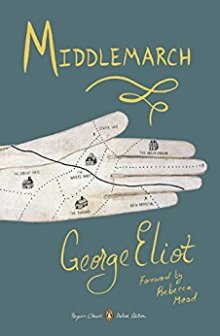 Best Book of the Week!
The first section of Middlemarch is concerned with Dorothea Brooke, an ardent but naive young woman who only wants to take part in something good. She thirsts for knowledge and wants to help with something important.
One trait of Dorothea’s that is physical as well as metaphorical is her shortsightedness. As her sister Celia tells her, “I thought it right to tell you because you went on as you always do, never looking just where you are and treading in the wrong place. You always see what no one else sees; it is impossible to satisfy you; yet you never see what is quite plain.”
Dorothea in her youthful ardor and intelligence attracts the attention of Mr. Casaubon, a cleric and scholar in his fifties who has been laboring for years on a work he calls “The Key to All Mythologies.” Dorothea decides it would be an honor to marry Mr. Casaubon and help him with his great work. And she does so, despite the admonitions of her friends and family.
It is while Dorothea is on her honeymoon in Rome that we meet other important characters in the novel, for Eliot subtitled her novel “A Study in Provincial Life.” There are the young Vincys, Fred and Rosamund, who have both been indulged by their wealthy parents. Fred has been raised to expect a fortune from his crusty old uncle, Peter Featherstone. Concerned at first only with leading the life of a gentleman, he has quit his university studies and fritters away his time. He would like to marry his childhood friend Mary Garth, but she won’t have him until he sticks to something.
Mr. Lydgate is a new doctor in town. He hopes to reform medical practices and make some significant discovery in medicine. Although he feels he cannot afford to marry for some years, he has not reckoned with Rosamund Vincy, a beautiful but self-centered young woman.
He also starts out by harming his chances through some outspoken comments and a too close relationship with Mr. Bulstrode. A wealthy businessman, Bulstrode is involved with the local hospital. But he likes to be in control of all his charities and is inflexible in his religious views.
In Rome, Dorothea and Mr. Casaubon re-encounter Will Ladislaw, Mr. Casaubon’s second cousin. Mr. Casaubon has been supporting Will financially through his studies after Will’s grandmother was disinherited from her family because of her choice in husband. Dorothea, in trying to befriend Will, does not see how much Mr. Casaubon dislikes him. That dislike is to have repercussions for Dorothea’s future life.
Eliot masterfully acquaints us with the problems and politics of this provincial area. Her characters are unforgettable, rich and human. There is a strong feminist sensibility, as Dorothea finds that everything she tries to do is balked because she’s a woman. And class is also an important theme. I continue to feel that Middlemarch is one of the best books ever written and was happy to have it chosen for me by the Classics Club spin.

