
 This week’s Best Book is The Home-Maker by Dorothy Canfield Fisher! Also recommended is The Orchardist by Amanda Coplin!
Category: books
Day 1040: The Orchardist
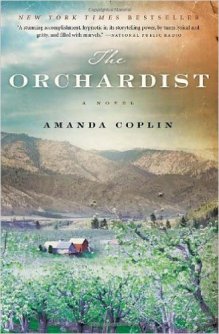 On Tuesday, I meant to say that my review was my tribute to Valentine’s Day, with an unusual story of love. Well, here is another one.
Talmadge is a man with a sad history. When he was still a boy in 1857, his father died in a mining town in Oregon. He and his mother and sister then walked all the way along the Columbia River to Wenatchee, Washington. They created an orchard from the start of two diseased apple trees.
Talmadge’s mother died in 1860, when he was 12, and after that, he and his sister Elsbeth were everything to each other. But then when he was 17, his sister went into the forest to gather herbs and was never seen again. Talmadge searched for her for years.
At the opening of the novel, Talmadge is in his 40’s. He has lived his subsequent life alone, working his orchard. He has friends, particularly Caroline Middey, an herbalist, and Clee, a Nez Perce horse trader whom Talmadge and Elsbeth were friends with since they were children. Every year, he and his men stop by with their horses to work the harvest.
One day in town, Talmadge spots two wild young girls who appear to be homeless. Although barely in their teens, they are both pregnant. They find their way to the valley where Talmadge has his orchard, and he leaves food out for them. Although he tries to make a shelter for them, they stay outside. The girls are named Jane and Della.
Talmadge hears someone is offering a reward for the girls. He does not intend to turn them in but travels to see what type of person this Michaelson is. He finds Michaelson runs a brothel for young girls and is an erratic opium smoker.
Michaelson eventually finds the girls, just after they have their babies. The result is disaster. Della has lost twins in childbirth, but the resulting tragedy leaves Jane dead and Jane’s child Angelene alone with Talmadge and Della.
The rest of the novel is driven by Talmadge’s sense that it is his duty to keep Della and Angelene safe. But Della is a wild girl whose actions are controlled by her unrecognized grief. She learns how to ride and finally goes off to work with Clee and his men. But she proves too unruly for them.
This novel is deeply interesting and beautifully written. It is also incredibly sad. It is about the loneliness of the human condition, about our ties to one another, about responsibilities to other people.
Related Posts
Day 1039: The Home-Maker
 Best Book of the Week!
The Home-Maker, which was published in 1924, was certainly a radical novel for its time. It has themes that resonate even today, although in some ways it is dated.
Evangeline Knapp is one of those super housekeepers whose home is always immaculate. When we first meet her, she has spent hours scrubbing a grease stain on the floor. But she does not love her work, and her unhappiness creates an atmosphere of tension in the house. She continually picks at her children for not meeting her standards, and everyone is afraid to upset her.
Lester Knapp works as an accounting clerk at a department store and hates every minute of it. He is not earning points with the new management for his dreamy demeanor or love of poetry. Although he is a good husband and father, he is perceived by his community as ineffective and a poor provider. Early on, we learn that he did not get a promotion he was hoping for, and his family will continue to be poor.
A terrible incident forces the two Knapps to swap responsibilities after Lester is injured. Lester takes over the household and child-rearing while Evangeline gets a job in the department store. Her new employers are struck by her energy and dedication to her work, while Lester’s patience with the children makes everyone’s temper and health improve. Everyone learns to adjust to a certain level of messiness.
The idea of swapping roles was much more controversial at this time, so much so that the novel is forced into a shocking conclusion. That was the only thing I didn’t like about this novel, which is touching and compassionate in its view of its characters. However, there probably wasn’t a better way to resolve the situation at the time.
This is a fascinating novel for its time, exploring the ideas of roles for the sexes and how well they actually apply, what happens when a person has no challenging life’s work, and so on. The novel’s themes are applicable to today, even if the times would not require such a resolution.
Related Posts
Day 1038: Truly Madly Guilty
 Truly Madly Guilty focuses around a suburban barbecue, during which something bad happens that literally everyone there blames themselves for. We don’t find out exactly what happened, though, until the end of the novel.
The novel follows two time streams. The first is a couple of months after the barbecue, when everyone is trying to process reactions to the event. Erika attends a talk that Clementine is giving about the event precisely because she has gaps in her memory. But she is unable to listen, because the whole thing upsets her too much.
Back on the day of the event, Erika and her husband Oliver have invited Clementine and her husband Sam over because they want to ask them something important, a favor. Erika and Clementine have been supposed best friends since school, but Erika is unaware how Clementine resents her. Years ago, Clementine only befriended Erika to please her mother, who felt sorry for Erika.
Erika and Oliver’s expansive neighbor Vid interferes with their plans. When he hears Clementine and Sam and their two little daughters are coming over, he invites everyone to his place for a barbecue.
Erika’s confusion results from her being so nervous that she takes an entire pill of a sedative that her doctor has told her to try half or a quarter of. Then she uncharacteristically drinks, causing problems with Oliver, whose parents are alcoholics.
This novel untangles the events of that evening while it explores the relationships between the two women and between them and their husbands. I don’t think it was the best or most suspenseful Moriarty I’ve read, but her novels are always eminently readable.
Related Posts
Day 1037: The Bloody Chamber
 Because a few months ago there was some mini hooplah about The Bloody Chamber, I thought it was a recent book, but it turns out Angela Carter died in 1992. I was totally unaware of her unique work.
The Bloody Chamber is a series of fairy tales and legends, retold. In them, heroines strip away their passivity. Some of the tales are gruesome, and all of them feature blood.
“The Bloody Chamber” is the story of Bluebeard retold. The young bride sells herself for riches and is taken to a castle floating in the sea. Her husband tempts her to look in the forbidden room by his very act of forbidding it, and she finds a slaughterhouse. When he returns unexpectedly, her intrepid mother saves her life.
I won’t tell the ending of the others, but Little Red Riding Hood, Puss in Boots, and Beauty and the Beast are all featured. The prose is gorgeous, with startling images and strong feminist themes, and Carter has a fascination with wolves.
This book will probably not be for you if you are at all squeamish. I am not, and some of it was a bit much for me. Still, it is a quick read, sometimes funny, always fascinating.
Related Posts
Day 1036: Edwin High King of Britain
 In the 7th century, Edwin has found refuge with Rœdwald, king of the East Angles. Edwin is the king of Deira and Bernicia, but he was long ago exiled when Aethelfrith usurped his throne. Edwin learns that Rœdwald is plotting to turn him over to Aethelfrith, and that provokes him to take back his kingdom.
Over time, through wars and alliances, Edwin is able to overcome his enemies and become High King of Britain. One of these alliances is his marriage with Aethelburh, daughter of the king of Kent, who is Christian.
I didn’t get terribly involved in the novel. I’m not sure if my problem was the flat characterization, the emphasis on battles and religion, or the lack of any sense of the characters’ day-to-day lives. If it was all feasting, fighting, and lusting after gold, then I don’t find this period very interesting. But I think the problem is that the characters and their lives are not fully realized. I couldn’t help contrasting this novel with King Hereafter by Dorothy Dunnett, set a few centuries later, which has similar themes and story arc, but it is so much richer. Or, for that matter, The Long Ships, set a little nearer in time, about characters leading a similar life, but with a rollicking sense of humor.
Related Posts
Best Book of the Week!

Day 1035: Literary Wives: The Wife
 Today is another review for the Literary Wives blogging club, in which we discuss the depiction of wives in modern fiction. If you have read the book, please participate by leaving comments on any of our blogs. Be sure to read the reviews and comments of the other wives!
Ariel of One Little Library
Emily of The Bookshelf of Emily J.
Kate of Kate Rae Davis
Lynn of Smoke and Mirrors
Naomi of Consumed By Ink
My Review
I’ve only read one other book by Meg Wolitzer, and I found it mildly interesting. The Wife, however, I found much more impressive.
Joan Castleman is traveling to Finland at the beginning of the novel. Her husband Joe is a famous novelist, and he is on his way to accept the Helsinki Prize for literature. On the flight, Joan decides their marriage is over. For too long, Joan has put up with Joe’s selfishness, including his infidelities. But their marriage is founded on a more fundamental lie.
The novel flashes back to incidents in the couple’s life, beginning with Joe’s seduction of her when she was a Smith co-ed in the 50’s and he was her literature instructor. Their relationship caused the end of his marriage and his fatherhood of a new baby.
Aside from a deft and insightful portrait of the end of a marriage, this novel deals with such feminist themes as the bias against women in the publishing industry and the sexual politics of marriage. Although I sometimes dislike Wolitzer’s apparent fascination with bodily functions, I found this carefully observed novel both dryly amusing and terribly sad. It had a twist that I saw coming, but that did not lessen the power of the novel.
What does this book say about wives or the experience of being a wife?
Although this novel comments on the experience of wives from the Greatest Generation, these experiences continue, in their own way, in many current-day marriages. In her marriage, Joan continually caters to the needs of her selfish and unfaithful husband on the grounds that he is a great writer. But she does even more for him than raise the kids, keep his house, meet his every need, and be a loyal wife. In fact, their relationship is entirely one-sided, with him becoming ever fatter and more self-satisfied.
In fact, the sacrifices Joan makes for her husband are shocking. But I am determined not to tell too much. Although Joan thinks the bargains they’ve made are exciting at first, she goes into her marriage with extreme naivety. In fact, over time, it is difficult to understand what Joan gets from the marriage at all, while it is clear what Joe gets from it.
Related Posts
Ahab’s Wife Or, The Star-Gazer
Day 1034: Ulverton
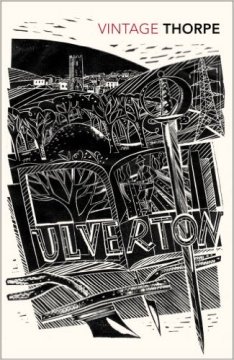 Best Book of the Week!
We’re now more familiar with novels written as related short stories, but Ulverton was written in 1992 and may be the first novel of this kind. The novel covers 300 years of English history and is set in one place, the fictional village of Ulverton. Other hallmarks of this unusual novel are that each chapter is written in a distinctly different voice and the chapters are written in different formats, from a tale told in an inn to the captions from a photographic display to the script of a documentary.
In 1650, the novel opens with the return of Gabby Cobbold from the Cromwellian wars. He meets the narrator, a shepherd named William, on his way home, but William does not have the courage to tell him that his wife, Anne, thinking he was dead, has remarried Thomas Walters. Gabby explains that he was away earning money to support the farm. Gabby disappears, and William is sure that Thomas and Anne killed him. But three hundred years later, Gabby gets his own back against a descendent of Thomas.
In 1689, the foolish Reverend Brazier tells the story of a strange night out on the downs, when he, William Scablehorne, and Simon Kistle were making their way through a snowstorm. As related in his sermon, they were apparently attacked by the devil and Mr. Kistle went mad.
Diary entries made in 1717 reveal a farmer’s preoccupation with improvements to his property and begetting an heir. Since his wife is ill, he does not touch her but begins trying to impregnate the maid.
In 1743, Mrs. Chalmers writes letters to her lover while shut away after childbed. Apparently having read her letters, her husband gets his doctor to keep her isolated longer.
And so it goes, stopping in about every 30 years, so that we sometimes hear of characters again. Through time, names are repeated and the story of incidents changes.
On occasion I had problems with the vernacular, although I tried to stick with it. The most difficult stories for me were the 1775 letters of Sarah Shail to her son and one side of the 1887 conversation between a man plowing and two boys. Sarah Shail is illiterate and is dictating her letters to John Pounds. However, this chapter has its own humor as Sarah is writing to her son Francis, who apparently answers her abusively, to the indignation of Pounds, who begins adding threats to the letters. Pounds’ spelling is so bad, though, that the letters are sometimes incomprehensible. In the case of the plowman, his dialect is so thick that I kept rereading parts of it but was unable to understand very much.
This was just one chapter, though. Overall, I found this novel deeply original and interesting. The countryside is so integral to the story that it features almost as a character. The writing is lovely, and the novel contains a great deal of drama and humor.
Related Posts
Day 1033: The Miller’s Dance
 The Miller’s Dance is the ninth Poldark novel in a series of 12. Perhaps 12 books is too many for a series, or perhaps the shift of focus more to the activities of Ross and Demelza’s children is a problem for me. I just feel a winding down of interest fighting with the feeling that, having read so far, I should finish the series.
It is 1812, so there are important historical events on the horizon, but they only receive a modicum of attention. Instead, we are focused on the love affairs of the two oldest Poldark children, Jeremy and Clowance.
In the last book, Jeremy proposed to Cubie Trevanion and was not accepted. He assumed it was because his lineage wasn’t good enough, but when he confronts her brother, he finds that what he needs is money.
Jeremy doesn’t have money, although he seems to have a future as an engineer. The person who has money is George Warleggan, and he sets about arranging a marriage between Cubie and his son Valentine.
Clowance betroths herself to Stephen Carrington, who for my money is not to be trusted for a minute. Ross and Demelza do not interfere but insist on a long engagement.
Although the novel contains brief accounts of the wars in Europe and with America, as I said before, it concentrates on Jeremy and Clowance. They are not the vivid characters their parents make, and I’m not that interested in their romances or in Jeremy’s steam engines, which we hear about in great detail. Three more books to go, but I probably wouldn’t read them if I didn’t want to know what happens to the family and if I hadn’t already bought the books.
Related Posts

