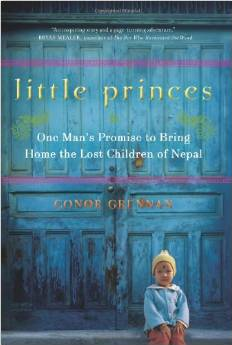
Day 696: Little Princes: One Man’s Promise to Bring Home the Lost Children of Nepal

Cover for Little PrincesAlthough I wrote this review several weeks ago, with the earthquake in Nepal, it is more timely now. I am happy to report that the children in the orphanages mentioned in this book are all well.

* * *

After the scandal of Three Cups of Tea, I wasn’t sure how much I wanted to read what seemed to be a similar book, but Little Princes was chosen by my book club. It’s the story of a man who volunteers for a Nepalese orphanage from fairly selfish motives but finds himself drawn in because of his affection for the children to do more.

Conor Grennan explains that he volunteered to work in the Little Princes orphanage in Nepal so that his decision to take a year off from work to travel wouldn’t look so selfish to others. This reasoning is an odd thing to admit and made me puzzle about his character. Still, once in place, he enjoyed work with the children enough to promise to come back.

It is right after he returned to Nepal that he met seven children from a remote province called Humla. Like many of the children, he learned, they were sent away by their parents from the district for their safety during civil war. What the parents didn’t know was that they were paying human traffickers, who got the children to Kathmandu and then sold them or abandoned them. Most of the children thought their parents were dead, and most of the parents had had no news of their children for years.

This was all to come out after Conor found the seven children from Humla in the custody of the wife of one of the traffickers. Just before he left the country again, he struggled to find a home that would take them in. A charity called the Umbrella Foundation, which had several orphanages, agreed. But after Conor returned home again, he learned that the trafficker had found out what was going on and removed the children before the Umbrella Foundation could fetch them.

Conor then decided to create his own foundation to work against child trafficking in Nepal. His first goal was to find those seven children. But after discovering that the mother of two of the children was alive and had not known of her children’s plight, he also decided to travel to Maoist Humla and try to find the parents of the seven children, as well as those of the children in Little Princes.

Conor does not do this all by himself. He has help from Gyan, a child welfare official; his coworker Farid, who founds an orphanage with him; the Nepalese men who go with him to Humla as guides and interpreters; and various European aid workers. Conor and the others eventually find the seven children and locate many parents in Humla, some of whom arrive to take their children back. The book also tells us how Conor met the woman he is now married to.

This book is interesting and makes you think about how much good can be done in poor countries with a small amount of money. The efforts of Grennan’s foundation and its results seem to be legitimate and worthy. What wasn’t entirely clear was how closely Grennan remains involved in the work now that he lives in Connecticut with his wife and child.
Related Posts

The Zookeeper’s Wife: A War Story

Conversations with Myself

My Father’s Eyes

Day 695: The Assassination of Margaret Thatcher

Cover for The Assassination of Margaret ThatcherThe Assassination of Margaret Thatcher is a collection of short stories that reveal an unusual sensibility. Some of the stories echo other of Hilary Mantel’s writings.

For example, the first story, “Sorry to Disturb,” seems as if it could be a chapter from Mantel’s Eight Months on Ghazzah Street. It is about an English woman living in Saudi Arabia who has troubles with a Pakistani man she befriends. Several other stories refer to physical ailments that she talks about in her memoir Giving Up the Ghost. Another story, “Terminus,” is about seeing the ghost of her father on the subway. But of course, many writers’ fiction has an element of the autobiographical.

The title story has more than a hint of the absurd. In the story, an apartment owner is held hostage by a sniper who is waiting for Margaret Thatcher to emerge from the hospital below her window. The hostage, who doesn’t like Thatcher either, begins helping with the planned attack and escape.

All of these stories are impeccably written, some are haunting, and all reflect the workings of an unusual mind.

Related Posts

Giving Up the Ghost

Beyond Black

The Stone Mattress

Day 694: The Paying Guests

Cover for The Paying GuestsSarah Waters builds on some of her themes from Affinity in the post-World War I novel The Paying Guests. Frances Wray lives with her mother in the family home, a large house that is getting a little seedy. Since the death of Frances’ father, they have had to dispense with servants, and Frances does all the housework herself. Now they have been forced to take in “paying guests,” giving up most of the top floor of their house to be their lodgers’ apartment. The lodgers are a young couple, Leonard and Lilian Barber.

Frances did not see her life like this. Not so long ago, she was in love with a friend, Christina, and they planned to make a home for themselves. But after the death of her father, Frances discovered he had lost all his money, leaving her mother nearly destitute, and she decided to stay to help her mother. Now she feels as if Christina and her new friend Stevie are leading the life she and Christina planned.

Class is an important issue in this novel and comes up constantly. Frances and Mrs. Wray feel they’ve been deceived when they take stock of their new guests, who are considerably less genteel than they thought. Frances often refers to them as being in the clerk class, but Lilian’s family is considerably more common. On the other end of the class scale, Frances has to wait to do her housework when her mother is out, because it appalls her so to see her daughter doing physical work. Her mother herself does none.

Different classes or not, Frances and Lilian tentatively develop a friendship. Soon, though, their relationship becomes a love affair. Frances wants them to run away to lead their own lives, but Lilian thinks she is fantasizing. Soon, their plans put them into peril.

This novel creates a fully realized time and place, with reference to many of Britain’s post-war issues. Unemployed soldiers on the streets are a problem as well as a growing sense of a less-ordered society.

I found Frances to be an interesting character but was less interested in Lilian, who seems more formless. I found the story compelling, though, wondering how the women would get through a difficult situation.

Related Posts

Affinity

Practical Magic

Trick of the Dark

Day 693: Fallout

Cover for FalloutMost of Fallout is told as a flashback, but the opening section is very short, so we can say we really encounter Luke Kanowski in 1961, when he is 14. He has busted his mother out of the mental asylum where she’s lived since he was five to take her to visit the art museum in London. The expedition is not a success, but while they are being questioned by a security guard, Nina Hollings notices them.

Nina is with her mother Marianne, a selfish woman who hands her off to her sister Mat when Nina is in her way but reclaims her before she can gain any stability. Later, she does other things to sabotage Nina’s self-confidence. Marianne works sporadically as an actress.

Luke is a young adult when he meets Paul Driscoll and Leigh Radley. He has been working at a mill, but shortly after he meets the two, he decides his life is harmful to him. Luke feels immediate friendship for Leigh and Paul and has soon moved to London. There the three of them work together with a few others to open a new theater.

Leigh has fallen immediately in love with Luke, but Luke is busy seducing practically every woman he meets, so Leigh becomes Paul’s girlfriend. Leigh’s father was unfaithful to her mother, so Leigh decides to stick with the man she feels is safe.

Then Luke meets Nina, who her mother has essentially pimped out to Tony Moore, a theatrical producer. Tony and Nina are soon married, Nina naively not realizing that Tony is using her as his beard. That is, she doesn’t realize until she finds him with two waiters during a party.

Luke’s first play is being produced as he and Nina begin an affair. This affair and the things Luke is willing to do to try to “save” Nina have repercussions for several people.

This novel is completely different from Jones’ The Uninvited Guests, which I enjoyed more. Although I was compelled to read the novel, I really don’t enjoy fiction where men betray themselves for a woman, or vice versa. Usually, the woman in these novels is bad. Nina isn’t, but she is weak and selfish and eventually asks Luke to betray his friends and his art.

Finally, I feel as if the ending of the novel is unrealistically hopeful and pat, when I think of the wreckage that has gone before. The background of the theater and play production with a bit about the politics of theatre is very interesting, though.

Related Posts

The Uninvited Guests

A Visit from the Goon Squad

The Cuckoo’s Calling

Day 692: The Devil in the Marshalsea

Cover for The Devil in the MarshalseaTom Hawkins has been leading a dissolute life ever since his ordination ceremony was sabotaged by his stepbrother’s reports of his behavior at school. In a desperate attempt to save himself from debtor’s prison, he goes out gambling with his disapproving friend Charles and manages to win enough money to save himself. But on the way home, he is attacked and robbed of everything. Soon, he is on his way to the Marshalsea.

In 1727, the Marshalsea is not the place Dickens described in Little Dorrit. Although Dickens’ prison was a place of lost hope, in the early 18th century, the Marshalsea is a hell-hole run by a venal and vicious governor, Mr. Acton. Hawkins is astounded to find that it costs more to live in the Marshalsea than it does outside, and if you can’t pay your lodging you will be banished to the horrors of the Common Side, from which bodies are brought out daily. Hawkins has no money at all except what he gets for pawning his mother’s cross and a bit of money from Charles.

To support himself, Hawkins takes on the job of investigating the death of another debtor, Captain Roberts. Although Roberts’ death was deemed a suicide, it was almost certainly a murder, and his ghost is reported as roaming the prison.

Hawkins has taken Roberts’ room, so his roommate is Samuel Fleet, whom all of the prison inhabitants fear. Fleet claims to have been asleep when Roberts’ body was dragged from the room that night. But Hawkins soon observes that Fleet never sleeps.

This novel is terrific. It is thoroughly researched and richly imagined so that both the setting and characters come to life. Hodgson explains at the back of the book that many of the characters are based on actual historical figures. This is Hodgson’s first book, and I’ll be looking for more.

Related Posts

Jack Maggs

Great Expectations

The Solitary House

Day 691: The Shadow of the Crescent Moon

Cover for The Shadow of the Crescent MoonI have to admit right away that I found this novel about modern-day Pakistan confusing. I think it’s because I don’t understand enough about the history of the area.

The Shadow of the Crescent Moon is set in Mir Ali in northern Pakistan. To help figure out what was going on, I did a little googling and found out that this area is known for jihadist insurgency. but it wasn’t clear to me that this is what the novel is about, exactly, although it certainly is about the complexities of life in an unstable area.

Set in one morning during Eid, the novel is about three brothers. The oldest, Aman Erum, has just returned from studying and starting a business in America. All his life, he has only wanted to leave Mir Ali and become a successful businessman. His tie to Mir Ali has been Samarra, the woman he has loved since they were children. But his price for leaving Mir Ali was a betrayal, even of her.

The youngest brother Hayat was the one who listened to his father’s stories of the past, when the region was free. Here is one source of my confusion, because Hayat has joined the insurgents working for the region’s freedom from Pakistan. It was not until late in the novel that I discovered they wanted to belong to Afghanistan instead, and it was not clear to me whether these insurgents were also jihadists. I think not, because the family is Shia and the jihadists seem to be Sunni. The actual term is never used in the novel. In any case, Hayat is plotting with Samarra an event to take place that day. In fact, Samarra, whose father disappeared years ago on a mission for the separatists, is in charge of their group.

Sikander, the middle brother, is a doctor whose son has recently been killed when a different group, apparently the Taliban, blew up the hospital where the boy was waiting for his father. Sikander’s wife Mina has taken to attending funerals of other children and behaving in a way that is slightly deranged. Sikander is taking Mina home from yet another funeral when he is summoned for a medical emergency so he brings her along. On their way, they are stopped at a Taliban roadblock. Sikander cravenly pretends that Mina is the doctor and he is simply her driver.

link to NetgalleyI don’t think we get to know any of these people well enough to become very involved in this novel. Further, more complete background on the history of the area, as opposed to allusions that assume we already know about it, would have helped me understand better what the issues are and who is who. It is clear that the residents of the area feel that Pakistan’s leaders have pilfered it and left them with little hope. The novel held a certain amount of drama but could have been more effective.

Related Posts

The Great Game: On Secret Service in High Asia

And the Mountains Echoed

A Thousand Splendid Suns


Day 690: Wylding Hall

Cover for Wylding HallElizabeth Hand’s earlier novel Mortal Love showed she was interested in a connection between inspiration and folklore. Wylding Hall is also an unusual exploration of this theme.

The novel is told as a series of possible interviews, maybe for a documentary, about a 70’s folk group called Windhollow Faire. The group released two albums, but a mystery surrounds the second one, which 20 years later has been re-released as a smashing success.

The novel is narrated by the band members, their manager, and a couple of other people who visited the band during the fateful summer the album was recorded. The band’s manager Tom Haring sets off the action of the novel by renting an old Tudor mansion in a remote rural area for the band to live and work in during the summer. Part of the house has been restored but the rest of it is a rambling wreck. The band works but in a party atmosphere of drugs and booze.

The novel builds up some suspense with the hints of something unusual happening that summer involving Julian Blake, the band’s lead singer and songwriter. He is the only member of the band who is not heard from in the novel. The house is described in a way that is both beautiful and creepy, featuring an old library that cannot always be located and is full of feathers. The local inn also features some folklore and is named after an old song about killing wrens on St. Stephen’s Day.

link to NetgalleyThe locals warn the band members away from the woods around the house, and their superstitious comments add to the hints of darkness in the book. For a short novel in which little actually happens, it creates quite a mood of creepiness.

My only criticism is that most of the band members blurred together for me, because I couldn’t keep them straight. A couple stand out, but most of them are too undefined to be successful characters.

Related Posts

Mortal Love

The Lace Reader

The Night Strangers

Day 689: Wild

Cover for WildI didn’t actually become interested in reading Wild until I saw the terrific movie adaptation. That and a few excellent reviews changed my mind about reading it. There was just something about the author having changed her name to Cheryl Strayed that annoyed me, to be honest, and was keeping me away from the book.

If you have seen the movie, it is amazingly similar to the book, only changing the sequence of some events and leaving a few things out.

This memoir is about Cheryl Strayed’s attempt to get her life back on track by hiking the Pacific Crest Trail from Southern California to near Portland, Oregon. After Cheryl’s mother’s death from cancer several years before, her life fell apart. She became promiscuous and eventually began using heroin. After she and her husband divorced, she decided to hike the trail alone in an attempt to return to her true self.

Although Cheryl views herself as an outdoorsy girl, she soon finds that she is unprepared for the rigors of the journey. Her pack is so heavy that she can barely lift it, her boots uncomfortable, she herself not in condition and not understanding that such an endeavor is painful even for an experienced hiker. She originally planned to hike about 20 miles a day but finds herself only making 6 to 8 miles, less at the beginning.

This memoir is vividly written and quite harrowing at times as it follows Strayed’s journey. She encounters snow and landslides, wild animals, friendly as well as scary people, and her own truth. Wild is an interesting journey into the wild and into self-awareness.

Related Posts

The Cruelest Journey: Six Hundred Miles to Timbuktu

A Walk in the Woods

A Time of Gifts: On Foot to Constantinople: From the Hook of Holland to the Middle Danube