Day 465: Betrayal

Cover for BetrayalA quick note before I start my review. Be sure to check back on Monday, February 3, for the Literary Wives reviews of The Inquisitor’s Wife by Jeanne Kalogridis. We encourage anyone who has read the book to add their comments on any of our blogs. We also have a new Literary Wives Facebook page where you can comment or add a link to your own review.

Now, to the book.

Eva suspects her husband Henrik might be having an affair, so she sets herself to find out. Meanwhile, in a nearby hospital, Jonas is caring for his girlfriend Anna, who is in a coma.

It is not too long before Eva discovers Henrik is having an affair with Linda, their child’s daycare teacher. Feeling at once enraged and rejected, she goes out one night to see if men still find her attractive. She meets Jonas and spends the night with him.

Of course, Jonas is a psychopath who drowned Anna when she rejected him. This is not a spoiler, as it is revealed at the beginning of the novel. Now he decides he’s in love with Eva and begins stalking her.

All of the characters in this novel are fairly despicable. Eva is contemptuous of her husband, who lets her take care of everything. Instead of being devastated to find he’s having an affair, she immediately begins looking for revenge. Henrik is spineless, and his lover Linda turns out to be a bitch. Jason has lots of strange character traits, but I doubt that someone suffering as strongly from OCD as he is at times could at other times be free of it or be functional enough to also be a very clever stalker.

The inner thoughts of Eva and Jason, the two narrators, are related in abrupt, harsh sentences, which also characterize all of the dialogue. The characters are all one-dimensional.

In order to be fully engaged in the suspense, I think we need to feel some sympathy for Eva, but we just don’t. Perhaps if the plot hadn’t resorted almost immediately to nastiness, we would have. All in all, I wasn’t that impressed with this novel.

Day 464: Practical Magic

Cover for Practical MagicI’m ambivalent about Practical Magic, the first novel I’ve read by Alice Hoffman. It reminds me a bit of the Vianne Rocher books by Joanne Harris, only it is more heavy handed and less principled.

Gillian and Sally Owens have grown up in their aunts’ house in Massachusetts and have always longed for something different. Their aunts are considered witches, and people walk on the other side of the street when they see the girls. Sally longs for normalcy and tries to keep the untidy house clean and feed everyone wholesome meals. Gillian is spoiled and beautiful.

Eventually, both of them leave. Gillian runs away to begin a series of ill-conceived marriages and affairs. Sally’s brief marriage brings her two daughters of her own, Antonia and Kylie. When her husband is killed in a car accident, she flees the dark old house for suburbia and a chance for a normal life for her daughters.

Thirteen years go by before Gillian arrives unannounced at Sally’s house bringing trouble. Her latest boyfriend Jimmy is a dangerous criminal, and Gillian has accidentally killed him. His body is out in the car, and she has come to her sister for help. Together, they bury the body in the yard, but soon they are being haunted.

This story is told in a fairy tale style, and despite several setbacks, we are in no doubt that everything will turn out all right in the end. Characters fall madly in love on sight, and the troubles between both sets of sisters are worked out. The final removal of the spirit requires the assistance of the aunts themselves. Of course, it turns out that Gillian didn’t really kill her lover.

I guess I felt as if everything was tied up too neatly in this story. It’s a romance novel lightly disguised as magical realism, and I haven’t much patience for either.

On the one hand, I found myself mildly enjoying the novel. On the other hand, I found it too cheerfully immoral. We are supposed to accept through most of the book that Gillian killed her lover, however accidentally, and that it is okay to cover it up. Finally, the law officer who tracks them down while looking for Jimmy is required to fall in love with Sally on sight so that he can help cover up their crime, despite his being perfectly straight-laced up to that point. Even if the “murder” turns out not to be as big a crime as they thought, now he has committed a crime, too, which everyone immediately forgets so that they can live happily ever after. It leaves a bad taste in my mouth.

Day 463: The Luminaries

Cover for The LuminariesBest Book of the Week! Year!

This last year I read several books that played wonderfully with structure. I’m thinking particularly of A Visit from the Goon Squad, a series of stories linked by their characters that somehow forms a whole, and Life After Life, in which the heroine’s life is repeated, with slight changes that lead to significant ones. I loved both of these inventive approaches to structure, and now I add to this list The Luminaries, the latest winner of the Man Booker Prize. This book is also my second recently reviewed novel set in New Zealand.

Walter Moody is newly come to the gold fields of the South Island of New Zealand in 1866. He has arrived in rough seas and is shaken by an apparition he has seen in the bowels of the ship. Seeking warmth and comfort, he checks into a seedy waterfront hotel and enters the parlor, where he accidentally interrupts the meeting of 12 other men.

After some initial hesitancy, the men begin telling him a series of tales, all interconnected, but the whole of which they cannot make out. The tales concern a missing trunk, a fortune found in a dead man’s cabin, the disappearance of a prominent citizen, the apparent attempted suicide of a whore. Each man at the meeting has his own part of the story to impart. Moody is able to make some sense of the story, but all go away from the meeting knowing that pieces are missing.

This section of the book is the longest, making up almost half its length. The cover of the novel, showing a waning moon, gives you a hint to its structure. It is divided into 12 sections, each one shorter than the one before but each one adding to the revelations of the original tales, until the final very short slivers of sections reveal all.

Each of these sections is also headed with an astrological chart that shows how the heavenly bodies are positioned within the signs of the 12 initial characters. This I did not understand at all, but Catton provides some indication at the beginning of the sections about what the astrology predicts.

The chapters of the novel are charmingly headed with old-fashioned descriptions of what happens in the chapter. Over time, the descriptions themselves begin to drive the narrative.

In The Luminaries, we’re presented with a novel that embodies a puzzle, a complex tale of villainy and foul crimes but also of love and loyalty. I was completely engrossed in  entangling the threads of this story. Despite its beginnings as a tale of cheats and chicanery, you may be surprised to find that you are reading a love story about two characters connected by their stars.

Day 462: The Return of Captain John Emmett

Cover for The Return of Captain John EmmettThe Return of Captain John Emmett is the first of Elizabeth Speller’s Laurence Bertram mysteries set just after World War I. I previously reviewed the second in the series, The Strange Fate of Kitty Easton.

Laurence Bertram has felt himself at a loss since the war ended. He is haunted by his memories of the war and also by guilt at his lack of grief over the deaths of his wife Louise and baby son, whom he never saw. Ostensibly writing a book about church architecture, he is finding it difficult to work. So, it is with a bit of relief that he responds to a letter from Mary Emmett, the sister of an old school friend John Emmett, in which she asks him to come visit her.

Laurence has fond memories of some school leave visits with the Emmetts after his parents died but feels Mary has misunderstood the depth of his friendship with John, whom he has not seen in years. Of course, he has heard of John’s death, an apparent suicide. Mary explains that John had been staying in a rest home because of mental disturbance following the war. Since he seemed to be improving, she and her mother cannot understand why he committed suicide. She asks John to find out what he can about John’s motives.

Laurence feels uncomfortable but agrees to look into it because he has always been attracted to Mary. With the help of his friend Charles Carfax, who gets his detective skills from reading Agatha Christie books, Laurence investigates the rest home and anything he can find out about John’s state of mind before his death. Included in John’s curious scraps of paper and photos is a list of the beneficiaries of his will, some of whom cannot be identified or located, and some photos from the war.

Laurence comes to believe that John’s death has something to do with his war experience, possibly with an execution over which he was forced to preside. And it seems John may not have committed suicide after all.

Speller takes her time with these mysteries. The settings are beautifully described and the period effectively evoked. A true sense of depth of character emerges. Even though I was about 100 pages ahead of Laurence, not in identifying the perpetrator but in realizing the motive, I enjoyed every bit of this novel.

In the last few months, I have read several historical mysteries where the author did little with the time or place, simply using the historical events to frame the plot. Thankfully, Speller has taken more care with this interesting period of history.

Day 461: My Life in Middlemarch

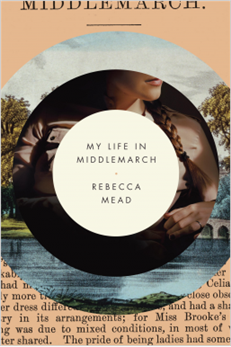
Cover for My Life in MiddlemarchMy Life in Middlemarch is a difficult book to categorize and an unusual effort. It is part memoir, part literary criticism, part literary history and biography, part thoughtful examination. Its focus is on George Eliot’s greatest novel, Middlemarch.

New Yorker writer Rebecca Mead muses about what the novel, her favorite as it is mine, has meant to her during different periods of her life, how different parts of the novel and different characters have spoken to her and how her sympathies with characters and comprehension of the novel’s themes have changed as her life was in its varying stages. She also examines events in Eliot’s own life—how they and the people she knew may have contributed to her works.

This book is about all things Middlemarch. Mead visits the towns and homes where Eliot resided and places where she may have set the novel. She reports on the ways that literary criticism of the novel changed over time—how it was immediately popular and then fell out of favor in later years to be rehabilitated, partially by the appreciation of Virginia Woolf. The book provides interesting insights into the novel and into Eliot’s life and possible thought processes as she wrote the novel.

http://www.netgalley.comFor those who have not read Middlemarch, the book still may hold some interest, but a lot will be lost. To those who have read and loved it, you will probably, like me, be compelled to pick it up again and reread it. I’ll be doing that soon.

Second Anniversary: Ten Best Books of the Year!

Cover for Life After LifeTomorrow is my second anniversary of keeping this blog. So, here I am with my second list of the year’s best ten books. This list is fairly arbitrary, because to get it down to ten books, I had to make some tough decisions. As with last year’s list, these books were not necessarily published in the past year. They are just the ten best from the ones I reviewed, in the order I reviewed them.

Day 460: March Violets

Cover for March VioletsThe blurb on Philip Kerr’s collection of three noir mysteries, Berlin Noir, compares him to John Le Carré and Alan Furst. I wouldn’t say that is an apt comparison. For one thing, the other two are writing in a different genre. For another, they are better writers. Still, if you like noir, March Violets has its own qualities.

This novel is the first in a series featuring private detective Bernie Gunther. It bears many of the hallmarks of a typical noir mystery. Its main character is a smart, wise-cracking tough guy who used to be a cop. It features beatings, untrustworthy dames, thugs, and murder. What makes it stand out is its setting in 1936 Berlin.

Bernie is hired by millionaire industrialist Hermann Six to find a family heirloom necklace. It was stolen from the safe of his daughter Grete and her husband Paul Pfarr when the two were brutally murdered in their beds and their bodies burned. Herr Six explicitly instructs Bernie not to look into their deaths but to find the necklace and return it to him. Of course, Bernie begins looking into everything.

Using credentials as a representative of an insurance company investigating the fire, Bernie soon finds out that Pfarr was a member of the SS, with a mission from Himmler to seek out corruption in the labor movement. That mission made him a lot of enemies. He also had some kind of friction with Herr Six, who is rumored to have ties to organized crime. In addition, there were unexplained problems in the Pfarr’s marriage.

Typical of noir fiction, the plot becomes very involved. The setting is convincingly evoked, especially the constant threat of violence for ordinary citizens under the Nazis. Bernie specializes in missing persons, and the novel makes clear that hundreds of people go missing from Berlin daily.

Since I am more familiar with classic noir, the novel occasionally struck me as too coarse, but that didn’t bother me as much as other uses of language. First, idioms with which I am unfamiliar are used constantly. Perhaps they are period German idioms, but they often seem clumsy and inapt, which idiomatic  language seldom does. Also clumsy and inapt are Kerr’s many metaphors, for example:

The butler cruised smoothly into the room like a rubber wheel on a waxed floor and, smelling faintly of sweat and something spicy, he served the coffee, the water and his master’s brandy with the blank look of a man who changes his earplugs six times a day.

Perhaps this style of writing is meant as a send-up of traditional noir style, but it is certainly overblown and irritating. (To be entirely dated in my references, it sometimes reminds me of the passages read by Jeff Goldblum’s character in the old TV series Ten Speed and Brown Shoe, but those were explicitly tongue in cheek, and I’m not as sure about Kerr’s writing style.) Although at one point I considered putting the novel aside, I finally decided to continue, and found the book moderately entertaining.

Day 459: The Orphan Choir

Cover for The Orphan ChoirThe Orphan Choir is a departure from Sophie Hannah’s Simon Waterhouse and Charlie Zailer mystery/thriller series. It still is darkly atmospheric and features her trademark neurotic characters but goes off in another direction.

Louise Beeston’s neighbor on her Cambridge street regularly wakes her up playing loud rock music late at night. When she goes over to complain in the beginning of the novel, he ridicules her in front of his friends and refuses to turn the music down. Louise’s husband Stuart can sleep through anything and doesn’t want her to call the police, but she does anyway. They refer her to the Council.

The music stops as the representative from the Council, Patricia Jervis, arrives, but Patricia seems very sympathetic and takes the complaint. Louise also complains to Jervis that her neighbor mocked her for sending her son Joseph away to school at the age of seven. Louise is actually very unhappy about the decision, but Joseph was given a place at a school that requires him to board if he is in the choir, and Stuart insists that she would be ruining Joseph’s chances if they send him to a different school.

Louise continues to hear music, but the neighbor seems to have begun a more insidious program of sometimes quietly playing choir music of children singing. After Louise turns on some loud music of her own at 6 a.m., when she knows the neighbor is sleeping, the rock music stops but the choir music continues.

With the house being renovated, Louise talks Stuart into buying a second home in a gated community in the country. Peace is the rule there, and she is happy and calm for awhile until an argument with Stuart about removing Joseph from the school results in Stuart summoning Dr. Freeman, the director of the choir, whom Louise despises. Suddenly, she begins hearing the choir music again, but without her neighbor nearby, she fears she is going crazy.

http://www.netgalley.comAs I am familiar with Hannah’s other novels, I suspected someone was gaslighting Louise, possibly her husband, who seems genial but overrides and undercuts her at many points during the novel, including summoning Dr. Freeman without discussing it with her first. Another suspect is Dr. Freeman, who seems creepy and overly concerned with whether Joseph is in his choir or not. However, I won’t say whether I was right. I think I prefer Hannah’s mysteries, but if you like novels that are unusual and slightly macabre, you may enjoy this one.

Day 458: Quiet: The Power of Introverts in a World That Can’t Stop Talking

Cover for QuietMy first impression of Quiet was that it seemed much like many management books I have read and at one time (when I had a director who enforced a “management book club”) considered the bane of my existence. Hallmarks of many of these books are to base broad conclusions on a few examples and to endlessly repeat the same information. Writer and lecturer Susan Cain’s focus on business and examples of individual people’s experiences made me fear this was yet another such book, so I continued only because it was recommended by someone I trust. However, I was pleasantly surprised, for Cain’s scope broadens as the book continues, and the book shows plenty of familiarity with studies and theories that support her positions.

Cain’s initial observations are about how Western, particularly American, society and business reward extroverted behavior and consider introverted behavior a fault. Since I am myself an introvert, I was happy to read her extensive support for the position that these attitudes can be harmful for business and other endeavors and are based on false assumptions that extroverts are smarter than introverts.

Just to go off on a personal tangent, one of Cain’s points—that volubility is often mistaken for intelligence—was demonstrated to me years ago when I worked with a loud, aggressive woman. One day after a coworker and I had been sledgehammered into submission for some minutes, the coworker remarked that she was annoying but smart. I rejoined, “Did you listen to her? What she said didn’t make any sense!” The coworker had not noticed, seemingly bowled over by the woman’s verbosity.

Cain’s book is full of examples of the qualities of introverts that should be more valued. She gives advice for introverts who want to appear more extroverted, both things people can do and thoughts about how they can evaluate whether that approach is best for them. She also provides suggestions for managers who are interested in creating a workplace that is effective for both extroverts and introverts. She talks about the challenges of Asian students, who tend to be more introverted, in American society. Especially valuable are her suggestions for parents and other adults in dealing with and helping introverted children.

Overall, I find the book to provide perceptive observations and practical suggestions for dealing with work and social life as an introvert, as well as providing insights about the unrecognized value of introverts in our society.