Libby Jones knows that she is adopted and that on her 25th birthday she’ll receive some sort of inheritance. However, she is floored to find she has inherited a house in Chelsea that is worth millions.
The house has a dark history, though. Twenty-four years ago, Libby was found in a cradle in the house with four dead people, an apparent cult suicide. Her teenage brother and sister were missing.
Alternating with Libby’s discoveries is the narrative of Henry Lamb, her brother, who was 10 years old when first Justin and Birdie and more fatefully, David Thomsen and his family moved into the Lambs’ house. Slowly, David begins bringing Henry’s infatuated mother and weak father under his thumb.
We also hear from Lucy, another former inhabitant of the house, who is barely surviving, homeless on Italian streets with her two children and her dog. She needs to get to England and to do so, must beg for help from her abusive ex-husband.
This novel feels like it is building to a suspenseful ending, but its ending is surprising and ambiguous. I wouldn’t exactly class it as a thriller, but it is dark and interesting.
The Man in the Wooden Hat is the second novel in the Old Filth trilogy. Old Filth examines the entirety of the life of its main character, Edward Feathers, while this novel takes a closer look at his marriage with Betty. As with Old Filth, The Man in the Wooden Hat appears to be straightforward, but there is a kick at the end.
At the beginning of the novel, Eddie has sent a letter containing a marriage proposal to Betty, who is vacationing in Hong Kong while Eddie has been working in London. Betty accepts his proposal when he arrives in Hong Kong, where he makes only one condition, that Betty never leave him.
Only hours later, Betty meets Eddie’s rival, Terry Veneering, and falls immediately in love with him, although he is married with a son, Harry. She also falls in love with nine-year-old Harry. She is determined to marry Eddie; however, she spends a night with Terry before the wedding. Unfortunately, he leases a house for their rendezvous from Albert Ross, Eddie’s best friend, a Eurasian dwarf. Ross finds her purse there. He does not tell Eddie but returns the purse to Betty and tells him she must never leave Eddie. He knows of all the loss in Eddie’s life.
So begins their marriage. I did not dislike Betty despite her infidelity; in fact, I liked her, although it’s hard to decide what to think about Veneering. The novel follows the entirety of their marriage, which is reticent and notable for Eddie’s absences for work. Betty, who was born in China and subject as a child to detention by the Japanese, finds she cannot have children.
It’s hard to explain how this sort of everyday novel can be so absorbing. We think we know everything about the Featherses. But Gardam tilts everything slightly in the final chapter.
If you’re not familiar with the plot of The Bride of Lammermoor, you might be wondering why I picked it for the Classics Club Dare 2.0, Time to Get Your Goth On. It’s not a gothic horror story common for the time but one of Sir Walter Scott’s historical novels about a doomed love. However, the ending, which I’m not revealing, puts it in a more appropriate category as do the dark local legends and prophesies of withered old dames (perhaps witches), not to mention the ruined tower.
Edgar, Master of Ravenwood, is from a proud Scottish family of distinguished lineage. His profligate father, however, did his best to waste the family estate and finished things off by fighting on the wrong side of the revolution. With other parties in power, lawsuits filed against the estate by William Ashton, Keeper of the Great Seal of Scotland, have resulted in almost all of the Ravenwood property being turned over to Ashton and in an early grave for Ravenwood’s father. The impoverished Master has sworn vengeance against Ashton.
Ashton, however, is a politician, and he hears that the political situation is changing. Things may be looking up for the Marquis of A___ and thus for his relative, the Master. After the Master saves Ashton and his beautiful daughter Lucy from a wild bull, Ashton tries to befriend him, even encouraging him to spend time with Lucy and Ashton himself considering the benefits of a marriage between the two. Against the Master’s better judgment (and supernatural warnings), he begins to fall in love with Lucy. They become betrothed, but Lucy wants it kept secret from her family.
Some meddling from a neighbor who is not a friend of the Master’s leads Lady Ashton, staying with friends away from home, to hear the rumors that her daughter is engaged to him. She is his implacable enemy, so she swoops home to Ravenwood Castle just as the Marquis of A___ comes for a visit. The Master has been residing there at Ashton’s invitation, but Lady Ashton unceremoniously throws him out. He has already agreed with Lucy, however, that he will consider himself betrothed until she herself releases him. Then he goes off to make his fortune.
This novel was quite hard going for me at times, particularly in the sections and whole chapters that are in Scottish vernacular. These are the parts concerning the common people, and some of them are supposed to be funny, especially the ones about the machinations of Caleb Balderstone, the Master’s only servant, as he tries to hide what everyone already knows—that his master is destitute. I just felt they slowed down the action as well as being hard to understand and not that funny.
The action, however, eventually gets going and really picks up toward the end of the novel. I read the second half twice as quickly as the first.
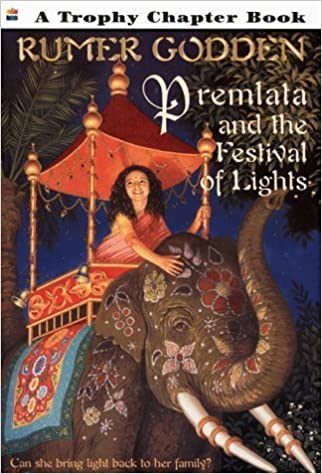
Premlata and the Festival of Lights is the first children’s book I’ve read in my mission to read all of Rumer Godden’s India novels.
Since seven-year-old Premlata’s Bapi died, her family is very poor. With all the village families preparing for Diwali, Premlata is shocked to find out that her mother has had to sell all their deepas, the little oil lamps that families put around their houses to help the goddess Kali battle the demons of darkness.
Premlata’s mother sends her up to the Big House to deliver some sweets to the housekeeper. While she is there, she goes to visit her friend Rajah the elephant and finds him being painted beautiful colors for the festival procession. This reminds her of the problem of the deepas, and she begins crying in front of Bijoy Rai, the kind owner of the Big House. Once she explains that her house will be the only dark one in the village for Diwali, Bijoy Rai gives her some money for her mother to buy deepas.
Premlata has a better idea, though. She will go to the town, three miles away, see Rajah in the procession, and buy the deepas herself.
This is a charming chapter book for children who are old enough to read. It introduces them to another culture and is a gentle story about good intentions gone slightly amiss. It includes a realistic adventure with elements of danger. I don’t know how easy it would be to find a copy, but I recommend it.
In Oh William! we meet again Elizabeth Strout’s alter ego, Lucy Barton. Lucy’s second husband David has recently died. She considers her own grief in addition to the state of mind of her first husband, William, who begins to experience some shocks in life.
First, William’s third wife, Estelle, leaves him abruptly. Then William begins to find out some family secrets, particularly about his mother, Catherine. Lucy, who has remained on good terms with William, reflects upon her relationships with him, Catherine, and her own family as she tries to help him.
As usual, the story, which is told as a series of apparently random recollections and incidents, is written in lovely prose. What stands out for me even more than that in the Lucy Barton books is Lucy’s gentleness and the loving, accepting way she approaches the world and the other characters. Although Strout’s novels are not strongly plot driven, once you start one, you just want to keep reading.
My final choice for the 1976 Club is this early novel by Margaret Atwood, her third. Up until now, the earliest novel I’ve read by her is The Handmaid’s Tale, published nine years later. Although her novels have mostly been totally unlike each other except for frequent forays into dystopia, Lady Oracle was surprising to me. For the most part, it is quite a silly romp.
When we first meet Joan, she has faked her own death and run away from her life to make a new start in Italy. Over the course of the novel, we learn why.
Joan grows up with a distant and disapproving mother and a mostly absent and ineffectual father. Her mother focuses on her weight, though, so as she gets older, Joan changes from trying to please her mother to defiantly trying to get fatter. It takes the death of her beloved aunt to bring her down to a normal size, because if she loses weight, she’ll inherit enough money to run away from Toronto to London. However, she is thereafter haunted by the spirit of the fat lady.
As a naïve teenager in London, she gets involved in the first of a series of odd relationships characterized by her eagerness to please—first an impoverished Polish Count to whom she loses her virginity simply because she doesn’t know what to do in an embarrassing situation; then her husband, a fervent and ascetic believer in some cause, if only he could figure out which one; then the Royal Porcupine, an artist who offers a bit of romance, albeit on the shabby side. All the while, she is hiding two secrets—that she used to be hugely fat and that she writes trashy romance novels for a living. To hide her past, she accumulates complex lies. However, her secrets are threatened when she almost inadvertently writes a best-selling book of poetry.
By and large, I enjoyed this novel, which gets more and more complicated as it goes along, and sillier and sillier. I was deeply disappointed in the ending, which read to me as if Atwood just got tired of writing the novel and wanted to get it over with. Although Joan seems to be finally developing some self-esteem by the last chapters, everything is left up in the air, and I fear she is doomed to repeat her past.
Meridian is another choice for the 1976 Club. It is about the life of a Southern black woman who becomes an activist during the 1960’s Civil Rights movement.
Meridian is hard to describe as a novel. Although it covers the teen and adult years of its heroine, Meridian Hill, it does so in a patchy, nonlinear way, at first seeming to be a series of nonsequential short stories. Meridian grows up with an uninvolved mother, who says things she doesn’t understand, like “Be nice,” as a code for her behavior with boys. So, it’s not surprising that she becomes pregnant at a young age and has to drop out of high school to get married.
However, the bulk of the story is about relationships formed after her marriage is over and she gives up her son so that she can accept a scholarship to a black girls’ college in Atlanta. She meets and falls for Truman Held, who encourages her to become more involved in the Civil Rights movement, demonstrating and signing up black adults to vote.
It is Meridian’s complex relationship with Truman and his white activitist wife from the North, Lynne, that is the focus of much of the novel. Truman and Lynne are involved in a black/white love/hate relationship that is familiar to me from reading other black authors of the time. At first, the Civil Rights movement is composed of a mixture of black and white activists. Then some of the groups shut out the white activists and then the women, so that only the black men have a voice. Meridian continues to adopt any cause she can find, but as Lynne is shut out, her relationship with Truman sours, as it does over his frequent infidelities.
Walker’s prose is lovely, although she seems detached from her characters. Meridian herself seems to have to remove herself from personal relationships before she can serve humanity. I had mixed feelings about this novel and wasn’t sure I understood everything.
The Classics Club has announced another spin. How do the spins work? I pick 20 books from my Classics Club list and number them. On October 17, the club picks a number, and that’s the book I will read before December 12, the deadline for this spin. So, here is my list for this spin. This time, I haven’t picked any of the difficult books on my list:
The Castle of Otranto by Horace Walpole
The Mayor’s Wife by Anna Katherine Green
The Black Arrow by Robert Louis Stevenson
Rhododendron Pie by Margery Sharp
The Grand Sophy by Georgette Heyer
Grand Hotel by Vicki Baum
Merkland, A Story of Scottish Life by Margaret Oliphant
When I was selecting a book to read for the 1976 Club, I realized I had read only one book by Gore Vidal and that so long ago I could barely remember it. So, I picked 1876.
Vidal’s sometime-narrator Charles Schuyler is returning to America after almost a lifetime in Europe, where he was documenting European events for the American press. He is accompanied by his daughter Emma, the widowed Princess d’Agrigente. Their circumstances are dire. Schuyler’s fortune was wiped out in the Panic of ’73, and when d’Agrigento died unexpectedly, Schuyler was shocked to find that the Prince’s debts exceeded his fortune. So, Schuyler has come back to America with two goals—to help get Governor Tilden elected as President in the next election so that he will be granted a post and to find a wealthy husband for his daughter.
They first return to New York. It is the Gilded Age, and they are at once drawn into the opulent but vulgar world of robber barons, the Astors and others, who now that they are loaded are trying to become the heads of society. Vidal uses this section to draw sketches and repeat gossip about many of these figures. The first section of the novel reminded me very much of Edith Wharton’s The Age of Innocence. I recognized some characters, although here they go by their real names.
I was about 100 pages into this social whirl, observed with a great deal of snark, when I began to wonder where the plot of the novel was. It eventually emerged, with almost creaking slowness, as the events of the election of 1876, told with a great deal of bias.
Now, I’m not an expert on this period, but I recently read Ron Chernow’s biography of President Grant. In it, he made the point that Grant’s ruined reputation was partially a result of the number of Southern historians who predominated from the post-Civil War years up well past World War II. Well, Vidal has certainly read them, for he does his best to continue trashing Grant. Governor Tilden is running as a Democrat, but not once do his characters mention, for example, the dire results for the South if a Democrat was elected that year. At this time, Federal troops were still posted in the South because people—particularly black men—were still being murdered years after the war. Vidal glancingly mentions but shrugs off suggestions that people were being “discouraged” from voting Republican and says that Grant dispatched troops to some Southern cities to meddle with the vote. Grant sent troops to avoid more deaths and to allow people to vote the way they wanted to. In any case, the result of the election for the South was the same, because the Republican candidate, Rutherford Hayes, promised the removal of troops from the South to get more votes, thus ending Reconstruction and setting the South back years in its recovery and in civil rights.
The 1876 election was stolen from Tilden, and the story of it might have been interesting if more impartially handled. Instead, Vidal makes Tilden the only honest politician in a country riddled with corruption (it was, but I doubt Tilden was the only honest man) and plays down the skullduggery engaged in by the Democrats.
Further, there are too many characters in this novel to keep track of and they are too lightly characterized. Vidal seems more interested in relating scandalous tidbits and making up epigrams.
Then there’s the description on the novel cover, which should have tipped me off about how I was going to feel about it. I know that authors don’t write the blurbs, but it’s he that calls his historical novels “Narratives of Empire.” Now there’s a guy who takes himself seriously. The cover says, “With their broad canvas and large cast of fictional and historical characters, the novels in this series present a panorama of the American political and imperial experience as interpreted by one of its most worldy, knowing, and ironic observers.” Oh, man.











 What? Me Read?