
The Best Book for this period is The Searcher by Tana French!
Reviews, reviews, and more reviews

The Best Book for this period is The Searcher by Tana French!

I might have saved The Woods in Winter for a chillier time of year, but its number was chosen for me for the latest Classics Club spin. It’s a lovely tale.
Ivy Gover (not Gower, as it says on the back cover of my Furrowed Middlebrow edition), three times a widow and a charwoman, is living in a tidy but small North London flat when she receives a letter. Not being able to read well, she takes it to her employer, Miss Helen Green, who tells her she has inherited her great-uncle’s cottage out in Buckinghamshire for her lifetime.
Ivy abruptly moves to the country but not before stealing a neighbor’s dog that she has heard barking for months and finds living in its own dirt. Although the cottage is primitive and has a hole in its thatch, she moves right in and begins befriending the local animals. For she has a touch with wild things and for healing, as Lord Gowerville finds out when she magically cures his dying dog. The next day, he sends someone over to fix the thatch in her roof.
As Ivy befriends the birds, a fox, and eventually a boy, her neighbors also have their adventures. The vicar is suddenly taken with Pearl Cartaret, one of two sisters who open a tea shop. Helen is sometimes nearby pursuing an affair with an elusive young man. Angela Mordaunt, a “spinster” brought up by her mother more as a well-bred boy than a girl, catches the eye of Sam Lambert, a kind farm laborer.
This novel was the last one published (in 1970) during Stella Gibbons’ lifetime and displays a longing for the England of 40 years before, when most of it is set. I just loved it. It is funny yet astringent, has some engaging and other very lifelike characters, and contains lyrical descriptions of the countryside around Ivy’s cottage as well as a conservationist conclusion. Ivy herself is a spunky individualist. I liked her a lot.

The third book of Pears’ West Country Trilogy and the book I read for my Walter Scott Prize project, The Redeemed begins in 1916. Leo Sercombe, now about 16, joined the Royal Navy at the beginning of the war as a boy seaman. In a battle, his ship, the Queen Mary, is sunk, and he is one of only 20 crew members rescued.
His father’s former employer’s daughter Lottie begins training as a veterinarian with Mr. Jago. He believes that soon the veterinarian college will be opened to women and she will be the first graduate.
The novel works slowly toward the reunion of its two main characters. There is one incident where this reunion is delayed because of a misunderstanding. It’s the type of plot device used frequently in movies, where the problem could be solved in a few words, and I think using it was a bit lazy.
Although Pears continues with his spare, understated writing style that is so eloquent, I found after a while that his minute descriptions of work, whether it be birthing a foal or floating a sunken ship, were losing my attention. Finally, the long-awaited reunion seemed somewhat anticlimactic. Pears’ style is very detached, maybe too much so. Although I was always interested in what happened to the characters, I probably could have been more so. Of the trilogy, I think the first book was the strongest.
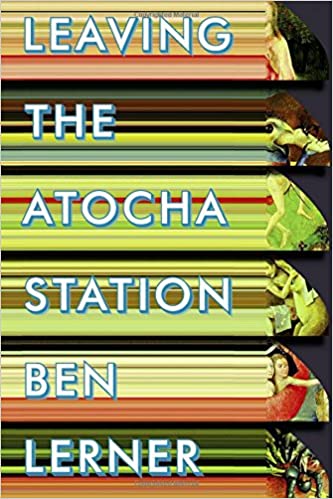
Adam Gordon is an American pursuing a project in Madrid in 2004. He only hints at the project’s purpose, but he spends most of his time taking drugs, visiting museums, and doing what he calls “translating,” in which he takes lines from other people’s works, substitutes words, and moves things around. He is supposed to be a poet on a grant to write a long poem about how the Spanish Civil War has affected poetry, but he is not doing any research and knows very little about Spanish poetry.
In fact, Adam lies almost all the time. He doesn’t consider himself a poet but a fraud. He is self-loathing and is constantly manipulating his face or thinking up things to say to seem deep. He talks about not feeling anything or experiencing the experience of the event rather than the event itself.
This novel, which seems more like a disguised memoir, is funny at times. It asks a lot of its audience intellectually, and at times I got lost in its logical circumlocutions. The narrator is not very likable, but he grows on you, and he undergoes a sudden transformation at the end.
Would I recommend this book? Only to certain people. I would like to say, though, that its cover design, which starts with snippets from The Garden of Earthly Delights on the right and then smears the colors of each snippet into a shape of a train, is fabulous.
This is a book I read for my James Tait Black Prize project.
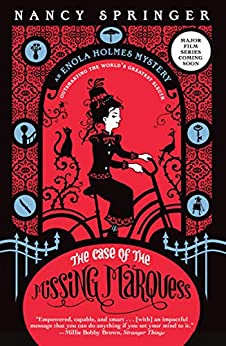
My husband and I enjoyed watching Enola Holmes over the Christmas holidays, so I decided to give the first book in the series a try. I had assumed it would be YA, but it is actually marked for middle grades.
Enola Holmes, who is the younger sister of Mycroft and Sherlock, finds that her mother has disappeared on Enola’s 14th birthday. When her brothers, who have not come home for 10 years, respond to her telegram, they have some unpleasant surprises in store—Enola that Mycroft is more interested in sending her to boarding school than in finding their mother and Mycroft that the money he’s been sending for the upkeep of the estate has clearly not been spent on the estate. Sherlock is just determined to find their mother.
Enola is offended at some slighting remarks Sherlock makes about her intelligence and is determined not to go to boarding school. Having figured out that her mother has left her some clues and hidden some money, Enola disguises herself as a widow and leaves the house to search for her mother. On the way, she hears that the 12-year-old Marquess of Tewksbury has disappeared and finds the first clues to his disappearance.
I always judge books by how much they entertain me, and I have to say, this one is probably very entertaining for a 12-year-old but was lacking for me. I can’t tell whether this is because I recently saw the movie—which really only borrowed the concept from the book—or not. Certainly, I found the movie sharper in wit, more full of adventure, and more likely, at least in its conclusion. I also couldn’t help comparing this book to the Flavia de Luce series, which has a much more distinctive voice and is much funnier. However, as reading for kids this is good fun.

Milton Place is sort of an update of King Lear—set in the 1950’s. It is partially drawn from de Waal’s experience and is one of two novels published posthumously.
Mr. Barlow, the elderly owner of Milton Place, receives a letter one morning from Anita Seiler. She is the daughter of a girl he fell in love with long ago in Austria, but unfortunately he was already engaged. Anita tells him that she no longer has ties in Austria and would like to come to England, asking him to recommend her to someone for work. He writes back inviting her to stay.
His daughter Emily is a busybody who thinks it’s time he sold Milton Place and moved somewhere smaller where he can be more comfortable. It’s true that the place is cold and shabby, but Mr. Barlow is comfortable in the few rooms he uses and loves his garden. However, Emily is already setting out on a plan to have the county request the house for a home for unwed mothers. When Emily hears about the new house guest, she is certain that Anita is after her father’s money.
Anita and Mr. Barlow get along beautifully, and he wants her to stay. She feels uncomfortable staying as a visitor, so she begins cleaning all the vacant rooms and making the house more cheerful.
Things change, though, with the arrival of Tony, Mr. Barlow’s beloved grandson, on break from university.
One plot line of this novel bothered me a bit. I want to be a little mysterious about it, but my difficulty hinges on how adult an 18-year-old boy is. I admit there is probably a difference of opinion on this, that clearly in the novel there is, and that this idea changes over time. That is, an 18-year-old of either sex is now considered less of an adult than they would have been then, and then less than 50 years before.
This caused a problem for me, but I found the novel beautifully written and affecting.

Since I posted my review of the last book from the 2018 shortlist of the Booker Prize on Tuesday, it’s time for my feature where I decide whether the judges got it right. It’s a hard decision this time, because there are so many good books on the list. Actually, they are all good. I just connected better with some than others.
As I often do, I’ll start with the books I enjoyed least. I think I just didn’t connect with The Long Take by Robin Robertson. At least partially, that’s because it is a poem, but it is also almost plotless and very gritty. It is beautifully written, though, about homeless World War II veterans and the selling out of L. A.
Another gritty entry is The Mars Room by Rachel Kushner. I found this novel more gripping, and it is about an important subject—the lack of justice in our justice system. However, it seems I am not really a Kushner fan.
To make my decision harder, I enjoyed all of the other four entries. Two of them were on my Best Books of the Year list two years ago, and another one—most likely both of the others—will be on the one for this year.

Washington Black by Esi Edugyan is really an adventure story set in the 1900’s. Washington is a slave on a Barbados plantation who flees with Titch, his master’s brother, after the death of his master’s cousin. Having left everything he knows, he is then abandoned in Canada by Titch. I liked the sense of not knowing what was going to happen next.
I enjoyed Everything Under by Daisy Johnson, too. It’s a mysterious rendering of the Oedipus myth set in the fascinating world of the people who live on Britain’s canal system. I found it atmospheric and interesting.
This year, The Overstory by Richard Powers blew me away, and it will be on my best books list for the year. Taking on the metaphor of a tree for its structure, starting with the roots, it is about the importance of trees. That may not sound very interesting, but Powers starts with a group of people who are all interested in trees in some way and begins to entwine their fates as he works his way up the trunk of his story. Although the ending was a little too abstract, I was fascinated by this book.
However, I’m going to pick Milkman by Anna Burns, which was also that year’s winner. I just loved it. It is a dazzling, exuberant novel about an Irish girl in 1970’s Belfast who is being stalked by a man she calls a “renouncer-of-the-state.” Much of its charm lives in the distinctive voice of the narrator. The judges got it right with this one.

Romy Hall is on her way to prison at the beginning of The Mars Room, having received two life sentences for murder. Because she worked as a stripper and led a not so savory life, she has been denied the opportunity in court to testify that her victim had been stalking her, even following her from San Francisco to L. A., where she moved to get away from him.
On the way to the prison in far eastern California, one woman dies. None of the prison personnel pay any attention. This is just one example of the treatment the women—and sometimes girls—receive.
This novel isn’t just about Romy, though. We hear the voices of quite a few characters, all of whom are incarcerated or are connected to the incarcerated. None of these characters are all bad or all good, but what they have in common is that they have been silenced.
There is Doc, a corrupt cop who has killed just for the pleasure of it but befriends Serenity, who has performed her own sex change operation in jail and is trying to be transferred to the women’s prison. There’s Gordon Hauser, who comes to teach at the women’s prison but gets a little too involved with the prisoners and quits to become a social worker. There’s even Kurt Kennedy, Romy’s stalker and victim. In between, we read paragraphs from Ted Kaczynski’s writing, most of them chilling.
This novel explores some deep territory, the lack of justice for the poor, the futility and vindictiveness of the prison system, the lack of any chances most of the characters had in their lives to begin with. It is gritty, difficult to read, and sometimes heart-wrenching. In general, I’m not that much of a fan of Kushner, but this novel has some powerful moments. I read it for my Booker Prize project.

Una, who shows promise for studying mathematics at university, has only two more years to prepare, having fallen behind because of all her moves between different schools with her diplomat father. Then, just as she’s feeling she will stay at Cerne, her father suddenly summons her and her sister Hal to India. They are to have a governess.
Una is sorely disappointed at this behavior that is so unlike Edward. Then she meets the governess, Alix, a beautiful Eurasian who orders around the servants and calls her father Edward. Soon she figures out that Alix is woefully uneducated. She does not know the difference between mathematics and arithmetic, and her idea of studying literature is to look at pictures of works cut from a magazine, not to read the works themselves. It becomes clear to Una that the girls are in India to hide from society that Edward and Alix are lovers.
Unbeknownst to anyone in the house, the second gardener, Ravi, is an ex-university student and poet on the run from the law after a demonstration. When he realizes Una is struggling to teach herself calculus, he offers help. He cannot help her, but his friend Hem can. So, Una begins sneaking out to meet Hem and Ravi.
This novel was another stunner from Godden. It overloads the senses with sights and smells as Alix tries to hide her past and Una strays from her goals.
Best of Ten!
Tana French has gone slightly afield from her usual dark mysteries in The Searcher. For one thing, this novel doesn’t involve the Dublin Murder Squad. For another, although morally murky, the novel isn’t as dark as most of the others.
Cal retired to Western Ireland from the Chicago police force, because he felt himself losing his moral certainty. He has purchased a dilapidated farm, which he is fixing up, and he has formed a sort of friendship with Mart, an older neighbor.
Lately, though, he feels like he’s being spied on. One night when he has that feeling, he climbs out the bathroom window and catches someone looking in the living room window, but the person gets away. A few days later, while he is working outside, he hears someone approach and tells him to come out. The person is a boy, about twelve, named Trey. Cal gives him work to do, and it takes about three visits before Trey tells him what he wants. His brother Brendan, 19, has disappeared. Trey has heard Cal is a policeman and wants him to find Brendan.
Cal soon believes that Brendan got involved with some bad people from Dublin, but no one will tell him anything. Then he finds himself being warned off by different parties. At the same time, someone is killing his neighbors’ sheep.
French likes to work in the gray areas of morality, and The Searcher continues this interest. I think it is one of her best.
Book reviews of mainly modern & contemporary fiction
Writer and Historian
There is nothing more satisfying than reading a book while sipping a hot cup of tea.
A historical fiction book blog
Emerging as an artist
Liz Dexter muses on freelancing, reading, and running ...
For mostly adult, literary, fiction; focusing on historical, contemporary, biographical, and women.
"Well, there’s so much to read, and I’m so far behind." Wallace Stegner
Read to live and live to read
A bookish blog (mostly) about women writers of the nineteenth and twentieth centuries
A Celebration of Russian Literature
Reading: it's personal
Based in Romania, reading all over the world. Mostly fiction, some memoires and a little bit of poetry.
Adam Burgess
"Vivre le livre!"
"History is a vast early warning system." Norman Cousins
Scottish Book Blogger
"She had read novels while other people perused the Sunday papers" - Mary Elizabeth Braddon
A word after a word after a word is power. --Margaret Atwood
Books • Opera • Art • History
FOR DISCERNING READERS
Your online source for Jane Austen and her legacy
A Community of Classics Lovers
A blog about Irish books, writers, writing and everything in between.
 What? Me Read?