Review 1655: Warlight

In 1945, Nathaniel and Rachel’s parents enter their young teen children into boarding school and leave for a year in Singapore. Hating school, the two children run away and end up at home in the care of their parents’ friend and boarder, whom they call The Moth.

Their lives become chaotic. Their house is filled with eccentric people. Nathaniel and Rachel grow apart, Rachel going off on her own while Nathaniel skips school to help the mysterious man called The Darter engage in low-level criminal activities.

They never see their father again, and it becomes apparent that their mother is engaged in some sort of espionage, which eventually proves dangerous for them.

This moody novel is intricately plotted, so that its secrets are revealed slowly, like peeling an onion. As Nathaniel becomes a man, he begins to look into the truths behind his formative years. What really went on? What did he know but forget? What was he oblivious to? This novel is dark, enigmatic and deeply engaging. I read it for my Walter Scott prize project.

Related Posts

The Cat’s Table

Manhattan Beach

Abigail

Review 1654: The Panopticon

Best of Ten!
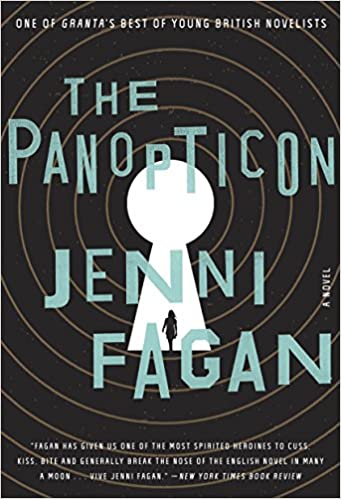
Anais Hendricks, 15, arrives at the Panopticon, an old prison designed so that someone can see the inmates at all times, which is now being used as a home for juveniles. The police believe she beat an officer and put her in a coma, but she was so high that she can’t remember what she was doing.

Anais has been in the system since birth, and the system has failed her on every front. Although at first she seems to be hard and criminal, she is a feisty girl, and most of her offenses have been a defense of someone else or an act of protest against an injustice. Her trouble with the law began when Theresa, her adoptive mother, was murdered. Anais now believes she is part of an experiment that wants her to fail.

At the Panopticon, Anais makes some friends and gets a better social worker in Angus, but she still ends up in trouble. Soon, the police tell her that one more offense will result in her being transferred to detention.

In Anais, Fagan has created an unforgettable character. The novel is full of bad language, but it is fluent and lively, and makes a riveting story. I read this book for my James Tait Black project.

Related Posts

The Death of Bees

Mountains of the Moon

The Girls

Review 1653: The Parisian

Midhat Kamal is the son of a wealthy textile merchant from Nablus in Palestine. His father more or less deserted him with his second marriage after his mother’s death and lives in Cairo, visiting a few times a year. When Midhat is 19, in 1914, his father decides he should study medicine in France and arranges for him to stay with a French professor of anthropology, Frédéric Molineu, in Montpellier.

Unfortunately, Midhat falls in love with Molineu’s daughter, Jeanette. Although his feelings seem to be returned, Midhat discovers a betrayal that makes him flee Montpellier for Paris. In Paris, he works on developing a reputation as a bon vivant and womanizer, only peripherally involved in his friends’ discussions about Arab nationalism.

Nonetheless, returning to Nablus, he almost immediately adopts the life his father demands, learning how to run the Nablus store in preparation for moving to Cairo and finding a wife. Events, however, will turn the course of his life again.

Although the novel covers the beginning of the fight for Arab nationalism against the British and French, which sounds interesting, as well as the time period of World War I, Hammad is hampered by her choice of main character, for Midhat is so self-absorbed through most of this book that he hardly seems to know what’s going on around him. This detachment affects the readers’ relationship to the novel, making me feel detached from its actions. Further, although there is a weak link between the first part of the book and the rest, there seemed to be little connection except that Midhat’s self-absorption is related to this character he has created for himself, the Parisian. I found the love affair unconvincing in any case.

For a historical novel set in an interesting time and place, there is very little sense of that time or place. So, not a big recommendation from me for this novel, which I read for my Walter Scott project. It is well written, but although important things happen in the novel, the action is at such a remove that it feels as if nothing is happening, if that makes any sense.

Related Posts

Palace Walk

The Map of Love

The Forty Days of Musa Dagh

Review 1652: The Silk Roads: A New History of the World

In the opening of The Silk Roads, Peter Frankopan talks about his uneasiness with the narrow focus of his historical studies in school, to Europe and the countries affecting Europe. This struck a chord with me, because I remember discussing this with my father when I was in high school. “Why don’t we learn about China or Japan?” I remember asking, and I didn’t even think of Central Asia or the Middle East. So, The Silk Roads seemed as if it would be very interesting to me.

Frankopan shows that while Europe was a backwater, the countries of Central Asia and the Middle East were vibrant with trade, of goods, culture, and ideas. His thesis is that this area of the world has long been its heart and is becoming so again.

The subject matter of this book is interesting, in a way that changes one’s preconceptions. Frankopan’s writing style, though, is clear but very matter of fact, with no attempt to be stylistically interesting or eloquent.

Although I’m sure this is a simplistic statement, it seems as if there are two ways of approaching historical content. One is to relate it more as a series of stories. The other is to throw in every fact that supports your thesis. Unfortunately, at least the later chapters use the second approach, making the last few chapters sort of a slog for me. For example, most of the last chapter is just lists to show the ways Central Asia has become wealthy. I believe that Frankopan’s ideas are important, but I sometimes found this book putting me to sleep.

The irony is that Frankopan’s book is, after all, westerncentric, especially the last half, which focuses on the mistakes England and then the U. S. made in the Middle East.

Related Posts

The Great Game: On Secret Service in High Asia

The Great Railway Bazaar

Tales from the Queen of the Desert

Review 1651: Three Weeks

I realized earlier this month that the deadline I set myself for finishing my Classics Club list is coming up this summer, with about a dozen books left. I’ve been reading lots of classic novels, just not necessarily the ones on my list. I have also read many of the ones on my list but just haven’t posted my reviews yet. So, I decided I was going to have to accelerate my schedule of reviewing and reading them in hopes of getting all my reviews posted on time. Here is one of them.

Elinor Glyn was a romance novelist at the turn of the 20th century whose works were considered scandalous at the time. Three Weeks is the story of a young English man who has an affair with an older Russian queen.

Naïve young Paul Verdayne fancies he is in love with the parson’s daughter, so his mother ships him off for a tour of the continent. He is young and sulky and hates Paris but, being a sportsman, enjoys Switzerland. While in Geneva, he becomes fascinated with a striking woman who is traveling only with her servants.

This mysterious woman, about ten years older than Paul, takes him in hand and begins opening his mind to art and ideas. Soon, they begin a torrid affair. But this affair must remain secret, because there is danger.

First, I found it difficult to buy that this sophisticated, cultured woman would fall madly in love with a gauche, uncultured young man whose only interest is his dog and horses and whose only attraction is his good looks.

Next, Glyn’s writing is florid and overwrought. It is often cloying and downright silly. The style resembles that of writers from the Romantic movement, which was well over by the time Glyn was writing. I have an idea that Glyn may be the type of writer Forster was mocking in A Room with a View.

Finally, the idea that Paul could become informed and educated just by spending three weeks with his mistress is ridiculous. The novel doesn’t say that he is interested in being more informed but that he comes back from his experience poised and culturally literate, enough so as to impress people with his elegance. Right.

In short, this is a really silly book.

Related Posts

Chéri

The Last of Chéri

Dolly: A Love Story

Review 1650: The River

Harriet and her family live along the river in a town in India. Harriet is dismayed at the changes in her sister Bea, who is becoming a young lady and is no longer fun to play with. Her brother Bogey spends his time looking at insects and animals in the garden. Victoria is just a baby. Harriet spends some time each day writing in her book that she keeps hidden away, and she also is fascinated by her parents’ guest, Captain John, who was injured in WWI. Captain John, however, likes Bea best.

This little novel has a plot, but it is mostly atmospheric and descriptive, of the garden and house, of life on the river. I was just a short way in when I realized that I had seen the movie based on it by Jean Renoir. I said, “If there’s a snake, I’ve seen this.” There was a snake.

The semi-autobiographical novel is about Harriet waking up from childhood and complete self-involvement and learning to become a writer. It is beautiful and touching.

My Virago Modern Classics version also included two short stories, “Red Doe,” about Ibrahim, a bakriwar nomad who is on the way to another encampment to claim a wife, and “The Little Black Ram,” about Jassouf, a bad boy who is tamed by being give a black ram to care for.

Related Posts

Coromandel Sea Change

A God in Every Stone

Sea of Poppies

Podcast Review 1: Four True Crime Podcasts

I have listened to a very few podcasts over the years, but just recently I began listening to more of them. I realized that I had strong opinions about how the podcasts were handled, so I thought that occasionally I would review some of them. So, this week I start with my first podcast review of four podcasts about unusual occurrences or true crime.

I found all four of these podcasts in a Marie Claire article listing the 60 best current true-crime podcasts.

These four podcasts fit very neatly into two groups. Two of the podcasts are limited series about one specific crime. The other two podcasts are series that continue indefinitely in which each podcast discusses one or two unusual cases. I’ll discuss the limited series first.

Tom Brown’s Body

Tom Brown’s Body is a very professionally produced podcast by Texas Monthly. It features their seasoned reporter and published author, Skip Hollandsworth, in a series of eight 45-minute episodes about the effect of an unsolved crime on a small Texas town. Or was it a crime? A popular high school boy first went missing and then was discovered dead, but it’s not clear whether the death is a suicide or a murder.

Of course, with this powerful magazine to produce it, there is not a glitch in the production, but also impressive is the writing and interview technique of this scripted podcast. Everything about this podcast is interesting and professional. I don’t mean to imply that I am biased toward a professional vs. unprofessional podcast, just that there is nothing to criticize. I found this podcast very interesting.

Paper Ghosts

Paper Ghosts is also a scripted podcast produced by iHeart Radio of ten half-hour episodes. It features true-crime writer M. William Phelps (at one point he asks a witness to call him M), and is about the disappearances or murders of several young girls and women near his home town in New England during the early 1970’s. It is also professionally produced.

While Hollandsworth’s interviews in Tom Brown’s Body had the more conventional purpose of just investigating the history and current status of the case, and the effect the case has on the town, Phelps is actively trying to solve the murders, or at least the podcast gives that impression. He is also very self-promotional and constantly brings himself into focus during the podcast. (I don’t mean he interviews people; I mean he talks about himself and his efforts a lot.) One serious negative for me as a grammar nerd was that, although this podcast is also scripted, he makes a few but consistent grammatical errors. I am not familiar with him as a true crime writer, but I hope he has a good editor. I found this podcast interesting, but I felt it was more repetitive than Tom Brown’s Body and less impressive. I’m also not clear on the meaning of the title.

And here’s a bitchy remark: We all know from studying “The Love Song of J. Alfred Prufrock” that using an initial instead of a first name is pretentious. The M is for Matthew. There’s nothing wrong with the name Matthew Phelps, M.

And That’s Why We Drink

And That’s Why We Drink is a weekly half-hour podcast featuring Christine Shiefer, a writer for Nickelodeon, and Em Schulz, a prop designer. Its focus is the supernatural and true crime, and it is much less formal than the other podcasts. It’s format is a couple of friends sitting around with drinks and telling each other spooky stories. It is produced by Kast Media, but I doubt that it is scripted, and at least the episode I listened to had none of the interim musical effects of the others or anything like that.

I have to confess that while I listened to the entirety of the first two podcasts, I could only stand listening to one episode of this one, despite the podcast being very popular. I found the format and unscripted nature of the podcast troublesome because the two women spend a lot of time chit-chatting about things that only they are interested in (like what their mothers are going to say about their podcast) and making lame jokes. Now, I listened to the first episode, and it’s very possible that they got better at this as they went along. However, this is a criticism I have had of all the two-person podcasts I have listened to.

I have more serious criticisms, though. One in particular about the first episode is that they selected some topics that most people know a lot about already, that is, the history and building of Winchester House and the Jim Jones tragedy. Contrast that with the other series I’m reviewing next, which told me about cases I’d never heard of. Again, this is just one episode, though.

What disturbed me more than that was my impression that they spent about ten minutes researching each topic. (One of them even said she looked it up the day before.) They showed an astounding ignorance of the time periods and settings of these events. For example, they made the fatuous assumption in the first story that because someone was known as the Boston Medium, he was the only medium in Boston at the time that he was consulted by Sarah Winchester. In reality spiritualism was very popular at that time and there were probably hundreds of mediums in Boston. Similarly, they basically boiled the 60’s down into sex and drugs. I would think that these two women, who (probably ironically) exclaimed that they had Master’s degrees could have put a little more effort into exploring the context of their stories.

OK, in this podcast, the two girls knew that hardly anyone was listening yet and they were just basically entertaining themselves. To be fair, I should have probably listened to a more recent episode. However, these women seemed so silly and superficial to me that I couldn’t bring myself to do it.

Supernatural with Ashley Flowers

Supernatural is a weekly podcast hosted by Ashley Flowers, a radio personality from Indiana and the creator of another podcast, Crime Junkie. My research on her, let me say right away, has indicated that she has been accused of plagiarism for some of the Crime Junkie episodes, in particular of copying other podcasts word for word. As an ex-writing instructor, I find this kind of behavior atrocious (apparently what she said in her defense was that people had copies from her as well), but I was not aware of this issue until I researched her name just now, and I didn’t see any similar allegations about Supernatural.

This podcast is concerned with unexplained cases, some of them true crime, that may involve the supernatural. I listened so far to two-and-a-half episodes. I found this series, which is produced by Parcast, to be very professional.

This podcast is clearly scripted, and in each half-hour episode Flowers covers one unusual case. Both of the complete episodes I listened to involved possible alien activity. I had not heard of either of these cases and found them interesting. One was a true-crime case about two men found dead wearing lead masks on the top of a hill near Rio de Janeiro. The other case was about possible alien abductions in 1980’s Maine. This podcast is professionally written and produced.

My Rankings

I ask myself “Would I return to this podcast?” for the weekly podcasts and “Would I listen to another podcast?” for the limited series that I have finished listening to.

In order from best to worst:

  1. Tom Brown’s Body: Would I listen to another podcast from Skip Hollandsworth? Yes
  2. Supernatural: Would I return to this podcast? Maybe, if I just consider the podcast and not the plagiarism charge
  3. Paper Ghosts: Would I listen to another podcast from M. William Phelps? Probably not
  4. And That’s Why We Drink: Would I return to this podcast? No

I just started out listening to these podcasts for my own amusement, but if there is interest in more reviews, I will take it on as more of a research project. Did you enjoy these reviews? Are there any podcast topics you would suggest I look into? Of course, the next review will be of book podcasts.

Review 1649: The Hoarder (aka Mr. Flood’s Last Resort)

Best of Ten!
Let me just start out by saying I hate the trend of changing the name of a book from the British edition to the U. S. edition. In this case, I got caught out buying both versions of this novel just because I didn’t realize they were the same. I loved this novel, but I don’t need two copies of it. If they are going to do this, the least they could do is warn us in really big letters on the cover.

____________________________

As with Things in Jars, it took a bit of time before I plunged myself into the eccentric world of The Hoarder. But when I did, I was all in.

Maud Drennan is a care worker whose job it is to feed the difficult Cathal Flood and attempt to make some headway in cleaning his house, for the old man is a hoarder. There are odd rumors surrounding Flood, not only about his recent behavior—he is supposed to have tried to brain carer Sam Hebden with a hurley—but also about his past—his wife died after falling down the stairs.

Maud herself is a little eccentric. She is followed around by the ghosts of saints, particularly St. Dymphna and St. Valentine, and her best friend is Renata, an agoraphobic transgender woman with an elaborate wardrobe. It is Renata who suggests that perhaps it was Cathal Flood who pushed his wife down the stairs.

Certainly, something is going on, because Maud is approached by Gabriel Flood, Cathal’s son, who is looking for something in the house. Then, Renata and Maud discover that Gabriel had a sister, Maggie, who disappeared as a teenager. Maud’s sister, we learn, also disappeared, so Maud becomes immersed in an investigation and attempts to search the blocked-off portions of Cathal Flood’s house.

This novel is a bit gothic, a bit funny, a bit haunting, and Kidd’s writing is brilliant. Love this one. Need more.

Related Posts

Things in Jars

The Vet’s Daughter

The Rathbones

Review 1648: Joanna Godden

At first, I wasn’t sure I was going to like Joanna very much, in this novel that is essentially a character study. She is large and brash. She likes to wear bright colors and to impress people. She is a fine figure of a woman.

As a young woman, she inherits her father’s sheep farm on Walland Marsh in far southeastern Kent. From the first, she will take no advice. She’ll run her farm the way she wants, and she scandalizes the neighborhood for firing her father’s shepherd of 28 years, for painting her wagons and her house yellow, and for other such offences against tradition.

At first, she makes some costly mistakes in her willingness to experiment. She hires a shepherd just because she likes his looks, but he is too docile and inexperienced to warn her when she’s about to make a big mistake in breeding. She sends her little sister Ellen away to a posh boarding school and gets back a sulky, discontented young woman who thinks she is too good for the farm.

I couldn’t help growing to love this heroine, though. She is bumptious but well-intentioned, pushy but kind. By the end of the novel, I was touched and sorry it was coming to a close. I read it for my Classics Club list and hope to find more by the author.

Related Posts

Far From the Madding Crowd

Miss Marjoribanks

Chatterton Square