If I Gave the Award

Cover for Solace

Having posted my review of There but for the, I find that I’ve reviewed all of the shortlisted books for the 2012 James Tait Black Fiction Prize. Therefore, it is time for my feature where I explore whether I think that judges got it right.

Occasionally I don’t know which book to start with, but in this case it’s a pretty easy choice. I’ll start with the winner, You & Me by Padgett Powell. Sometimes, I think that critics and judges get so tired of the same old thing that they like books just because they’re different. This may be a classic example. It’s supposed to be a take-off on Waiting for Godot, as if Waiting for Godot needed one. I found it utterly unfunny and boring and thought it was the worst book in the bunch.

There but for the by Ali Smith was much better, but I found it annoying at times. A series of linked stories that are sometimes touching, the novel also featured some verbal gymnastics that I found tiring after a while, especially in the last section.

Cover for Snowdrops

Now, we come to Solace by Brenda McKeon, about the relationship between a man and his son in rural Ireland. I am torn between this one and the next shortlisted book. I found Solace interesting and insightful, also touching.

I think I’m going for Snowdrops by A. D. Miller as my choice. This novel is about the horrible results of a young British lawyer’s infatuation with a Russian girl and his resulting willful blindness during the wild 2000’s in Russia. It is a slowly developing but absorbing thriller. I liked it a lot.

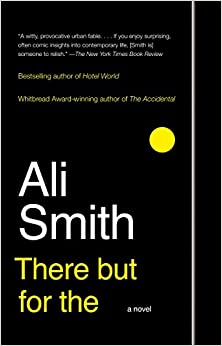
Review 1577: There but for the

I have enjoyed most of what I have read by Ali Smith, but at first the premise of There but for the seemed a little too absurdist for me. The novel is really four separate stories that are related to the event in the first story and share characters.

In “There,” Anna is summoned by Gen Lee to Gen’s house, because Gen found Anna’s contact information in Miles’s jacket pocket. At a dinner party at Gen’s, Miles, whom Gen does not know, locked himself in a guest room and refuses to come out. At first, Anna barely remembers Miles from a trip to Europe when she was 18, 30 years before, but then she remembers his act of kindness.

In “But,” Mark Palmer, who took Miles to the Lee’s dinner party, recounts his initial meeting with Miles, notable for Miles’s kindness, and invites him to Lee’s party. Some of the conversation of the party is marked by astounding stupidity, rudeness, and bigotry by some of the guests, so much so that I found it hard to believe, especially as a mixed-race child was there.

In “For,” a dying old lady is determined not to be sent to a depressing nursing home she visited long ago. After the death of her youngest daughter, she has been visited every year by one of her daughter’s friends, even though she doesn’t like him. This year he doesn’t come, because he is Miles, locked up in the Lee’s spare room, outside of which has formed a circus-like gathering of observers. But Miles has sent a substitute.

In “The,” Brooke, a precocious nine-year-old who also attended the party, recounts her ideas and memories, particularly a meeting with Miles.

Almost despite myself, I got caught up in this novel even when impeded by its verbal gymnastics, which were sometimes amusing but often annoying. I had a great deal of trouble, though, with the semi-stream-of-consciousness approach to the last section. At first, it was fun, but eventually I got tired of it and felt it could use some editing.

I read this book for my James Tait Black project and found it inventive but a bit overwhelming. Too many ideas are thrown out to us, in the end.

Related Posts

How to Be Both

Autumn

Winter

Review 1576: Smile of the Wolf

Best of Ten!
During a long winter night, Kjaran, a skjald, or poet, tells his host, Gunnar, about stories of a ghost on the farm of the recently deceased Hrapp Osmundsson. Gunnar, a Viking who retired to a farm and family, decides they should go kill the ghost.

At Hrapp Osmundsson’s farm, they find a ghost and challenge him to a battle. Gunnar kills him, and only then do they realize he is a neighbor, Erik Haraldsson, dressed as a ghost. He had been conspiring with Vigdis, the widow, to scare the neighbors off their lands so they could take them.

According to Icelandic law, the death would call for blood money paid to the man’s relatives, perhaps followed by a feud. But Vigdis urges the men not to report the death because of the shame to Erik of his deception. To not report the death is a worse crime than the killing, but Kjaran and Gunnar agree.

They soon learn what a mistake they’ve made, because Vigdis comes to Gunnar’s house and demands he put aside his wife and children and marry her. Gunnar refuses, and Vigdis begins making trouble that results in a feud and outlawry for Kjaran.

This gripping tale set in 10th century Iceland is modeled after the Icelandic sagas. Kjaran tells his story to someone who remains unidentified until the end. It is beautifully written, a memorable novel that is heart-breaking and powerful.

Related Posts

The Long Ships

Iceland’s Bell

The Greenlanders

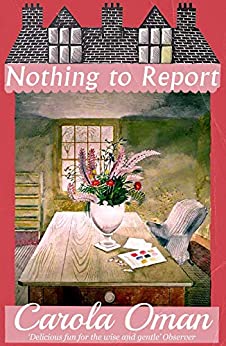
Review 1575: Nothing to Report

Best of Ten!
The circumstances by which I came to read this novel were a bit different from usual. I received Somewhere in England by the same author as a review copy, but when I sat down to read it, I realized it was a sequel to Nothing to Report. So, I immediately sent off for this novel so that I could read them in order.

Mary Morrison, Button to her friends, is an unmarried middle-aged woman living in a village near London in 1939. She has been forced to sell the family home, which is now a school. From her cottage, she seems to be at the center of village life, often being called on for advice, running a woman’s society, and living a busy social life.

Her childhood friend, Catha, Lady Rollo, and her family have returned from years in India and want her to help them find a house. Catha’s youngest son, Tony, a surly university student and would-be revolutionary, is hanging around Mary Morrison’s house trying to avoid his family. Mary’s widowed sister-in-law, Marcelle, has just announced her plans to vacate London and move in with Mary, bringing her daughter Rosemary. Rosemary, in preparation for the move, has shipped her piano to Mary’s house. Mary herself has been trying to organize gas mask training. Finally, Catha’s daughter, Elizabeth, is preparing for her debut to society. In short, things are chaotic. Slowly, events work up to World War II, of course.

I was delighted to read this novel, which I found charming. It has some very funny scenes, such as Lady Rollo’s preparations for going to Ascot, and is at other times quite touching. I loved this book.

Related Posts

Northbridge Rectory

Bramton Wick

Mariana

Review 1574: The Templars: The Rise and Spectacular Fall of God’s Holy Warriors

Maurice Druon’s spectacular historical novel The Iron King ends with a dramatic scene in which Jacques de Molay, the Master of the Knights Templar, is burned to death at the stake, and dying, curses Philip IV, King of France, as well as Pope Clement V. It was my interest in this particular event and my curiosity about the truth of Druon’s story that led me to read The Templars.

This book is a high-level history of the Knights Templar, an order of knights dedicated to poverty and to the protection of pilgrims in the Holy Land. As well as being about the battles it fought for Christendom (an appalling time), it is more interestingly about how the organization grew to become one of the most powerful multinational forces in Europe during the 12th, 13th, and 14th centuries.

Although The Templars is meant to be a history for the general public, it does provide footnotes and citations for those who want to explore further, which I think is good. I have lately read a few history books and biographies that didn’t even bother listing sources, so there’s no way of ascertaining how accurate they are, which I find a disturbing trend. The book is written to hold its audience’s attention, which it does a fair job of. But, of course, it’s mostly about the Crusades, so you have to have a lot of fighting.

As for the Templars’ end, Jones depicts them as a mostly honorable and dedicated group of men who toward the end were fighting a losing battle. Europe wasn’t interested in crusades anymore, and the last few were disasters resulting in huge losses of men, largely through the misjudgments of Western leaders who did not understand their enemies rather than because of the Templars themselves. After these disasters, the Templars found themselves without enough knights to keep control of the territory they had once won.

It was on a trip to Europe to try to win support for another crusade that Jacques de Molay and all the knights in France were arrested on the same day. There had been much talk of combining the Knights Templar, the Knight’s Hospitaller, and the Teutonic Knights into one unit, which de Molay hoped to counter. What he did not anticipate was that King Philip of France wanted the Templars’ money and valuables. Starting with the testimony of one aggrieved man who had been ejected from the Templars for some crime, the king’s men had the knights tortured until they admitted crimes like denouncing Christ and committing sodomy. Although prosecution of the Templars was a church matter, not a civil one, Clement V was too much under Philip’s thumb to do much more than make mild efforts on their behalf. The result was that Templars who renounced their “confessions” were burned by the Inquisition. This shocking ending, Jones proposes, is why the Templars are still such a fascination in popular culture, although popular culture tends to treat them as satanists, when they were innocent of the charges against them.

So, yes, Druon got it right.

Jones did one thing that drove me crazy, which he claims is accepted practice in covering this time period, and that was to anglicize everyone’s names. I have never run across this before, but I think it’s ridiculous and ethnocentric. For example, Jacques de Molay is called James of Molay throughout the book. Why would anyone do this, accepted practice or not? Does Jones think the French name is too tough for us? If it’s accepted practice, it’s stupid.

Related Posts

The Iron King

The Strangled Queen

The Lily and the Lion

Review 1573: One Woman’s Year

I was delighted to receive One Woman’s Year from Persephone Press as a review copy. I hadn’t heard of Stella Martin Currey before, but I shall be looking out for her books.

One Woman’s Year is a journal but with a very specific structure. Each chapter is for one month and begins with a quote from a 1677 book called British Merlin, which seems to be a sort of almanac. Then there is an article on some subject, often related to the month. Following this are the following sections: ‘Most Liked Job,” “Most Disliked Job,” “Recipe,” “Excursion,” and “Anthology.” The short pieces often contain amusing anecdotes. “Excursion” is always a suggestion of an interesting outing to make with children, and “Anthology” is quotes from books and poetry. All this is nicely illustrated with woodcuts at the beginning of each chapter and elsewhere.

Although Currey is a lot more domesticated than I am, I found this book light and easy to read. I skipped over most of the recipes but may try others. All in all, I found this book charming, quick to read and entertaining. She sounds like a good mom.

Related Posts

The Diary of a Provincial Lady

The Provincial Lady in London

A Mountain of Crumbs

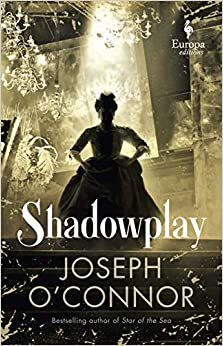
Review 1572: Shadowplay

Joseph O’Connor’s Ghost Light dealt with a relationship in the life of the playwright John Millington Synge. Shadowplay deals with a period in the life of another Irish literary figure, Bram Stoker.

In a novel that shifts back and forth over a 30-year time period, Stoker goes to work as general manager for the Lyceum Theater in London, having been hired by Henry Irving, the greatest Shakespearean actor of his time. Stoker has taken what he believes is a part-time job that will allow him to work on his fiction, but he finds himself assuming responsibility for everything in the theater, an overwhelming position. Further, he has to cope with his employer’s extravagance and his occasional wild rages. Worse, Irving is dismissive of Stoker’s literary efforts. Nevertheless, they form a lasting friendship.

Also involved in the theater is the famous actress Ellen Terry. Shadowplay is primarily about the enduring relationship between these three. However, it reflects other events of its time, particularly Jack the Ripper and the trial of Oscar Wilde. It deals with Stoker’s struggles to earn a living as a writer, a feat he never accomplished. And it has a ghost.

Shadowplay, which I read for my Walter Scott project, was involving and interesting.

Related Posts

Ghost Light

Dracula

The Children’s Book

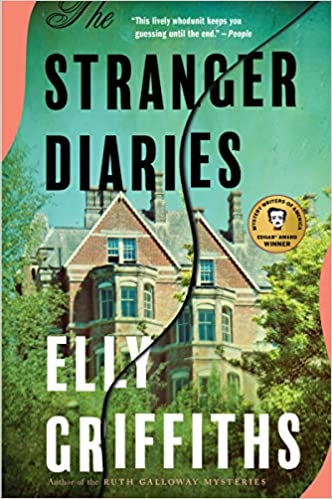
Review 1571: The Stranger Diaries

Here’s a final book for RIPXV!

I have been following Elly Griffiths’ Ruth Galloway mysteries, which I enjoy, but Galloway’s homage to the gothic novel, The Stranger Diaries, is something else again. I thought it was a stand-alone, but Goodreads has it marked as Harbinder Kaur #1, so perhaps there will be more.

Clare Cassidy is a schoolteacher who is writing a book about R. M. Holland, a Victorian gothic writer whose home is now occupied by Clare’s school. He was also the author of a horror story called “The Stranger.”

When she arrives at school, Clare is horrified to discover that her friend Ella was murdered in her home. Later, when Detective Sergeant Harbinder Kaur comes to interview her, Clare learns that a piece of paper with “Hell is empty” was found with the body. Although Clare tells the police that the quote is from The Tempest, she does not say that it is also used in “The Stranger.” Another thing that Clare doesn’t tell police is that Ella had a one-night stand with Rick Lewis, their married department head.

Later, when Clare goes to check her diary to see what she wrote about Ella and Rick, she finds that someone has written a message in her diary. When the handwriting is compared to that of the note by the body, it is the same.

This tribute to gothic literature is atmospheric and truly scary at times. I thought it was terrific.

Related Posts

The Fifth Petal

The Crossing Places

The Janus Stone

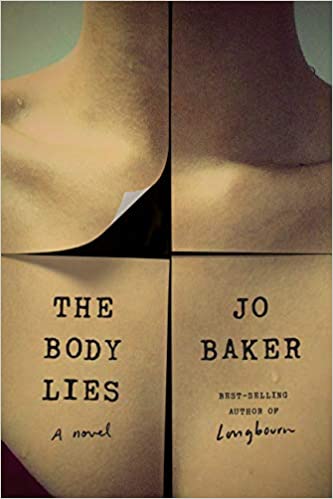
Review 1570: The Body Lies

Here’s another book for RIPXV!

The Body Lies opens with the body of a woman lying in the cold. We don’t have any context for this scene for some time during the novel.

The unnamed narrator is pregnant when she is attacked by a complete stranger in the street. Three years later, when she is ready to return to work after a break for child care, she is still afraid, so she looks for a job outside the city. On the basis of her published novel, she is offered a job at a university in the north. Her husband Mark says he can’t leave his job immediately, so he comes to visit as often as he can.

The narrator’s inexperience results in her getting more and more work piled on her by her department head. But more worrisome is the contentious tone between some of the members of her MA creative writing class. In particular, Nicholas Palmer, who seems talented, takes an aggressive attitude toward Steven Haygarth, who opens his crime novel with a nude girl’s dead body.

The narrator finds herself unwittingly getting involved with Nicholas in a way she doesn’t want to be. Nicholas says he’s trying an experiment with fiction never tried before. She has no idea how it will affect her.

At first, I was a little impatient with the student compositions, especially Nicholas’s, even though I knew they would be important to the plot. However, this novel slowly becomes very suspenseful. I have liked all of Jo Baker’s books, and they’ve all been different from each other.

Related Posts

A Country Road, A Tree

The Mermaid’s Child

Longbourn