
 The Best Book for this period is Coromandel Sea Change by Rumer Godden!
Review 1570: The Body Lies
 Here’s another book for RIPXV!
The Body Lies opens with the body of a woman lying in the cold. We don’t have any context for this scene for some time during the novel.
The unnamed narrator is pregnant when she is attacked by a complete stranger in the street. Three years later, when she is ready to return to work after a break for child care, she is still afraid, so she looks for a job outside the city. On the basis of her published novel, she is offered a job at a university in the north. Her husband Mark says he can’t leave his job immediately, so he comes to visit as often as he can.
The narrator’s inexperience results in her getting more and more work piled on her by her department head. But more worrisome is the contentious tone between some of the members of her MA creative writing class. In particular, Nicholas Palmer, who seems talented, takes an aggressive attitude toward Steven Haygarth, who opens his crime novel with a nude girl’s dead body.
The narrator finds herself unwittingly getting involved with Nicholas in a way she doesn’t want to be. Nicholas says he’s trying an experiment with fiction never tried before. She has no idea how it will affect her.
At first, I was a little impatient with the student compositions, especially Nicholas’s, even though I knew they would be important to the plot. However, this novel slowly becomes very suspenseful. I have liked all of Jo Baker’s books, and they’ve all been different from each other.
Related Posts
Review 1569: The Seagull
 Here’s another book for RIPXV!
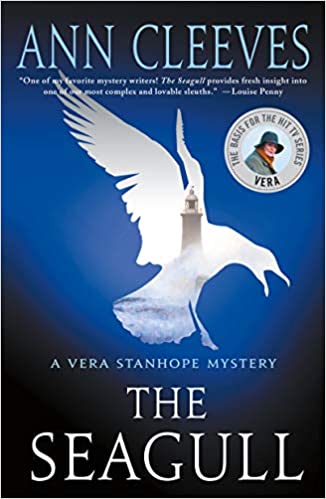
Disgraced former superintendent John Brace is dying in prison, so he asks Vera Stanhope to visit him. He tells her he has information about the disappearance years ago of Robbie Marshall. He will tell her where Robbie’s body is if she will check in on his daughter, Patty Keane, a single mother with mental health problems.
Vera does, so Brace tells her he discovered Robbie dead one night and buried him in a culvert on St. Mary’s Island. When the police investigate the scene, they find two bodies in the culvert, a man and a woman.
The team’s investigations seem to indicate that the female may be Mary-Frances Lascuola, the mother of John Brace’s daughter, a junkie who vanished a few years before Robbie did. Then, Gary Keane, Patty’s ex-husband, is found dead. A common denominator that seems to link all of the people the team is investigating is the Seagull, once an upscale nightclub that burned down years ago. Another common link seems to be the Gang of Four, a group of wildlife buffs whose members were John Brace, Vera’s father Hector, Robbie Marshall, and a shadowy character known as the Prof.
This is another complex and interesting mystery by Cleeves. Her novels are always atmospheric with believable characters and difficult mysteries.
Related Posts
Review 1568: The Cross
 The Cross, the final book of Kristin Lavransdatter, begins after Kristin’s husband Erlend Nikulaussön’s political intrigue has resulted in the loss of all his property to the crown. Kristin and her family have resettled on her farm, Jörundgaard, which she inherited from her father. Erlend is no farmer, however, so Kristin and Ulf Haldorssön must see to everything. Kristin despairs because her sons are not learning how to keep the estate. Instead, they go running off with Erlend to hunt and occupy themselves as knights do. The likelihood of their being able to lead a knightly life is little, though, because of Erlend’s disgrace.
Although Kristin believes that her relationship with her sister, Ramborg, and brother-in-law Simon Andressön is good—in fact, she turns to Simon when she needs help—she finds that Ramborg is jealous of her.
This novel is the last volume of the series, and I found it more touching in several places than I did the other two. Kristin has found that her headstrong insistence on marrying Erlend has brought her to a life of unending care, and she must somehow resolve this.
This is a really interesting series which endeavors to show the whole of this medieval woman’s life.
Related Posts
Review 1567: Beneath the Visiting Moon
 It is the summer of 1939. The Fontaynes are dreaming along in their stately but crumbling home, left without much money since the death of Mr. Fontayne, who had been a noted thinker and politician. Unusually for them, they attend a local dance, where 17-year-old Sarah meets and falls immediately in love with Sir Giles Merrick, a middle-aged diplomat. Sarah begins a series of attempts to develop more of a life for herself so that she can meet more people and perhaps see more of Sir Giles, her hazy mother Elisabeth seeing no attraction in anything but staying home.
The Fontaynes have been trying to sell their house. When they learn that an “artsy” family is leasing a house of no distinction, the children urge their mother to call on them in hopes the family will buy Fontayne. This meeting has unexpected consequences, for soon Elisabeth has agreed to marry Mr. Jones, an orchestra conductor on rest cure.
The Jones children, Peter and Bronwen, are more sophisticated than the Fontaynes and take delight in mocking things the Fontaynes like. The Fontaynes particularly find 13-year-old Bronwen, who has written a book that is being published and constantly quotes poetry, to be ghastly. Shortly after the marriage, Sarah decides it’s time to get a job.
I found this novel delightful and was disappointed to learn it was Cavan’s last, for she became a playwright later on, encouraged by Noel Coward. It’s a vivid picture of life in an eccentric household right before everything is about to change.
Full disclosure: I received a copy of this novel from the publisher in exchange for a free and fair review.
Related Posts
Review 1566: Coromandel Sea Change
Best of Ten!
Rumer Godden was around for so long as an author that when I couldn’t find the book by her that I had on my Classics Club list, I thought nothing of substituting Coromandel Sea Change. Even when I noticed a publication date of 1991, I assumed it was a reprint. It wasn’t, however, which brings up something I’ve been thinking about, and that’s how do we decide something is a classic if it’s not tested by time? I associate Godden with the 30’s through 50’s, when she was very active, and which I considered long enough ago to put her on my list. Oh well. We had this discussion on the Classics Club blog, in fact, this book was the one that gave me the idea. In any case, it is a wonderful, atmospheric book.
Newlyweds Blaise and Mary Browne arrive at Patna Hall on the Coromandel Sea evincing different reactions. Mary is enchanted by this view of the “real India,” while Blaise is enraged that their rooms are not in the main hotel and offended by the bathroom arrangements. As a couple, they seem particularly ill-suited—the young Mary is eager to observe ordinary people and take part in their customs while the older Blaise, a diplomat, is interested only in schmoozing with important people. Very soon, they are bickering like children while the other guests and hotel staff look on in dismay and Kuku, the young assistant manager, hopes to get her chance with Blaise.
The hotel is busy with an upcoming parliamentary election, and Mary meets Krishnan, one of the candidates, out on the beach one night. He is young and charismatic and seems genuinely concerned to help his people. Mary is happy to oblige when the campaign asks for her help, but Blaise is offended and misinterprets her interest.
In this novel, the stories of Mary and Blaise are not the only interest. The hotel staff are important, and the country itself is vividly evoked and almost a character. The election is charming in its own way. Even a donkey named Slippers, an elephant named Birdie, and a squirrel have their places. Mary is likable, although very naive, while Blaise is pretty unbearable.
Despite the sad ending to this novel, I found it colorful and charming. It made me want to visit the Coromandel Sea. Research has told me that the area was virtually destroyed by the tsunami in 2004, but apparently Chennai, mentioned in the book, is considered a top location to visit by Lonely Planet, so perhaps the area has recovered. In any case, perhaps it isn’t the paradise described by Godden anymore.
Related Posts
Review 1565: A Struggle for Fame
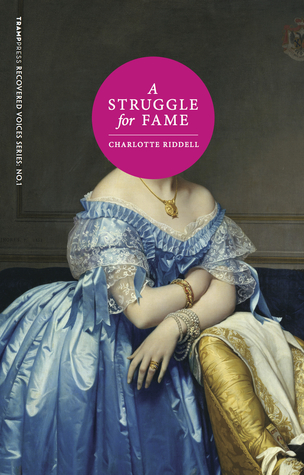 After reading The Uninhabited House, I looked for more books by Charlotte Riddell and came across the Recovered Voices series published by Tramp Press and this book, A Struggle for Fame. A Struggle for Fame is Riddell’s semi-autobiographical novel about the publishing industry.
Although Glen Westley is the main character in the novel, it follows the progress of two Irish young people who meet on the ship from Ireland and both end up in London’s literary milieu. Through poor investments, Glen’s father has lost the family home and all his money. She determines that they will travel to London so she can try to make a living as a writer.
On the ship, they meet Barney Kelly, a young chancer who is looking for a way to make money.
Glen works hard at good literary fiction and is repeatedly rebuffed by editors even while being told she has promise. Barney, on the other hand, falls into an opportunity to write articles for a journal. The novel makes clear that Glen has much more ability than Barney, but he is able to make a living at writing much earlier than Glen. It is clear from the beginning that the novel is about Glen’s rise and fall, but we are drawn in to see what happens.
A lot of characters are vividly drawn and quite Dickensian in their idiosyncrasies. It is fairly obvious that Riddell is depicting, sometimes satirically, publishers and authors she knew. Although written in 1883, the novel has observations about gender and ability that still apply today.
Related Posts
Review 1564: Dangerous Ages
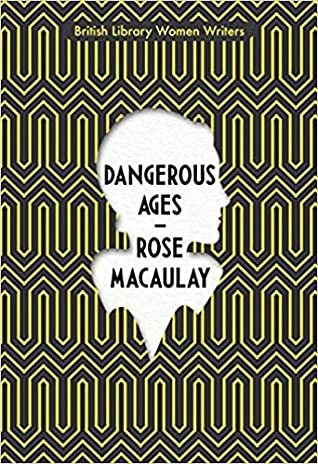 Thanks to Simon Thomas’s posts (Stuck in a Book) on the new British Library Women Writers series, I was able to request some review copies. I received Dangerous Ages, which, according to the novel, are all of them. This novel examines the lives of women in the early 1920’s.
Neville is 43, a woman who gave up her medical studies as a young woman to marry and raise a family. That job done, she finds herself feeling adrift, with no purpose, and views her mother, Mrs. Hilary, as an object lesson. She must find work and decides to return to studying medicine.
Mrs. Hilary is a silly woman who always pretends she has read important books and is knowledgeable on all subjects. At 63, she has nothing to do, because she defines herself as a wife and mother. Now she is a widow whose children are grown. She is jealous of anyone being intimate with Neville if her son Jim isn’t around and is jealous of Neville’s intimacy with Jim. She thinks psychoanalysis, which is being talked about, is horrid until she realizes it means someone will listen to her stories.
Nan, Neville’s younger sister, has been courted by Barry for ages. She finally decides she loves him, but instead of telling him so, she goes off to Cornwall to finish writing her latest book, never thinking that Barry might give up on her.
Gerda, Neville’s daughter, is ardently engaged in left-wing activities. The question is, when she falls in love with a man of a different background, whether she will compromise her principles, which reject all the values of her parents’ generation.
Macaulay’s novel is rooted in the early 1920’s, as characters examine hot topics of the time. I had to laugh at the scenes where Mrs. Hilary’s psychoanalysts inundate her with Freudian jargon that she has very little understanding of. That most of these women are frustrated in their aims should not be surprising, for this is a satirical look at the position of women in society. Only Neville’s sister Pamela, who refuses to be bothered, and Neville’s grandmother, who says she is past all that, seem happy.
Simon Thomas’s Afterword provides some insight into views of psychoanalysis in the early 1920’s, which is interesting.
I enjoyed this novel very much. It feels like light, lively reading while dealing with experiences that are universal, no matter the generation.
Related Posts
Review 1563: #1956 Club! Palace Walk
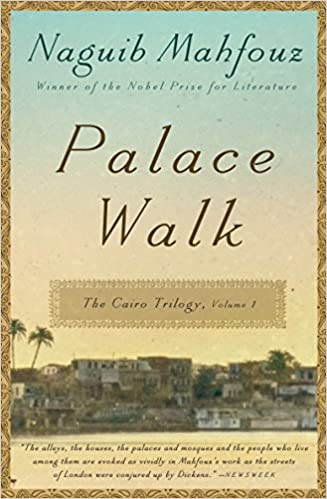 I experienced quite a bit of culture shock reading Palace Walk, which made me realize that although I have read books set in Egypt about Egyptians, all but one were written by Western writers, and that one, Map of Love, was much more modern. Palace Walk is about Ahmad Abd al-Jawad and his family, and I believe it’s Mahfouz’s own family thinly disguised.
The novel is the first of three in Mahfouz’s Cairo Trilogy. It begins with al-Jawad’s wife, Amira, getting up at midnight to help her husband get ready for bed after his usual night of carousing and womanizing. Although her husband is a good friend and convivial participant in nightly drinking bouts, at home he is an angry tyrant to his wife and children. I found it interesting that although he has the reputation of a righteous and observant man, no one seems to think his drinking and womanizing make him a hypocrite.
Mahfouz was a writer in the Realism school and as such explores both the good and bad facets of his characters’ personalities (although it sometimes seems like Realists concentrate on the gritty). The novel develops slowly, introducing us to al-Jawad, Amina, and his five children—Yasin, a government clerk who immerses himself in sensuality like his father but with less control; Fahmy, a university student who is serious and ardent; Khadiya, the older, sharp-tongued daughter; Aisha, the younger, beautiful daughter; and Kamal, a schoolboy who may be Mahfouz’s alter ego.
Beginning in 1917 near the end of World War I, the novel at first focuses on purely family concerns such as Fahmy’s desire to be affianced to Maryam, the neighbor girl; Aisha’s receipt of an offer of marriage before Khadiya’s, when their father has decreed that the younger girl will not be married before the older; and Yasin’s mother getting married again, which Yasin thinks is obscene, since she has been married several times. In these domestic incidents, the family constantly faces their father’s anger and intransigence. Mahfouz frequently tells us of his good points although they are not often demonstrated. In fact, there is a lot of explanation going on about the thinking and characters of the family members, some of it quite repetitive.
As the novel develops, external events become more important, especially the Arab Revolution of 1919 against the protectorate of the British. This more outward view makes the second half of the novel move along more quickly.
Certainly, al-Jawad’s actions toward his wife and children are shocking, and Mahfouz makes clear that he is stricter than most others by the comments of al-Jawad’s friends. Yet, it is also clear that no one would interfere in his treatment of his family, since it is his right to behave as he wishes. As an example of some of the things he does, Amina, who has only left the house a few times in 23 years of marriage, takes the opportunity of her husband’s absence on a business trip to visit a nearby mosque. Because Kamal guides her out of her route so that he can visit a pastry shop, she becomes disoriented and faint and is hit by a car. After she recovers, her husband banishes her from the house for leaving it without asking him (and believe me, he would have said no).
His son Yasin, the leaf not falling far from the tree, thinks later in the book when his wife is not happy with his nights out that it is the husband’s right to do anything he wants and the wife’s to obey. Nice.
The trilogy is supposed to be about the effect the father’s tyranny has on his family. I read it for the 1956 Club, and I suppose I will go ahead and read the other two novels. It certainly provides an intimate look into family life and customs in early 20th century Egypt.
Related Posts
Review 1562: #1956 Club! The Fall
 I’ve never read any Camus before, so I decided to read The Fall for the 1956 Club. This I can say: after reading The Kreutzer Sonata, The Prague Cemetery, The King Without a Kingdom, and The Fall, I’ve decided I hate novels that are monologues.
An unnamed person meets Clamence, an ex-Parisian lawyer, in an Amsterdam bar. Clamence begins his monologue explaining how his life changed. He began as a successful lawyer for the defense—handsome, genial, charitable, always doing good—and a womanizer. As he talks, we see that his charitable impulses are rooted in self-regard. His discourse becomes more and more cynical until . . . .
 Well, I don’t know, because 50 pages before the end, I realized I was struggling to pay attention, and I stopped reading. His “witty” discourse may have been ground-breaking in 1956, but in 2020, it just seems banal.
 What? Me Read?