Review 1538: Miss Boston and Miss Hargreaves

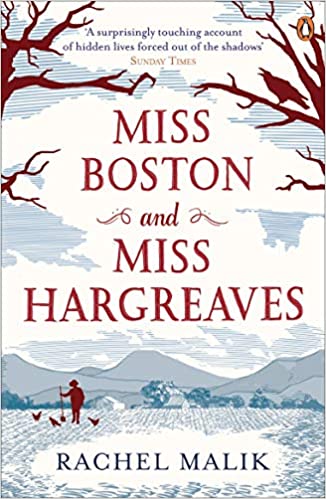
Rachel Malik’s investigation into the life of her grandmother has resulted in a gentle and touching story of friendship and love. It is an unusual one, too.

Rene Hargreaves leaves her difficult marriage to sign on as a land girl during World War II. She is assigned to work on a remote farm named Starlight owned by Elsie Boston. Elsie is a little peculiar and uncomfortable with strangers, but the two form a close friendship.

When a law is passed allowing the agricultural board to take charge of poorly run farms, Elsie’s greedy neighbors on the board use it to cheat her out of her farm, even after the examiner rates it “fair.” As a result, Elsie must leave the farm. Rene goes with her, and they become itinerant workers.

A promise Rene made to an old friend puts their lives in peril when Elsie is nearing old age and Rene is middle aged. Rene promised Bertha she would take care of her in old age, but it is Bertha who dies, leaving her difficult and senile husband Ernest with no place to go, so the two women take him in.

Although the two women live unremarkable lives for most of the novel, something about their story is compelling. Ultimately, it takes a turn I didn’t expect at all, despite its opening. I read this novel for my Walter Scott prize project.

Related Posts

White Houses

The Paying Guests

The Danish Girl

Review 1537: The Moth Catcher

The body of a young man is discovered beside the road in a remote valley near Kimmerston. He was house sitting for Major and Mrs. Carswell while they are in Australia. When the investigative team goes to the attic apartment where he was staying, they find the body of a middle-aged man in a suit.

The house sitter was a researcher named Patrick Randle, but Vera Stanhope’s team is unable for some time to figure out the identity of the second man or the order in which the two were killed. When they finally identify the second man as Martin Benton, the IT person for a local charity, they have a hard time figuring out what the two have in common. They eventually identify an interest in moths.

In this valley, the only residents are the owners of three barn conversions nearby. Yet, the six people who live there, three sets of retirees, claim not to know either Randle or Benton.

Cleeves always presents real puzzles, and this one’s a doozy. Although the clues are there, I couldn’t figure this one out at all. There’s a slight cheat, in that information discovered 50 pages from the end isn’t divulged until the end, but frankly, even if it was, I’m not sure I’d make the connection. A good mystery, as usual.

Related Posts

Harbour Street

The Glass Room

Silent Voices

Review 1536: The Vanishing Act of Esme Lennox

Best of Ten!
I’m late to discover Maggie O’Farrell, but better late than never. I’ve read a few books by her now, and she just keeps getting better and better.

Iris Lockhart is contacted by a mental hospital, which wants to find out if she can offer a home to her great aunt, Esme, who has been incarcerated there for more than 60 years. The problem is that Iris has never heard of Esme and believes her grandmother to be an only child.

Her mother now lives in Australia and has never heard of Esme, either. When Iris tries to discuss Esme with her grandmother, Katherine, who is suffering from Alzheimers, she gets a fractured response that implies Esme is her sister. In particular, she says, “She wouldn’t let go of the baby.”

Through third-person narration from Iris’s point of view, Esme’s stream of consciousness memories, and Katherine’s more fractured ones, we learn how it came to pass that vibrant and unconventional Esme was abandoned in the hospital from the age of 16. Iris is shocked to learn that Esme was incarcerated for such outrages as insisting on keeping her hair long and dancing in her dead mother’s clothes. She learns that at the time women could be committed on the signature of one doctor.

This is a shattering, sad story about a girl whose life is stolen because she doesn’t fit in. It is spellbinding as it draws you along to learn Esme’s story. This is also fascinating tale about how sisterly love turns to jealousy and anger.

Related Posts

After You’d Gone

Instructions for a Heatwave

This Must Be the Place

Review 1535: The House at Sea’s End

Forensic archaeologist Ruth Galloway is called in by DCI Harry Nelson when a group of archaeologists studying a Norfolk cliff find a collapsed cleft containing bones. There are six bodies, their hands bound. Ruth thinks they are recent, within the last hundred years, and all men.

Ruth’s university determines that the men were German, and Harry’s team begins concentrating on a time during World War II when the Home Guard of the village, Broughton Sea’s End, was preparing for a German invasion. The Home Guard men were led by Buster Hastings, father of the current owner of Sea’s End House, near where the body was found.

In the meantime, Ruth is struggling with the balance between her work, at the university and for the police, and her baby daughter, Kate. She is also concerned because Michelle, Harry’s wife, has been trying to befriend her, unaware that Kate is the result of a harrowing night during Ruth’s first case with Harry.

Aside from one ridiculously easy clue, I found this mystery much harder to guess than the first two. I continue to be interested in the characters and the setting, although it looks like we may be in for major melodrama in the next book. I like the concept of this series, which is inspired by the profession of Griffith’s husband.

Related Posts

The Crossing Places

The Janus Stone

206 Bones

Review 1534: The Body: A Guide for Occupants

Bill Bryson started out writing travel books that were notable for his humor and the many factiods and interesting stories he told about the places he visited. I imagine him with an insatiable curiosity about just about everything.

More recently, he has tackled other subjects, and his newest book is about the human body. In this book, he approaches the body system by system to explain what it does and how miraculous it is. As usual, he relates stories about the various people who made discoveries about the body and includes lots of factoids.

This book is entertaining enough, but it wasn’t the book for me. I have a personal black hole when it comes to subjects such as health and medicine (also religion). Although I was mildly interested in it and found lots of passages to read to my husband (who is interested in that kind of thing, although not religion), I decided not to finish it. I think it is a good book, though, for those who are more interested in the topic or like lots of interesting facts.

Related Posts

At Home: A Short History of Private Life

The Life and Times of the Thunderbolt Kid

Notes from a Small Island

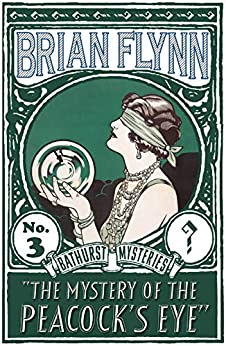
Review 1533: The Mystery of the Peacock’s Eye

A mysterious man dances with Sheila Delancy at the Hunt Ball, the same night the Crown Prince of Clorania is rumored to be there. Some months later, a young woman is murdered in a dentist’s chair in Seabourne, and Detective Bannister is called away from his vacation to take charge.

A few weeks before, Anthony Bathurst is requested by the Crown Prince of Clorania to look into a case. Someone is attempting to blackmail him over an affair with a young woman. Soon, Bathurst begins to suspect that the two cases are related.

While I enjoyed the first book in this series, I thought this one was a bit of a cheat. That’s because only one piece of information links the killer to the case, and we don’t get to hear that conversation. The plot has a clever concept, but there’s no way a reader could guess the solution.

Related Posts

The Billiard-Room Mystery

Death Has Deep Roots

The Red House Mystery

Review 1532: Tidelands

For years, I read Philippa Gregory’s books faithfully, but at some point I decided that she was just cranking them out, so I stopped. I felt that less attention was going to such things as fully realized setting and well-rounded characters.

Recently, however, I noticed that she was doing something different with Tidelands, so I thought I’d give her another try. This book is set in the 17th century and features a heroine living in poverty.

Alinor is a wise woman—a healer and a midwife who does not deal in magic and charms and is very concerned, as she has to be, about her reputation. It is in jeopardy, because her husband has disappeared, and if he has deserted her, she will be considered a loose woman. So, on Midsummer’s Eve at midnight, she goes to the church believing she will see the ghost of her husband if he is dead.

She does not see her husband but a total stranger. He is a young man, a gentleman in difficulty, who introduces himself as James Summer but is a Catholic priest in a time when Catholicism has been banned in England. He is traveling and was supposed to find refuge with Sir William Peachey, but Sir William is not home. Although she is Protestant, Alinor is not much concerned with religion, so she gives him refuge overnight in her shed and leads him through the marshes in the morning to consult with Sir William’s steward.

As a result of her actions, Sir William gives her son a place as his son’s companion. This is a step up for him, and she is grateful. James Summer masquerades as a tutor for Sir William’s son, but he is really there to help free King Charles, in prison on the Isle of Wight.

Unlikely enough, I thought, James and Alinor fall in love. James begins to lose faith in his religion and his king as events progress. But he is a priest, and Alinor is married, and on the Isle of Wight, he encounter’s Alinor’s husband, who does not intend to return.

For a long time I found the situation unconvincing and considered dropping the book. The ending, however, was surprising and affecting, so I’ve changed my mind. I’m willing to try the second book of this series.

Related Posts

Merivel: A Man of His Time

Lark

Corrag


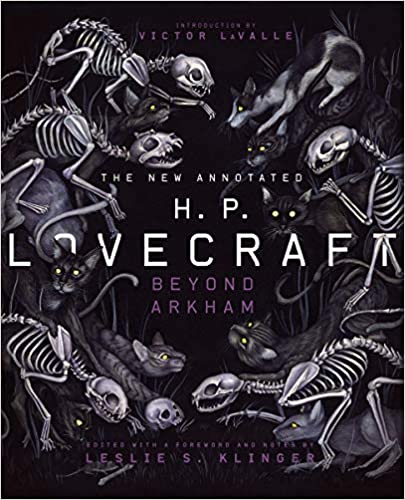
Review 1531: The New Annotated H. P. Lovecraft: Beyond Arkham

I picked up this collection of gothic stories from the library so that I could read one of them, “The Doom That Came to Sarnath,” for the 1920 Club. Then I decided to read the rest of this beautifully presented book.

It’s hard for me to know what to say about it, because this type of gothic horror story, which used to appear in such magazines as Weird Tales, is just not my thing. On the other hand, it is almost definitely for people who like this genre. I prefer my scary stories to be about things that could happen or about ghosts, but Lovecraft is clearly drawn to grotesque creatures, dark family histories of the most freakish, and ancient rituals and beliefs become reality.

That he was deeply knowledgeable in the latter and often based his stories in actual locations or history is attested to by the many annotations and pictures in the margins of this book. That his writing is heavily dependent on description, some of it highly florid, is also certain. He loves using adjectives and adverbs, many of them unlikely, such as describing ruins as “hideously ancient.” In fact, he seems to have a fascination and repugnance for old things, both at the same time—or at least his narrators do.

The earlier stories are very short, only a couple of pages, while the later ones get longer and longer, so that I finished about half of the book but more than 3/4 of the stories.

Some of the more notable stories are “The Shunned House,” based on an actual house in Providence, in which the inhabitants seem to die off; “The Rats in the Walls,” combining a haunted house story with one of his favorite themes of a dark, hidden family history; and “The Outsider,” about a being who discovers he lives in a crypt. One of the stories, “Ex Oblivione,” described as a prose poem, I was unable to finish, but the rest were entertaining enough, just not my thing.

Related Posts

The Doom That Came to Sarnath

The Bloody Chamber

Tales of Mystery and the Macabre

Review 1530: The Last of Chéri

The Last of Chéri is the second novella by Colette about Chéri and Léa. I try to avoid spoilers, but in this case I can’t avoid one, although it is actually about the previous novella, Chéri.

At the end of Chéri, Léa, Chéri’s middle-aged lover, made a sacrifice of her own love by separating from the young Chéri so that he could grow up. Now, it’s six years later. World War I has intervened, during which Chéri received a medal he didn’t exactly earn. His wife, Edmeé, is heavily involved in running a hospital and is in love with its lead physician. During the war, Edmeé and Charlotte, his mother, took over managing his fortune, a task that he was good at, and he doesn’t know how to ask for it back. His friends have been killed or have gone to work. In short, Chéri feels no purpose in life. The old ways of living for pleasure are dead, and in any case, he finds them boring.

Chéri hasn’t thought of Léa for years, but with her he was loved. He wonders if he can return to her.

I frankly didn’t much like the Chéri of the first novella, but I have more sympathy with thirty-year-old Chéri, even though I regret the solution he finds for his problem. Ultimately, this book is an indictment of how he was raised, and I eventually found it touching.

Related Posts

Chéri

Red Pottage

The Collector’s Apprentice