Review 1503: The Battle Lost and Won

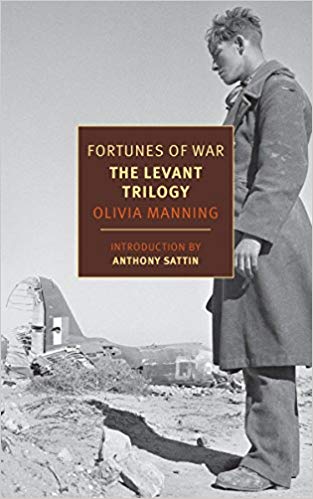
The second novel in Manning’s Levant Trilogy, The Battle Lost and Won begins one day after The Danger Tree ended. Simon Boulderstone continues his leave after finding out that his brother Hugo has been killed. He tags along with Harriet and her friends for an evening in Cairo, but when he hears that the big push is coming up, he returns to his unit hoping to be in on the action.

This book continues the pattern of its predecessor by alternating the points of view of Harriet and Simon. Simon becomes more closely involved in the second battle of El Alamein while Harriet becomes more frustrated with her husband Guy. As usual, Guy occupies all his time with projects and saves none for her, nor does he agree to anything she asks for. He is generous with anyone but her. Without any job or other occupation, she gets dragged into the love lives of her flatmates Angela and Edwina.

Like many middle novels, this one does not have its own climax but works its way to the final volume. Still, I am interested to see what happens to Guy and Harriet, and to some extent, Simon.

Related Posts

The Danger Tree

Friends and Heroes

The Map of Love

Review 1502: Wild Decembers

Best of Ten!
Although the Bugler and Brennan families have been feuding for generations, when Mick Bugler inherits land in the mountains of Western Ireland near the Brennans, he and Joseph Brennan are disposed to be friends. They are, that is, until Bugler goes behind Joseph’s back to lease the field Joseph has leased for the past 15 years. Joseph must take a huge loss on dairy cows that he can’t feed, but that doesn’t seem to faze the wealthy Bugler.

As the situation deteriorates, Bugler keeps getting the best of Joseph, however inadvertently. Joseph’s attitude is egged on by the villagers, who don’t like Bugler. It doesn’t help that Joseph’s sister, Breege, has fallen in love with Bugler, unaware that he’s engaged to a woman back in Australia.

This beautiful, moody novel winds its way to an inevitable sad end. O’Brien’s writing is gorgeous and evocative. This is quite a book.

Related Posts

Solace

When They Lay Bare

The Spinning Heart

Review 1501: Pachinko

In 1932, 16-year-old Sunja is fascinated by Hansee, a debonair Korean who lives in Japan but visits her small village in Korea to buy fish. Sunja has an affair with him, but when she learns she is pregnant, he tells her he has a wife and children in Japan but wants her to be his Korean wife. While realizing she will disgrace her family, she does not agree.

Isak, a frail Christian minister, comes to stay at Sunja’s mother’s boarding house on his way to Japan, but he soon falls ill with tuberculosis. Sunja and her mother Yangjin nurse him back to health. When he understands Sunja’s predicament, he offers to marry her to give her child a father. So, the couple leave for Japan, where the novel follows the fates of them and their descendents for the next fifty plus years.

At the time of the beginning of the novel, Japan ruled Korea, and the Japanese treated the Koreans as second-class citizens in their own country. In Japan, the Koreans are considered dirty and lazy and are forced to live in ghettos. They are discriminated against, and most are not allowed to become citizens even if born there.

This novel is an interesting story about the difficulties Koreans had living in Japan. It is the type of novel that is more interested in what happens to this family, though, than in creating well-rounded characters. I liked it but did not love it.

Related Posts

A Tale for the Time Being

The Vegetarian

Unbroken

Review 1500: Sofia Petrovna

The heroine of Sofia Petrovna is an ordinary Soviet woman, not political but a happy worker at a publishing house. She has a son, Kolya, a promising engineering student who is a dedicated party member.

Then things begin to go wrong. She hears of the arrest of some doctors, one of whom she knows. They have been accused of sabotage. She can hardly believe it. He seemed like such a nice man. But if they say it is true, it must be. Then Kolya is arrested.

Lydia Chukovskaya’s novella about the Great Purge under Stalin was written in 1939-40, and she kept it hidden for years. A Soviet publishing company accepted it for publication in 1962, but when it was almost ready, backed out. It was finally published in Europe in 1965 after having been smuggled out of the country.

This is a deeply interesting and harrowing novella about what happens to an individual when the world seems to have gone crazy.

Related Posts

Memories: From Moscow to the Black Sea

The Ukrainian and Russian Notebooks

A Gentleman in Moscow

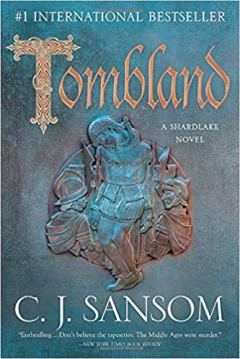
Review 1499: Tombland

My understanding was that Lamentation was supposed to be the last of C. J. Sansom’s Matthew Shardlake mysteries; then Tombland came out. I had previously wavered about whether to continue with the series about the dour lawyer, but Lamentation was so good that I decided to read Tombland.

It is 1549. Edward VI is 12 years old, so the country is being ruled by Lord Somerset, the Protector. It has been a late summer, so crops are not expected to be good. Further, landlords have begun illegally enclosing common land for sheep, throwing their tenants off the land. As a result, thousands of poor are roaming the country. The Protector has promised that a commission will look into this problem, but so far nothing has happened.

Lady Elizabeth asks Matthew to look into a case where a distant relative, John Boleyn, has been arrested for murdering his wife, Edith. Lady Elizabeth does not wish anyone to know that Edith came to her for financial help and did not receive it. Edith had left her husband nine years previously, and no one knew where she went. Recently, she was found brutally murdered, upside down in the creek on her husband’s property. Lady Elizabeth wants to know whether John was guilty and if not, have Matthew find the murderer. If need be, she will try to get John a pardon. This notion is difficult politically because of the Boleyn connection, so it is a last resort.

Matthew thinks it is unlikely that John would have killed his wife and left her body so exposed, because he is the likely suspect and it negates his subsequent marriage to his mistress, Isabella. John’s twin sons, Barnaby and Gerald, seem like demented feral animals, but Matthew also believes they loved their mother. He finds Edith’s father, Gawen Reynolds, to be an angry, hateful man. Still, aside from a land dispute, he can’t find a motive for Edith’s murder.

This novel is 800 pages long, and John’s trial is in the first few hundred pages, so I was wondering about that as we approached the verdict without a solution to the crime. But, for this novel, the mystery is really an excuse, almost a McGuffin, for what Sansom is really interested in, the story of Kett’s Rebellion. Common men anticipating the promised commission begin making camps, rounding up landlords who have enclosed their land, and tearing down enclosures. Matthew, his assistant Nicholas, and his old friend Barak are taken up by the rebels when they go to visit a potential witness, Flowerdew. The last half of the novel is about this incident in history.

I thought this novel was interesting, but I also felt that if Sansom wanted to write about the rebellion, it might have been better not to wrap it into a mystery. In fact, I felt that the section dealing with the rebellion was a bit too detailed, taking up more than 400 pages, with a 50-page essay at the end of the novel. As a result, I didn’t think this book was as good as some of his others, particularly Lamentation. Sansom appears to want to be a straight historical novelist, and maybe he should just do that.

Finally, although I feel that some of the books in this series are outstanding, it has always bothered me that no one in them ever shows a vestige of humor, and Matthew has to be one of the most depressed characters ever.

Related Posts

Lamentation

Heartstone

Revelation

Review 1498: The Danger Tree

The Danger Tree is the first volume of The Levant Trilogy, the second half of Olivia Manning’s Fortunes of War. It begins with the adventures of a new character, Simon Boulderstone, a subaltern in the army who has missed his transport to his unit in Egypt. During the course of a day in Cairo, he meets Harriet Pringle, who seems at first as though she is going to be a minor character.

However, the book alternates chapters between Simon’s experiences in the desert and Harriet and Guy Pringle’s in Cairo and Alexandria. The last book of the Balkan Trilogy left the Pringles in Cairo after they fled Athens. It’s a year later. When they arrived in Cairo, Guy found Colin Gracey, his nemesis from Athens, in charge of the Organization, for which Guy works. Gracey is neglectful of his position, a characteristic that Guy despises, and has gone off traveling, so Guy has trouble meeting with him to ask about a position. Gracey has again employed the unqualified Dubedat and Toby Lush while ignoring the very qualified Guy.

Guy stupidly then offends Gracey by writing a limerick about him, which he hears of. As a result, Guy is finally posted to an unimportant school in Alexandria nearer to the front, and Harriet is stuck in Cairo living in one room in a pension and working for the American embassy.

The focus of Harriet’s portion of the book is the uncertainty in Cairo, as the Europeans wait for an attack from Rommel. For Simon’s section, it is the confusion he finds at the front.

This book made an interesting start to the second trilogy. I’m happy to follow Guy and Harriet a while longer as they make their way through World War II.

Related Posts

The Great Fortune

The Spoilt City

Friends and Heroes

Review 1497: Elmet

Best of Ten!
My very brief research on Elmet tells me that it was a Welsh kingdom in what is currently West Yorkshire, but the Wikipedia article says that Bede refers to it as “the forest of Elmet.” This reference is certainly apt for the novel Elmet.

Daniel, his father Daddy, and his sister Cathy live in the deep forest in a house their father built. Daddy has claimed the land, which the children’s mother owned when she died.

Before they lived there, the children stayed with their grandmother while Daddy was gone for long periods. But Cathy was being harassed by local boys until she finally beat them up. When Daddy took Daniel and Cathy to report the repeated bullying to the head teacher, he could see that she already believed that the attack was unprovoked, believed the middle-class boys’ lies over the poor children’s truth, that is. So, Daddy took them away to the forest and told them he wouldn’t leave them again.

At first, their life seems idyllic as they live mostly off the land, but we know from the beginning that Daniel is running away from some horrible event. So, a feeling of dread builds.

Daddy is an uneducated giant who makes a living fighting illicit bare-knuckles boxing matches. In his past, he also did violent work off the edges of legality, but lately he has used his great strength to help out poor people against injustices by landlords and former employers. Because of his past, however, he can’t seek out legal means to sort out his problems, and the worst one appears with Mr. Price, a man known to have cheated locals out of their land and a poor landlord. He claims that the kids’ mother sold him her land before she left the area.

This novel is stunning in its beauty, full of dread, dark, and wonderful. Set in the present, it depicts life so violent and exploitative for the locals in poverty that you would think it was feudal times. It’s not often I read a book this good. I read this book for my Man Booker Prize project.

Related Posts

History of Wolves

All the Birds, Singing

Milkman

Classics Club Spin #23

It’s time for another Classic Club Spin, in which we club members select 20 books from our lists, and the club picks a number, determining which book we read next.

So, with no more further ado, here is my list for this spin:

  1. The Prince by Machievelli
  2. I Go by Land, I Go by Sea by P. L. Travers
  3. Edward II by Christopher Marlowe
  4. August Folly by Angela Thirkell
  5. Titus Andronicus by William Shakespeare
  6. Challenge by Vita Sackville-West
  7. Oroonoko by Aphra Behn
  8. The Sea Hawk by Raphael Sabatini
  9. The Duchess of Malfi by John Webster
  10. The Last of the Wine by Mary Renault
  11. Mansfield Park by Jane Austen
  12. Mary Lavalle by Kate O’Brien
  13. The Tenant of Wildfell Hall by Anne Brontë
  14. Coromandel Sea Change by Rumer Godden
  15. The Brothers Karamazov by Fyodor Dostoevsky
  16. Three Weeks by Elinor Glyn
  17. The Viscount de Braggelone by Alexandre Duma
  18. My Brilliant Career by Miles Franklin
  19. Kennilworth by Sir Walter Scott
  20. The Winged Horse by Pamela Frankau

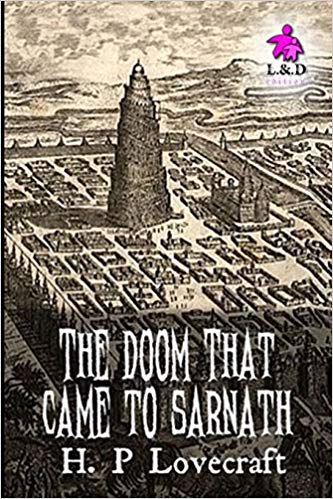
Review 1496: #1920Club: The Doom That Came to Sarnath

“The Doom That Came to Sarnath,” which I read for the 1920 Club, was my introduction to H. P. Lovecraft, whom I’ve read about for years. Based on this one story, I can’t really say much about Lovecraft’s work, but I intend to read all of the book it came in, The Annotated H. P. Lovecraft: Beyond Arkham.

The short story is written in archaic language that is supposed to remind us, and does, of old stories and legends. It tells how men came to live near the ancient city of Ib, occupied by green, voiceless beings with bulging eyes, and destroyed the city and all its inhabitants, and how its sea green idol disappeared. There the men founded the city of Sarnath.

Later, the city becomes wealthy and so beautiful that people from other cities visit it. But doom was foretold with the original actions of the men, and on the city’s thousandth anniversary . . . . Well, I won’t tell.

I get the impression just from the notes on this annotated edition that Lovecraft invented whole worlds that he returned to in other stories. The story is atmospheric but very short and not particularly scary or disturbing.

Related Posts

Cheri

The Bridal Wreath

The Bloody Chamber