
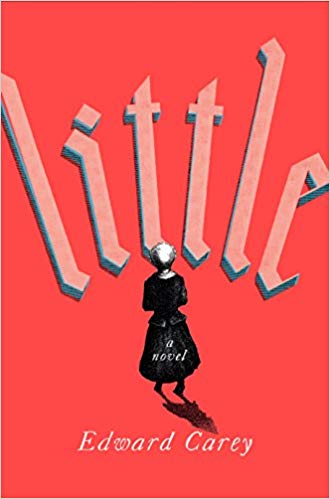
 The Best Book for this period is Little by Edward Carey! Also recommended: The Children’s Book by A. S. Byatt!
Classics Club Spin #22
It’s time for another Classics Club Spin, in which we post 20 books from our Classics Club lists. On Monday, December 22, a number will determine which of the books we’ll read next.
So, with no further ado, here’s my list. I hope for a good one!
- I Go By Land, I Go By Sea by P. L. Travers
- August Folly by Angela Thirkell
- Challenge by Vita Sackville-West
- The Sea Hawk by Rafael Sabatini
- The Last of the Wine by Mary Renault
- Mary Lavelle by Kate O’Brien
- Joanna Godden by Sheila Kay-Smith
- Coromandel Sea Change by Rumer Godden
- Three Weeks by Elinor Glyn
- My Brilliant Career by Miles Franklin
- The Winged Horse by Pamela Frankau
- This Side of Paradise by F. Scott Fitzgerald
- Vanishing Cornwall by Daphne du Maurier
- Kenilworth by Sir Walter Scott
- The Viscount de Bragelonne by Alexandre Dumas
- The Brothers Karamazov by Fyodor Dostoevsky
- The Tenant of Wildfell Hall by Anne Brontë
- Mansfield Park by Jane Austen
- Evelina by Frances Burney
- The Duchess of Malfi by John Webster
Review 1450: The Christmas Card Crime and Other Stories
 For a Christmas season treat, I read this latest British Library Crime Classic short story collection, published in October. Most of its stories are set in winter and several around Christmas. This collection includes crime stories published between 1909 and 1965.
I was surprised to find the first story was written by Baroness Orczy, whom I associate with the Scarlet Pimpernel. It turns out that she started by writing crime fiction. In “A Christmas Tragedy,” her detective is Lady Molly, who is convinced that the accused Mr. Smethick did not murder Major Ceely. The police theorize that the motive was the major’s refusal to allow his daughter’s engagement to Mr. Smethick. Lady Molly discovers a more obscure motive for the crime.
In “By the Sword” by Selwyn Jepson, Alfred Caithness plots and kills his cousin Herbert after Herbert refuses to lend him more money. Alfred’s guilt is explored in an unusual way.
“The Christmas Card Crime” by Donald Stuart is more of a crime adventure, as a criminal tries to steal an heiress’s proof of her identity.
Although some of the stories were more clever than others, the only story I couldn’t finish was “Twixt the Cup and the Lip” by Julian Symons, a caper story that seemed to go on and on.
I received a copy of this book from the publishers in exchange for an honest review.
Related Posts
Review 1429: The Old Man’s Birthday
 I’ve only read two books by Richmal Crompton, but she seems to be interested in studying the individual members of large families. In The Old Man’s Birthday, she focuses this interest around Matthew Rowston’s 95th birthday.
Matthew has led an exciting and sometimes disreputable life, but he married an extremely conventional woman and now lives in a village stifled by class consciousness and respectability concerns. To this birthday party, he has insisted on inviting his grandson Stephen, who is living with a married woman and has been cast off by most of the rest of the family. Part of Matthew’s motivation is a perverse desire to shock these family members, but when he meets Stephen’s partner, Beatrice, he is also reminded of a girl he loved when he was young.
This novel is about how the introduction of a single person into a group can change dynamics that seem fairly set. You may feel that a multitude of difficult situations are resolved too easily, but still, this is an enjoyable and touching novel. I read it for Classics Club and was glad I did.
Related Posts
Review 1428: The Children’s Book
 I have an inconsistent reaction to Byatt. I find her novels either completely absorbing, as I did Possession, or perplexing, as I did A Whistling Woman. The very long novel, The Children’s Book, nevertheless falls into the first category.
Byatt’s novel takes on the late Victorian and early Edwardian periods, a time when, she says, adults seemed to be trying to prolong childhood, when, for example, Peter Pan made its appearance. Fittingly then, a major character is Olive Wellwood, a writer of children’s tales. She has many children, and aside from her authorly output, she writes a continuing story for each one of them. It’s her oldest son, Tom’s, misfortune that she confuses fiction with reality.
The novel begins when, on a visit to a museum with his mother, Tom notices a ragged boy and follows him to find he is living in a closet in the museum. This boy is Philip Warren, a worker in a pottery factory who has run away because he wants to make pottery, not feed fires and do other mundane tasks. Major Prosper Cain, the museum keeper Olive is visiting to consult, thinks he may be able to find a place for Philip, and Philip ends up working at Prospect House for the brilliant but disturbed potter Benedict Fludd.
But first we have the Wellwood’s elaborate Midsummer play, where we meet all of the important characters of the novel. The Wellwood’s guests are artists, anarchists, socialists, fellow Fabianists, and even a banker in the person of Basil Wellwood, the host Humphry’s brother. Of course, other guests are these people’s children, who eventually become important characters in their own right.
The novel covers the time from 1895 to the end of World War I, although the war is covered only briefly. Over this time period, Byatt not only tells us the stories of her many characters but also checks in to events in the lives of actual figures of the time, for example, Oscar Wilde, Emma Pankhurst, H. G. Wells, and Rupert Brooke.
This novel is interesting both on an intimate level, as the children discover their parents’ secrets and have their own, and on the broader, more ambitious level of a portrait of the age. There are casualties in this novel, and it is at times very dark, the way Olive likes her stories.
Related Posts
Review 1427: Dandy Gilver and a Spot of Toil and Trouble
 Dandy Gilver receives a note from an old school friend, Minnie Bewer, asking for her assistance, but when she and her partner Alec Osborne arrive at Castle Bewer, what exactly the family wants is more difficult to ascertain. Whatever it is, it revolves around a missing necklace they call the Cutthroat and the disappearance 30 years ago of Bluey Bewer’s father, Richard.
Minnie Bewer wants Dandy and Alec to safeguard the castle while the Bewers put on a play. Bluey wants them to search for the Cutthroat and assure inland revenue that it is not in their possession before death taxes are assessed on his father’s 100th birthday. Ottoline Bewer, Bluey’s mother, wants them to find the necklace. To do that, Dandy reckons they must find Richard. There is a lot to do, and it must be done during the disturbance of rehearsing and performing the play Macbeth.
As usual with this series, there are lots of red herrings and a lot of confusion. That usually derails me, but this time I realized almost immediately the truth of one facet of the story, and I was right. Once I had figured it out, a lot became obvious.
Still, the Dandy Gilver mysteries are always fun cozies. The first one was set at the end of World War I, and this one in 1934, so it’s been a long-developing series.
Related Posts
Dandy Gilver and the Unpleasantness in the Ballroom
Review 1426: The Wardrobe Mistress
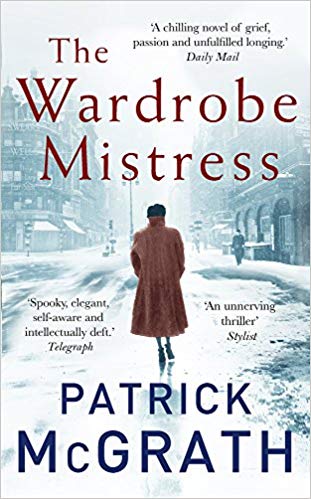 In post-World War II London during a cold winter, the famous actor Charlie Grice, called Gricey, has died. His widow, Joan, a wardrobe mistress, is bereft. When a young actor, Daniel Francis, takes over Gricey’s role as Malvolio and plays it exactly the same, Joan comes to believe that he has become Gricey.
As Joan is beginning to befriend Daniel Francis, or Frank Stone, his real name, she makes a horrible discovery about Gricey. Behind the lapel of one of his coats she finds a badge, the emblem of Britain’s fascist party. This is doubly horrible because Joan is Jewish. Asking around discreetly, she finds what everyone else knows—Gricey was indeed a fascist.
The stress on Joan becomes even worse as her friend Frank begins working with her daughter Vera on The Duchess of Malfi. Vera’s husband and his friend Gustl ask her to help them fight the fascists by infiltrating them.
This novel is written from an omniscient viewpoint with a first person plural accompaniment by the ladies of the chorus. This technique lends it a certain ironic tone. It’s a creepy and atmospheric novel that chills to the bone.
I read this novel for my Walter Scott Prize project.
Related Posts
Review 1425: High Wages
 Jane Carter is a young girl hoping to get a job in Tidsley so she can move out of her stepmother’s house. While her father was alive, she was educated and cherished, but since the age of 15, she’s only been tolerated in her home. In front of Chadwick’s shop, she sees a sign posted for a shop girl. This would be a good opportunity for her, because Chadwick’s is the best draper in Tidsley. And, as she is of genteel appearance, she is hired.
She is excited to get the job, although she slowly realizes its problems. The room above the shop where she must live is not very nice, but it seems fine to her, and her roommate, Maggie, is friendly. However, Mrs. Chadwick skimps on the girls’ food, and Mr. Chadwick sometimes cheats her out of her commission, taking it for himself. Worse, though, is his caution at change in the shop. Jane finds she is good at her job and has ideas that will make money, but Chadwick often won’t let her try them.
A difficulty she isn’t aware of, as Maggie and her young man, Wilfred, invite her out with them every Sunday, is that Wilfred is falling in love with her. She, herself, is attracted by a young man named Noel Yarde, but he is above her in class. Then, lives change as World War I begins.
This novel has an appealing heroine, naïve yet practical, and not to be beaten down. Its realistic portrait of the times, particularly as they change over a period of about eight years, is interesting. The flavor of the northern town, with its grimness and social barriers, is interesting, too. As usual with Whipple,, I enjoyed this novel very much.
Related Posts
Review 1424: Little
Best of Ten!
Often I don’t read reviews attentively or more often I don’t remind myself what a book is about before reading it, so I didn’t realize for some time that Little is a fictional biography of Madame Tussaud. It is an idiosyncratic one, to be sure.
Marie, often called Little for her small stature, is familiar with loss. In 1760, when she is five, her father dies. Her mother never recovers from it, and shortly after she and her mother take up residence with Doctor Curtius, for whom her mother is employed as a servant, her mother commits suicide.
Doctor Curtius is one of many peculiar characters, Marie not excepted, who occupy the novel’s pages. He is a very odd creature, unused to others, who models body parts in wax to be studied by anatomists. Marie is not dismayed by his peculiarities and is entranced by his wonderful collection of body parts. So, he begins teaching her to draw and model objects in wax.
At Little’s suggestion, they model the entire head of some subjects. Soon, they have a business of selling heads of themselves to customers. Dr. Curtius is mistreated by the hospital, so when a traveling Frenchman, Louis-Sébastian Mercier, suggests they move to Paris from Switzerland to model great men, they do.
Shortly after they arrive in Paris, Doctor Curtius falls under the influence of their landlady, the Widow Picot, who soon has Little working for the entire family, not just Doctor Curtius, even though Little has never been paid. Madame Picot makes no secret that she would like to get rid of her. In the meantime, she and Doctor Curtius begin by modelling the heads of famous criminals. By now, the French Revolution threatens.
Little is narrated in a sprightly, whimsical fashion even when it relates things that are not so pleasant. That, and the pervading personality of its main character, are two of its charms, even as it becomes darker. This is a strange and wonderful novel.
Related Posts
The Fountain of St. James Court or, Portrait of the Artist as an Old Woman
Review 1423: Literary Wives! The Home-Maker
 Today is another review for the Literary Wives blogging club, in which we discuss the depiction of wives in fiction. If you have read the book, please participate by leaving comments on any of our blogs. Be sure to read the reviews and comments of the other wives!
Eva of Paperback Princess
Lynn of Smoke and Mirrors
Naomi of Consumed By Ink
* * *
The Home-Maker is a reread for me, so let me just provide a link to my original review and then discuss our regular question.
What does this book say about wives or about the experience of being a wife?
Evangeline Knapp is a perfect example of a woman, like my mother, who was not suited to be a housewife, a kind of person not recognized in her time. Unlike my mother, who at home was the female equivalent of Lester Knapp at work, Evangeline compensates by becoming overzealous and overparticular in her housekeeping, making the immaculate home a miserable place for everyone, including herself.
In this ground-breaking work of 1924, the couple are forced to switch places, and Evangeline finds her place in life. At work in a department store, her efficiency and energy are appreciated, and because she enjoys the work, she loses her resentment. The Knapps change from a dysfunctional family to one that is much happier, because everyone is happy in his or her role. In fact, to keep this happy solution in this chauvinist time, they have to come up with a rather shocking solution. The Knapps develop a true partnership in their marriage.
 I like this novel because instead of depicting a family in stasis, it presents a problem that probably wasn’t much recognized in its time and shows how the family relationships improve as a result of its solution. The marriage evolves from a somewhat unhappy one to a happy one, and everyone is fulfilled. Lester understands Evangeline’s need for meaningful work, and he enjoys taking her position in the household, albeit not providing an immaculate household but a loving, slightly messy one. Evangeline’s sharp temper subsides.
In her way, Evangeline is a little more exaggerated version of Brenda in Happenstance, who began to have periods of anger before she took up quilting.
 What? Me Read?