Review 1400: The Girl Who Takes an Eye for an Eye

Here’s another review for Readers Imbibing Peril!

* * *

Like many others, I devoured Stieg Larsson’s Millenium Trilogy. I didn’t seriously consider reading David Lagercrantz’s continuation to the series until I picked up this novel on impulse. I have skipped one book in the series, but this one didn’t seem difficult to understand even though I hadn’t read the last.

Lisbeth Salander is in prison on charges related to events in the last book. There she has observed an inmate, Faria Kazia, subjected to routine abuse by another inmate, Benito, a gang member, with no intervention by authorities. In fact, although Warden Olsen came in with good intentions, he’s been held in check by Benito’s threats against his daughter.

Faria is in prison for shoving her brother out the window. She has said nothing in her defense, but Lisbeth is inclined to believe the death is related to an honor killing.

Lisbeth is also engaged in research into her own past. She asks the journalist Mikael Blomkvist and her elderly guardian Holger Palmgren to find some information for her. Soon, Palmgren is found dead under suspicious circumstances.

I know that Stieg Larsson wrote outlines of several more Salander novels before his death. What I don’t know is whether Lagercrantz is working from Larsson’s outlines or not. Lagercrantz is no Stieg Larsson, however. I don’t think Larsson was a great writer—he was too inclined to go into extensive detail on political issues—but he was a master of the gripping tale. The bones of one of his complex stories is here, but Lagercrantz fails to construct the fully realized world of Larsson’s novels. Further, he writes choppy subject/verb/object sentences that don’t flow well, and he gives away most of his plot points fairly early on.

So, no more Lisbeth Salander for me, which is a shame.

Related Posts

The Girl with the Dragon Tattoo

The Girl Who Played with Fire

The Girl Who Kicked the Hornet’s Nest

Review 1399: The Mermaid and Mrs. Hancock

In 1785, Jonah Hancock is a merchant who is waiting for his ship to arrive. It is delayed, and he has heard nothing for a long time, but such is the life of a merchant. Finally, his captain arrives but without his ship, which he has sold to purchase, of all things, a mermaid.

Mr. Hancock doesn’t quite know what to do with the wizened, grimacing creature with the fish tail, especially as it is dead and Captain Jones has sold his ship for £2000 less than it is worth. But the Captain blithely believes the mermaid will make his fortune—he should exhibit it.

Angelica Neal’s protector recently died, leaving her with nothing. Her friend, Mrs. Frost, worried about their household expenses, urges her to return to the house of Mrs. Chappell, the bordello owner, but Angelica is hoping to attract a protector rather than to fall back in debt to Mrs. Chappell. Unfortunately, she falls in love at the party Mrs. Chappell gives to exhibit Mr. Hancock’s mermaid, with a young lieutenant who doesn’t come into his fortune for years.

I enjoyed this peculiar novel, which seems solely a historical novel but contains a whimsical dash of the supernatural. I was interested in both Angelica and Mr. Hancock as characters, as well as some of the others. There is an odd subplot about a girl who runs off from Mrs. Chappell that, while not unfinished, takes some part of the narration and then vanishes from the book until the end. I wasn’t sure of the point of that story line.

In fact, the entire novel sort of meanders past the point where you think it will end, making for an unexpected last 100 pages.

Related Posts

Viper Wine

The Mermaid’s Child

Pure

Review 1398: The Arlington Inheritance

The identity of the criminal is not a secret in The Arlington Inheritance. Instead, the suspense lies with how Miss Silver, Wentworth’s Marple-like sleuth, will find and put together the clues.

My friend and I have been trading books lately, and she loaned me this one. At the time, she commented that she didn’t like the repetition. More about that later.

Jenny Hill’s guardian, her old governess, Miss Garstone, dies unexpectedly in a hit and run accident. When she is dying, she tries to tell Jenny about a letter written from her father to her mother. Her father died in the war, and her mother was injured shortly thereafter, not speaking again until she died shortly after Jenny was born.

After Miss Garstone’s death, her sister immediately descends to claim her property and grudgingly gives Jenny the little chest that is supposed to contain the letter. But when she opens it, no letter is there.

Jenny has nowhere to go, but Mrs. Forbes, her neighbor across the road, offers her a job as governess for her two girls, Meg and Joyce. Jenny was born in Mrs. Forbes’s house, owned at the time by her father, but as he didn’t marry her mother, Jenny as a baby was dispossessed by Mr. and Mrs. Forbes, her father’s nearest relatives.

Jenny thinks she is in love with Mac Forbes, who is occasionally attentive to her, but when she is away from him, she has doubts. When Mac visits this time, he seems to be paying more attention to her. However, Jenny overhears a conversation that chills her. She hears Mac tell his mother that Jenny’s father did marry her mother. Rather than tell Jenny, he plans to marry her, assuring himself the possession of the house and property.

Appalled, Jenny runs away from home, but trouble comes after her.

Wentworth draws some appealing although mostly one-dimensional characters in Jenny, some of her relatives, and Miss Silver. Occasionally, I mildly enjoyed this effort even though Wentworth’s writing style deals in a lot of repetition. Someone will recount something that has happened, that we already know about, sometimes several times. It’s not done for a reason, for example, to show that a witness is leaving something out, but simply seems to be her style and makes the book slightly longer. This doesn’t occur until the crime, though, which happens well into the book (as far as we know). After that, it can certainly be annoying.

Related Posts

Coffin, Scarcely Used

Antidote to Venom

The Horizontal Man

Review 1397: Deep Waters

I have read several of British Library Crime Classics’ mystery story collections, usually themed around a locale. In Deep Waters, most of the stories are set at sea, although some involve rivers and one each a pond and a swimming pool. The stories are in chronological order by when they were published, from 1893 to 1975.

The first story, “The Adventure of the ‘Gloria Scott'” by Arthur Conan Doyle, is a Sherlock Holmes I have never encountered before, supposedly his first case. Like several of the first few stories, it presents and solves a puzzle so quickly that I was barely aware there was a puzzle. In fact, as I read these stories, I felt as if I was watching the evolution of the mystery story.

“The Eight-Mile Lock” by L. T. Meade and Robert Eustace, only the second story, was one of three written by women. It details the theft of a diamond bracelet from a party staying on a houseboat. The mystery is not so much about who stole the bracelet or how but where he put it to evade the police.

“The Gift of the Emperor” is a Raffles story written by E. W. Hornung, who was Arthur Conan Doyle’s brother-in-law. I don’t know if it was the last of Raffles’s career, but it seemed to be.

One of the stories I liked best was “A Question of Timing” by Phyllis Bentley. The main character, Robert Beringer, uses his observation skills as a writer to foil a criminal, save a detective’s life, and get the girl, all during a walk. This story takes place on an embankment of the Thames.

I have a frustration in general with mystery short stories as they really only have space to pose and solve a puzzle. So much that I enjoy about mystery novels is not possible at this length. Some of these stories, though, had beautiful descriptions of their settings. In any case, this is a good collection for those interested in the evolution of the mystery story.

I received a copy of this book free from the publishers in exchange for an honest review.

Related Posts

Murder at the Manor

Silent Nights

The Mistletoe Murder and Other Stories


Review 1396: Kingdom of the Blind

Here’s another review that is suitable for Readers Imbibing Peril!

* * *

Although I’ve enjoyed many of Louise Penny’s Armand Gamache series, I had stopped reading them. However, on impulse I picked Kingdom of the Blind up at the library.

Having skipped one book in the series caused a problem, as the last book apparently climaxed in a major event that forced Gamache to allow a new drug onto the street, a killer. Now, Gamache is suspended and under investigation, a familiar situation for him. And that’s one problem for me. Since the beginning of the series, different figures in law enforcement have been out to get him. Each time this plot line seems to be wrapped up, it isn’t. I’m frankly tired of it.

This novel centers on two plot threads, something common to Penny’s books. In one, Gamache is among three people asked to execute the will of a woman they don’t know. Why were they selected, and why has the woman, who worked as a house cleaner, left money and property she doesn’t seem to possess?

The second thread is related to the search for the drugs. It begins when Gamache has one of his proteges, Amelia, dismissed from the police academy for possession of drugs.

It wasn’t very hard to figure out what was going on in one of these plot lines. The other was more difficult.

But really, my problem with this series relates to its sameness, the reason why I almost always quit reading series. First, the same ancillary characters go through the same routines. Second, Penny doesn’t really trust her audience. If someone says half of a well-known phrase, someone else has to finish it. She constantly tells us what to think about exchanges between characters. There’s a certain heaviness to Gamache, whom she depicts as almost like a saint, so that despite some kidding around, everything feels heavy. And anyway, the jokes are always the same.

Finally, there’s the writing style. Penny uses lots of short sentences and sentence fragments in this novel, particularly when hammering home a point that the reader doesn’t really need hammered. I don’t remember her using this style before, but perhaps I just didn’t notice it in the previous books.

This all sounds like I hated the book. I didn’t. I am just tired of the series, as I often become tired of series. This series started out as a really good one, so if you’re interested, I suggest starting at the beginning. Penny almost always links story lines from one book to the next, so it’s best to read them in order.

Related Posts

A Great Reckoning

The Nature of the Beast

The Long Way Home

Another Classics Club Spin

The Classics Club is having another spin. For that, we post a list of twenty of the books from our Classics Club lists, and then Classics Club picks a number, and that’s the book we read next. The goal is to read the book by October 31st.

So, here is my list for Spin #21:

  1. I Go by Land, I Go by Sea by P. L. Travers
  2. The Old Man’s Birthday by Richmal Crompton
  3. The Tenant of Wildfell Hall by Anne Brontë
  4. Oroonoko by Aphra Behn
  5. The Wise Virgins by Leonard Woolf
  6. The Duchess of Malfi by John Webster
  7. Mansfield Park by Jane Austen
  8. The Last of the Wine by Mary Renault
  9. Edward II by Christopher Marlowe
  10. The Viscounte de Bragelonne by Alexandre Dumas
  11. The Winged Horse by Pamela Frankau
  12. August Folly by Angela Thirkell
  13. Kenilworth by Sir Walter Scott
  14. Evelina by Frances Burney
  15. The Prince by Machievelli
  16. The Brothers Karamazov by Fyodor Dostoevsky
  17. This Side of Paradise by F. Scott Fitzgerald
  18. Challenge by Vita Sackville-West
  19. The Sea Hawk by Rafael Sabatini
  20. My Brilliant Career by Miles Franklin


Review 1395: Fire & Blood

I thought Fire & Blood was going to be a prequel to George R. R. Martin’s A Song of Ice and Fire, but actually it is the first volume of the history of the Targaryen kings of Westeros. It is written more like a history book than a novel, hitting on the things history books cover, which in this case is one battle after another. It is this kind of study of history that made me hate history class in school even though I am interested in history. In no time, we are overwhelmed with a huge number of names with no context except titles and no true characterization.

I gave this book two shots. I put it away for months and then restarted it. The second time, I found it a little more interesting but not enough to continue. I’m sure it’s the type of thing that Game of Thrones fanatics would love, but I just wish Martin would stop fooling around with things like this and finish the series. There are a lot of people who believe that because of the TV show, he will not. If so, that’s unfortunate.

Related Posts

A Dance with Dragons

A Feast for Crows

A Storm of Swords

Review 1394: Mothering Sunday

Best of Ten!
It’s a warm day in the spring of 1924, Mothering Sunday, a day when servants are released from their duties to visit their mothers. Jane Fairchild is a young maid in the home of the Nivenses, but she has no mother. She plans to curl up with a good book until she receives a phone call from her long-time lover.

Her lover is Paul Sheringham, the only son left after World War I to a neighborhood family. Although he is to be married in two weeks, he sets up a tryst with Jane in his own home while his parents and the servants are out.

Jane is to revisit these hours spent with her lover for the rest of her life. For something happens that afternoon that changes the course of her life.

This is a remarkable novel. It is very short, but it somehow covers the course of Jane’s entire life while minutely examining one scene, the meeting with her lover. It touches on every action and word, considers them from several sides just as the mind does as it re-examines an event. At the same time, it examines what qualities make a writer and what a writer attempts to do when writing. This is an excellent novel I read for my Walter Scott Prize project.

Related Posts

Toby’s Room

C

Solace


Review 1393: Friends and Heroes

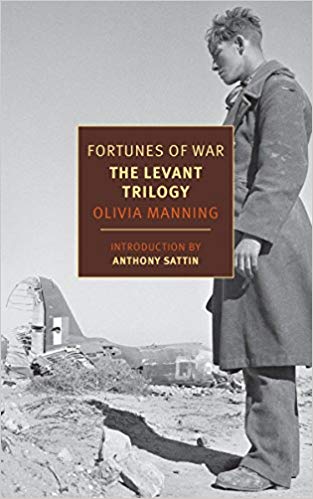
Cover of Fortunes of WarAt the end of the previous book of Olivia Manning’s Balkan Trilogy, Harriet Pringle flew out of a besieged Bucharest without knowing whether Guy would be able to follow. She ends up in Athens, and the first person she meets is Prince Yakimov. Although he betrayed the Pringles to the Germans through his foolishness, Harriet is happy to see a friendly face.

Guy does arrive in Athens in the hope of getting a teaching job at the Academy. He finds Duderat and Toby Lush ensconced there as teachers. Although he employed them in Bucharest despite their lack of credentials, they do not repay his kindness with assistance. Instead, they lie to the director about him to prevent him getting a position. The director will not allow the Pringles to live at the Academy, so they find themselves with only a room to stay in and no money.

Even after they manage to establish themselves, Harriet feels alone. She understands that Guy considers her part of himself, but he therefore expends himself in work and helping others and hardly thinks of her. Out of loneliness, she finds herself attracted to a young soldier.

I didn’t like the turn the plot took with the soldier, whom I thought tiresome, but I have found this series more and more interesting. Although Friends and Heroes is the third book in the Balkan Trilogy, it ends with another evacuation and feels incomplete, so I feel compelled to read the second trilogy in the series Fortunes of War, the Levant Trilogy.

Related Posts

The Great Fortune

The Spoilt City

Munich

Review 1392: A Very Private Eye

I am not much for reading letters and diaries, because I like story telling, even in nonfiction, rather than glimpses of a life. So, A Very Private Eye, a collection of Barbara Pym’s diary entries and letters, was probably not the best choice for me. Still, a good friend gave me the book, so I decided to read it.

The book was both worse and better than I expected. It begins with Pym’s diary entries as she starts Oxford. In no time, she has embroiled herself with Henry Harvey, who treats her shamefully. Unfortunately, instead of telling him to bugger off like he deserves, she records her heart-rendings, which continue for years.

Next comes a series of letters to Harvey and his wife, and to other friends. I found the letters to the Harveys excruciating. She gives herself the identity of the spinster, Miss Pym, and writes about herself in the third person in a false, jokey tone with constant reminders of her single status. Very obvious. I would think the wife would have been wary.

I was just about to give up on her at around 100 pages in, when the book gets into the war and becomes much more interesting. Similarly, it gets more interesting as she ages, although she refers to a lot of people whose role in her life is not explained. (That would have been helpful, although each section begins with an explanatory introduction by the editors.)

She went through about ten years when no one would publish her books because they were no longer thought to be marketable. Then two prominent literary figures independently listed her as one of Britain’s most underrated authors. Her next books were published, and she was eventually shortlisted for the Booker Prize. I felt it was sad that this happened for her just a few years before she died.

Related Posts

I Know Why the Caged Bird Sings

West with the Night

The Talented Miss Highsmith