Review 1362: Begin Again

In the 1930’s, generational social changes away the Victorian age occurred, including sexual and social liberation. Begin Again follows four young women recently down from Oxford as they try to redefine themselves in the light of these changes.

Leslie is living at home, but she regularly visits her friends Jane and Florence in London. She has a romantic idea about the freedoms the two girls have and wants to get a place of her own in London, an artist’s studio, using her inheritance. Her mother doesn’t want her to use up her inheritance and has suggested she live with her aunt. Leslie, in truth, would like a little opposition to her plans instead of her mother’s acceptance and prefers complete independence to living with her aunt.

Jane and Florence are living the realities of the independent life, which means no servants and often very little food. Jane takes everything in her stride and doesn’t seem to have any deep feelings for anything or anyone. Unfortunately, this includes her boyfriend, Henry, who wants constant assurances of her devotion.

Florence, however, hates her office job and sometimes feels miserable about her and Jane’s lack of comforts. She feels that the girls who started work straight out of school have the advantage over her and that her Oxford education is not valued at work.

Sylvia lives in her parents’ home but has a lover, Claude. Despite their mutual devotion, Sylvia has kept Claud away from her family, assuming they will not get along. She believes in being absolutely honest and behaving honestly rather than worrying about how others are affected by this honesty. Her younger sister, Henrietta, has been taking Sylvia’s beliefs seriously, maybe more seriously than Sylvia intends, and is thinking of embarking on an affair with a middle-aged married man.

Each of the girls has to adjust her theoretical views about life to deal with reality. This is a sometimes amusing, true-to-life novel about how naive, idealistic young women learn to adapt between the gaps of Victorian and Edwardian values and Oxfordian theories and real life. I enjoyed it very much. The characters are depicted affectionately and seem very real.
Related Posts

My Mortal Enemy

The Home-Maker

Someone at a Distance

Review 1361: Blue Lightning

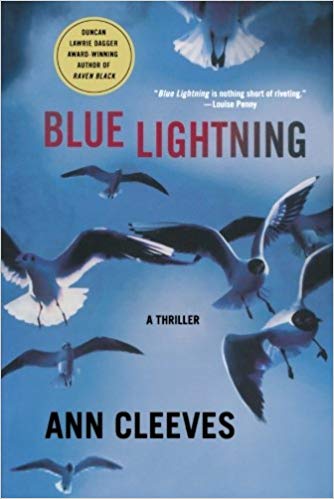
Cover for Blue LightningI started watching the Shetland television series, based on Ann Cleeves’s books, before reading the books but found that they had changed the TV series just enough to allow the books to still surprise (or vice versa). Unfortunately, however, I accidentally read one of the later books before this one, so I knew about a key plot point going in.

Inspector Jimmy Perez takes his fiancée, Fran, home to Fair Isle to meet his parents. A storm comes in shortly after their arrival, making the island inaccessible. So, although he is supposed to be on vacation, when Angela, the scientist at the island bird research center, is found murdered, Jimmy must begin working the case by himself.

He finds that Angela, although married to the site administrator, Maurice, was quite free with her favors, especially to younger, fit men. That would seem to make Maurice a suspect, but he doesn’t appear to care. Further, Angela was not well liked, being arrogant and rude to most people. The night of her murder, she had a big fight with her stepdaughter, Poppy.

Jimmy’s team and the Fiscal finally make it over to the island, but they have only been there a short time when Jane, the cook at the research center, is also found dead. Jimmy thinks she must have found out or witnessed something.

As usual, Cleeves keeps us guessing. I thought I knew who the murderer was through most of the novel only to be wrong about that and the motive. There is a shocking event toward the end of the novel. I couldn’t judge its effect, because that was the thing I knew about.

Related Posts

Raven Black

Red Bones

White Nights

Review 1360: Abide with Me

Cover for Abide with MeElizabeth Strout is known for her compassionate explorations of true-to-life characters. Set in the late 1950’s, Abide with Me explores the states of mind of Tyler Caskey, a troubled minister, and his congregation.

Tyler is in mourning for his wife, who passed away from cancer. His mother has insisted on caring for his youngest daughter, Jeanne, while his five-year-old daughter, Katherine, lives with him.

Tyler is afraid he has lost his relationship with God. He is performing his duties without joy or inspiration. Katherine is having troubles in Kindergarten, because her teacher can’t understand that she is grieving. Aside from this, Tyler only feels comfortable talking to his housekeeper, Connie, and rumors are beginning to go around.

Misunderstandings divide the minister from his congregation. Strout builds tension as the pressures upon the minister build.

This is another insightful and touching novel by Strout. In some ways, it reminded me of Gilead by Marilynne Robinson, except that it doesn’t require as much erudition to understand it.

Related Posts

My Name Is Lucy Barton

Anything Is Possible

Gilead

Review 1359: Go to My Grave

Cover for Go to My GraveDonna Weaver and her mother have invested everything in The Breakers, a large house on the Galloway coast that they have made available as either a self-catered or fully catered vacation rental. Donna is excitedly awaiting their first guests, an anniversary party of cousins and their spouses, while her mother attends a hospitality convention.

When the guests arrive, however, it becomes clear that they have all been there before. Twenty-five years ago, they attended a 16th birthday party for Sasha, the man whose wife, Kim, has planned this trip.

The reactions of the guests when they recognize the house make it clear that they do not relish memories of this party. Then, shortly after they arrive, things begin appearing in the house that hearken back to that occasion. What is happening in the house? Is one of the guests trying to gaslight the others?

Occasionally, we see flashbacks to 1991, when a 14-year-old local girl named Carmen is invited to the party. When she arrives, she brings along her 12-year-old sister.

This novel is truly riveting, although the answer to what is happening seems a little too contrived. Although McPherson is known for her “cozy” thrillers, this one is probably more accurately described as a modern gothic thriller. The ending to it is a bizarre mixture of cozy and chilling. I didn’t know quite what to think of it, but the best term I can come up with is “morally challenged.” We are presented with an ambiguous conclusion to tone down the ending, but I know very well what I think happened.

Related Posts

The Day She Died

House. Tree. Person

As She Left It

Review 1358: Literary Wives! A Separation

Today is another review for the Literary Wives blogging club, in which we discuss the depiction of wives in fiction. If you have read the book, please participate by leaving comments on any of our blogs. Be sure to read the reviews and comments of the other wives!

Emily of The Bookshelf of Emily J.
Eva of Paperback Princess
Lynn of Smoke and Mirrors
Naomi of Consumed By Ink

* * *

The unnamed narrator of A Separation receives a call from her mother-in-law, Isabella. Isabella has been trying to contact her son Christopher, the narrator’s husband, and demands to know where he is. What Isabella doesn’t know is that the narrator has been separated from Christopher for six months because of his infidelities. She has promised him to tell no one, which has become awkward because for three months she has been living with another man, Yvan.

Isabella can’t believe the narrator doesn’t know where Christopher is. His mother has traced him to a hotel in rural southern Greece and demands that the narrator go there to find out what is going on. For some reason, Isabella is alarmed.

The narrator makes some inexplicable decisions during this novel, almost as though she is obeying instinct rather than thinking. The first one is in not telling Isabella that she and Christopher are separated. The second is in actually doing what Isabella asks.

When she arrives at the hotel, she finds that Christopher is indeed staying there, researching a book on death rituals. However, he has been away for a few days. The narrator decides to wait for his return. Soon, something happens that forces her to re-evaluate her relationship with Christopher.

This novel is a carefully observed work about the complexities of marriage, love, betrayal, and loss. As the narrator, with her secret, is forced more and more back into the role of wife, she uncovers feelings about her husband that she didn’t know she had. Although a fairly simple story plotwise, the novel delves into the layers beneath the facades of marriage. This is a much more intelligent, sophisticated look at marriage than we have yet read in this club.

What does this book say about wives or about the experience of being a wife?

This novel is one of the most complex and true-to-life that we have read for this club, while not really looking at what the marriage was like while the couple were still together. Even though the narrator considers her marriage over, and in fact, goes to Greece planning to ask for a divorce, she finds that the bonds of marriage affect her more strongly than she would have guessed. She finds herself forced back into the role of wife, for example, experiencing the dichotomy of having to make decisions she doesn’t feel she has the right to. The situation forces her to re-evaluate her relation to Christopher and his family. She is bound in ways she didn’t expect.

Literary Wives logoEven though Christopher was the one who strayed and her relationship with Yvan didn’t begin until after they separated., she feels she has betrayed him in some way through that relationship.

I wonder about Kitamura’s decision to make the narrator the only unnamed character in the novel. I have only seen this device used a couple of times, and I can only put a name to one of them now, Daphne du Maurier’s shy, self-effacing narrator in Rebecca. Surely the reason that Kitamura used this device is not the same. Of course, the novel is narrated in first person, and we don’t think of ourselves by our names. Still, no one calls her by her name, either. Perhaps Kitamura uses the device because in some ways the narrator seems to be functioning blindly and is at times an unreliable narrator because she is unaware of her own motivation. I wonder if anyone else has an insight into this.

Related Posts

Stay With Me

After You’d Gone

First Love


Review 1357: Memories: From Moscow to the Black Sea

In the early 20th century, Teffi was Russia’s most famous writer, a journalist, short story writer, and playwright. In 1918, after the October Revolution, an impresario persuaded her to travel to Odessa along with a troupe of actors and other performers to give some readings. She ended up four years later in Paris, where she lived the rest of her life. This book relates the beginning of her journey.

The dangers of revolutionary Moscow convinced her to leave, but she never meant the move to be more than temporary. People had been disappearing from the city, and it wasn’t clear whether they left voluntarily, were killed, or were deported to Siberia.

The journey to Odessa was harrowing. Conditions were chaotic. At one stop in Ukraine, only their status as performers saved them from the authorities, who were murdering train passengers to take their valuables.

In Odessa, Teffi found almost a holiday atmosphere, meeting some of the people who had disappeared from Moscow. Soon, though, everyone was panicking at the approach of the Bolshevik army.

This book is written in a lively, quirky style with a great deal of humor. Although Teffi herself is sometimes naive, she observes events with a satirical eye. Yet, at times, she is lyrical in her longing for her homeland.

I put this book on my Classics Club list because I was unfamiliar with it and it sounded interesting. Then it came up for my Classics Club Spin. I am glad to have read it. I am interested in Russia, and it gives a much more accurate idea of the effects of the Russian revolution than books like A Gentleman in Moscow.

Related Posts

Diaries 1907-1914: Prodigious Youth

The Revolution of Marina M.

A Gentleman in Moscow

Review 1356: The Ides of April

Cover for The Ides of AprilFor a long time, I followed Lindsey Davis’s Marcus Didius Falco mystery series set in Ancient Rome. Davis knows her period, and the books are amusing, but after a while I got tired of them. A few friends have recommended her newer Flavia Alba series, so when I found the first one at the library, I decided to try it.

Flavia Alba is the daughter of Marcus Didius Falco and Helena Justina, who adopted her as an abandoned and wild fifteen-year-old in Britain on one of their cases. Hence, I was vaguely aware of her in some of the Falco books. At the beginning of The Ides of April, she is a young widow who has become an enforcer in her adoptive father’s footsteps.

As a female enforcer, she doesn’t get the best cases. She is trying to get her client, Salvidia, off the hook in a lawsuit against her company for running down a young boy. The aedile, Manlius Faustus, has advertised for witnesses to the accident, so she goes to his office to find out if anyone has left a statement. At the office, she encounters two key characters, Tiberius, who works for the aedile, and Andronicus, an archivist, with whom she begins a flirtation.

Flavia Alba’s case very soon becomes more sinister as she learns that her client, Salvidia, is dead of no apparent cause. A visit to the undertaker leads her to understand that a lot of healthy people are dying for no apparent reason. She begins investigating these deaths despite being warned off by the aedile’s office, but soon she is working with them in the person of Tiberius.

Unfortunately, although I enjoyed this book in some ways, there was nothing new here. Flavia Alba’s jaunty, flippant first person sounds exactly like Falco’s. Davis avoids too much repetition by hardly mentioning Flavia Alba’s parents, even when she goes to visit them, but by then I would have been happy to meet them again.

As to the mystery, there is one character with a hidden identity that was obvious to me, and I was onto the murderer fairly quickly, at least mistrusting this character almost immediately. The story arc is very similar to Davis’s first book, Silver Pigs, in that the main character encounters someone who may be a future love interest.

So, for me anyway, been there, done that.

Related Posts

Alexandria

Master & God

Pompeii

Review 1355: Transcription

Cover for TranscriptionBest of Ten!
Things are not always what they seem in Transcription, Kate Atkinson’s latest novel, but it isn’t until the last pages of the book that you understand what’s going on. For this novel, Atkinson returns to the time period that was so fruitful for her last two, World War II.

Juliet Armstrong hearkens back to 1940, when she becomes, at 18, a transcriptionist for a team in MI5 that is bugging the meetings of Fascist sympathizers acting as fifth columnists. She is at once extremely naive yet clever and prone to lying. She has a crush on her handsome boss, Perry Gibbons, and does not understand that he is using her as a beard. The team’s work centers on Godfrey Toby, who has infiltrated a group of Nazi sympathizers.

In 1950, Juliet is working for BBC radio on a children’s show, but she occasionally harbors refugees from Communist Europe for her old bosses. One day, she spots Mr. Toby in the park, and he pretends not to know her. Later, she receives a note that says, “You will pay for what you did.” She fears that her life during the war is catching up with her.

Transcription seems much more straightforward than Atkinson’s last two books, but Atkinson always has something up her sleeve. The last few pages turn the novel on its head, but getting there is a pleasure. Atkinson finds some sly humor in the mundanity and ineptness of the spying operation and entertains us with Juliet’s amusing turn of thought and exactness of expression. I loved this book.

Related Posts

A God in Ruins

Life After Life

Started Early, Took My Dog

Review 1354: Weekend at Thrackley

Cover for Weekend at ThrackleyOccasionally, I have been reading the British Library Crime Classics published by Poison Pen Press, so I was delighted to find one on the shelves of my local library. I had not heard of the author, Alan Melville, but I was pleased to find the novel one of the most enjoyable of this series that I have read so far.

Jim Henderson isn’t getting ahead in life, but he’s doing it cheerfully. He has a room in a rather seedy rooming house, but he likes his landlady. He hasn’t been able to find a job in years, but he has managed to keep his membership to his club.

One morning, he gets an unexpected invitation from an Edwin Carson, who claims to have known him as a child, for a weekend at his country house, Thrackley. Jim knows nothing about Carson, but when he visits his friend Freddie Upton to borrow evening clothes, he finds that Freddie is invited, too. Freddie tells him that Carson is a jewel collector with an amazing collection, and he has asked him to bring the Upton diamonds so that he can look at them. That doesn’t explain why Jim has been invited, however.

Before the two men arrive at the house, Freddie knocks over a charming girl on a bicycle. That girl, Mary, turns out to be Carson’s ward. Jim thinks things are looking up.

When the men arrive at the house, Jim is even more perplexed about why he is invited. The four other guests have only one thing in common: they all own famous jewels. Jim does not.

The house itself, although luxuriously and tastefully finished, is gloomy and built like a fortress. Jim soon finds that both his room and Freddie’s have been bugged. Just what is Carson up to?

This novel has an engaging hero and is written in a pleasantly jaunty style. It also has some witty dialogue. As is common in the genre, Carson’s plots are ridiculously complicated, and the chapter at the end where the police inspector explains everything seems unnecessary. All in all, though, I enjoyed this light novel.

Related Posts

The Red House Mystery

The White Cottage Mystery

The Iron Clew