Review 1354: Weekend at Thrackley

Cover for Weekend at ThrackleyOccasionally, I have been reading the British Library Crime Classics published by Poison Pen Press, so I was delighted to find one on the shelves of my local library. I had not heard of the author, Alan Melville, but I was pleased to find the novel one of the most enjoyable of this series that I have read so far.

Jim Henderson isn’t getting ahead in life, but he’s doing it cheerfully. He has a room in a rather seedy rooming house, but he likes his landlady. He hasn’t been able to find a job in years, but he has managed to keep his membership to his club.

One morning, he gets an unexpected invitation from an Edwin Carson, who claims to have known him as a child, for a weekend at his country house, Thrackley. Jim knows nothing about Carson, but when he visits his friend Freddie Upton to borrow evening clothes, he finds that Freddie is invited, too. Freddie tells him that Carson is a jewel collector with an amazing collection, and he has asked him to bring the Upton diamonds so that he can look at them. That doesn’t explain why Jim has been invited, however.

Before the two men arrive at the house, Freddie knocks over a charming girl on a bicycle. That girl, Mary, turns out to be Carson’s ward. Jim thinks things are looking up.

When the men arrive at the house, Jim is even more perplexed about why he is invited. The four other guests have only one thing in common: they all own famous jewels. Jim does not.

The house itself, although luxuriously and tastefully finished, is gloomy and built like a fortress. Jim soon finds that both his room and Freddie’s have been bugged. Just what is Carson up to?

This novel has an engaging hero and is written in a pleasantly jaunty style. It also has some witty dialogue. As is common in the genre, Carson’s plots are ridiculously complicated, and the chapter at the end where the police inspector explains everything seems unnecessary. All in all, though, I enjoyed this light novel.

Related Posts

The Red House Mystery

The White Cottage Mystery

The Iron Clew


Review 1353: There There

Cover for There ThereThere There is about the life of urban Native Americans. Set in Oakland, it follows numerous characters who plan to attend a powwow. However, we know from the beginning of the novel that some men are planning to rob the powwow.

The novel begins with a Prologue about depictions of Native Americans in popular culture. Then we meet Tony Loneman, a low-level drug dealer who is being compelled by his contacts to help them rob the powwow. Tony was born with fetal alcohol syndrome, so his thinking processes are not great, but when he puts on his regalia to attend the powwow, he sees a dancer in the mirror.

Dene Oxendene makes a presentation to a grant committee to get funding for a project to record the stories of Oakland Native Americans. The powwow is a good place to find them, and it’s not hard to image that Dene is Orange himself.

Next, we meet Opal Viola Victoria Bear Shield as a child in the late sixties, taken by her mother to occupy Alcatraz. With her is her sister Jacquie Red Feather, who is raped by a boy named Harvey. In the present day, Opal doesn’t plan to attend the powwow until she learns that her great nephew, Orvil Red Feather, plans to dance. Ultimately, Opal’s entire family, including Jacquie and Jacquie’s children, ends up at the powwow.

Another important character is Edwin Black, a young man who has spent his time since college trolling the internet and gaining weight. When he finds out that his father, Harvey, is a powwow emcee, he gets a job helping organize the powwow.

Although this novel is an angry one, it at least has a hopeful ending. However, it was marred for me by the promise of violence. Of course, that was the way to lend it suspense, but I had the same reaction to it as I did as soon as I saw the gun in Thelma and Louise. Although these people have a tough life, there isn’t any gun violence in it (although there is domestic violence) except for this plot device. I wish Orange had found a different way to hold his stories together.

Related Posts

A Brief History of Seven Killings

Telegraph Avenue

LaRose

Review 1352: Solace

Cover for SolaceSolace examines with intelligence and compassion a difficult relationship between father and son. This relationship is eventually made more complex by grief.

Mark Casey is a graduate student writing his Ph.D. dissertation in English literature at Trinity. He feels as if his father, Tom, expects his help on the farm too often. His presence at the farm is brokered by his mother, who barely lets a day go by after he has left before she is asking when he’ll be back. Mark has no interest in running the farm, however, even though his work on his dissertation is faltering.

Tom Casey thinks Mark was born to work the farm. Although Mark was interested in helping as a youngster, his interests began changing when he became a young man. Tom does not understand Mark’s choice of a profession and makes it clear that he thinks Mark will eventually choose to return to the farm. When they are together, they are soon arguing.

Then Mark meets Joanne Lynch at a party, and they begin dating. By rights, he should already know her, because she grew up not ten minutes down the road from home. However, since they were both young, his father has had a feud with Joanne’s, which has not ended with Brian Lynch’s death. The situation between Mark and Tom becomes more complicated when Joanne finds she is pregnant after they’ve only been dating a few weeks.

This novel shows insight into a difficult relationship, how both father and son say things they don’t mean while being unable to say what they do mean. Then their relationship is tested further through tragedy.

This is an interesting, empathetic novel about ordinary lives that I read for my James Tait Black project. It is touching and true to life and provides no easy answers for its characters.

Related Posts

& Sons

The Sea

Gilead

Review 1351: Taken at the Flood

Cover for Taken at the FloodHercule Poirot is the interested listener to the club bore one evening in 1944. Major Porter tells the story of a widow who went on to marry Gordon Cloade, a wealthy man. Mr. Cloade was recently killed in the blitz, but Porter’s story is about Mrs. Cloade’s previous husband, Captain Underhay. Underhay reportedly made remarks to the effect that if he was reported dead, he may not be. Instead, he might return to his widow under the name Enoch Arden, a reference to a poem. Later, he was reported dead in Africa.

Two years later, Poirot is consulted by another Mrs. Cloade, the sister-in-law of the woman from the story. She wants Poirot to find Robert Underhay, whom she believes may be alive. She presents this request as a favor to Rosaleen Cloade, the widow of Gordon Cloade, but in fact, the Cloades, who were taught to depend on Gordon financially, were disinherited by Rosaleen when Gordon died intestate. If Robert Underhay can be found to be alive, Rosaleen’s marriage to Gordon will be nullified, to the benefit of the rest of the Cloades. Two days later, Poirot reads that a man named Enoch Arden was found dead in Warmsley Vale, the home of the Cloades.

Who killed Enoch Arden? It seems that the only people with a motive are Rosaleen Cloade and her brother, David Hunter, assuming Enoch Arden was Captain Underhay. But was he?

This is a complicated mystery and not one of Christie’s best. Her talent for portraying characters is lacking in this novel, as many of them seem flat.  It also seems unlikely that anyone would ever guess the culprit, so few clues point in that direction.

Related Posts

Appointment with Death

At Bertram’s Hotel

Death on the Nile

Review 1350: Nine Perfect Strangers

Cover for Nine Perfect StrangersLiane Moriarty must be reading Carl Hiaasen or something. Her works have changed from being domestic thrillers to almost a satire of the genre. In the latest, it was difficult to get too worried about the characters.

Frances is a romance novelist who has just received her first turn-down of her latest book, after a long career. She has also read a nasty review of one of her older books. Finally, she’s been the victim of a romantic scam. To recover, she signs up for a 10-day cleanse at a health spa.

Masha, the charismatic owner of the spa, is trying out some new techniques on her clients. A powerful executive ten years ago, she changed her life after a stroke and took up the health field with all the determination she showed in her previous life. Only now, she wants her clients to have an experience that will permanently change their lives.

For about half this novel, I wondered where the heck it was going. It seemed more comic than anything else. Masha is a marvelous egoist, but it was also hard to take most of the other characters seriously.

When the novel finally started getting somewhere, the whole idea just seemed kind of silly, as does the section where the characters inadvertently take some illegal drugs, well, not exactly inadvertently, and we have to observe their silly thought processes.

A hmmm for this one.

Related Posts

The Husband’s Secret

What Alice Forgot

The Hynotist’s Love Story

Review 1349: I Took the Moon for a Walk

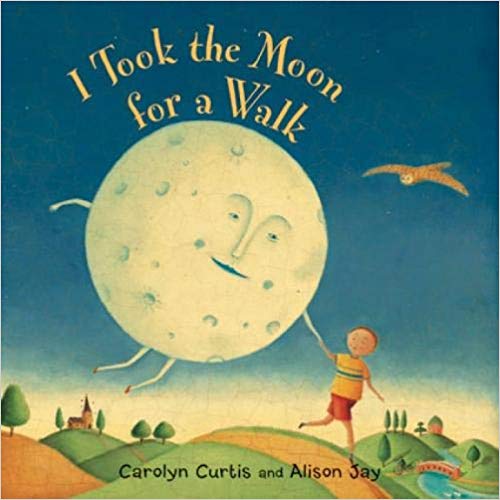
Cover for I Took the Moon for a WalkI Took the Moon for a Walk is an adorable book with beautiful, retro illustrations for preschool children or early readers. A little boy takes the moon for a walk, helping it over church spires and so on, until it is time for bed.

I bought this book for my great nephew, because I was struck by the gorgeous illustrations, but the text is nice as well. A lovely book.

The last couple of pages, after the story is finished, include information about the moon, what it’s made of and its phases, and about animals that are out at night.

picture from the book
The moon got scared . . .

Review 1348: The Ukrainian and Russian Notebooks

Cover for The Ukrainian and Russian NotebooksFor anyone who has not followed recent Russian history very closely, The Ukrainian and Russian Notebooks are eye openers. Drawn and written by acclaimed Italian graphic artist Igort, they are the result of two years he spent traveling in the Ukraine and Russia listening to people’s stories.

The Ukrainian Notebook focuses on the Stalin-era Holodomor. This was a government-caused famine imposed on the Kulaks—the Ukrainian farmers who owned their own land—to force them into collectivization. At the time, Ukraine was a rich agricultural region, but by the time the Soviets had finished, millions had starved or been deported to Siberia and the land was a desert. The notebooks tell some stories of the survivors as well as stories about the modern effects on the country.

The Russian Notebook focuses on state-sponsored assassinations, rapes, and kidnappings that are going on under Putin. In particular, it starts with the murder of human rights activist Anna Politkovskaya and her attempts to help the Chechens. Then it goes on to explore the cause of the Chechens.

Finally, the book ends with an epilogue about the more current situation in Ukraine and the Russian “mandate” to take it back.

Since my husband and I are interested in Russia, these notebooks didn’t surprise us, but they may surprise people who are less aware of the recent history of Russia. Igort has written about a lot of other subjects, but his drawing style particularly suits this one.

One small comment about the cartoons. The text is translated, I assume from Italian, and very well done. The text in the illustrations, however, has an occasional typo, and the transliterations of some words from the Russian alphabet are nonstandard with Russian typos, too. For example, on one page, the Russian word “gazetta,” or magazine, is written with the character for “n” instead of “g.” This is a quibble, however, for what is a pair of effective and shocking graphic novels.

Related Posts

Maus I

Snowdrops

The Revolution of Marina M.

Review 1347: A Place Beyond Courage

Cover for A Place Beyond CourageIn 12th century England, John FitzGilbert is the marshal for King Henry. He is an astute politician and a masterful organizer. FitzGilbert’s comfortable position is threatened, however, after Henry’s death. Henry has made all of his men pledge fealty to his daughter, Matilda, upon the event of his death, but he does not affirm his successor before his death. Many of Henry’s men prefer to follow Stephen, Henry’s likable nephew, after his death rather than recognize Matilda as queen or even as regent for her young son, Henry. The result is the period of English history called the Anarchy.

At first, John throws in his fortunes with Stephen, but he eventually recognizes that Stephen is a weak ruler, too swayed by his closest advisers. In particular, Stephen fails to reward John for his successes in battle. So, John switches sides to Matilda, along with other discontented men.

John is also unhappy in his marriage. He married Aline, his innocent young ward. Aline is painfully shy and seems totally unsuited for her position. She takes little interest in anything but the church.

A Place Beyond Courage is moderately interesting, but I feel it suffers from a trait common to historical fiction about actual characters. It tries to follow too faithfully the events of FitzGilbert’s life, resulting in a series of brief scenes instead of a more integrated novel.

Chadwick has also taken a character historically reviled because he gave his son over as a hostage with a famous speech that boils down to “There can be more where that came from” and depicted him sympathetically. Whether he deserves this treatment is questionable. Chadwick says he is know to have been gentle with women and children, but he sets aside Aline, his wife of many years and mother of his son, a woman he married for her fortune, for Sybilla, a young, beautiful woman the marriage with whom brings peace and useful connections. To justify this, Chadwick makes Aline unfit for her position and Sybilla so eminently more suitable that in the book this relationship is telegraphed for years before they even meet. Do any of these people actually deserve how Chadwick treats them? I’m not sure. Certainly, FitzGilbert seems mostly driven by ambition to me.

Making interpretations like this is the purview of a historical novelist, certainly, but most are more cautious than this. In any case, these doubts of mine are just thoughts that occurred to me as I was reading. My main objection is how Chadwick crams 20 years of events into a long series of short, staccato scenes. Few of the characters are very fleshed out because of this approach.

Related Posts

King Hereafter

The Siege Winter

The Winter Isles

Review 1346: After You’d Gone

Cover for After You'd GoneAlice Raike takes an unplanned trip from London to North Berwick to see her family. After she arrives, she sees something horrible that makes her return immediately to London. Later that evening, her mind in an uproar, she steps off a curb into oncoming traffic and ends up in the hospital in a coma.

In vignettes shifting in time and point of view, After You’d Gone tells the story of Alice’s life and of her family’s secrets. This novel is powerful, and it had me in tears by the end. O’Farrell slowly peels off layer after layer to reveal the truths of Alice’s life.

I don’t know what else I can say about this novel except I loved it.

Related Posts

Autumn

The Rehearsal

Atonement