Review 1345: The Invited

cover for The InvitedHelen and Nate bought a piece of acreage in the New Hampshire countryside and are building their dream house, doing most of the work themselves. What they don’t know, though, is that 90 years ago, Hattie Breckenridge was hanged on their land as a witch. Since then, the property is said to be haunted, especially the nearby bog.

Next door, 14-year-old Olive resents the newcomers. Her mother ran off a few months before, and her father, Dustin, has gone off the rails a bit. He keeps renovated rooms in their house but not finishing them, telling her that her mother will love the house when she returns. Olive has been searching the bog for Hattie’s treasure, rumored to be on the neighbor’s land, something her mother had been doing before she left. Olive thinks Helen and Nate will get in the way of her finding it, so she has been stealing things from their trailer and work site, hoping to drive them away.

link to NetgalleyHelen gets interested in the story of Hattie. After she and Nate incorporate an old beam from the tree on which Hattie was hanged into their house, Helen comes to believe that Hattie is trying to tell her something.

Jennifer McMahon is known for her spooky thrillers set in New Hampshire. This one is fairly good, even though some of her others have been scarier. Although you are led to wonder about Helen’s sanity, I didn’t really doubt that there would be a ghost. More is going on in this book than that, however.

Related Posts

The Winter People

The Night Sister

Burntown

Review 1344: Minds of Winter

Cover for Minds of WinterBest Book!
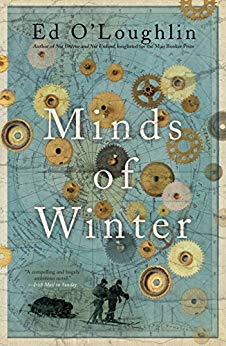
By coincidence, Fay Morgan, who has traveled to Tuktoyaktuk, within the Arctic Circle, to track down information about her missing grandfather, meets Nelson, a man whose brother Bert has also disappeared. Fay’s search has been jump-started by the discovery of an old chronometer disguised as a carriage clock. This instrument was carried into the Arctic by Commander Crozier, a member of Franklin’s ill-fated expedition of 1845. Fay remembers the clock, however, in her grandmother’s house when she was a child. Oddly, Bert Nilsson, Nelson’s brother, was investigating the disappearance of his own great-uncle, whose tracks seem to intersect with those of Hugh Morgan, Fay’s grandfather.

Mixed in with the story of Fay’s investigations is the track of the chronometer, beginning in 1841 in Van Diemen’s Land, to which the ships Terror and Erebus are lately returned from Captain Ross’s exploration of the Antarctic. They will be going to the Arctic in Sir John Franklin’s search for a Northwest Passage. With him goes Commander Crozier.

This is an absolutely riveting book, following the course of a series of polar explorations up through the years to post-World War II, and finally to the present with Fay’s search. This novel does not so much document their physical hardships but explore the state of mind that leads men to return to these harsh regions again and again. It also follows the mystery of the chronometer. What path brought it back to England after it disappeared into the Arctic? What happened to Commander Crozier, last seen traveling with an old one, a race of men known by the Inuit to have been there longer than they?

O’Loughlin has done a beautiful job of intermingling history and fiction, reality and mysticism to write this novel, an exploration in itself. This novel is wondrous.

Related Posts

The Orenda

River Thieves

Fatal Journey: The Final Expedition of Henry Hudson


Review 1343: The Expedition of Humphry Clinker

Cover for Humphry ClinkerWhen I was making up my latest Classics Club list, I looked for some 18th century fiction to add to it. The result was this peculiar novel by the Scottish author and poet, Tobias Smollett.

Smollett was known for picaresque novels, but I wouldn’t exactly call this novel that. In fact, I don’t know what to call it. The novel it reminds me most of is The Pickwick Papers,  because it is about a group of amusing people on a road trip.

Written in letter form, it starts out as a social satire. Matthew Bramble is a middle-aged hypochondriac who sets off with his family for a tour of the watering holes of England. His travelling companions are his nephew, Jeremy Melford, an Oxonian; his frippery niece, Lydia Melford; and his sister, Tabitha, who is on the hunt for a husband.

The novel begins by poking fun at the characters and the eccentric people they meet as they do the rounds of the watering holes. When they reach London, this becomes political and literary satire as well as social satire, as Jeremy visits literary salons and Matthew looks into politics.

However, the novel changes character when they travel north to Scotland. Through the polemics of a Scots lieutenant they befriend, Mr. Lismahago, we learn about the condition of the Scots peasantry and industry. These letters read almost like textbooks. Meanwhile, Smollett even introduces himself as a very minor character. Later, as the group travels south again, humor returns.

The novel is virtually plotless, the only continuing thread the fate of Lydia’s love affair with a travelling player. Humphry Clinker doesn’t even appear until 100 pages in. It was the contention of an essay I read that this novel is an example of the kind where the servant knows more than the master, but I don’t agree. Actually Humphry is pretty much an idiot.

I had a hard time finishing this novel. The humor didn’t appeal to me, nor was I enough informed about the time and place to understand some of the satire, for example, against certain literary figures who were probably recognizable at the time. The introduction calls the novel a snapshot of the whole of Britain at a time when everything was beginning to change with the onset of the Industrial Age. I have also read it is a commentary about Colonialism, but that only seems to apply to the Scottish section. I guess both of these topics might be interesting to some more informed readers.

Related Posts

The Vicar of Wakefield

Robinson Crusoe

Guy Mannering

Review 1342: The Garden of the Gods

Cover for Garden of the GodsThe Garden of the Gods is a fitting conclusion to Gerald Durrell’s Corfu Trilogy. In the book, we meet a few more eccentric characters and are treated to funny events and lush descriptions of the island of Corfu.

The centerpiece of this book is a visit to Corfu by the King of Greece. This event brings about a multitude of opportunities for incompetently executed patriotic displays.

One of the most entrancing new characters is Jeejee, a visitor from India whom Mrs. Durrell takes for royalty because of his first name, Prince. (That is, Larry sends her a letter saying that Prince Jeejee is arriving for a visit.) He is a charming person who entertains us with his attempts at levitation.

Cover for the Corfu TrilogyThe final chapters of the book deal with a typically over-the-top party that the Durrells throw for Jeejee’s birthday. All goes well until Margo’s cabaret, in which the various characters entertain the other guests with acts that include an interminable saucy sea chanty by Captain Creech and an escape act by Mr. Kralefsky and Theodore that goes badly wrong.

The trilogy is funny and entertaining. Although the first book is the source of the original Masterpiece series, the newer series is suggested by characters and events in the last two books. I think most people would enjoy these memoirs.

Related Posts

My Family and Other Animals

Birds, Beasts, and Relatives

H Is for Hawk

Review 1341: The 1965 Club! Frederica

Cover for FredericaThe Marquis of Alverstoke is known for his elegance, athletic skill, and selfishness. He never does anything that causes the least inconvenience for himself. So, when his sister, Lady Buxted, tries to persuade him to give a coming out ball for her daughter Jane, he does not hesitate to refuse. Mrs. Dauntry, his heir’s mother, hears a rumor about the ball and asks Alverstoke to include her daughter Chloë.

Then Miss Merriville comes to call. Frederica Merriville is a distant connection of Alverstoke’s who has come to London hoping to introduce her beautiful sister, Charis, to society with the object of making her a comfortable marriage. Since she has no acquaintance in London, she hopes Alverstoke can help her.

Alverstoke has little interest in helping Frederica until he sees Charis. Then he decides to throw a ball for Jane and Chloë out of maliciousness toward his sister, making it a condition that Lady Buxted sponsor Frederica and Charis. He knows that she will be furious when she meets the beautiful Charis.

Soon, Alverstoke finds himself embroiled in the affairs of the active Merriville family, which includes two younger boys—Jessamy, a serious sixteen-year-old, and Felix, a scamp of twelve. After a few weeks and several scrapes, Alverstoke realizes he hasn’t been bored in ages.

Frederica is one of the delightful novels by Georgette Heyer, a writer full of wit and a recognized expert in the period. As is frequently the case with Heyer, I found it funny and touching with a cast of amusing and likable characters.

This was a book I read for the 1965 Club. Here are some previous reviews that also qualify for the club:

Related Posts

The Convenient Marriage

Cotillion

Friday’s Child

Classics Club Spin #20!

Classics Club has announced another spin, in which we post 20 books from our Classics Club lists. On April 22, the club will pick a number, and that will determine the book we read for our spin by May 31. So, with no further ado, here is the list for my spin.

  1. The Wise Virgins by Leonard Woolf
  2. Madame de Treymes by Edith Wharton
  3. The Prince by Machievelli
  4. The Expedition of Humphry Clinker by Tobias Smollett
  5. Aurora Floyd by Mary Elizabeth Braddon
  6. This Side of Paradise by F. Scott Fitzgerald
  7. The Last of the Wine by Mary Renault
  8. Owls Do Cry by Janet Frame
  9. Mary Lavelle by Kate O’Brien
  10. Titus Andronicus by William Shakespeare
  11. The Viscounte de Bragelonne by Alexandre Dumas
  12. The Sea Hawk by Rafael Sabatini
  13. Edward II by Christopher Marlowe
  14. Mansfield Park by Jane Austen
  15. The Tenant of Wildfell Hall by Anne Brontë
  16. Kenilworth by Sir Walter Scott
  17. Oroonoko by Aphra Behn
  18. The Winged Horse by Pamela Frankau
  19. Memories: From Moscow to the Black Sea by Teffi
  20. August Folly by Angela Thirkell

Review 1340: The Word Is Murder

Cover for The Word Is MurderAnthony Horowiz does an unusual thing in his new mystery. He inserts himself into his novel as a character. It’s not just first-person narration by a fictional character, because he mentions projects he has worked on in real life.

He is approached by Daniel Hawthorne, a brusque ex-police detective, who wants Horowitz to shadow him on a case and write about it. Horowitz is hesitant at first but soon gets interested in the case.

Diana Cowper is murdered on the same day that she met with an undertaker to plan her own funeral. There may be some connection to an accident she had nearly ten years ago, in which she hit two boys with her car when they ran into the street. One was killed and the other badly injured. She has received threatening letters from Alan Godwin, the boys’ father.

Diana’s son Damian is a famous Hollywood actor who returns for his mother’s funeral. Horowitz assumes Diana’s murder is connected to the car accident, but then Damian is murdered, too.

Frankly, I was underimpressed by Horowitz’s last mystery, and I probably wouldn’t have read it if I hadn’t run across it in the library. I felt it was too concerned with the complicated plot and too little with the characters.

Right off the bat with this novel, I felt uncomfortable with Horowitz’s angle of making himself a character. I didn’t really like the narrative style.

I was really offended, though, when I realized that he kept important information that was vital to discovering the solution until the last 100 pages of the novel. That’s just plain cheating.

Horowitz has written screenplays for very good mystery shows, but his novels seem superficial and facile to me. I feel that his approach is more suited to television than to novels.

Related Posts

Magpie Murders

Moriarty

The Silkworm

Review 1339: In Pieces

Cover for In PiecesI don’t normally read celebrity biographies or memoirs or, for that matter, very many autobiographies at all, because I don’t expect them to be truthful. Or let’s just say, I expect them to leave a lot out. Also, I’m not interested in celebrities so much as literary or historical figures. That being said, I was struck by how forthcoming Sally Field seemed in an interview, so when I saw In Pieces at the library, I decided to read it.

Field talks of a lifelong battle between what she needed to do for herself and what she needed to do for other people. The roots of her problems and her lack of confidence in herself seem to lie in the sexual abuse she underwent throughout her childhood at the hands of her stepfather and her mother’s reaction when she told her. Because of that, she learned to separate herself from her emotional life and only connected with it when she was acting.

Also interesting is her struggle to get herself taken seriously after her role in The Flying Nun. This problem haunted her career, even after she took on some difficult parts.

I found this an affecting and interesting book. It is well written and involving.

Related Posts

Open: An Autobiography

Giving Up the Ghost

Wild

Review 1338: Eligible

Cover for EligibleSo far, the Austen Project, for which current writers rework Jane Austen’s novels within a modern framework, hasn’t worked for me. I have a theory that the readers who like them are reading mostly for plot, whereas I read Austen for her quick but subtle wit and her precision. Let’s face it, although humor is always in style, these days subtlety is not. Still, I thought I’d give Eligible, Curtis Sittenfeld’s reworking of Pride and Prejudice, a try.

Obviously, some of the dilemmas in the original novel are just not workable in today’s society, a problem that foundered Joanna Trollope’s reworking of Sense and Sensibility. Sittenfeld is wise enough to realize this and has made significant changes to the characters and plot.

Liz Bennett is a magazine writer who lives in New York. She and her sister, Jane, a yoga instructor, have returned to their home town, Cincinnati, to help out after Mr. Bennett’s heart attack. Their help is needed even though their three younger sisters, suffering from failure to launch, are still living at home, because they are doing nothing. Mrs. Bennett, a social climber, is too involved in running a charitable event to take her husband to his doctor’s appointments.

Jane is pushing forty, so she started in vitro fertilization before returning home. Then she meets Chip Bingley at a charity event. Jane and Chip immediately become involved, but Liz has formed a negative impression of Chip’s friend, Fitzwilliam Darcy, because of remarks she overhears at a party.

Liz has been involved for years with Jasper, a man she fell in love with in her early 20’s. Jasper claims he has an open marriage, and he has been seeing Liz on the side. When Jasper hears Liz has met Darcy, he hints at some misbehavior of Darcy’s when the two attended Stanford together.

Of the Austen Project novels I’ve read, this is the most successful rewrite, but the bar is fairly low. Although the dialogue is humorous, it’s not the sparkling dialogue of the original. Kitty and Lydia, for example, are almost unbelievably vulgar and poorly behaved. It’s also hard for me to believe that these days a mother would be pushing marriage after Jane and Chip have only had a few dates.

I was fairly well entertained, though, until the emphasis went to the Eligible reality show. Although I’m sure Sittenfeld had fun with her parody, that’s where I felt the novel lost steam.

Related Posts

Persuasion

Sense & Sensibility

Northanger Abbey