 The Best Book for this period is Golden Hill by Francis Spufford!
Highly recommended: Samuel Pepys: The Unequalled Self by Claire Tomalin and Brief Lives by John Aubrey.
Reviews, reviews, and more reviews

The Best Book for this period is Golden Hill by Francis Spufford!
Highly recommended: Samuel Pepys: The Unequalled Self by Claire Tomalin and Brief Lives by John Aubrey.
 Twenty years after Arundhati Roy’s transcendent The God of Small Things, she has written another work of fiction. The Ministry of Utmost Happiness deals with varied characters and sources of unrest in India, though, rather than the unhappiness of a single family.
The novel begins in roughly the 1950’s Delhi with Aftab, the only son of his Muslim family. Aftab was born a hermaphrodite, and his parents decided he would be a boy. Aftab, however, feels he is a girl, so in his teens he joins the hijras of Shahjahanabad, a group of transexuals and transvestites who are mostly sex workers. Aftab becomes Anjum.
Roy follows Anjum’s adventures for nearly half the book, during which time India is rocked by several eras of attacks on its Muslim communities. Eventually, as an older woman who feels that the affections of her adopted daughter have been lured away from her, Anjum moves away from the hijras to live in a graveyard and befriend a host of misfits.
With the appearance of a second unwanted baby, Roy’s narrative goes off in an entirely different direction, which does not seem to tie up with the previous story for some time. Instead we have the story of the friendship between Tilo, Naga, and Musa, a Christian-raised girl and two boys. Musa eventually becomes a revolutionary fighting for the freedom of Kashmir. Roy’s book is angry as she documents abuses of power by the Indian government on relatively innocent citizens who are not Hindu.
Frankly, it’s hard to know what to make of this novel, which seems to be all in pieces and has too easy of an ending. One key to it is a poem written by Tilo at the end of the novel. “How to tell a shattered story? By slowly becoming everybody. No. By slowly becoming everything.” Well, this novel feels like Roy tried to cover everything, with many characters, many forms of narration, many stories.
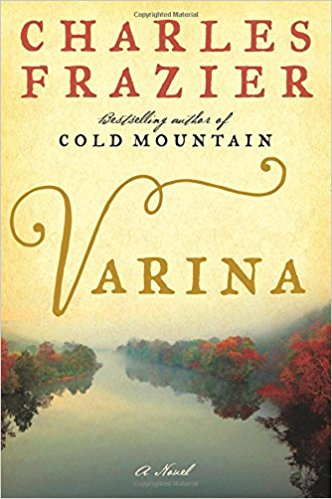 Varina is one of those books that makes me wish Goodreads allowed half stars, because it is better than the books I’ve given three stars (my okay or ho-hum rating) but it’s not quite as good as many books I’ve rated four stars. It is interesting, though, the story of Varina Davis, Jeff Davis’s young wife.
The novel begins when Varina, or V as she is called, as an old woman meets James, a young African-American boy she raised with her own children. At the time of the fall of the Confederacy, Jimmy was taken from her after she was captured.
James comes to see V because he remembers very little of that time and has read some things in a book he wants to ask her about. She is happy to see him, because all of her children have died. He is the last one left. The novel skips backward and forward through incidents in her life as she and James hold a series of conversations.
I found this novel both interesting and touching. I know very little about Jeff Davis and knew nothing of his wife. V seems to have been an unconventional and spirited woman. She led a difficult and sad life.
 At first, I really didn’t think I would enjoy What Belongs to You, which I read for my James Tait Black Fiction Prize project. One reason was its explicit sexuality, which I didn’t really find interesting.
As I read further, I didn’t like it because it is about the unnamed main character’s affair with a Bulgarian male prostitute named Mitka. I have never understood why some people believe that they can have a meaningful relationship with someone they’re paying for sex, or even more pertinently, why that is such a common theme for fiction. The novel is divided into three parts, with the first and last devoted to this relationship.
Still, it is very well written, with clean, crisp prose. I also found the second section, which is about the narrator’s relationship with his father, more interesting. I felt it explained a lot about the relationship with Mitka.
Ultimately, I was touched by this novel, even though its sexuality was so explicit that it occasionally made me uncomfortable.
 Although John Aubrey has been criticized as a historian, he was actually a collector, of documents, stories, and little bits of information. For a project in the late 17th century undertaken by Anthony Wood, he began collecting short biographies of Oxford scholars of his time but then expanded his collection to include other notables of the 16th and 17th centuries. From 426 lives, this book has collected the most significant 134, some as short as a few sentences while others are several pages long.
These lives do not necessarily list their subjects’ accomplishments, although most of them begin with a short biography included by the editors. Aubrey’s talent was for telling something about each person that defines him or her, makes the person seem more knowable, whether it be a physical description or a story about the person.
Aubrey was apparently a rather disorganized person, so sometimes we are amused by a story or comment that seems to have nothing to do with the subject. Although well written and entertaining, his lives sometimes use pronouns confusingly, so that you’re not always sure who he’s talking about.
Just as entertaining as the original subject matter is the 100-page introduction about Aubrey’s life and milieu. I have to say that he seldom says anything really negative about anyone, even if you can tell he didn’t like that person. He was plainly a good-natured man who also sometimes likes to tell bawdy stories. Centuries after his lives were written, they make a living document, bringing exceptional people back to life. I was interested to see that one of them was Venetia Digby, the main character of Hermione Eyre’s Viper Wine.
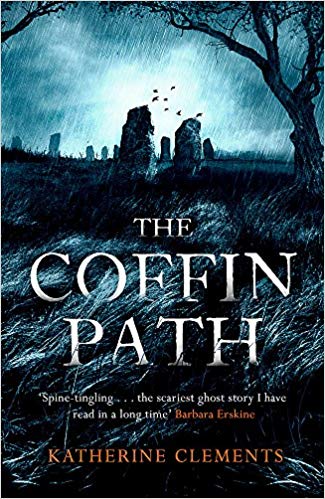 It’s 1674, and Mercy Booth helps her aging father work a sheep farm in remote northern England. She feels that at 28, she is beyond marriage, but she really only cares about the farm.
In early spring, she is out on the moor when she feels that someone is watching her with enmity. After that, strange things begin happening in the house. Three old coins disappear from her father’s drawer. She hears noises upstairs when no one seems to be there. She catches glimpses of a pale face. The home is believed to be cursed after the three prior inhabitants were all murdered, their mouths covered with those missing coins.
Early in spring the head shepherd hired Ellis Ferreby, a wandering shepherd. The novel is narrated by him in alternate chapters as he observes what is going on. He, too, has seen and heard strange things.
Also key to the story is Sam, the young son of Ambrose, the head shepherd, who lately lost his twin brother after a fall. He is a favorite of the house but begins to behave strangely.
This novel is truly atmospheric, and although I had glimpses of its secrets, I could not figure everything out. I found myself interested in the characters and involved in what was happening to them. This is a real page-turner.
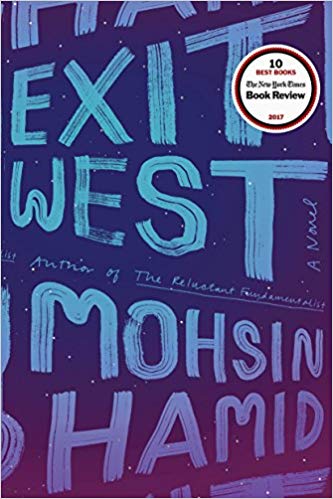 It’s difficult to describe Exit West. Part embedded in a slightly futurist reality, a small part speculative, part romantic, the novel is mostly a parable. Those of you who know me, know I don’t really like parables and I seldom appreciate magical realism, so this probably wasn’t the best choice for me, but I read it for my Man Booker Prize project.
Saeed meets Nadia in class as their unnamed city succumbs to war. They secretly see each other while a war goes on between religious fundamentalists and the government. As the situation deteriorates, Saeed’s mother is killed.
Saeed and Nadia hear rumors about doorways that can take refugees to other parts of the world, and we take a few side trips from their stories to witness people emerging in other countries. In some countries, the doors are guarded to keep the refugees safe. In others, the governments are trying to keep refugees out.
Saeed and Nadia decide to leave, but they cannot convince Saeed’s father to go with them. They eventually go, emerging first in Mykonos, where they live in a refugee camp, then in London, and finally in Marin County. Everywhere they go, they join swarms of refugees.
Hamid isn’t as interested in the grueling journeys of refugees as he is in the psychological effects of their journeys. Quiet, reflective Saeed has more difficulty adjusting than does the more adventurous Nadia.
Because this is more of a parable, though, the two main characters are mostly ciphers. We don’t really get to know them or care that much about them. Hamid’s lightning glimpses of other people’s lives open up the novel a little bit. It’s a technique similar to that used by David Mitchell, but in this novel it doesn’t work as well. Sometimes these glimpses seem to have little point, although most of them are linked to the doorways.
Aside from the timeliness of this novel (which I’m guessing is what has made it so popular especially with predictions about climate refugees to add to our current economic refugees and those fleeing violence), this novel was interesting but not altogether successful.
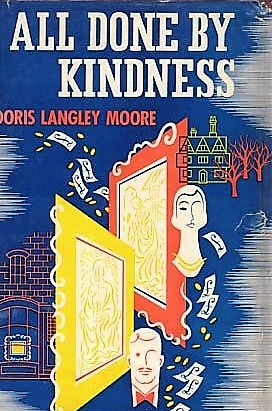 My friend Deb recommended that I read All Done by Kindness based on a post she read by Furrowed Middlebrow. Such is the power of the web, though, that by the time I looked for it, the few copies available were expensive. I had to borrow hers.
Caper books and movies were popular in the 1950’s and 60’s, and All Done by Kindness fits the description, telling the story of a crime committed with worthy motives, a light-hearted caper with a dash of romance. It begins with a visit by Dr. Sandilands to an elderly patient, Mrs. Hovenden. Mrs. Hovenden’s family has been wealthy, but since the war, Mrs. Hovenden has fallen into hard times. She tells the doctor she is badly in debt for the first time in her life.
Dr. Sandilands offers to lend her the money, even though he can hardly afford it, but Mrs. Hovenden is too proud to take it. Instead, she offers to sell him some boxes of clothes and linen from her attic, including a box of pictures. When the Sandilands family opens the boxes, the results provide Beatrix Sandilands, the doctor’s sharp-tongued daughter, with a great deal to say, for everything is either worthless to begin with or is mouldering away. About the pictures, however, daughter Linda suggests that they consult her knowledgeable fellow librarian, Stephanie du Plessis.
Stephanie thinks that the paintings might be quite valuable, even Old Masters. She does some research that indicates they may have been removed from an Italian villa. Beatrix thinks they are worthless and wants them out of her house. Finally, the family agrees to consult Sir Harry Maximer, an art expert who has the reputation for integrity.
Here, the plot thickens, for Sir Harry recognizes the paintings as Old Masters, but he tells Dr. Sandilands they are only good copies. Why? Because he intends to have them in his own collection.
This is a charming little novel, a delightful book for when you want to read something light.
 The Spy Who Came in from the Cold was the novel that made John Le Carré’s name as a master of espionage fiction. His introduction to my edition tells just how much he resented the attention he got for it. Even though it is one of his earlier books, having been published in 1963, it is one I hadn’t read.
At the beginning of the novel, Leamas watches in anger from West Berlin as his last good agent, Karl Riemeck, is shot crossing the border from East Berlin. Leamas is fairly sure, on his return to England shortly thereafter, that his career as an operator is over. Instead, he is offered a dangerous last mission. He is to appear to have been retired to a desk job, to go to pieces and lose his position and continue to go downhill with the hopes that he will be approached from the other side. The objective? To take down Mundt, a ruthless official on the other side of the wall and the man responsible for Karl’s death.
All goes according to plan, and Leamas is approached shortly after he gets out of prison for assaulting a grocer. Only, if you are familiar with Le Carré, you know that things will be much more complicated than they seem to be. And Leamas has one weakness. During his descent, he got involved with a young, naïve girl, Liz, a member of the Communist Party.
Le Carré is a master of suspense and a plotter of labyrinthine plots. In addition, his novels always have more going on in them that just action, such as raising serious issues of morality. This novel is rightfully a famous member of its genre.
Best of Ten!
It is 1746 when a mysterious young man arrives in New York and immediately goes to Lovell & Company on Golden Hill. He presents a bill for a thousand pounds, an enormous amount of money, from a trading partner of Lovell. Although the bill looks legitimate, Lovell insists on sending back to London for confirmation of the bill’s legitimacy before paying out.
Perhaps Lovell would have felt more comfortable if Richard Smith was more forthcoming, but Smith has nothing to say about who he is or what he plans to do with the money. He is, in fact, dissembling in some way, but we don’t learn how for some time.
These are uneasy days in the colonies. The governor is not popular, and he is constantly undercut by Mr. De Lancey, who has better connections. Most of the New Yorkers are very touchy about anything that seems to threaten their liberty. Smith himself is the type of person who rubs others in the wrong way. He is also hapless. Within no time, he has been robbed of almost all his money and has to subsist on a few guineas until the bill clears. At the same time, he must present a facade of wealth to all the curious New Yorkers.
On Guy Fawkes Day, he accidentally offends a gang of laborers and is rescued by the governor’s secretary, Septimus Oakeshott. They begin an uncomfortable friendship.
Finally, Smith has the misfortune to fall in love with Tabitha Lovell, a quick-witted, quick-tempered girl who seems to hate him.
The novel is written in a humorous, sprightly style, and we don’t find out who the narrator is until the last chapter. We end up with a picaresque adventure story that has a hidden purpose, and hints of more important issues.
Golden Hill is an excellent historical novel that I read for my Walter Scott prize project. It depicts the beginnings of English New York with its solid Dutch background, hints of the coming revolution, and looks at the issue of slavery. It is entirely unpredictable and highly enjoyable.
Book reviews of mainly modern & contemporary fiction
Writer and Historian
There is nothing more satisfying than reading a book while sipping a hot cup of tea.
A historical fiction book blog
Emerging as an artist
Liz Dexter muses on freelancing, reading, and running ...
For mostly adult, literary, fiction; focusing on historical, contemporary, biographical, and women.
"Well, there’s so much to read, and I’m so far behind." Wallace Stegner
Read to live and live to read
A bookish blog (mostly) about women writers of the nineteenth and twentieth centuries
A Celebration of Russian Literature
Reading: it's personal
Based in Romania, reading all over the world. Mostly fiction, some memoires and a little bit of poetry.
Adam Burgess
"Vivre le livre!"
"History is a vast early warning system." Norman Cousins
Scottish Book Blogger
"She had read novels while other people perused the Sunday papers" - Mary Elizabeth Braddon
A word after a word after a word is power. --Margaret Atwood
Books • Opera • Art • History
FOR DISCERNING READERS
Your online source for Jane Austen and her legacy
A Community of Classics Lovers
A blog about Irish books, writers, writing and everything in between.
 What? Me Read?