
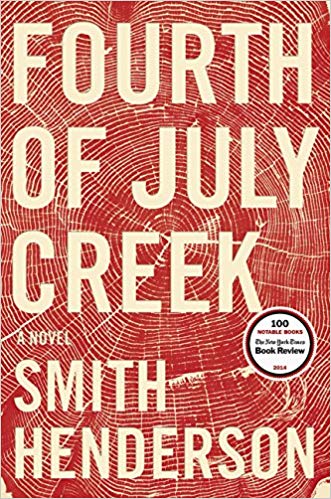
 The Best Book for this period is Fourth of July Creek by Smith Henderson!
Day 1295: Scot Free
 I’ve read almost all Catriona McPherson’s books, which up to now have fallen into two categories—her historical mystery series set in post-World War I Scotland and England featuring Dandy Gilver and her stand-alone present-day cozy thrillers, set mostly in Scotland. Scot Free is the first in a new series, the Last Ditch mysteries, featuring Lexy Campbell and set in California.
Lexy is waiting to have her last meeting with clients before she returns to Scotland. Her marriage to an American dentist has turned out to be a big mistake. She is waiting at her office for the Bombaros, who hired her as a marriage counselor to help them keep their divorce amicable. After she helps them with divorce papers, she’ll be off.
But the police arrive to question her. Mr. Bombaro is dead, having been murdered with fireworks. Elderly Vi Bombaro is the chief suspect, and Lexie is suspected of being her accomplice.
Lexie can’t believe Vi is guilty, and she is even more sure of that when Vi’s niece Sparky shows up with her new husband and a couple of thuggish business associates, and they begin taking over Mr. Bombaro’s fireworks manufacturing business. So, she decides to investigate.
Lexie has her own problems, however. She is currently homeless, and her clothes are locked in her office, the pass for which has expired. So, she checks into the Last Ditch motel and into the realm of a collection of colorful characters.
Scot Free is a funny, enjoyable novel even though McPherson signaled a little too obviously the identity of the murderer. I am a little worried, though, about the change of locale. If McPherson decided to move to the United States to appeal more to American audiences, I have to say that much more appealing to me are her Scottish settings, especially the atmospheric ones of her thrillers. The Scottish fish out of water theme can be funny, but I can imagine it getting old quickly, along with the cast of eccentric characters at the Last Ditch. For one thing, Lexie makes a lot of generalizations about Americans based on the Californians she meets, and we all know that Californians aren’t that representative of average Americans. Also, she gets at least one thing wrong. The American cop catches her in a lie because she claims that someone says “I’ve got . . . ” instead of “I have . . .” I believe that most people I know are just as likely to say it one way as the other. I noticed a few other small problems as well.
These are not very big criticisms. I just hope that McPherson doesn’t drop her moody present-day stand-alones for this series, because they are my favorite.
Related Posts
Day 1294: Birds, Beasts, and Relatives
 When I began reading this sequel to Durrell’s My Family and Other Animals, I assumed it would begin sometime after the first book, which ended with the Durrells leaving Corfu and heading back to England. Instead, it seemed to be about to cover the same ground, starting with an abbreviated account of their arrival.
 Although this novel is slightly repetitious of the previous one, briefly reintroducing some characters and summarizing important events, for the most part it covers different events and introduces new characters. We meet Larry’s friends Max and Donald when they arrive at the house, drunk, at 2 AM. We also meet the disreputable Captain Creech, and Sven, the accordian-playing sculptor. There are also old friends like Theodore and Spiro.
The book relates memorable events, such as what happens when Margo agrees to take care of Gerry’s baby hedgehogs and how the family receive a performing bear that follows Gerry home one day. Although I began the book worried that this memoir would cover too much of the same material, I ended up charmed again by the stories of this eccentric family and their stay in Corfu.
Related Posts
If I Gave the Award
 Since I just reviewed Fourth of July Creek by Smith Henderson, the last of the shortlisted novels for the 2015 James Tait Black Fiction Prize, it is time for my feature, where I give my opinion about whether they got it right or not. The 2015 list is a difficult one, because I didn’t love any of the shortlisted novels, but I thought all of them were excellent in different ways.
I read We Are Not Ourselves by Matthew Thomas the longest ago, in the same year that it was published. I recollect that, while I stayed interested in the novel, it was a long time before I was very vested in this story about a family coping with Alzheimer’s.
Fourth of July Creek was another novel with a more straightforward narrative. It focuses on people on the fringes of society in Montana. It is interesting and involving and ultimately touching as it explores the stresses upon an already fanatical man being pressured by the government.
Dear Thief by Samantha Harvey uses a more inventive approach to narrative, it being a long love/hate letter from a woman to her former best friend. While it recounts the reasons for the destruction of their friendship, it reveals how the woman yearns to see her friend again.
 Also a novel about a friendship and the winning entry, In the Light of What We Know by Zia Haider Rahman is the most ambitious of the novels and also the one least likely to appeal to some readers. It is a tour de force in narration, consisting mostly of a long series of narratives by one character on a wide variety of subjects. It is the most thought-provoking of the shortlisted books and the most difficult.
I can understand why the judges chose In the Light of What We Know, but as I think about it, I have to choose the book that I connected with most. Although I enjoyed the winning novel, I also was just on the edge of irritation with it as I read it. So, for its slightly inventive approach and the connection I felt to the material, I am picking Dear Thief with a strong nod to Fourth of July Creek.
Day 1293: Fourth of July Creek
Best Book of Five!
Pete Snow is a social worker living in a remote region of Montana in the early 1980’s. His life is slowly falling apart. He has left his wife because of her infidelity, and she soon decides to move to Texas, taking their thirteen-year-old daughter, Rachel, with her.
Pete is called to school because a ragged boy is found there. The boy is Benjamin Pearl, the son of a religious fundamentalist who thinks the feds are after him. In trying to help the boy, Pete slowly begins to learn the forces that have made Jeremiah Pearl so distrustful.
The world Henderson depicts is a rough one and it seemed at times to be filled with lowlifes. Nevertheless, Henderson draws you into his universe and makes you understand these people. Although this novel is at times harrowing, it is also touching and compassionate. I read it for my James Tait Black project and really enjoyed it.
Related Posts
Day 1292: The Silence of the Girls
 Fictionalizing ancient stories and myths seems to be popular now. I have read a few of these novels, including The Song of Achilles, Madeline Miller’s novel about the Trojan War. That novel focused on the relationship between Achilles and Patroclus. Although The Silence of the Girls is also partially about them, it is from a point of view heretofore unexamined, that of the Trojan women taken as slaves by the Greeks during the war. It is narrated mostly by Briseis.
Depending upon how well you know your Iliad, you may remember that Briseis is the woman awarded to Achilles who is later taken away by Agamemnon when he is forced to give up Chryseis. It is Achilles’s forced forfeiture of Briseis that leads him to sulk in his tent while the other Greeks are being slaughtered.
The novel begins with the fall of the Trojan city Lyrnessus, of which Briseis is the young queen. Achilles is called “the butcher” by the Trojans, and the women wait in fear when the citadel falls, knowing their boys will be murdered along with the pregnant women, and girls as young as nine will be raped and enslaved. Briseis is awarded to Achilles, whom she hates and fears.
 As the story of the war progresses, Barker builds a nuanced portrait of Achilles, his anger at Agamemnon, his Oedipal relationship with his goddess mother Thetis, his friendship with Patroclus. Although Achilles is not a sympathetic character, Briseis eventually becomes conflicted about him.
This is an interesting and affecting novel. It is completely unlike the only other novel I have read by Barker, but it makes me want to continue seeking out her books.
Related Posts
Day 1291: Through the Looking Glass: Further Adventures in the Realm of Children’s Literature
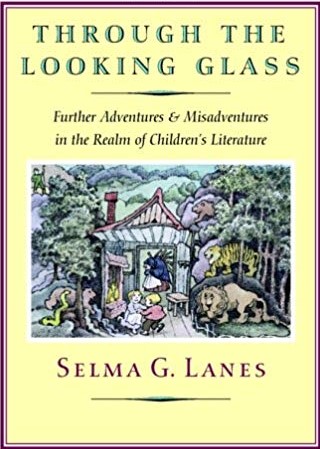 This book sounded interesting to me, but I did not realize it was a collection of Selma G. Lanes’s essays on various topics related to children’s literature. Lanes herself was a writer about children’s literature, as well as an editor, critic, and essayist. Although Lanes writes in the introduction about the tendency for publishers to look for marketable books rather than good ones, the essays largely deal with a more congenial time for children’s literature, the 1970’s.
This collection includes reviews, obituaries, and opinion pieces on such topics as whether children’s books are literature, what constitutes a great children’s book, and whether the pursuit of political correctness can go too far. These topics are interesting, but because most of the essays are from the 1970’s, some of them seem dated. Lanes also is nostalgic for the works of an earlier time, many of which I’m not familiar with.
A final essay about J. K. Rowling written in 2004 brings us more up to date as does the introduction. Still, a reader looking for good reading for a child (and sometimes an adult) can get some ideas, albeit older ones, from this book.
Related Posts
By a Woman’s Hand: Illustrators of the Golden Age
Neverland: J. M. Barrie, the Du Mauriers, and the Dark Side of Peter Pan
Best Book of Five!
 This period’s Best Book is The Clockmaker’s Daughter by Kate Morton! Also recommended is In the Light of What We Know by Zia Haider Rahman!
Day 1290: Literary Wives! The Stars Are Fire
 Today is another review for the Literary Wives blogging club, in which we discuss the depiction of wives in fiction. If you have read the book, please participate by leaving comments on any of our blogs. Be sure to read the reviews and comments of the other wives!
Emily of The Bookshelf of Emily J.
Eva of Paperback Princess
Lynn of Smoke and Mirrors
Naomi of Consumed By Ink
* * *
After a winter that seemed like it would never end, the autumn in Maine of October 1947 is in severe drought. Grace Holland is pregnant and the mother of two small children. She feels that her marriage is in jeopardy. Her husband, Gene, never loving or communicative, has barely spoken to her since his mother died. Soon, though, she has the very existence of her family to worry about as fires threaten their small beach community.
Grace is able to save her children and her neighbor’s family, but Gene, who went out to fight the fire, doesn’t return. Everything she owned is gone, so now Grace must learn to live an entirely different life.
Anita Shreve knows how to tell a story, and this one drew me right in. Her characters are vibrant and believable. A few of her books have brought me to tears. This is not one of them, but it is still an absorbing novel to read.
What does this novel say about wives or the experience of being a wife?
At the beginning of the novel, Grace’s life as a wife is one of loneliness. Her husband barely speaks to her or touches her. We get the feeling he blames her, as does his mother, for getting pregnant so that he had to marry her. Left all day without a car, she can walk to shop, see her mother, or visit her girlfriend, Rosie. In her own house, however, she is treated as someone to keep the house, care for the kids, and occasionally provide sex.
Spoilers ahead . . . . Sorry, they’re unavoidable.
After she learns independence when Gene disappears during the fire, her marriage changes with his return. Now, he begins to behave with the more classic traits of an abusive husband. He speaks to her cruelly, tries to isolate her in their home, and eventually becomes threatening and physically abusive. Since the fire, Grace has had to learn to survive, and she has to figure out how to do that in an abusive marriage.
Related Posts
Day 1289: The Clockmaker’s Daughter
Best Book of Five!
The first character we meet in The Clockmaker’s Daughter is the ghost of the clockmaker’s daughter. Although she used the name Lily Millington, we don’t find out her true name, or why she haunts Birchwood Manor, until the end of the novel.
The novel begins in the present, though, with Elodie, an archivist. She is about to be married, but she is having trouble concentrating on the wedding. That is because, in going through the archive of James W. Stratton, a philanthropist, she has found the belongings of a Victorian artist, Edward Radcliffe, in particular, a sketchbook. This discovery is of interest because inside it is a picture that she realizes is of a house from a children’s story handed down in her own family.
While Elodie begins exploring this link between Radcliffe and her family, we slowly hear the stories of Lily Millington, of a beloved house, and of a long-lost family heirloom. We also learn the stories of a series of inhabitants of the house.
Although I love a good ghost story, I wasn’t sure whether I would appreciate the ghost being one of the narrators. And this is not a traditional ghost story, for the ghost is not one that frightens. Kate Morton is a masterful storyteller, however, so that I was engrossed as always. Although this is not my favorite book by Morton, which still remains The Forgotten Garden, I really enjoyed it.
 What? Me Read?