
 The Best Book for this period is The Forty Days of Musa Dagh by Franz Werfel!
Day 1280: The Last White Rose: The Secret Wars of the Tudors
 I’ve read a couple of histories by Desmond Seward now, one of which, The Wars of the Roses, did a much better job of explaining the complications of those wars than any other book I’ve read. In The Last White Rose, Seward details the attempts by the first two Tudor kings, Henry VII and Henry VIII, to wipe out the Plantagenet line.
Real or imagined conspiracies against the Tudors haunted the reigns of both these kings. At first, those conspiracies that actually existed had their roots in Henry VII’s very tenuous claim on the throne. There were still plenty of Yorkists around, and some of them had much better claims. It was Henry VII’s knowledge of these plots that led him to construct a complex web of spies for the state. Later, his growing paranoia led him to execute young Warwick, whose only crime was his birth.
Although Henry VIII continued his father’s policy of stamping out conspiracies, as he grew older and more erratic, he conducted a reign of terror. Courtiers were charged for slight errors or none at all. Henry succeeded in killing off almost every person with Plantagenet blood. His paranoia was manipulated by Thomas Cromwell, who invented conspiracies to rid himself or Henry of enemies.
Seward could be writing novels, his style is so easy to read and interesting. Although he introduces many players, he is somehow able to interest readers in all their fates. I found this another fascinating book about this period.
Related Posts
Richard III: England’s Black Legend
Day 1279: Harriet
 Harriet is a novel written in 1934 based on a true crime that occurred in 1875. As such, it is suitable for the season as well as for the R. I. P. Challenge and the Classics Club Dare.
Harriet is a woman in her 30’s who has her own fortune of £3,000 with prospects of 2,000 more. She is a “natural,” which I take to mean having some sort of mental incapacity. Although her mother, Mrs. Ogilvie, cares about her, she boards her periodically with poorer relatives, allowing them to make a little money and giving herself and her husband a little break from Harriet, who can be difficult.
Mrs. Ogilvy sends Harriet to stay with her cousin, Mrs. Hoppner. Mrs. Hoppner lives with her spoiled daughter, Alice. Visiting her are her older daughter, Elizabeth, and Elizabeth’s husband, Patrick Oman, an artist. Also visiting is Patrick’s brother, Lewis, a clerk. Patrick and Elizabeth are devoted to Lewis.
Although the charismatic Lewis is courting the delicate and beautiful Alice, he turns his attention to Harriet. He is soon engaged to her and marries her despite Mrs. Ogilvie’s objections. In fact, Mrs. Ogilvie tries to get Harriet made a ward of the court to block the marriage, but this backfires when Lewis finds out and tells Harriet she wants to have her committed. Once they are married, Lewis proceeds to strip Harriet of her money and possessions.
After Harriet has a child, he boards her at his brother’s house and moves into a nearby house with Alice. Up until then, Lewis’s actions are marginally legal if morally repellent. It is after this that the behavior of the two brothers and two sisters becomes criminal.
This novel is chilling in its psychological depictions of the two sisters and brothers. Jenkins was fascinated by the case and uses people’s actual Christian names, imaging the thoughts and activities of the characters. This novel was one of the first fictionalizations of a true crime.
Related Posts
The Wicked Boy: The Mystery of a Victorian Child Murderer
The Invention of Murder: How the Victorians Reveled in Death and Detection and Created Modern Crime
The Fall of the House of Walworth: A Tale of Madness and Murder in Gilded Age America
Day 1278: The Forty Days of Musa Dagh
Best Book of Five!
In 1915, the Ottoman Empire decided to make a scapegoat of its Armenian subjects. It declared all Armenians to be subversive and began “relocating” them to the deserts of Syria. Those who did not die on the way from starvation or mistreatment starved to death upon arrival. In this way, the Turks rid themselves of 1.5 million Armenians, a fact the Turkish government still denies.
In the shadow of the mountain named Musa Dagh, the inhabitants of seven villages decided not to go. After the villages received the news that they would soon be relocated, they sneaked supplies and livestock up into the mountain. Then, the day before the evacuation, they walked up onto Musa Dagh. There, for forty days, they managed to defeat the Turkish army’s attacks until they were rescued by the French navy. Although there were casualties, more than five thousand people were rescued.
The Forty Days of Musa Dagh is considered Franz Werfel’s masterpiece—his fictional account of the event. The main character is Gabriel Bagradian, a wealthy man raised in Europe who has recently returned to this family home after the death of his older brother. He is a reserve army officer, and when he reports to the regional capital to find out why he hasn’t been called up, he hears disquieting rumors.
Back home, he consults with village leaders until the arrival of Aram Tomasian, a Protestant pastor who was relocated with his family from another village. He and his family have been allowed to travel to his father’s village, the authorities thinking it will not affect his fate. But he is able to tell the villagers what is happening during the relocations.
Gabriel has been trying to save his French wife, Juliette, and his son, Stephan. But now he proposes that the villagers ascend Musa Dagh and defend themselves. Only the followers of one church decide to cooperate with the Turks.
At 800+ pages, this novel is very long, but completely absorbing. Werfel’s characters are not heroes but complex people. The novel is suspenseful because even though we know the result for the village as a whole, we don’t know what will happen to the individual characters. The villagers have deserters, loss of their livestock, a fire in their grainery, and other hazards to navigate. I don’t know any other way to explain it but to say this. This novel is fantastic. It is absolutely what I look for in a good novel, where I can immerse myself in another world for a short while.
P. S. If you are interested in reading more about the Armenian genocide, another touching novel is Birds Without Wings by Louis de Bernières.
Related Posts
Day 1277: Fool’s Gold
 Here is another book for the R.I.P. Challenge.
* * *
Fool’s Gold by Dolores Hitchens is the last novel of my Women Crime Writers collection and my least favorite. Although several of the novels were noirish, this one is definitely in the noir style.
Skip and Eddie are two young men who have already served time in prison. Both are attending night school but have little hope of finding a job. In fact, Skip is already planning a robbery based on information he has received from Karen, a girl in his class. She has told him about a stack of money hidden in the room that Mr. Stolz, a frequent visitor to her aunt’s house, keeps in his room.
This crime is poorly planned, but things begin to go wrong before its execution, when Skip’s uncle turns it over to some professionals in exchange for a cut in the proceeds. Skip is determined that no one will deprive him of his big haul.
We are supposed to feel some sympathy for Eddie, who would like to go straight. Skip is the one with the big ideas, who moreover is inclined to abuse Karen. But Eddie is too easily led to feel much sympathy for, and Karen is an outright idiot.
Most of the rest of the characters are despicable, and we watch as everything goes badly wrong.
Related Posts
Day 1276: The Haunted Hotel
 Wilkie Collins’s The Haunted Hotel was the spooky book I read for the Classics Club Dare that will also do for the R.I.P. Challenge.
* * *
His family is shocked when Lord Montbarry jilts his gentle cousin, Agnes, and marries the infamous Countess Narona. Agnes herself cannot explain the behavior of the Countess when she meets her in London. The Countess seems horror struck by Agnes and says she will be her undoing.
Lord Montbarry and his new wife go off with her brother, Baron Rivar, to live in Venice. It is not long before the family hears, first, of the disappearance of Ferrari, Lord Montbarry’s courier and the husband of Agnes’s former ladies maid, and then of Lord Montbarry’s death from bronchitis. Lord Montbarry’s fortune is entailed, but he leaves a large life insurance award to his widow. Although the insurance company conducts an investigation into the death, they can find nothing wrong.
Lord Montbarry’s younger brother, Henry Westwick, has been trying to court Agnes, but she is still in love with her former fiancé. In the meantime, he occupies himself with investments, including in the hotel that used to be the villa where his brother died. After the hotel opens, one family member after another stays there, in room 14, all having bad experiences. What happened in that hotel?
Frankly, this short novel has neither the entertaining narratives of The Moonstone nor the intriguing plot of The Woman in White. It is a potboiler, not one of Collins’s best. The hero and heroine aren’t much more than cardboard figures. The only character of interest is Countess Narona herself. The plot is predictable, the novel not scary, and the truth, although creepy, is not told to maximize the effect. On the scary scale, it gets a low mark.
Related Posts
Best Book of Five!

This period’s Best Book is They Were Sisters by Dorothy Whipple! Also recommended is Mistress of the Art of Death by Ariana Franklin.
Day 1275: The Women in the Castle
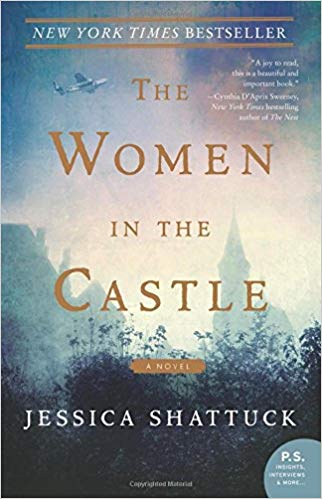 In 1938, a group of Germans meet at Burg Lingenfels, a castle in Bavaria, during a party. They are resistors against the Nazis, and they are planning to kill Hitler. After the meeting, Connie Fledermann, a childhood friend of Marianne von Lingenfels, asks her, if the plot fails, to take care of his wife, Benita, and the other wives of the men involved in the plot.
In 1945, the European war is over. Marianne’s husband was executed during the war for his part in the conspiracy. She has returned to the castle and begun looking looking for the wives she promised to help. So far, she has only found Benita, who spent time in a camp, and Anie, the wife of a man she can’t really remember. But both women have secrets, and post-war Germany is a dangerous place. This novel tells the women’s stories through flashbacks as it moves forward in time to the 1990’s.
Although I don’t understand quite why, I didn’t really get that involved with this novel. It may have been because Benita and Anie have some secrets that aren’t revealed until the end, which leaves them relatively unknowable. Marianne is the only character who seems to have much depth.
Related Posts
Day 1274: The 1944 Club! No Exit
 The 1944 Club crept up on me. I found I didn’t have time to read anything very long, so I decided to reread Jean-Paul Sartre’s No Exit. When I say reread, I mean that I must have read the play before, as I own a copy of it and took a course in Absurdist drama that included it. However, I don’t really remember it except that I knew the premise, which is famous, going in.
Sartre himself wasn’t exactly an Absurdist but an Existentialist who believed that people can define their own essence. That done, though, they must be authentic to that essence.
In No Exit, three people are locked in a room. They are dead, and they are in hell, but hell is not like what they expect. Inez is a lesbian who is attracted to Estelle. Estelle is a beautiful young woman who needs the attention of men. Garcin is a journalist who is preoccupied with the fear that he was a coward after he deserted because of principle.
I’m sure that No Exit was shocking and controversial in its day, but I found it predictable and sexist. The arguments among the characters that provoke the conflict and lead to the famous conclusion “Hell is other people” seem contrived, and Garcin is the only character who is even slightly sympathetic. To me, the women seem stereotypical—Inez as the woman who hates men and Estelle as the cloying dependent type.
So, I’m not sure how well this play translates to the modern day. I think I generally have problems with works that are about ideas rather than actual people, and these characters do not seem like real people to me.
Related Posts
Day 1273: The 1944 Club! They Were Sisters
Best Book of Five!
I was going to save my review of They Were Sisters for our February Literary Wives club, but I saw it was also published in 1944, so applied to the 1944 Club! So, for Literary Wives, I will just have to refer back to this review and then make my further comments about the depiction of wives in fiction.
I previously read another book published in 1944. Here is its link:
Friday’s Child by Georgette Heyer
* * *
Lucy’s sisters, Vera and Charlotte, are much younger than she, so much so that she was largely responsible for raising them when their mother died. Lucy never thought she would marry, but she is, happily, to William, who is a bit eccentric. She has misgivings, though, about her sisters’ choices of husbands, especially Charlotte’s.
Vera’s husband, Brian, is solid and devoted. Lucy likes him, but Vera, who is a stunning beauty, seems to be bored with him. She has a constant entourage of male followers and loves to entertain. They have two daughters, Meriel and Sarah. Meriel is close to her father and paternal grandmother, who hates Vera and is always trying to make trouble. Sarah is closer to her mother, but she is the volatile one, who has trouble making friends.
Charlotte married Geoffrey. As a young man, he was constantly pulling pranks, and Lucy couldn’t see what Charlotte saw in him. As a husband, he is hypercritical and verbally abusive, teaching his daughters, Margaret and Judith, to disrespect their mother.
 The three women have been apart for years when they get together at the beginning of the book. After that visit, Vera and Lucy vow to keep in better contact with Charlotte because they are worried about her. Only Lucy pursues this, however, and through her efforts falls completely for Judith as a child. Although Charlotte avoids Lucy as she loses herself to alcoholism, Judith becomes a regular visitor to Lucy and William’s home, where she sees a more normal home life than the one she has. She also makes unlikely friends with her cousin, Sarah.
This novel is an insightful study of the bonds of sisters, despite their differences. It is a lovely book, also about how the act of caring on Lucy’s part has ramifications beyond her own sisters’ lives. Again, Whipple gets better and better. I will be sad when I will have read all of her books.
More about this book in February for Literary Wives!
Related Posts
 What? Me Read?