Day 1264: Telling Tales

Cover for Telling TalesHere’s another book for the R.I.P challenge!

In addition, I have just read the Get Your Goth On Dare at Classics Club, so I have decided that I will take up that dare. During the month of October, I will read The Haunted Hotel by Wilkie Collins for the dare. I picked it for obvious reasons.

* * *

Ten years ago, Abigail, a fifteen-year-old girl, was discovered dead by her best friend, Emma. Abigail’s father’s spurned lover, Jeanie Long, was found guilty of the murder. Police have now received belated testimony confirming Jeanie’s alibi. She was not guilty. It is too late for her, though. When her request for parole was turned down a few days earlier, she hung herself.

Vera Stanhope is called in to find out how the investigation could have gone so wrong. Right off the bat, she finds that Jeanie was convicted on no forensic evidence. Looking further, she finds indications of conflict of interest in the case.

On hearing the news about Jeanie, Emma’s younger brother Chris returns from university. He seems to be visibly upset and tells Emma he followed Abigail everywhere the summer she was killed. The next day, he is found murdered. Vera guesses that he must have witnessed something ten years ago that made him realize now who the murder was.

As the villagers’ secrets begin to come out, Vera finds several people to suspect of murder. This novel is truly suspenseful at times, and I never came near to a solution of the crime. This is proving to be a good series.

Related Posts

The Crow Trap

Raven Black

White Nights

Day 1263: The Provincial Lady in London

Cover for The Provincial Lady in LondonFans of E. M. Delafield’s Diary of a Provincial Lady should also enjoy The Provincial Lady in London, which is humorous in the same vein. The narrator, having made a surprising amount of money with her first novel, decides to buy a flat in London and to write there, free from the interruptions of daily life.

If only. Instead, we meet an entirely new set of characters. Emma is always dragging the narrator off to literary events and forcing her to speak on little or no notice. Pamela Pringle, who the narrator knows from a girl, has since had at least three husbands and uses the narrator as an alibi to her current husband while she is out with her boyfriends.

At home, Vicky has decided she wants to go to school and dispense with the services of Mademoiselle, which results in some painful scenes, almost as bad as those with the succession of cooks. For times when the children are home from school, they hire a tutor, whom the narrator refers to as Casabianca. I had to look that up to get it.

The narrator and her taciturn husband, Robert, navigate family vacations in France, dismal parties, church fêtes, casinoes, and unbalanced checkbooks while the narrator makes just as much fun of herself as anyone else. Amusing stuff!

Related Posts

The Diary of a Provincial Lady

Merry Hall

Pomfret Towers

Day 1262: The Disappearance of Adèle Bedeau

Cover for The Disappearance of Ademe BedeauThe R.I.P. challenge surprised me this year, so I thought I’d look at what I already planned to review that would fit the category. The first book was this one. The idea is to spend September and October reading books that fit into specific categories, and mine are most likely to be mystery, suspense, or thriller, but a horror book or gothic novel might creep in there.

* * *

The Disappearance of Adèle Bedeau is an unusual character study wrapped around a semblance of a murder mystery. Although it is labeled Inspector Gorski on Goodreads, much of it is concerned with the actions and thoughts of Manfred Baumann.

Manfred is a bank manager in Saint-Louis, a small town in the Alsace region of France. He leads an isolated life of extreme regularity, spending every evening at the Restaurant de la Cloche. He has no friends and spends most of his time by himself.

Manfred does not really date. He takes care of his needs in a weekly trip to a brothel. But he has become fascinated by surreptitiously observing the waitress at the restaurant, Adèle Bedeau, a sulky teenager with a well-developed figure. He even goes so far as to follow her when she meets her boyfriend.

Then Adèle goes missing. Inspector Gorsky can find no evidence of a crime, but he fastens on Manfred because he tells some lies. As far as the reader knows, he has not harmed Adèle, but maybe Raymond Brunet, the fictitious author of this novel, isn’t telling us everything.

Gorski begins to feel there is a connection with another crime years earlier, his first, for which a culprit was identified and convicted. Gorski was never satisfied, however, that they got the right man.

The depth of character portrayal of both Manfred and Gorski is what makes this novel stand out. It is portraying a creepy and paranoid guy in Manfred, however, and that may affect how much you enjoy the novel.

Related Posts

His Bloody Project

When They Lay Bare

Elizabeth Is Missing


Day 1261: The Last Painting of Sara de Vos

Cover for The Last Painting of Sara de VosBest of Five!
In 1957 New York, Ellie Shipley is a graduate student in art history who also does restorations. A contract for restoration work asks her to make a copy of a 17th century painting, “At the Edge of a Wood” by Sara de Vos, her only known work, for the owner. Soon, however, Ellie understands that she is creating a forgery, but she is too interested in the work to stop.

Marty de Groot, the painting’s owner, notices that his painting has been stolen. He determines he will find out who took it.

In 1631 Amsterdam, Sara de Vos and her husband are poverty stricken after the death of their young daughter. Because they have sold paintings without the permission of the guild, they have temporarily lost their membership. Sara has been painting flowers for a catalog and her husband has been working for a bookbinder. But secretly, Sara has been painting a symbolic memorial for her daughter, “At the Edge of a Wood.”

In 2000 Sydney, Ellie is now a respected academician and museum curator. She has discovered that both of the de Vos paintings, the original and the copy, are being sent to her museum for an exhibit on 17th century Dutch women painters. Now, after 40 years of strict integrity, she is afraid her past is catching up with her.

Although I found the story interesting, I was not at first that involved with this novel. Soon, however, I was totally captivated by all three stories. At first seemingly a crime novel, it goes much deeper. I really enjoyed it.

Related Posts

How to Be Both

Let Me Tell You About a Man I Knew

Burning Bright

If I Gave the Award

Cover for Parrot and OlivierHaving finally posted my review of The Finkler Question, I see that it is time again for my feature “If I Gave the Award,” in which I evaluate the shortlist I have just read and say which book I think deserves the award.

The winning book for the 2010 Man Booker Prize was Howard Jacobson’s The Finkler Question, but if you read my review on Tuesday, you’ll know I’m not going to pick that one. I found most of the characters unbelievable, the humor not funny, the tone irritating, and the preoccupations of the characters kind of ridiculous. In fact, it was my least favorite of the shortlisted books.

I felt too much distance from the action and characters of C, by Tom McCarthy, to pick it. Similarly, I felt that the narrative style of The Long Song by Andrea Levy distances the reader from its characters.

Room by Emma Donoghue was a compelling read, so I can’t complain that I felt distanced by it. However, I don’t think it is in the same league as the other books. It employs an imaginative approach by narrating a difficult situation from the point of view of an innocent boy, but this approach is not always convincing, and it is essentially just a thriller. I almost feel that its selection on the short list was an effort to attract more readers to the prize by selecting a popular novel.

Cover for In a Strange RoomIt has been a very long time since I read Parrot and Olivier in America by Peter Carey, but I still have fond memories of its sly humor. It is my second favorite of the nominated books.

So, we get to the novel that I think should have won the award, In a Strange Room by Damon Galgut. This book is not only beautifully written, but it is affecting and insightful in the behavior of its characters. Although it purposefully keeps some distance from the readers at times, I found it powerful and touching.

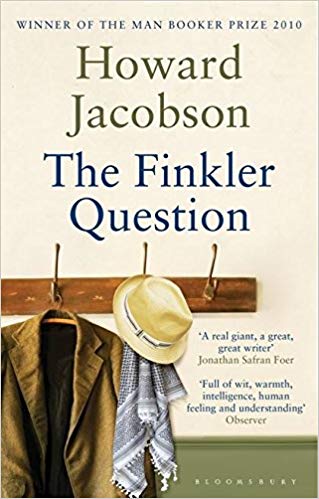
Day 1260: The Finkler Question

Cover for The Finkler QuestionHaving read Howard Jacobson’s J for my Booker Prize project, I was not looking forward to reading The Finkler Question for the same project. Since it won the award in 2010, I was hoping to like it better. I found it, however, very difficult to stay interested in.

Julian Treslove, the main character, is always expecting loss. He imagines himself holding the women he loves as they lie dying. I found him unbelievable and cartoonish.

Treslove has a long friendship with Libor, his former professor, and Finkler, an old school friend. Both of them are Jewish and recent widowers. Treslove, naturally lugubrious, has been hanging out with them while they grieve and argue endlessly about Jewishness and Israel.

I mean endlessly.

Treslove tends to make generalizations about Jewish traits and calls Jews “Finklers.” I ask you, who would do that?

Then one night on the way home from Libor’s house, Treslove gets mugged by a woman who says something to him that might be “You Jew.” After Treslove endlessly examines this event, I mean endlessly, he decides maybe he’s actually Jewish. He hopes he’s Jewish.

It doesn’t help that Jacobson tells this story using the same jokey, ironic tone that drove me crazy in J. I know that there are people who convert, but Treslove is such a ridiculous person I feel he’s there to be ridiculed.

Yet, I briefly became interested in him after he buckles down to become Jewish and meets a woman who seems suited to him. I could not say the same for Finkler, who belongs to ASHamed, Jews who are ashamed of the behavior of Israel.

I assume Jacobson is mocking the different characters and their ideas about Judaism, but no one in this book feels like a real person but Treslove’s girlfriend, Hephzibah. This novel really bugged me. I see it as the type of literary novel honored by the male publishing elite that no one actually likes.

Related Posts

J

The Fixer

The New Sweet Style

Day 1259: Closed Doors

Cover for Closed DoorsBest of Five!
I loved The Death of Bees, so recently I looked to see if Lisa O’Donnell had written anything else. Closed Doors did not disappoint.

The action of the novel, set in the 1980’s, begins when eleven-year-old Michael Murray’s mother comes home with cuts and bruises on her face. She says she’s been assaulted by a flasher and fell. Mike’s Da urges her to go to the police, but his Ma is worried about the vicious gossip in their small island community off the coast of Scotland. She makes the family promise to keep her secret (which, we sense, is worse than a flasher), but the neighbors all assume that Michael’s Da beat her up.

The ramifications of the lie continue with strained relationships with the neighbors. Then, another woman is assaulted. Now, Michael’s Ma is afraid she won’t be believed because she waited so long to talk. In the meantime, she suffers from anxiety and fear of being touched or looked at.

Michael’s voice is absolutely convincing as a naive boy who doesn’t quite understand what’s going on. This book is sometimes harrowing, but it is also touching and funny. Another great book for O’Donnell.

Related Posts

The Death of Bees

Pigeon English

Mountains of the Moon

Day 1258: Classics Club Spin #18! The Heir of Redclyffe

Frontispiece for The Heir of RedclyffeIt’s a quirk of mine that, while I research the books for my Classics Club list, when I finally get to them, I don’t remind myself what they are about before reading them. So, when I got The Heir of Redclyffe in the Classics Club spin, I vaguely guessed from the title that it might be a gothic thriller. Boy, was I wrong.

In fact, in tone and attention to right behavior and emphasis on everyday family life, the novel reminds me more of works by Jane Austen than anything else I’ve read, although it lacks the Austen humor and sense of the absurd. In addition, it perhaps doesn’t translate as well to modern times because of its sense of piety.

The Heir of Redclyffe is the story of two cousins, the branches of whose families have long held a feud. Guy Morville is the heir, at the beginning of the novel a 17-year-old who comes under the guardianship of Mr. Edmonstone. Guy is a stranger to the Edmonstone family when he comes to stay. He has been strictly brought up out of his grandfather’s fear of his family’s violent tendencies. The Edmonstones find him charismatic and full of the joy of life but quick to temper, always attempting to control his darker impulses.

Philip Morville, Guy’s cousin from the other side of the feud, is long a friend of the Edmonstone family. He is a captain in the army, and the young Edmonstones have been used to think of him as a pattern of well-bred, right behavior. Charlie Edmonstone, an invalid, thinks him patronizing and sententious, and Amabel, who is shy, is a little afraid of him, but Laura, the oldest daughter, thinks he can do no wrong, and her parents rely on his advice.

Unfortunately, Philip takes a dislike to Guy that he does not recognize himself. Instead, he thinks he is concerned for Guy’s welfare when he interferes in Guy’s life and misconstrues his actions. Although Guy forms an excellent relationship with the Edmonstones, Philip creates serious trouble for him by almost willfully assuming the worst about him.

The latter part of this novel is  full of sentimentality and pathos similar to Dickens at his “worst,” but the characters seem believable and interesting, and we care what happens to them. Perhaps modern readers won’t find the quiet and delicate but determined Amy to be the most interesting heroine, but in contemporary times she was considered a pattern of womanhood, as Guy was the epitome of the Romantic hero.

I was interested to read that in her time, Charlotte M. Yonge’s books were as popular as Dickens’s and she wrote to the service of the Oxford Movement, yet these days we don’t know her name. Like many other women writers, she was probably pushed aside by editors and academics as not as worthy to be remembered as her male counterparts.

Related Posts

Christowell: A Dartmoor Tale

Red Pottage

Dombey and Son

Day 1257: The Last Hours

Cover for The Last HoursI have been following Minette Walters since her first thriller came out, and I think she is a superb plotter and suspense writer. So, I was intrigued when I learned she had written a historical novel, and I requested it from Netgalley.

The Last Hours follows two main characters in the year 1348. Lady Anne is the wife of Sir Richard of Develish, a stupid and cruel lord and husband who has turned their daughter, Eleanor, against her mother. With difficulty, Lady Anne has done her best to improve the life of the serfs, while Sir Richard and Eleanor treat them with disdain and cruelty. The other character is a young serf, Thaddeus, a bastard who has been mistreated by his family. Lady Anne has educated him, and he is resourceful and intelligent.

Sir Richard has arranged a marriage for Eleanor and seems to want to put it forward, so he goes to the home of the bridegroom to seal the deal. Eleanor does not want to marry the young man he selected and does not seem to realize that although she is beautiful, she comes with a small dowry so is not desirable as a wife. Nor does her personality make her so. Sir Richard has blamed the acceleration of the marriage on Lady Anne, who actually thinks they should wait.

On the visit to the bridegroom’s family, Gyles Startout, a serf who has been made a member of Sir Richard’s soldiery, notices that a lot of peasants in the nearby village are being buried at night. He tries to tell his commander about it, but the Norman commander is disdainful of a serf. Soon, though, they realize that a terrible disease has struck, and they flee.

Back at Develish, Lady Anne hears about the disease. Years ago, she instituted more sanitary measures within the demesne, and now she barricades her people within its walls, deserting the village. She has made Thaddeus her new steward, and the two do their best to protect the people. Unfortunately, Eleanor is doing her best to cause trouble.

link to NetgalleyThe time period and story idea for this novel are interesting, and the characters are well drawn. However, the novel has a big flaw, the plotting. It is all too obviously the first book of at least a trilogy. Whereas most first books have their own arc, even though they may end in suspense, this one is very unsatisfying, standing alone in no respect (something that is more common with a second book in a trilogy). It goes along very well until Thaddeus takes some boys out of the demesne to look for provisions. At that point, too much attention goes to the details of how they collect food and other needed goods, and the plot bogs down. The book also ends on a very flat note. Although the entire trilogy may provide exciting, this book is not a very satisfying read.

Related Posts

Cathedral of the Sea

The Illuminator

The Owl Killers