
 The Best Book for this period is The Weight of Ink by Rachel Kadish!
Day 1300: Munich
 Robert Harris’s newest book, Munich, takes place during four days in September 1938, during which England’s Prime Minister, Neville Chamberlain, met with Hitler, Mussolini, and the President of France to try to avoid war over Czechoslavakia. Or at least Chamberlain was trying to prevent war. As he has done before, Harris manages to create suspense around an event the outcome of which we already know.
He does this by introducing two characters, friends from Oxford who are now diplomats. Hugh Legat is a junior secretary for the Prime Minister. Paul von Hartmann is in the German foreign ministry, but he is also a member of a group who would like to bring down Hitler. The group asks him to attempt to encourage a strong response from England on the Sudetenland issue by leaking secret German aspirations in Europe to England through his friendship with Hugh. The group believes that if war is declared, the German army will stop Hitler.
This mission is a dangerous one for Hartmann, who already has one SS officer on his tail. Meanwhile, Hugh in trying to be a liaison is continually stymied by orders from his jealous boss.
I felt a little more detached from this one than I usually do for Harris’s work. It depicts Chamberlain, though, as a much more determined and politically savvy man than he is believed to be now. I get the feeling that Harris, who states in the afterword that he has been fascinated by this meeting for years, wants to show Chamberlain in a more positive light than history generally affords him.
Related Posts
Day 1299: Flush: A Biography
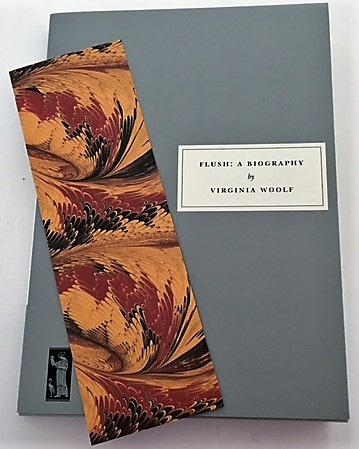 I admit to feeling rather perplexed by Flush, which seems to be a light-hearted biography of Elizabeth Barrett’s pet dog. It was clear to me that a lot more was going on than a story about a dog. The introduction to my Persephone edition by Sally Beauman draws parallels between Flush’s life and Barrett’s—and Virginia Woolf’s own life.
Flush is a cocker spaniel, a hunting dog, given to Elizabeth Barrett as a gift. Woolf is clear about how Flush’s life on Wimpole Street becomes one of constraint and even neuroticism as the lap dog of a constrained, restricted, and hypochondriacal Elizabeth Barrett.
The slant the novel puts on the famous romance between Barrett and Robert Browning is also very interesting. Flush is immediately jealous of Browning and tries to bite him twice. From being loved and terrifically spoiled by Barrett, he learns he has to take second place.
Now to get to the source of my perplexity. Just in terms of mistreatment of dogs, this novel was not, to me, the one fondly referred to by others over the years. Woolf’s doggy hero is restricted by Elizabeth just as she was by her father. To add interest, though, there are sly digs at social strata and Victorian life throughout.
Related Posts
Day 1298: Hidden Depths
 After a rare night out, Julie Armstrong returns home in the wee hours to find her son, Luke, dead in the bath. Her 14-year-old daughter, Laura, is sound asleep in her room.
Luke has been despondent since the death of his friend, Thomas Sharp, from drowning. Julie assumes he killed himself, but Vera Stanhope’s team assures her it was not a suicide. Luke was strangled, his bath filled with scented oil and flowers.
Felicity Calvert is surprised when she meets her son at the bus to find that her teacher has traveled out there to view their cottage with the idea of renting it. Felicity isn’t sure she wants to rent it again but is surprised when the young woman, Lily Marsh, leaves without asking the rate.
Vera’s attentions turn to the Sharps, a local criminal family, wondering if Davy Sharp blamed Luke for his son’s death. But Davy says it was a accident. Soon, another body is discovered in a tide pool by Felicity Calvert’s son. It is Lily Marsh, submerged in a pool surrounded by flowers. The Calverts are at the shore as part of Pete Calvert’s birthday celebration, accompanied by his three best friends, all bird watchers.
This is another clever mystery by Ann Cleeves. Her characters are convincing, and her plots complex without being overly complicated. I am enjoying both the Ann Cleeves series I’m reading.
And by the way, I wish everyone a safe New Year’s Eve and a happy new year!
Related Posts
Day 1297: The Weight of Ink
The Weight of Ink is a dual time-frame novel set in the current time and the 17th century. At first, I wasn’t as captured by the present-day sections as I was by the past, but eventually the entire novel absorbed me. There is a big revelation at the end that I anticipated, but that did not lessen the power of the novel.
In the present day, Helen Watt is an English university professor of Jewish history who is elderly and ill. Requested by a previous student to examine a cache of papers he found in a wall of his 17th century house, Helen does not expect any great finds. What she discovers is a genutza, the hidden papers of a 17th century rabbi, and on one page, a mention of Spinoza. Understanding that this could be a major discovery, she requests help and gets that of Aaron Levy, an American graduate student.
One of their first, startling discoveries is that Rabbi HaCoen Mendes’s scribe, identified only by the Hebrew letter aleph, is a woman. Having reported her initial findings to Jonathan Martin, the head of the History Department, so that he could buy the papers from the owners, Helen is dismayed to find her place on the investigation usurped. She can continue working with the papers, but Martin has also given Brian Wilton access. He arrives with four graduate students to beat Helen and Aaron to any discoveries and immediately publishes an article about one of the topics in the letters.
In 1657, Ester Velasquez is a young Jewish woman who has been allowed an unusual education. In these dangerous days of the Inquisition, her family fled Portugal for Amsterdam, where her parents were killed in a fire. She and her brother Isaac are part of the household of Rabbi HaCoen Mendes, who travels to England to educate the British Jews in their heritage, these people having been hiding there pretending to be Protestants during hundreds of years when Jews were not allowed in England. Rabbi Mendes’s difficult job is made harder when Isaac, his scribe, leaves. But the rabbi lets Ester take his place.
Offered an opportunity of knowledge, Ester comes to know that she does not want to return to a woman’s life. So, she sets about a daring deception.
Aside from covering some key events of its time—the Inquisition, the return of Jews to England, the plague, and the Great Fire—The Weight of Ink offers us an intrepid, determined heroine in Ester as well as an interesting modern story. I was really touched by this novel. It’s terrific—the kind of novel I look for in historical fiction.
Related Posts
Day 1296: The Battle of Life
 As has been my tradition for several years, only missing the year I moved to Washington, I am reviewing one of Dickens’s Christmas books for the Christmas season. I only have one left, so I’ll have to think up a new tradition in a couple of years.
The Battle of Life begins with a section about a battle that was fought years before on the site of the main characters’ home. I thought that since Dickens’s Christmas books often involve ghosts, this battle might be the source of a ghost story, but no. Apparently, this section is just an extended and rather laborious metaphor.
In any case, we soon meet the Jeddlers, who are celebrating some important birthdays. It is the birthday of Marian, the younger and more beautiful Jeddler sister, who is provisionally engaged to Alfred Heathfield, Dr. Jeddler’s ward. It is also Alfred’s birthday. This day he will be released from his wardship and travel to the continent to study medicine. In three years, he will return and marry Marian, if they are both so inclined. There is something odd, however, in the way in which Marian bids farewell to her sweetheart, looking at her sister Grace all the while.
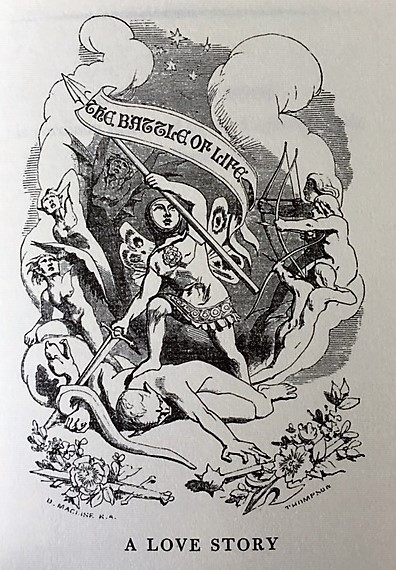 In the second part, the plot thickens. It is three years later. Alfred is due back, but another player has entered the scene. Michael Warden has ruined himself with his spendthrift ways and meets with his solicitors, Snitchey and Craggs, to discuss how he might save himself. Snitchey and Craggs have already appeared as Alfred and Dr. Jeddler’s solicitors and provide some of the typical Dickens comedy, along with their wives. During this meeting, Warden states his intention of eloping with Marian Jeddler. Could Marian be contemplating an elopement just when Alfred is due home?
This novella about two sisters each of whom is ready to sacrifice her own happiness for the other is a little predictable but makes a touching, if slightly sappy, story. As one of Dickens’s Christmas books, I would rate it below A Christmas Carol but above the others, especially The Chimes. I have one more to read, and next Christmas will show how well I liked it.
Related Posts
Best Book of Five!
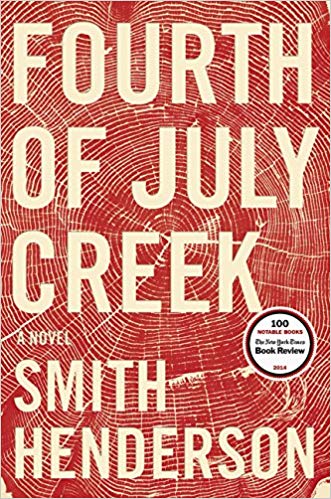 The Best Book for this period is Fourth of July Creek by Smith Henderson!
Day 1295: Scot Free
 I’ve read almost all Catriona McPherson’s books, which up to now have fallen into two categories—her historical mystery series set in post-World War I Scotland and England featuring Dandy Gilver and her stand-alone present-day cozy thrillers, set mostly in Scotland. Scot Free is the first in a new series, the Last Ditch mysteries, featuring Lexy Campbell and set in California.
Lexy is waiting to have her last meeting with clients before she returns to Scotland. Her marriage to an American dentist has turned out to be a big mistake. She is waiting at her office for the Bombaros, who hired her as a marriage counselor to help them keep their divorce amicable. After she helps them with divorce papers, she’ll be off.
But the police arrive to question her. Mr. Bombaro is dead, having been murdered with fireworks. Elderly Vi Bombaro is the chief suspect, and Lexie is suspected of being her accomplice.
Lexie can’t believe Vi is guilty, and she is even more sure of that when Vi’s niece Sparky shows up with her new husband and a couple of thuggish business associates, and they begin taking over Mr. Bombaro’s fireworks manufacturing business. So, she decides to investigate.
Lexie has her own problems, however. She is currently homeless, and her clothes are locked in her office, the pass for which has expired. So, she checks into the Last Ditch motel and into the realm of a collection of colorful characters.
Scot Free is a funny, enjoyable novel even though McPherson signaled a little too obviously the identity of the murderer. I am a little worried, though, about the change of locale. If McPherson decided to move to the United States to appeal more to American audiences, I have to say that much more appealing to me are her Scottish settings, especially the atmospheric ones of her thrillers. The Scottish fish out of water theme can be funny, but I can imagine it getting old quickly, along with the cast of eccentric characters at the Last Ditch. For one thing, Lexie makes a lot of generalizations about Americans based on the Californians she meets, and we all know that Californians aren’t that representative of average Americans. Also, she gets at least one thing wrong. The American cop catches her in a lie because she claims that someone says “I’ve got . . . ” instead of “I have . . .” I believe that most people I know are just as likely to say it one way as the other. I noticed a few other small problems as well.
These are not very big criticisms. I just hope that McPherson doesn’t drop her moody present-day stand-alones for this series, because they are my favorite.
Related Posts
Day 1294: Birds, Beasts, and Relatives
 When I began reading this sequel to Durrell’s My Family and Other Animals, I assumed it would begin sometime after the first book, which ended with the Durrells leaving Corfu and heading back to England. Instead, it seemed to be about to cover the same ground, starting with an abbreviated account of their arrival.
 Although this novel is slightly repetitious of the previous one, briefly reintroducing some characters and summarizing important events, for the most part it covers different events and introduces new characters. We meet Larry’s friends Max and Donald when they arrive at the house, drunk, at 2 AM. We also meet the disreputable Captain Creech, and Sven, the accordian-playing sculptor. There are also old friends like Theodore and Spiro.
The book relates memorable events, such as what happens when Margo agrees to take care of Gerry’s baby hedgehogs and how the family receive a performing bear that follows Gerry home one day. Although I began the book worried that this memoir would cover too much of the same material, I ended up charmed again by the stories of this eccentric family and their stay in Corfu.
Related Posts
If I Gave the Award
 Since I just reviewed Fourth of July Creek by Smith Henderson, the last of the shortlisted novels for the 2015 James Tait Black Fiction Prize, it is time for my feature, where I give my opinion about whether they got it right or not. The 2015 list is a difficult one, because I didn’t love any of the shortlisted novels, but I thought all of them were excellent in different ways.
I read We Are Not Ourselves by Matthew Thomas the longest ago, in the same year that it was published. I recollect that, while I stayed interested in the novel, it was a long time before I was very vested in this story about a family coping with Alzheimer’s.
Fourth of July Creek was another novel with a more straightforward narrative. It focuses on people on the fringes of society in Montana. It is interesting and involving and ultimately touching as it explores the stresses upon an already fanatical man being pressured by the government.
Dear Thief by Samantha Harvey uses a more inventive approach to narrative, it being a long love/hate letter from a woman to her former best friend. While it recounts the reasons for the destruction of their friendship, it reveals how the woman yearns to see her friend again.
 Also a novel about a friendship and the winning entry, In the Light of What We Know by Zia Haider Rahman is the most ambitious of the novels and also the one least likely to appeal to some readers. It is a tour de force in narration, consisting mostly of a long series of narratives by one character on a wide variety of subjects. It is the most thought-provoking of the shortlisted books and the most difficult.
I can understand why the judges chose In the Light of What We Know, but as I think about it, I have to choose the book that I connected with most. Although I enjoyed the winning novel, I also was just on the edge of irritation with it as I read it. So, for its slightly inventive approach and the connection I felt to the material, I am picking Dear Thief with a strong nod to Fourth of July Creek.

