
 The Best Book for this period is Snowdrops by A. D. Miller!
Day 1285: Miss Buncle’s Book
 Miss Buncle’s investments have not been providing her an income, so she realizes she must do something. She decides to write a book. She submits it to a publisher, Mr. Abbott, who can’t decide whether it is a sly satire or a story written by a rather simple person. Nevertheless, he likes it and decides to publish it. In particular, he is impressed by the lifelike characters.
Miss Buncle always says she has no imagination and has simply described the people she knows. When the book comes out, all of her neighbors begin to recognize themselves, and many of them are not pleased. But no one knows who the author, John Smith, is. Some of the less likable people in the village decide to find out. The topper is that Miss Buncle has imagined futures for some of her characters, and they start to behave as she predicted.
This is a delightful novel, a fun, light read. It’s the perfect thing to go with a cup of tea on a rainy afternoon. I can see why so many people have loved it. I read it for my Classics Club list.
Related Posts
Day 1284: Hot Milk
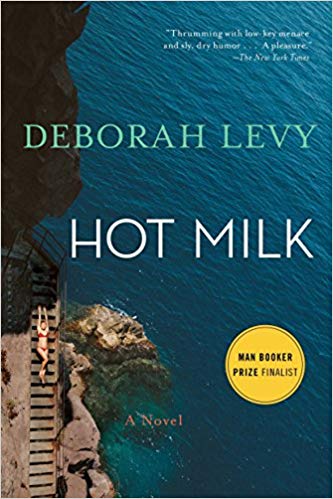 Sofia is an anthropology graduate student who has given up her job and her room in a storage cupboard to care for her mother, Rose, as she seeks medical help at a clinic in Spain. Rose has a myriad of symptoms, but no one has been able to diagnose a problem. Mostly, she is concerned about her legs. She can’t walk, at least when she doesn’t want to. She can’t feel anything, except when she does. She complains constantly, and nothing is ever right.
Sofia is unhappy with her life—her unfinished dissertation, her job as a barrista, the cubbyhole she lives in, her subservience to her mother. Her father left them when she was five and despite being wealthy, seems to feel no responsibility for them, even in the days when they could barely afford to eat. He has made a religious conversion and now has a young wife and baby daughter.
Sofia is dabbling in an affair with a German girl, Ingrid, from Berlin, but they seem to be at cross purposes.
This novel is intelligent and sometimes almost hallucinogenic as it explores Sofia’s attempts to wake up and take responsibility for herself. At times, I found it a little confusing and its incidents unlikely but mostly I was engaged in Sofia’s journey.
This is another book I read for my Man Booker Prize project.
Related Posts
Day 1283: The Husband’s Secret
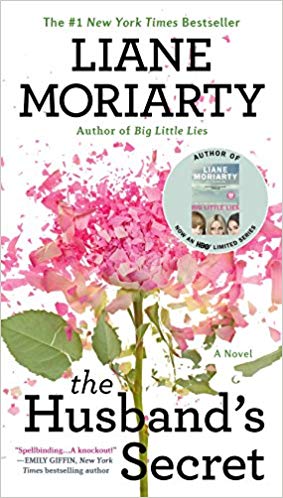 Cecilia Fitzpatrick is a super organized woman who volunteers for things and executes them perfectly all the while keeping an immaculate house, running a Tupperware business, and caring for her husband and children. One day, she accidentally finds an envelope addressed to herself from her husband, John Paul, to be opened in the event of his death. She asks her husband about it, and he gives her an unsatisfying answer and asks her not to open it.
Tess O’Leary thinks her marriage to Will is a happy one. She does, that is, until Will and her best friend and cousin, Felicity, come to tell her they are in love.
Rachel Crowley has been depressed ever since the death of her daughter, Janey, as a teenager. Only since the birth of her grandson has Rachel been happy. But now, her son and daughter-in-law are planning to move away to New York.
The lives of all these people are going to change with the revelation of John Paul’s secret.
I just gave this novel three stars on Goodreads but not because I wasn’t deeply involved in it. Rather, Moriarty presents us with some situations that aren’t easily resolved, but some of the choices she makes to resolve them make me uncomfortable. There is sort of a cruel quid pro quo that feels like it minimizes the acts of some of the characters. Further, it is put across in a jarringly flippant tone.
Related Posts
Day 1282: Snowdrops
Best Book of Five!
At the beginning of Snowdrops, A. D. Miller explains that “snowdrops” are what Russians call the bodies that emerge from the snow after it melts. Sometimes these bodies are of drunks who have fallen asleep in the snow, but sometimes the explanation is more sinister. This note at the beginning of the novel is not the only hint that things are not going to go well for someone.
Nick Platt is a British lawyer who has been transferred to Moscow during the reckless years of the 2000’s. He thinks he is worldly and sophisticated, but he has a lot to learn when he meets Masha and her sister, Katya, in the metro one day. He is soon involved in a love affair with Masha, who asks him to help with the paperwork for her elderly aunt’s purchase of an apartment.
During the same time, Nick’s bank is shepherding an investment in oil managed by a character he calls the Cossack, a typical example of the gangsterish businessmen he and his boss have to deal with. Finally, Nick’s elderly neighbor, Oleg Nikolaevich, is worried about the disappearance of his friend.
It doesn’t take much to guess that all three of these situations will go badly wrong, assisted by Nick’s willful blindness because of his infatuation with Masha. It is getting there that is the pleasure of this engaging, slowly unfolding thriller and absorbing character study. Snowdrops is a novel I read for both my James Tait Black and Man Booker Prize projects. It’s really good, teeming with the atmosphere of those lawless days in Moscow.
Related Posts
Day 1281: My Family and Other Animals
 I first was charmed by My Family and Other Animals many years ago, but it is only recently that I learned it was part of a trilogy. So, I am reading it again to kick off the trilogy.
Gerald Durrell was a boy in 1935 when an impulsive decision on a dreary summer day lead to his family deciding to move to Corfu. This book is an account of the indefinite period of their life there before Mrs. Durrell decides they must move back to England for Gerry’s continued education.
The Durrell family members are all the types of people who know their own interests from an early age. Larry, who becomes the well-known literary novelist Lawrence Durrell, fills the house with his literary and artistic friends. In fact, the family is forced to move to a larger villa to accommodate them. Leslie is interested in hunting and is constantly shooting things. Margo likes sunbathing and clothes and has an atrocious taste in young men. With Gerry, it’s animals, and he proceeds to fill the house with them.
 This memoir is very funny, with a humor that derives from the family just being themselves and the eccentric friends they make. It also has lush, gorgeous, and sometimes stunning descriptions of the setting and flora. Durrell says that he intended to write a book about Corfu’s flora and fauna, but his family kept intruding.
Whether the family decides to give a small party and just invite ten people—at which point each of them invites ten—journey off on an outing in a perfectly round boat, or give another party when the dog is in heat and snakes are in the bathtub, I assure you, you’ll be laughing.
Related Posts
Best Book of Five!
 The Best Book for this period is The Forty Days of Musa Dagh by Franz Werfel!
Day 1280: The Last White Rose: The Secret Wars of the Tudors
 I’ve read a couple of histories by Desmond Seward now, one of which, The Wars of the Roses, did a much better job of explaining the complications of those wars than any other book I’ve read. In The Last White Rose, Seward details the attempts by the first two Tudor kings, Henry VII and Henry VIII, to wipe out the Plantagenet line.
Real or imagined conspiracies against the Tudors haunted the reigns of both these kings. At first, those conspiracies that actually existed had their roots in Henry VII’s very tenuous claim on the throne. There were still plenty of Yorkists around, and some of them had much better claims. It was Henry VII’s knowledge of these plots that led him to construct a complex web of spies for the state. Later, his growing paranoia led him to execute young Warwick, whose only crime was his birth.
Although Henry VIII continued his father’s policy of stamping out conspiracies, as he grew older and more erratic, he conducted a reign of terror. Courtiers were charged for slight errors or none at all. Henry succeeded in killing off almost every person with Plantagenet blood. His paranoia was manipulated by Thomas Cromwell, who invented conspiracies to rid himself or Henry of enemies.
Seward could be writing novels, his style is so easy to read and interesting. Although he introduces many players, he is somehow able to interest readers in all their fates. I found this another fascinating book about this period.
Related Posts
Richard III: England’s Black Legend
Day 1279: Harriet
 Harriet is a novel written in 1934 based on a true crime that occurred in 1875. As such, it is suitable for the season as well as for the R. I. P. Challenge and the Classics Club Dare.
Harriet is a woman in her 30’s who has her own fortune of £3,000 with prospects of 2,000 more. She is a “natural,” which I take to mean having some sort of mental incapacity. Although her mother, Mrs. Ogilvie, cares about her, she boards her periodically with poorer relatives, allowing them to make a little money and giving herself and her husband a little break from Harriet, who can be difficult.
Mrs. Ogilvy sends Harriet to stay with her cousin, Mrs. Hoppner. Mrs. Hoppner lives with her spoiled daughter, Alice. Visiting her are her older daughter, Elizabeth, and Elizabeth’s husband, Patrick Oman, an artist. Also visiting is Patrick’s brother, Lewis, a clerk. Patrick and Elizabeth are devoted to Lewis.
Although the charismatic Lewis is courting the delicate and beautiful Alice, he turns his attention to Harriet. He is soon engaged to her and marries her despite Mrs. Ogilvie’s objections. In fact, Mrs. Ogilvie tries to get Harriet made a ward of the court to block the marriage, but this backfires when Lewis finds out and tells Harriet she wants to have her committed. Once they are married, Lewis proceeds to strip Harriet of her money and possessions.
After Harriet has a child, he boards her at his brother’s house and moves into a nearby house with Alice. Up until then, Lewis’s actions are marginally legal if morally repellent. It is after this that the behavior of the two brothers and two sisters becomes criminal.
This novel is chilling in its psychological depictions of the two sisters and brothers. Jenkins was fascinated by the case and uses people’s actual Christian names, imaging the thoughts and activities of the characters. This novel was one of the first fictionalizations of a true crime.
Related Posts
The Wicked Boy: The Mystery of a Victorian Child Murderer
The Invention of Murder: How the Victorians Reveled in Death and Detection and Created Modern Crime
The Fall of the House of Walworth: A Tale of Madness and Murder in Gilded Age America
Day 1278: The Forty Days of Musa Dagh
Best Book of Five!
In 1915, the Ottoman Empire decided to make a scapegoat of its Armenian subjects. It declared all Armenians to be subversive and began “relocating” them to the deserts of Syria. Those who did not die on the way from starvation or mistreatment starved to death upon arrival. In this way, the Turks rid themselves of 1.5 million Armenians, a fact the Turkish government still denies.
In the shadow of the mountain named Musa Dagh, the inhabitants of seven villages decided not to go. After the villages received the news that they would soon be relocated, they sneaked supplies and livestock up into the mountain. Then, the day before the evacuation, they walked up onto Musa Dagh. There, for forty days, they managed to defeat the Turkish army’s attacks until they were rescued by the French navy. Although there were casualties, more than five thousand people were rescued.
The Forty Days of Musa Dagh is considered Franz Werfel’s masterpiece—his fictional account of the event. The main character is Gabriel Bagradian, a wealthy man raised in Europe who has recently returned to this family home after the death of his older brother. He is a reserve army officer, and when he reports to the regional capital to find out why he hasn’t been called up, he hears disquieting rumors.
Back home, he consults with village leaders until the arrival of Aram Tomasian, a Protestant pastor who was relocated with his family from another village. He and his family have been allowed to travel to his father’s village, the authorities thinking it will not affect his fate. But he is able to tell the villagers what is happening during the relocations.
Gabriel has been trying to save his French wife, Juliette, and his son, Stephan. But now he proposes that the villagers ascend Musa Dagh and defend themselves. Only the followers of one church decide to cooperate with the Turks.
At 800+ pages, this novel is very long, but completely absorbing. Werfel’s characters are not heroes but complex people. The novel is suspenseful because even though we know the result for the village as a whole, we don’t know what will happen to the individual characters. The villagers have deserters, loss of their livestock, a fire in their grainery, and other hazards to navigate. I don’t know any other way to explain it but to say this. This novel is fantastic. It is absolutely what I look for in a good novel, where I can immerse myself in another world for a short while.
P. S. If you are interested in reading more about the Armenian genocide, another touching novel is Birds Without Wings by Louis de Bernières.

