
 The Best Book of the last five is A Little Life by Hanya Yanagihara!
Day 1165: The Winter Isles
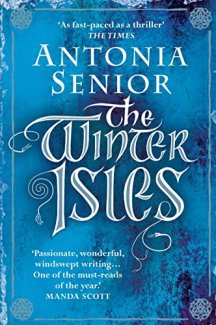 In the 12th century, a boy warrior named Somerled in the islands west of what would become Scotland began leading his father’s small band out of obscurity. His father was ineffectual. After a victory, he failed to post guards while his people celebrated, and they were nearly annihilated, driven from their home. Afterwards, the much smaller band moves back to the caves where they first lived when they came from the mainland. But Somerled’s friend Eimhear, nicknamed Otter, is taken away by her father, who returns to the mainland.
The Winter Isles follows the rise of Somerled as he becomes Lord of the Isles. It also follows the love story between Somerled and Eimhear. Much of the novel is devoted to battles, as Somerled takes on one lord after another.
Although the novel covers an interesting period and person, it is only a middling success as a historical novel. It does not have the depth of feeling of the period or character that I expect from a really good historical novel. Characters have a few characteristics rather than distinct personalities, and we are mostly left to imagine the details of ordinary life that make a good historical novel convincing.
It was interesting to read about Somerled, but for a fuller experience of a similar time and a similar character, try King Hereafter by Dorothy Dunnett, the queen of the historical novel.
Related Posts
Day 1164: A Brief History of Seven Killings
 I have so many thoughts about A Brief History of Seven Killings, but not many of them are positive. The novel is based around an assassination attempt on Bob Marley in 1976, the reasons behind the attempt, and the ramifications for 20 years later. It is about political skullduggery and the drug wars.
The novel begins days before an election in Jamaica. The political parties in the country have connections with gangs running specific areas of Kingston, and the areas of the city belonging to the wrong party get no services. So, an election is an excuse for an outbreak of violence.
Bob Marley, though, has been working with the dons of the two biggest gangs to bring about a peace concert. The CIA is worried about Jamaica turning communist if the JPL party is elected. One of the first narrators is the ghost of a politician who has already been killed in the battle for power. Out of what seems to be chaos comes Josey Wales, an enforcer for one of the gangs, who is more interested in getting involved with Columbian drug dealers than in following his gang’s agenda. The price for allowing him an in with Medellin—kill Bob Marley.
Although this beginning results in the flood of cocaine and crack into U. S. cities, I expected this novel to fit together more cleanly, a bit like Leif GW Persson’s trilogy about the assassination of a Swedish prime minister. It was much messier than that.
The novel was written from the points of view of many characters, most of whom are thugs. Much of the narrative is in Jamaican slang and a little hard to understand. All but one of the characters are abhorrent, and I had great difficulty reading the novel even though I was interested to see what would happen. The novel is brutal, the thoughts and conversations of most of its characters disgusting, and loaded with sexism. A lot more people are killed than seven (in fact, I wasn’t even completely sure which seven the title referred to), and at almost 700 pages, the novel is anything but brief. (I believe the title is meant ironically.) Occasionally, when reading some character’s narratives, especially the heroine addicts, I felt like screaming.
One Goodreads reviewer said the novel is not for the faint of heart. I am not generally squeamish, but I found the novel an agony to read, even though its subject matter is interesting. This novel was the 2015 winner of the Booker Prize. I am fairly sure that when it comes time for my article about which book I would have chosen, this won’t be it.
Related Posts
Day 1163: The Shuttle
 At first, I wasn’t sure I would like The Shuttle, despite my enjoyment of Frances Hodgson Burnett’s other novels. That is because it begins with an extended metaphor, rather cumbersome, about the shuttle of fate weaving together east and west. I wasn’t altogether sure which east and west she was talking about and had wild thoughts about China. But we weren’t leaving the Occident. By west she meant America, more precisely the United States. By east, England. But this introduction lasts only a couple of pages, and then we get into the action.
The novel begins with Rosalie Vanderpoel, the gentle, naive daughter of a New York millionaire. It is the early days of the migration of young, titled Englishmen to New York looking to marry money, and the relatively innocent New Yorkers don’t understand that most of these men are fortune hunters. Rosalie becomes engaged to Sir Nigel Anstruthers. Although Reuben Vanderpoel, Rosalie’s father, does not like Nigel, only nine-year-old Bettina sees him for the vicious bully that he is.
But Nigel hasn’t done his homework. He doesn’t realize that American girls don’t come with dowries nor that Rosalie won’t expect to hand her money over to her husband for handling, as an Englishwoman might. Once he realizes his mistake, he blames it on Rosalie.
Rosalie goes to live in dilapidated Stornham Court, where she is mistreated and bullied by her husband and his mother. Thinking that no man would take money from a woman, Rosalie doesn’t offer any, and it takes a while before she realizes that’s what he wants. But he doesn’t want money for the estate, just to support his vicious habits. He cuts her off from her family to make her miserable and keep control.
Rosalie isn’t the heroine of the novel, however. That honor belongs to Bettina, or Betty, who vows at the age of nine to go sometime and rescue Rosalie. And so she does, 15 years later.
This novel isn’t one of great surprises. When Betty finds Rosalie and her son alone and works to buck them up and get them ready to leave, the tension builds from the expectation of a showdown with Nigel. When Nigel finally arrives, he uses all his cleverness to foil Betty. We know who will win—we just don’t know how.
I don’t think Burnett’s adult novels were considered sensation fiction, but this one certainly deals with those kinds of topics and is very melodramatic. Still, it was a fun book to read. Betty is clever and determined. You know she will win at love and defeat Sir Nigel.
Related Posts
Day 1162: Classics Club Spin! Letters from Egypt
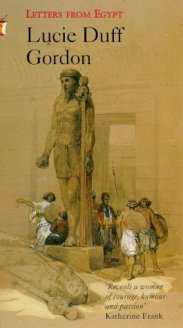 Letters from Egypt is the book I drew for the latest Classics Club spin! A book like this one is hard for me to evaluate. Lucie Duff Gordon was an English gentlewoman suffering from consumption who spent the last seven years of her life in Egypt, hoping the climate would help her. The book of her letters is heralded as a first to deal with the Egyptian people rather than the scenery and monuments. She was by all accounts beloved by the people she lived among in Luxor from 1862 to 1869.
I try to judge books as best I can by the standards of their own time, but sometimes with this book that was a struggle for me. Duff Gordon is known for being kind to the people she met, particularly the Arab fellaheen, who by all accounts were the despised of Egypt. Certainly, she was loved by them and is careful to follow their customs, but she does patronize them in just about every word of her letters. She also takes pleasure in telling stories about how much they love her and what courtesies they exchanged. She adopts their customs and learns to speak Arabic, all very laudable. However, it seems to me that she takes their part to the point of perversity, for example, sprinkling Arabic words into her letters to friends and so participating in their customs that she speaks casually of such things as buying slaves (for herself), always for their own good, thirty years after England outlawed slavery. Further, she favors the Arabs by putting down other groups, like the Copts, the Jews (even though she meets hardly any), and some of the Turks but not all, even though the Turks would seem to be to blame for the dire state of the country.
If you are feeling politically correct, you may not appreciate her frequent use of the N word, and her constant mention of the color of the various people she meets, although that is clearly a difference in the standards of the time.
The book does have descriptions of various ceremonies and customs, which are interesting. And Duff Gordon’s behavior toward the people was clearly better than that of most “Franks.” Another slight issue is that she tends to use Arabic and Egyptian words without always explaining what they mean, which can be confusing.
I want to compare this book to West with the Night, which was written 90 years later. Beryl Markham was raised with Masai playmates in what was British East Africa. Never does she treat her native friends condescendingly. Not only that, but her book provides a better sense of the landscape and society of Africa, although admittedly more oriented toward the European. Another contrast is Tales from the Queen of the Desert, in which Gertrude Bell ventures into even more remote corners of the Arab world while not once patronizing anyone.
Related Posts
Tales from the Queen of the Desert
Day 1161: A Little Life
 Best of Five!
For me, anyway, it often happens that a novel gets a lot of hype, with reviewers raving about it, and when I finally read it, it is unable to live up to its reputation. Such is not the case, however, with Hanya Yanagihara’s A Little Life. I found it to be thoroughly absorbing, all 800+ pages of it.
It begins with four young men who all roomed together in college—Willem, Jude, J.B., and Malcolm. The novel, which covers roughly thirty years, begins when they are all struggling to make their way in New York City. Willem and Jude still share a tiny apartment while Willem works as a waiter and auditions for acting parts, and Jude works as a lawyer for the district attorney’s office. Malcolm is poorly paid and given boring work in the office of a prestigious architectural firm, and J.B. is working on his art.
In at first a very subtle way, though, the novel centers around Jude. For some time, Jude remains a mysterious presence in the novel. He was severely injured when he was young, but he never speaks of that incident or any other in his past. But Jude’s life, we eventually find, is ruled by his past, during which he was repeatedly abused.
Since college, Jude believes that he has been pretending to be a different person than he is, and that if his friends found out who he really is, they would leave him. He is full of self-hatred.
This novel is extremely powerful and deals with some heavy issues. But it is beautifully and empathetically written. It makes us love some of the characters, and the others seem fully realized. I may not have read it if it hadn’t been on my Booker Prize project list, but I’m glad I did.
Related Posts
Best of Five!
 The Best Book for this period is Mrs. Engels by Gavin McCrea!
Day 1160: The Mistletoe Murder and Other Stories
 The Mistletoe Murder and Other Stories is a short collection of four previously uncollected stories by P. D. James. Two of them are set at Christmas, and two feature Adam Dalgliesh, one when he was a newly made sergeant.
“The Mistletoe Murder” is written as a reminiscence, as if it really happened, and P. D. James herself is a character (or the unnamed narrator is a mystery writer). A war widow, she is invited for Christmas at her grandmother’s house, after years of a family feud. There she spends almost all of Christmas Day with her cousin Paul. Another guest is Rowland Maybrick, who has been invited to value a coin collection and whom the narrator finds unappealing. The next morning, he is found with his head smashed in.
“A Very Commonplace Murder” is about an unpleasant man, Ernest Gabriel, and his memory of a murder. Having sneaked into the office at night to view a pornography collection owned by his deceased employer, Gabriel witnesses an illicit love affair going on next door. When the woman is murdered, Gabriel knows her young lover did not do it, but will he give evidence?
In “The Boxdale Inheritance,” Adam Dalgliesh’s godfather, Canon Hubert Boxdale, receives an inheritance from his stepgrandmother. But 67 years ago, Allie Boxdale was famously tried for the murder of her elderly husband. Although she was not found guilty, the Canon asks Dalgliesh to help determine whether she was or not before he can accept the legacy.
Finally, in “The Twelve Clues of Christmas,” young Sergeant Dalgliesh is flagged down on the road to his aunt’s house in Suffolk by Helmut Harkerville, who wants to report his uncle’s suicide and says his phone is out of order. Adam takes him to a phone box but then brings him home to inspect the scene. There he spots 12 clues that tell him this was a murder and the identity of the murderer.
In general, I don’t much enjoy crime short stories because they don’t allow time to develop a plot or characters so must rely on tricks. These stories, though, were a little more clever and interesting than the usual. I only guessed the solution to the second story, and I think some of the clues in the last were not fairly revealed. But the first and third stories held surprises. Overall, this was a set of entertaining mystery stories, much lighter than James’s usual fare.
Related Posts
Day 1159: A Christmas Party
 This is the second time recently that I’ve thought a new book by Georgette Heyer has been published, only to find it has not. instead, some of her existing work is being republished under different titles. In this case, Envious Casca, one of her mysteries, has been republished as A Christmas Party.
Fortunately, I always enjoy Heyer, and I read Envious Casca so long ago that I didn’t remember it. However, I didn’t really need a second copy of the novel, so here’s a warning to you.
Wealthy curmudgeon Nathaniel Herriard has no interest in Christmas, but his brother Joseph thinks it would be nice to have an old-fashioned Christmas house party. In an inept attempt to heal family rifts, he invites his nephew, Stephen, whose fianceé Nathaniel disapproves of, and that fianceé, Valerie. He also invites his niece, Paula, who has been badgering Nathaniel to back a play she wants to star in, and Paula brings the playwright, Willoughby Roydon. Also attending is Nathaniel’s business partner, Mr. Mottisfont, who has been arguing with Nathaniel about something. Mathilda Clare, Stephen and Paula’s cousin, has arrived uninvited, and of course Joseph’s placid wife, Maud, is present.
On Christmas Eve, after several tiffs with the various guests, Nathaniel is found dead in his locked bedroom, having been stabbed. Inspector Hemingway cannot find any way that the murderer could have entered or left the room. That being said, things don’t look good for Stephen, who is Nathaniel’s heir.
I was immediately suspicious of one character, and my instincts proved right, but I still couldn’t figure out how the murder was committed. There was a broad hint about that, however, in something trivial that keeps being mentioned. I knew it was a hint but was too lazy to look it up. I don’t really think, though, that the puzzle is the point with Heyer’s mysteries. Instead, it is her entertaining characters and her wit. I enjoyed this mystery, and Inspector Hemingway seems to be a worthy successor to Inspector Hannasyde.
Related Posts
Day 1158: Mrs. Engels
 Best of Five!
Lately, I’ve realized that the novels I enjoy most have a strong narrative voice or sense of character. Mrs. Engels, the debut novel of Irish writer Gavin McCrea, is one of these. I had the fortune to read it as part of my Walter Scott Prize Project.
Lizzie Burns is the Irish mistress of Frederick Engels, long accepted as Mrs. Engels. She has a lot to put up with. Although Engels supports Karl Marx’s entire household, liberally, so that Marx can work on his book, he is very careful about what is spent on his own household. Further, Lizzy suspects him of yearning for her sister, Mary, who was his mistress before she died. And Lizzy is aware that Frederick is not faithful. Finally, he is completely devoted to a Communist revolution, so he often opens the house to his comrades or sends Lizzy on errands for the cause.
Mrs. Engels is a vivid imagining of Lizzy’s life, beginning in 1870 and looking backward to the past. A poor worker in Engels’s cloth mill, she leads a penurious life until Mary takes up with Frederick Engels. She becomes involved with the Fenian movement through her lover, Moss Óg. All in all, she’s a strong presence, funny and putting up with no nonsense. As she becomes more involved with the Marx family after she and Engels move to London, she begins to learn more about Frederick and what he will do for the cause, which to him means Marx.
This novel is beguiling, drawing me, at least, into a topic that I wasn’t much interested in. It tells Lizzy’s story with wit and creates a wonderfully realized setting and character.
 What? Me Read?