Day 1139: Framley Parsonage

Cover for Framley ParsonageIn the fourth of the Barsetshire Chronicles, we meet some old friends and make some new ones. Of particular interest to Framley Parsonage are two occupants of the parsonage, Mark Robarts and his sister, Lucy.

Mark Robarts is a young clergyman who has been remarkably lucky and successful because of his friendship with Lord Lufton and his patronage by Lord Lufton’s mother, Lady Lufton. Instead of slaving away at a curacy like most clergymen of his age, he has the living at Framley, given to him by Lady Lufton, at a very good income. His lovely wife, Fanny, was chosen for him by Lady Lufton and makes him very happy.

Perhaps Mark has been too lucky, for he begins to think that his good fortune is due to his own efforts. He is a good man, but he is still only twenty-six. In any case, he ignores Lady Lufton’s prejudices against a set of people headed by Lord Omnium, her particular enemy, and accepts an invitation to Gatherum Hall. He believes he can better himself through acquaintance with the politicians he will meet there.

At this gathering, he is befriended by Mr. Sowerby, an insolvent member of parliament. Mr. Sowerby talks him into signing a bill for him for 500 pounds, promising repayment (reminding us of a similar subplot in Middlemarch). But Sowerby has no means by which to pay. Later, Sowerby talks Mark into compounding his error by signing another bill for £400. Mark is now in debt for his entire yearly salary.

Lucy Robarts, Mark’s sister, comes to live at Framley Parsonage after her father’s death. Lady Lufton has been trying to match her son with the beautiful Griselda Grantly, daughter of archdeacon Grantly, but Lord Lufton falls in love with Lucy. Lady Lufton is not at all in favor of the match.

Among these new acquaintances are old friends and acquaintances. The wealthy Miss Dunstable, whom Frank Gresham’s family wanted him to court in Doctor Thorne, is now being sought in matrimony by Mr. Sowerby. Doctor Thorne and his niece, Mary, also make an appearance. And the Grantly’s were, of course, prominent characters in the first two novels. We also see a lot more of Bishop and Mrs. Proudie than we have since The Warden.

I am really enjoying this series, and I like how Trollope ties in all of the characters so that some who are important to one book appear as minor characters in another. Trollope examines in this novel the standards of behavior expected of a gentleman, particularly a clergyman. Mark Robarts has broken with those standards, and as slight as his offence may seem, is forced to pay the consequences.


Related Posts

Doctor Thorne

Barchester Towers

The Warden

Day 1138: The Vengeance of Mothers

Cover for The Vengeance of MothersThe Vengeance of Mothers is Jim Fergus’s sequel to One Thousand White Women, and telling about it faces me with a problem. If you are at all interested in reading either of these books, this is your warning that it’s impossible to tell anything about this one without mentioning the events at the end of the other.

One Thousand White Women was presented as the journals of Mary Dodd, who participated in a (fictional) U.S. government exchange of white women as wives for the Cheyenne for horses. In the 1990’s, the son of the journal’s publisher receives a visitor in his office, Molly Standing Bear, who gives him another set of journals, the basis for The Vengeance of Mothers.

These journals are those of three women—Meggie and Susie Kelly, the wild Irish twins who appeared in the previous novel, and Molly McGill, a young woman participating in the second program of brides for horses. Meggie and Susie are determined to wreak vengeance for the events at the closing of the last novel, which resulted in the deaths of their children. Molly’s group is captured by the Lakota when their train is massacred, but the Lakota give the survivors to the Cheyenne.

link to NetgalleyThe women’s adventures include the return of the dastardly Jules Seminole, who led the army to attack the Cheyenne instead of the group of Native Americans they were supposed to attack; the reappearance of a few of the women from the first book; and a romance between Molly and Hawk, a young warrior.

I found the same things interesting in this novel that I liked in the other, particularly the details of life among the Cheyenne, but Fergus doesn’t give us much of anything new here, except a strange turn to the spiritual. In particular, I found the ending unsatisfying. Still, I enjoyed most of the journey to a limited extent.

Related Posts

One Thousand White Women

The Loon Feather

Appaloosa

Day 1137: The Rehearsal

Cover for The RehearsalThe Luminaries was one of my favorite books several years ago, so when I ran across a copy of The Rehearsal at Powell’s a few months ago, I snapped it up. The Rehearsal is Eleanor Catton’s first novel.

The novel focuses obliquely on an affair between a high school student and her teacher. Although those two characters hardly appear in the novel, it is about how the discovery of the affair affects the girl’s younger sister, Isolde, and others in the all-girls’ school the two sisters attend.

At the nearby drama institute, the freshman students decide to design a play around the affair for their first-year project. This conceit and the nonlinear organization of this portion of the narrative have the effect of blurring reality, making it hard to tell which scenes are part of the novel’s “real life” and which are part of the play rehearsal. I had to admit to being confused about whole story lines.

There are clues. Characters sometimes break out into astounding monologues or remarks that people would not make in real life. The saxophone teacher, an unnamed character, is very important in the novel but often makes these kinds of remarks. I took this to mean that the teacher was often in the play—and in fact that is signaled at times by references to who is playing her or lighting changes and so on. Sometimes I wondered if in terms of this novel she was entirely fictional, that is, just a character in the play.

The afterward tells how Catton originally wrote a monologue for the saxophone teacher, using the position of her sax as body language. I did note as I read that the positioning of the sax seemed to be important, but either I have little visual imagination or this is something you have to see, because I could make nothing of it.

Dealing with themes like sexual identity, victim and perpetrator, and coming of age, the novel is brilliantly written and very inventive. But sometimes I felt as if it was not altogether successful, perhaps its originality being pushed too far and getting in the way of itself.

Related Posts

The Luminaries

The Virgin Suicides

A Visit from the Goon Squad

Day 1136: The Wonder

Cover for The WonderLib Wright, a nurse trained by Florence Nightingale, journeys to a small village in Ireland to take on a two-week case. Her assumption that she is being hired by a wealthy family that can afford to bring a nurse out from England turns out to be false. She has been hired by a committee to observe Anna O’Donnell, an eleven-year-old who has reportedly not eaten for months. Her job is to make sure whether the girl is actually eating or not.

At first, Lib suspects that Anna is perpetrating a hoax, but slowly she realizes that the deeply religious girl believes she is living on manna from heaven. Still, she finds the people of the village steeped in ignorance and superstition, the local doctor incompetent, and her employers with a vested interest in a miracle. Her only confidante becomes someone she shouldn’t even be talking to—William Byrne, a journalist.

link to NetgalleyAs Anna shows unmistakable signs of starvation and imminent death, Lib eventually finds out what is going on, but no one believes her. Suspense builds as you wonder whether and how Lib will be able to save Anna.

For me, this was a surprisingly good book. I didn’t think I would enjoy it based on the subject matter, and later, I could not imagine how it would end. It has a great deal of psychological depth and often feels like a mystery.

Related Posts

Room

The Forgotten Garden

Your Presence Is Requested at Suvanto

A New Project, the James Tait Black Memorial Prize Shortlist

In the most recent Tea or Books? podcast, Simon and Rachel discussed whether they were less or more likely to read a book because it had won a literary prize. This was an interesting topic to me, because as you may know, I am working on two projects to read the shortlists of the Man Booker prize and the Walter Scott Prize for Historical Fiction starting in 2010. Although I never used to read a book because it won a prize, I personally have found, despite some disappointments, that reading the shortlisted books has helped me by raising the quality of the books I read in general. I agree with Simon and Rachel, though, that the book winning the prize is not necessarily the best one in the shortlist.

During the course of this conversation, Simon mentioned the James Tait Black Memorial Prize, which is one of the oldest literary prizes in Britain and is given by the University of Edinburgh. (I hadn’t heard of it.) He said that he felt as if the books chosen for that shortlist more adequately represented what people were actually reading. That led me to take a look at the shortlist for that prize, and I decided that, nuts as it may seem, I would add the shortlist for that prize, just the fiction portion of it, to my projects, beginning in 2010 as I have done with the others.

So, here are the books that I have challenged myself to read. The winners are indicated in red (or purple, if there is a link to my review). It helps that I have already read half a dozen of them. I will transfer this information to a page where I can keep track of my progress. (Note that, depending on where you look for a list, there is some difference of opinion on the numbering of the years. I have chosen to follow the numbering that the prize itself uses.)

Cover for Wolf Hall2010

Strangers by Anita Brookner
The Children’s Book by A. S. Byatt
Nocturnes by Kazuo Ishiguro
The Selected Works of T. S. Spivett by Reif Larsen
Wolf Hall by Hilary Mantel

Cover for The Thousand Autumns of Jacob De Zoet2011

The Thousand Autumns of Jacob De Zoet by David Mitchell
La Rochelle by Michael Nath
The Invisible Bridge by Julie Orringer
The Lotus Eaters by Tatjana Soli

2012

Solace by Belinda McKeon
Snowdrops by A. D. Miller
You and I by Padgett Powell
There But For The by Ali Smith

2013

The Panopticon by Jenny Fagan
The Big Music by Kirsty Gun
Leaving the Atocha Station by Ben Lerner
The Deadman’s Pedal by Alan Warren

Cover for Harvest2014

Harvest by Jim Crace
Benediction by Kent Haruf
The Flame Throwers by Rachel Kushner
All the Birds, Singing by Evie Wyld

Cover for We Are Not Ourselves2015

Dear Thief by Samantha Harvey
Fourth of July Creek by Smith Henderson
In the Light of What We Know by Zia Haider Rahman
We Are Not Ourselves by Matthew Thomas

2016

Beatlebone by Kevin Barry
The Wolf Border by Sarah Hall
The First Bad Man by Miranda July
You Don’t Have to Live Like This by Benjamin Markovits

2017

A Country Road, A Tree by Jo Baker
What Belongs to You by Garth Greenwell
The Lesser Bohemians by Eimer McBridge
The Sport of Kings by C. E. Morgan

Day 1135: Death Among Friends

Cover for Death Among FriendsDeath Among Friends is a much more typical Elizabeth Cadell novel than the last one I read, Consider the Lilies. Here is her trademark humor, a likable heroine, and a couple of eccentrics, in this case Madame, the heroine’s employer, and James, her nephew. Also, a mystery rounds off the plot.

Eighteen months ago, Alison was jilted nearly at the altar. She left her home in Edinburgh and got a job in London, working for Madame as her companion/secretary. Now, her past is coming after her. James Maitland, Madame’s nephew, is preparing a play written by Madame’s brother for production in Edinburgh. The well-known producer, Neil Paterson, wants to produce it, and he wants Eden Croft to take the lead.

The problem is that Eden is Alison’s ex-fiancé and is now married to Alison’s godmother’s daughter, Margaret, whom she grew up with. Because Madame has delegated Alison to help James, she is forced to interact almost daily with the cast of the play, and with Margaret and Neil.

Although she has always disliked Neil and blames him for the break-up of her engagement, Alison is surprised to find him asking her out. When Eden tries to get her back, she is relieved to find she has no difficulty in brushing him off.

But as the group prepares for and begins their trip to Edinburgh, accidents start to happen to Alison. When she leans over a banister to call the cook, it collapses, and she is only saved because the cook moved a sofa to a position under the stairs. When she is driving down a steep hill at a B&B, her brakes give way, and only because she gave a young man a lift is she saved from going over a cliff. Later, when the travelers stop for lunch, an old man is killed because a rock knocks him off a cliff, where Alison was standing moments before.

Alison slowly realizes that someone is trying to kill her. But why? And who?

This was an enjoyable light read, as I usually expect from Cadell. It is another book for R.I.P.

Related Posts

Money to Burn

Consider the Lilies

On Her Majesty’s Frightfully Secret Service

Day 1134: Manhattan Beach

Cover for Manhattan BeachI have enjoyed everything that Jennifer Egan has written and thought that A Visit from the Goon Squad was one of the best books I read that year. So, when Netgalley offered Manhattan Beach, I was pleased. Egan’s other work has been, in one way or another, experimental, but Manhattan Beach is a straightforward historical novel, to my surprise.

Anna Kerrigan is a young girl at the start of the novel in 1930’s New York. Her father, Eddie, works as a bagman for the longshoreman’s union and takes her with him on his rounds. But shortly after the start of the novel, he begins leaving her home. He does this after he takes a new job working for a gangster, Mr. Styles. Although Anna interprets this as rejection, it is to keep her safe.

Eddie does not enjoy his home life. Although he loves his wife, they have a second daughter, Lydia, who is severely handicapped. Her presence makes him feel uncomfortable, and Agnes is always trying to force him to show affection to Lydia.

Then Eddie disappears without a trace. Anna begins working to help support the family. Eventually, the story splits into two. In one, Anna becomes involved with Mr. Styles, whom she remembers visiting as a child with Eddie, and works her way into the man’s world of marine diving as part of the war effort. In the other story, we find out what happened to Eddie.

For most of this novel, I wondered where it was going. Much of it centers around Anna, Eddie, and Mr. Styles. But first it seems to wander in focus from the New York underworld to the war effort and diving to Eddie’s experiences during World War II. Although the bulk of the novel is set during the war, there is very little feeling for the period.

link to NetgalleyOverall, I was a little disappointed in Manhattan Beach. It was well written, but Egan’s previous novels sparkled with originality. Egan makes it clear in the acknowledgements that she wanted to write about New York during the period, but the period feel is just not there. She is interested in the Naval Yard, where Anna works, but I didn’t really get an idea of what it was like.

Related Posts

A Visit from the Goon Squad

Look at Me

The Keep

Day 1133: Dept. of Speculation

Cover for Dept. of SpeculationToday is another review for the Literary Wives blogging club, in which we discuss the depiction of wives in fiction. If you have read the book, please participate by leaving comments on any of our blogs. Be sure to read the reviews and comments of the other wives!

Eva of Paperback Princess
Kate of Kate Rae Davis
Lynn of Smoke and Mirrors
Naomi of Consumed By Ink
TJ of My Book Strings

My Review

Dept. of Speculation is a clever and affecting short novel about marriage and relationships. It is written mostly in little fragments but still manages to generate both sympathy for the main character and suspense.

The narrator is referred to as “I” in the first half of the novel and “the wife” in the second half, I suppose signifying a sense of distance from herself. The wife and the husband navigate some of the common problems in marriage, including parenthood, settling for less interesting careers to have a paycheck, changing houses, and so on. But the primary tension comes from when the wife realizes the husband is cheating.

The novel has some truly comic moments, especially concerning motherhood. The narrator, who is scarily intelligent, feels her brain is turning to mush after she has a daughter. I could relate to some of the comments she makes, as my niece has been going through the same thing.

Funny and sad, this novel feels like a true exploration of a relationship. It is sparsely written and contains many thought-provoking quotes and facts.

What does this book say about wives or the experience of being a wife?

Last meeting of Literary Wives, I commented that On Beauty was the most realistic book we had read in dealing with marriage, but Dept. of Speculation sets forward a similar situation in all its difficulty and ambiguities. It does this in an inventive way, by only looking at the fragmentary thoughts and feelings of one character, the wife. And she has complex reactions to events as well as an astounding intelligence.

Literary Wives logoFirst, we are treated to her reactions at being a mother—a frustration at the stalling of her career, exhaustion from little sleep, the sense that her intelligence is failing her, and overwhelming love. Her feelings about her husband aren’t as obvious until she is astounded to learn he is unfaithful. It is clear she thought that nothing was wrong and they would be together until death. Then she has to deal with the complexities of her reactions to that.

I think this is as thoughtful and true an observation of marriage as I have ever read.

Related Posts

On Beauty

Look at Me

How to Be Both

If I Gave the Award

Cover for On Canaan's SideHaving reviewed the last book on the Walter Scott Prize shortlist for 2012, it is time for me to give my opinion on whether the judges got it right. Of all the books in the shortlist, would I have picked On Canaan’s Side to be the winner?

For me, this is a much more clear-cut decision than for my last feature, where I compared the books on the shortlist for 2014. For that list, I felt that all the books were excellent, but I chose Life After Life for its combination of inventiveness and sense of history, acknowledging that the winner, An Officer and a Spy, was an excellent historical novel.

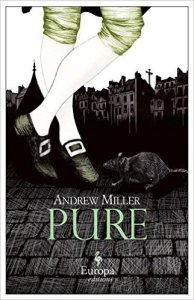
Cover for PureFor 2012, however, I can honestly say that I didn’t enjoy most of the books on the shortlist, or I enjoyed them only mildly. The one book that I enjoyed wholeheartedly was that year’s winner, On Canaan’s Side by Sebastian Barry, about an Irish woman emigrating to the United States during the Troubles. I also thought that Pure was very interesting and showed a strong sense of the period. The books I enjoyed least were The Stranger’s Child and The Sisters Brothers.

So, for 2012, I agree with the judges. If I had picked the winner from this group, it would be On Canaan’s Side.