Day 1125: A Gentleman in Moscow

Cover for A Gentleman in MoscowFor some time after I began reading A Gentleman in Moscow, I was bothered by the idea that I was reading Aftermath of the Russian Revolution Lite. Still, I enjoyed the novel and finally decided that the historical background was not really the point.

Count Alexander Ilyich Rostov is living in the Metropol Hotel in Moscow in 1922 when he is summoned to a tribunal. Although he has committed no crime except perhaps one of attitude, the people have no use for aristocrats anymore. He might have been imprisoned or executed except that he is considered one of the heroes of the revolution because of a poem he wrote. So, the Count is sentenced to live in the Metropol. He is not allowed to leave, or he will be shot. Further, when he returns to his luxurious rooms, he finds he is to be relegated to a small room in the belfry.

The Count makes himself as comfortable as he can and continues to live a more restricted version of the life he led before, socializing in the lobby, reading, and meeting with friends. But he begins to be bored. We follow the Count as he slowly changes the purpose of his life, beginning with his friendship with a nine-year-old girl, Nina Kulikova.

This tale of more than 30 years of life in the Metropol, I finally decided, is not meant to be realistic but is a gentle story about the effects of the Count’s gentility on other people and of the Count’s own personal development. There is a villain in the form of a character the Count calls the Bishop, a bad waiter who uses his contacts to become manager of the hotel. Life in the hotel is thus not always roses, but its employees and residents are subject more to inconvenience than to misfortune.

This is not to say that nothing bad happens. Friends are exiled to Siberia or disappear, and a famous poet commits suicide. Still, we are detached by the novel’s playful writing style from anything happening outside the Metropol and even from most of the things happening inside the hotel.

Overall, I was captured by the charm of the novel, but I don’t think it consitutes a very accurate reflection of its time and place. Horrible things were happening in Russia through these years, but to this novel, events are just footnotes and parentheses. And, by the way, the Russians executed lots of heroes of the revolution.

Related Posts

The Rules of Civility

Mastering the Art of Soviet Cooking

The Storied Life of A. J. Fikry

Day 1124: The Ivy Tree

Cover for The Ivy TreeThe Ivy Tree is the first book I’m reading for R.I.P.

Mary Grey is a Canadian who has recently moved to Northumberland when she encounters Connor Winslow on the Roman Wall. Connor mistakes her for his long-lost cousin Annabelle and seems so angry to see her that Mary is frightened. She has some difficulty convincing him of his mistake.

Later, Connor’s half-sister Lisa locates Mary at her workplace in Newcastle. Connor and Lisa want Mary to impersonate Annabelle to help insure that Con will inherit the family farm, Whitescar, from his great-uncle Matthew, who is in poor health. If Mary as Annabelle inherits the farm, she will give it to Con in exchange for a small income that will save her from poverty.

Mary agrees to the job because it doesn’t seem as if it will hurt anyone. The only other interested party, Annabelle’s cousin Julie, views the farm simply as a holiday home. But the impersonation may turn out to be more difficult than anticiapted, for Annabelle had her secrets. And Mary has some, too.

I have long been a huge fan of Mary Stewart. Recently, I turned a friend on to her, and our discussions made me eager for a Stewart fix. The Ivy Tree is one of her best, particularly because, on reread, when you understand a secret of the plot, almost every scene in the novel turns out to have a double meaning.

Stewart is known for her convincing characters and her gorgeous descriptions of the setting. This novel is lush with descriptions of the plants and rural geography of Northumbria. It has a great plot and is truly suspenseful. If you have never read anything by Mary Stewart, I can’t recommend her highly enough, particularly those of her novels written before the 1980’s and her Merlin series.

Related Posts

This Rough Magic

Wildfire at Midnight

Touch Not the Cat

R.I.P.

logo for RIPI haven’t ever participated in R.eaders I.mbibing P.eril before, but I saw a post about it on Helen’s She Reads Novels page, so I took a look at my future posts. The object of the challenge is for people to read books in the following genres during September and October:

  • Mystery
  • Suspense
  • Thriller
  • Dark Fantasy
  • Gothic
  • Horror
  • Supernatural

It looks like I have plenty of mysteries on my schedule, and I may be able to come up with something in the other genres as well, so I think it will be fun to participate. You can look at the pages of the hosts, Estella’s Revenge and My Capricious Life for more information if you are planning to participate.

I think I’ll be participating at the Peril the First level, which means I must read four books from these genres in the next two months. If you’re familiar with my blog, you know that will not be a problem for me. I will be reading at least four of the following novels:

  • The Ivy Tree by Mary Stewart (suspense)
  • The Unquiet Grave by Sharyn McCrumb (mystery)
  • Consider the Lilies and Death Among Friends by Elizabeth Cadell (suspense)
  • The Moonstone by Wilkie Collins (mystery)
  • The Victorian Chaise Lounge by Marghanita Laski (gothic and supernatural)
  • My Darling Detective by Howard Norman (mystery)

Day 1123: The Reek of Red Herrings

Cover for The Reek of Red HerringsAlthough I’ve come to prefer Catriona McPherson’s contemporary thrillers, for lighter fare, her Dandy Gilver mysteries are lots of fun. Dandy began her career in 1918 with After the Armistice Ball. Twelve years later, she and her partner Alec Osbourne are more sedate, but not much more.

Dandy and Alec’s newest client wants them to skip the family Christmas to investigate a confidential problem. He is a herring exporter, and several barrels of his herring have been returned containing foreign objects, that is, the pieces of someone’s body. Mr. Birchfield does not want to notify the police, because knowledge of this problem will ruin his business. He wants Dandy and Alec to find out who is missing and what happened.

Because the herring fishermen and the “quines,” the girls who gut the fish, only return home a couple of months a year, they must travel to the fishing village of Gamrie, on the Banffshire coast, over Christmas. Dandy is all too happy to escape a dreary house party.

In Gamrie, the two pose as philologists, supposedly recording the local dialect. The village is an uncomfortable one, with freezing weather and a stark hotel as the only accomodation. The villagers themselves are caught up in the preparations for five marriages. All the brides are pregnant, for the custom is to be handfasted and only marry if the handfasting “takes,” that is, the bride gets pregnant.

There is some concern in the village about the marriages of two of the Mason girls. They are marrying two of the Gow boys, who fished in the same boat with John Gow, their older brother. John Gow went overboard last year, and it is considered unlucky for anyone to marry his shipmates unless they take to different boats. But the Gow brothers are keeping their brother’s boat and marrying the two Mason girls, whose older sister was handfasted to John Gow and who disappeared after his death. This news has Dandy checking with Mr. Birchfield that the corpse is indeed male, but it is.

Dandy and Alec also have the dubious pleasure, suggested by Dandy’s husband Hugh, of going to visit Searle’s Realm of Bounteous Wonder. This display is a series of rooms depicting various scenes made up entirely of stuffed animals, a wonder of taxidermy. The two brothers, Warwick and Durban, are very odd, and the exhibits are appalling.

Dandy and Alec’s investigations turn up no unaccounted for villagers except Nancy Mason, but they eventually hear about several missing strange men, people who came to town but never were seen again. Some of the men were derelicts and one was an artists’ model. At least two claimed to have work. So, Dandy and Alec go from having no potential victims to several. All the while, a terrific storm is threatening.

This novel was interesting, from the perspective of the villagers’ wedding traditions and beliefs. Although I figured out fairly soon something about the missing men, I did not figure out the overall scope, nor the identity of Mr. Pickle, as Alec calls the body. This was a fun, if a bit ghoulish, mystery.

Related Posts

Dandy Gilver and a Bothersome Number of Corpses

Dandy Gilver and a Deadly Measure of Brimstone

The Day She Died

Day 1122: Lolly Willowes

Cover for Lolly WillowesThe two novels I’ve read by Sylvia Townsend Warner are as different as they can be. The True Heart is a historical novel about a woman who lives through great troubles to be with the man she loves. Lolly Willowes is a feminist novel about a spinster who tires of her life dedicated to her family.

The Willowes family doesn’t go in much for change. They have lived in the same house for years, and even after they move, they bring all their possessions, which are never moved from their set positions. Lolly Willowes grows up loving the countryside around her home, and she is so comfortable with her family that she never considers marriage. When her mother dies, she takes over running the house, and neither she nor her father want her to go.

But when her father dies, her wishes are not consulted. Her older brother Henry is more willing to have her in London than her younger brother at the family home. So, she moves to London to be of service to her family.

Twenty years later, she’s had enough. Without seeing it first, she decides to move to a rural village named Great Mop. Her family is very much against this plan, and it is only then that she finds out her brother has mishandled her money and there is very little left. She can’t have the house and donkey she planned on, but she plans to move, and move she will.

It is after Lolly moves that the novel takes a decidedly eccentric turn. Some readers will appreciate it more than others, and I’m not sure how much I do. I’m also not going to tell you what happens. But the message of the novel, though playfully told, is that women are not just adjuncts to their families, to have their lives plotted out for them just because they’re single. There were plenty of women in Lolly’s position in the 1920’s, when this novel was written, and that is probably the reason that the novel became an unexpected best seller in its time.

Related Posts

The True Heart

The Land of Green Ginger

The Daylight Gate


Day 1121: Salt to the Sea

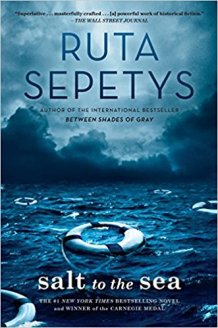
Cover for Salt to the SeaAt the end of World War II, three teenagers are among the refugees fleeing through East Prussia from the Russians. Joanna is a Lithuanian nurse who was patriated into Germany. Emilia is a young Polish girl with no papers. Florian is a Prussian on a mission.

Salt to the Sea follows these three on their flight, as well as Alfred, a Nazi sailor helping ready the Wilhelm Gustloff for its load of refugees. The novel switches among the points of view of these narrators in brief chapters.

And this is one of its fundamental problems. The novel jumps back and forth between narrators, allowing us to really know no one. To add further to that distancing, most other characters are referred to only by their professions or other attributes, even fairly important ones such as the old shoemaker travelling with the group. The result is that we don’t really care about any of the characters.

Further, this novel shares an attribute with much other young adult fiction that I dislike. It is told in first person—in this case four first persons—which is not necessarily a problem. But except for Alfred’s, the narratives are indistinguishable in style and written in short, choppy sentences with simple structure, as if the assumption is made that young adults have no complex thoughts. To make things worse, some of the metaphorical language is excruciating. Witness the following:

And for some reason those words are now caught, like a hair, in the drain of my mind.

Of course, this sentence is from the abhorrent Alfred, but similar excrescences come from the other narratives.

Finally, the chopped up narrative style so slows down the action at the end of the book that, combined with the distance we feel from the characters, it makes the climax of the novel actually boring. And really (spoiler), when a torpedo hits the ship, the only description Sepetys can think of is “Bang!” repeated four times?

The evacuation of the refugees and the sinking of the Wilhelm Gustloff make an important story, but sadly Sepetys is not the writer to tell it.

Related Posts

The Book Thief

Maus I

Suite Française

Day 1120: They Found Him Dead

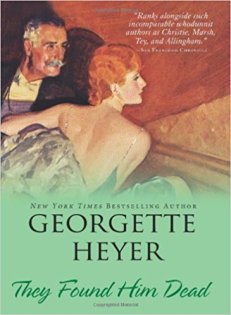
Cover for They Found Him DeadThe wealthy Silas Kane is celebrating his sixtieth birthday, but the party is anything but jolly. His business partner, Joe Mansell, is trying to talk him into a deal with an American company for Australia, but he thinks it’s too big a risk. His cousin Clement’s self-obsessed wife, Rosemary, is considering leaving Clement for Trevor Dermott. Betty Pemble, Joe’s daughter, can only talk about her obnoxious children.

That night Silas goes for his customary walk along the cliff top. The next morning it is clear that his bed was never slept in. He has apparently fallen off the edge of the cliff.

Clement Kane is now the heir to the estate and company, but he doesn’t seem to be any more inclined to the business deal than Silas. His wife, however, decides to stay with him because she needs money. Emily Kane, Silas’s mother, is angry that the property is going to Clement rather than to her grandson, Jim Kane.

As the businessman from America, Oscar Roberts, appears on the scene, Joe Mansell and his son Paul pressure Clement to agree to their deal. But soon Clement is also dead, shot in his office just as Patricia Allison, Emily’s companion, was about to show in Oscar Roberts for an appointment. To Jim’s surprise, he is the next heir, not his female cousin in Australia, as the estate is entailed to the male heir.

No one knows whether Silas was murdered or not, but Clement certainly was. And soon someone appears to be trying to murder Jim.

Detective Inspector Hannasyde has a plethora of suspects and doesn’t even know how many deaths to look into. Could the Mansells have committed murder for a business deal? Is someone really trying to kill Jim, or is it a blind?

I guessed the murderer and the motive almost immediately, but the puzzle isn’t the point of an Heyer mystery. Instead, it’s the characters and the amusing dialogue. This mystery isn’t very mysterious, but it’s a pleasure to read.

Related Posts

Behold, Here’s Poison

Death in the Stocks

Black Sheep

Day 1119: Northbridge Rectory

Cover for Northbridge RectoryEclipse day! We are not in the path of totality here,
but we are at about 97%. We thought about driving down into Oregon, but since the state is supposed to have more than a million extra people coming for the eclipse, we decided to stay home. I hope you have a nice view!

* * *

Northbridge Rectory is another of Angela Thirkell’s delightful Barsetshire books. I have been making no effort to read them in order, and this one is set during World War II.

The Villarses moved to Barsetshire only a year ago when Mr. Villars was appointed Rector. Mr. Villars formerly had a career as a headmaster of a boys’ school, and Mrs. Villars feels somewhat inadequate in her new role as rector’s wife.

The Villarses expected the rectory to receive its quota of refugees from London, but instead eight officers of the Barsetshire regiment have been quartered there. The Villarses particularly enjoy the company of Mr. Holden, who is managing some of his work as a publisher’s associate along with his military duties. Mr. Holden has become attached to Mrs. Villars and is constantly wearing her out by telling her she looks tired.

Although Northbridge Rectory is mostly from Mrs. Villars’s point of view, it also deals with two poverty-stricken scholars who share a house. Mr. Downing is a middle-aged man working on an abstruse book about medieval Provençal literature. His hostess, Miss Pemberton, is an older lady working on a monograph about the work of an Italian Renaissance artist. Miss Pemberton spends a lot of time keeping spinsters away from Mr. Downing. Mr. Downing, however, soon begins to feel very comfortable visiting the widowed Mrs. Turner and her bouncing teenage nieces.

Wartime brings everyone among unaccustomed people and activities, as when a watch from the church tower is proposed to look for parachutists. The Villarses spend an excruciating weekend entertaining an unexpected guest who will not stop talking, Mrs. Spender, the wife of Major Spender. Other entertaining characters include the couple of spinsters who so loved living in France that they throw mispronounced and misused French into every conversation.

Thirkell’s books are always funny, with a gentle humor that pokes fun without making anyone entirely unlikable. She has an unusual style of narration that breaks out to address readers directly, as if she is having a private conversation with us, usually just before a zinger.

Related Posts

Wild Strawberries

Pomfret Towers

Enter Sir Robert

Day 1118: Henry VI, Part II

Cover for Henry VI, Part IIJust by coincidence, I began reading Conn Iggulden’s Wars of the Roses series right around the same time as I started reading these three plays about Henry VI. I found it interesting that Iggulden’s first book, Stormbird, begins almost exactly in the same place as does Henry VI, Part II. Suffolk has brokered Henry’s marriage to Margaret of Anjou, but Henry’s nobles are shocked to learn that the price is to return the provinces of Maine and Anjou to France. Further, the French are not even paying a dowry.

As with Part I, Henry isn’t much of a character in this play, the intent of which is to tell the events of his reign. But whereas he was a child in the first play, this absence in Part II helps to signify his ineffectuality as a ruler. When we see him, he is kindly, but he is unable even to keep his nobles from fighting in his presence.

Besides the struggle for power among the nobles, we are witness to some of the important events in the King’s reign. These include the disgrace of the Duchess of Gloucester and the murder of her husband, the disgrace and murders of Suffolk and Somerset, and Jack Cade’s rebellion.

This play is supposed to be the best of the three Henry VI plays, and apparently Shakespeare’s contemporaries found it exciting because they were unaware of their history. Especially at the beginning, it certainly provides a cogent explanation of the problems of Henry’s realm. Unfortunately, he was not the man to handle them.

Related Posts

Henry VI, Part I

Stormbird

The Wars of the Roses